
Crowdfunding Market Is Redefining How Ideas, Startups, and Social Causes Get Funded
Digital fundraising platforms are transforming global finance by giving entrepreneurs, creators, and communities direct access to supporters and investors.

Crowdfunding Market Is Growing Rapidly Worldwide
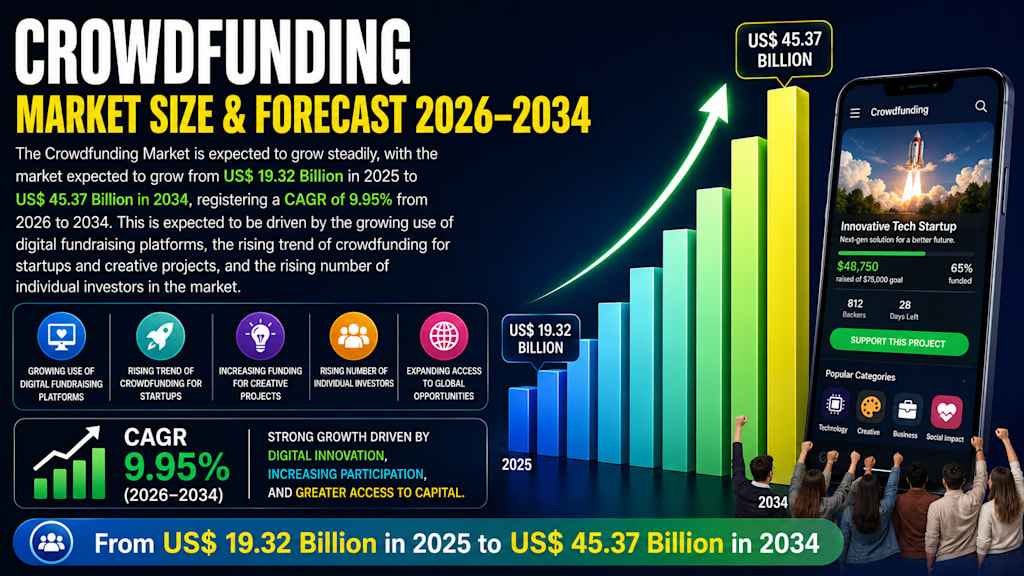
The global crowdfunding market is witnessing strong growth as digital fundraising becomes an increasingly popular alternative to traditional financing methods. According to Renub Research, the crowdfunding market is expected to grow from US$ 19.32 billion in 2025 to US$ 45.37 billion by 2034, registering a CAGR of 9.95% from 2026 to 2034. The expansion is being driven by rising internet penetration, widespread adoption of online payment systems, growing startup culture, and increasing participation from individual investors across the globe.
Crowdfunding Is Changing the Traditional Funding Model
Crowdfunding allows individuals, startups, businesses, and organizations to raise money by collecting small contributions from a large number of people through online platforms. Instead of depending entirely on banks, venture capitalists, or institutional investors, project creators can now present their ideas directly to the public and receive support from interested contributors.
This funding model has become increasingly attractive because it offers accessibility, transparency, and community engagement. Crowdfunding also enables entrepreneurs to validate ideas, build customer interest, and generate early momentum before launching products or services on a larger scale.
The market includes several crowdfunding models such as donation-based, reward-based, equity-based, and debt-based crowdfunding. Each serves different financial and business objectives, making crowdfunding highly flexible for various industries and use cases.
Digitalization and Online Payments Are Fueling Growth
One of the strongest growth drivers for the crowdfunding market is the rapid development of digital infrastructure and online payment systems. The increasing use of smartphones, internet services, and secure digital payment solutions has made crowdfunding platforms more accessible than ever before.
People can now contribute to campaigns instantly from virtually anywhere in the world, while project creators can reach global audiences without geographical limitations. Mobile wallets, real-time payment systems, and simplified online transactions have also improved trust and convenience among users.
The report highlights the significant rise in internet and mobile wallet adoption, especially in emerging markets such as India. As digital financial ecosystems continue expanding worldwide, crowdfunding platforms are benefiting from higher user engagement and smoother transaction experiences.
Startup Culture Is Driving Crowdfunding Adoption
The growing startup ecosystem is another major factor accelerating the market. Entrepreneurs increasingly use crowdfunding platforms to raise early-stage capital, test market interest, and build communities around their products before full-scale commercialization.
Traditional financing methods can be difficult for early-stage startups to access, particularly when businesses lack financial history or collateral. Crowdfunding offers a more flexible alternative by allowing creators to connect directly with supporters and investors who believe in their ideas.
This trend is especially visible in technology, innovation, creative projects, and consumer-focused product development. Crowdfunding campaigns not only provide funding but also generate publicity, market validation, and loyal customer bases.
As startup incubators, entrepreneurship programs, and innovation-driven economies continue growing globally, crowdfunding is becoming an increasingly important component of the modern startup ecosystem.
Financial Inclusion Is Expanding Through Crowdfunding
Crowdfunding is also contributing to broader financial inclusion by allowing individuals to participate in fundraising and investment opportunities with relatively small amounts of money. Equity and debt-based crowdfunding models have opened access to investment opportunities that were previously limited to venture capital firms and institutional investors.
This democratization of finance is attracting retail investors who are searching for alternatives to traditional investment products. At the same time, entrepreneurs and social organizations gain access to wider pools of potential supporters.
As awareness of alternative finance grows, crowdfunding is increasingly viewed not only as a funding mechanism but also as a tool for community participation and economic empowerment.
Trust and Fraud Concerns Remain Major Challenges
Despite strong growth prospects, the crowdfunding market faces several challenges related to trust and credibility. Many campaigns are launched by early-stage entrepreneurs or individuals without established track records, which can create uncertainty among contributors regarding project legitimacy.
Instances of fraud, misuse of funds, or unrealistic project promises can damage confidence in crowdfunding platforms. Even legitimate campaigns may experience delays or failures because of technical difficulties, poor planning, or operational inexperience.
Building and maintaining trust therefore remains one of the industry’s biggest priorities. Platforms increasingly focus on transparency, verification systems, and campaign monitoring to improve confidence among users and investors.
Regulatory Complexity Is Another Key Barrier
Regulation is another major challenge within the crowdfunding sector. Different countries maintain different rules regarding investor protection, taxation, disclosure requirements, and fundraising limits, particularly for equity-based and debt-based crowdfunding models.
Balancing innovation with investor protection can be difficult for regulators and platform operators alike. Compliance costs and legal complexities may create obstacles for smaller crowdfunding platforms and startups trying to operate internationally.
Rapidly evolving regulations can also create uncertainty in the market. However, stronger regulatory frameworks may ultimately improve transparency and help increase long-term investor confidence.
Reward-Based Crowdfunding Continues to Lead
Reward-based crowdfunding remains one of the most popular models within the industry. Under this approach, contributors receive non-monetary rewards such as early access to products, exclusive experiences, or branded merchandise in exchange for their financial support.
This model is especially popular among startups, artists, creators, and technology innovators because it allows them to validate products and engage directly with future customers. Reward-based crowdfunding is generally easier to launch and faces fewer regulatory hurdles than equity-based investment models.
As direct-to-consumer business strategies continue expanding, reward-based crowdfunding is expected to remain a strong segment within the broader market.
Equity Crowdfunding Is Democratizing Investment
Equity-based crowdfunding is also growing steadily because it allows retail investors to purchase ownership stakes in startups and early-stage businesses. Previously, these investment opportunities were typically accessible only to venture capitalists and institutional investors.
For startups, equity crowdfunding provides both funding and community engagement while reducing reliance on traditional investors. Although the regulatory environment for equity crowdfunding is stricter, improved transparency and investor awareness are supporting continued growth.
The increasing popularity of alternative investments is expected to further strengthen this segment over the coming years.
Food, Beverage, and Media Industries Are Using Crowdfunding More Frequently
The food and beverage industry is increasingly using crowdfunding to launch innovative products, restaurants, and beverage brands. Entrepreneurs are using campaigns not only to raise money but also to measure customer interest before large-scale production. Health-focused, organic, artisanal, and plant-based concepts are particularly popular among crowdfunding audiences.
The media sector is also heavily utilizing crowdfunding for films, music, journalism, web series, and digital content creation. Crowdfunding allows creators to maintain creative independence while reducing dependence on traditional financing models. The growth of digital media consumption has further strengthened this trend.
The United States Leads the Global Crowdfunding Industry
The United States remains one of the most advanced crowdfunding markets due to its strong startup culture, digital infrastructure, and high investor awareness. Crowdfunding is widely used across reward-based, equity-based, donation-based, and debt-based models.
American startups, innovators, and social organizations actively use crowdfunding to raise funds, validate concepts, and build loyal supporter communities. Strong social media usage and digital marketing strategies also contribute significantly to campaign visibility and success rates.
The presence of established platforms and mature investor communities continues to support innovation and growth within the U.S. market.
India and Saudi Arabia Are Emerging as Important Markets
India’s crowdfunding market is growing rapidly because of increasing internet access, rising digital payment adoption, and a large young population. Donation-based crowdfunding is especially popular for medical emergencies, education, and social causes. Reward-based and startup-focused crowdfunding models are also expanding gradually.
Saudi Arabia is witnessing steady growth as fintech adoption, entrepreneurship, and alternative finance gain momentum. Government support for innovation and private sector development is helping crowdfunding platforms gain traction among startups and SMEs.
As digital finance ecosystems continue evolving across emerging economies, these markets are expected to contribute significantly to future crowdfunding growth.
Competition Is Intensifying Across Crowdfunding Platforms
The market includes major players such as Alibaba Group Holding Ltd, Kickstarter, PBC, Indiegogo, Inc., GoFundMe, Fundable, Crowdcube, SeedInvest Technology, LLC, and Fundly. These companies are investing in platform innovation, analytics tools, community engagement features, and global expansion strategies to strengthen their market positions.
Artificial intelligence, data analytics, and improved personalization tools are increasingly being integrated into crowdfunding platforms to help creators improve campaign visibility and success rates.
Final Thoughts
The crowdfunding market is transforming the global financing landscape by making fundraising more accessible, transparent, and community-driven. Entrepreneurs, creators, nonprofits, and startups are increasingly using crowdfunding platforms to raise capital, validate ideas, and engage directly with supporters. According to Renub Research, the market is expected to grow from US$ 19.32 billion in 2025 to US$ 45.37 billion by 2034, highlighting the growing influence of digital fundraising and alternative finance worldwide. As digital infrastructure, fintech adoption, and startup ecosystems continue expanding, crowdfunding is likely to become an even more important part of the global financial system.
About the Creator
Enjoyed the story? Support the Creator.
Subscribe for free to receive all their stories in your feed.
Comments
There are no comments for this story
Be the first to respond and start the conversation.