
"You want what?"
We had something. But it didn't last.

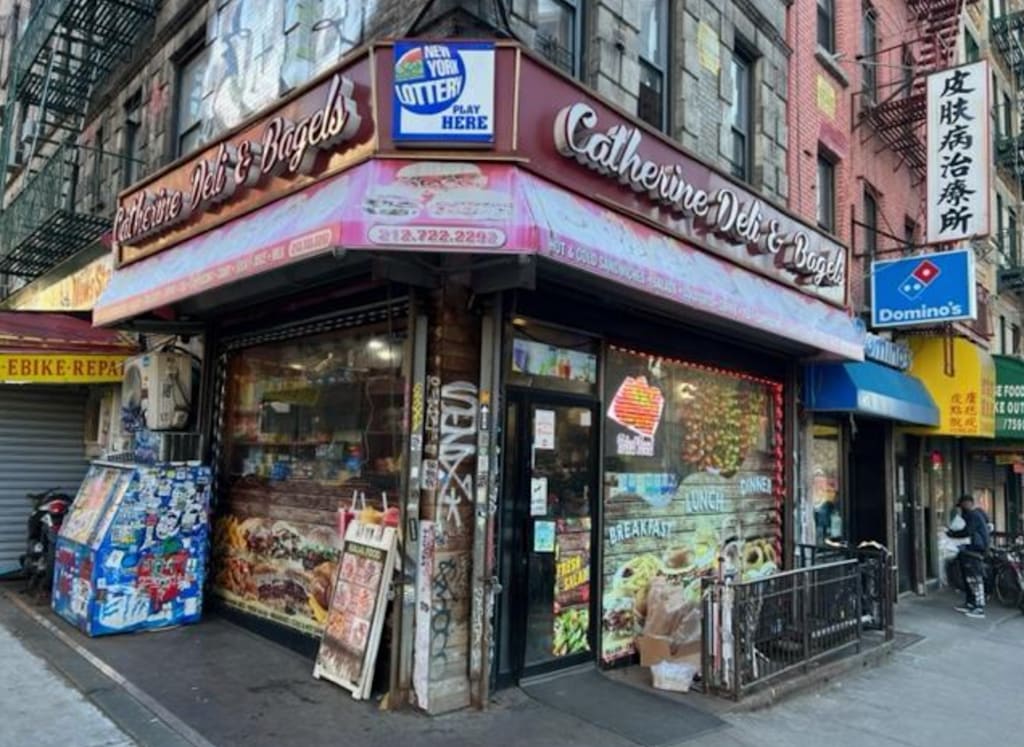
According to people who look into these sorts of things, New York City is home to over 190 different nationalities. A population that speaks 300 to 360 different languages across the city's five boroughs. And God only knows how many different national and regional cuisines.
It seems unlikely that you could think of something to eat, some mix of ingredients, that had not already been thought of. And in a city where 50 cents of every food dollar goes to eating out or delivery, the odds are that some cook or other food prep professional has made it. But long odds against don't mean it’s impossible.
I know because I ordered something made with six common ingredients in a combination that may not have been ordered before. It certainly came as a shock to a man who probably thought he had seen it all,
Most New Yorkers and other cogs in the city's economic machine buy lunch at a deli. It is usual and predictable fare: sandwiches, soups, salads, baked goods, and other sweetmeats and comestibles. Add to the list the quintessential American foods with foreign roots: white box Chinese and pizza. And there you have it. From the club to the sub. From ham on rye to turkey on white. And for the considerate eater, all of the above in vegan form.
Nothing can surprise the working stiff slinging hash behind the counter. You want it? You got it. No questions asked; the customer is always right. Besides, what business is it of theirs? You pays your money, you takes your choice.
However, there are rules. Don't get to the counter without knowing what you want. Be ready to order in a New York minute. Time is money. There is no committee meeting. No options to mull over. And if you must ask the pointless question, “Is the xyz any good?” the answer will be “yes.” Even if that honorable citizen earning their daily crust serving you knows for a fact that xyz may not be optimal.
This is not a universal condition. It’s not like that in Dallas. There, the citizens will put on makeup to pump gas. When they order lunch in a sandwich shop, there is time for consultation and debate. A couple may discuss their needs and preferences without the pressure of an immediate deadline. Do not get me wrong. Even these superficially polite and agreeable Texans have a time limit. But it is measured in minutes, not seconds.
Those stuck in line behind the preprandial conversationalists will give the disquisitive dinners some leisure to ensure their lunchtime needs are met down to the jot and tittle. There is slack in the rope. As long as the discussion appears to be making progress toward the epicurean goal, the rest of the lunch orderers will accept the delay. Perhaps not in good spirits. But at least with the consolation that they have met the standards of politesse in a society that treasures the architecture of good manners and accommodation.
Try that in New York, and you will hear, “Next.”
In one syllable, the rules are established. Be ready or be gone. You do not have to go to the back of the line. But you must stand to one side until you have formulated your order down to which condiments should be held or extra. “Extra cheese, hold the mayo,” for example. Or “just a schmear.”
The good soul behind the counter is not a collaborator in your order. They are there to execute your command. So make it clear and complete.
The machine hums. Millions belly up to the sandwich bar, and in a New York minute, their orders are executed. Then they leg it back to a desk, a company lunchroom, or a park bench if it’s a nice day.
Yet sometimes the smooth operation falters. Someone makes a request that, while it is easy to fulfill, is so off the reservation that time warps. The sandwich-making maven, the victualer who has heard it all, is confronted with a first. An order that glitches the usually inexorable flow. A Planck time disruption in the culinary scheme.
I once authored such an interruption.
My request in the particulars was beyond reproach. It was the combination that caused comment. In this case, that comment was, “You want what?”
Had I known the reaction, I might have refrained from my rash act and taken the safer road. But I had not thought the conversation through from my interlocutor’s point of view. It is a paradox, or perhaps an understandable psychological deficit, that we do not accord individuality to those we see every day but only briefly.
Ask most New Yorkers to describe the person who makes their takeout order, and they'll likely identify the gender, give a vague approximation of their height, and hazard a guess as to age and ethnicity.
Indeed, in my mind's eye, as I look back on the event, I remember the other party as being a man, below average height, and Hispanic. I confess I do not know his name. We were never introduced. But he and I were confreres once a day. Each of us was assigned an invariable role. I ordered. He created. It was a productive harmony. He earned his wages. I got my lunch.
So intimate and long-term was our relationship that he accorded me entry to his circle of preferred customers. A status sealed each day with a brief nod as I took my turn at his station.
He was comfortable in the arrangement. I would order a Reuben. A turkey club. Or an Italian hero with mayo rather than the traditional oil and vinegar. I realize that to the purist, the latter was an affront to the Gods of casual eating. But he didn’t seem to mind.
Then came the day. It was 12:30. The lunch rush was cresting. The line moved slowly but inexorably. I watched my man complete the order in front of me and hand it over the glass deli case holding the plastic-wrapped logs of meat, the potato salad and coleslaw in big white tubs, and such standards as fish salad, chicken salad, and pickles in serving dishes chilled by the ample refrigeration.
I was ready. It turned out he wasn’t. I heard “next” and planted myself in front of him. I said, clearly and without apology or warning, “I’ll take a tuna salad, hard salami, lettuce, onion and mustard on a hard roll.”
As if on autopilot, he reached for the roll as his brain processed the filling. Then the full realization of what I had said hit him. You could see, or more accurately sense, that he wasn’t sure if he had heard me correctly. It was then that I realized I may have painted outside the lines.
In my mind, I had created a flavor and texture profile that brought together the savory qualities of fish and cured meat. A downmarket surf and turf, if you will. The crunch of the lettuce, the tang of onion, and the vinegar bite of mustard provided counterpoints to the smooth richness of the tuna and salami, all held together by a robust roll.
However, in recounting this story to family and friends over the years, the review has been unanimous: “That sounds revolting.”
It was what I wanted, but I hadn’t considered its effect on others. Perhaps you like salt in your coffee. Why not? It won’t kill you. In fact, having never tried it, I cannot say it has no merit. But absent any applied test, all the mind has is the theoretical taste the mixture might produce. And at first blush, no matter how you look at it, it doesn’t seem like a good idea.
That was his reaction.
But the man was a professional. He may have staggered under the sheer horror of the idea, but he had fortitude. He could take incoming and give as good as he got. He recovered his balance. Without fuss, he made me my sandwich. Quickly wrapped it in white paper. Scrawled the price on the wrapping. And yelled, “Next.” I completed the transaction by handing over cash (back when that was still accepted) to the Korean queen of the register.
The shock did not end our relationship. In fact, it may have strengthened it. I am a creature of habit. When I light on something I like, I stick with it. I ordered this same sandwich for days on end. Monday through Friday, rain or shine, I crossed from my office to his deli. Stood in line. And ordered without variation. He obliged with what seemed to me a glint in his eye, as if we were sharing something private.
It became such a habit that by the time I got to the counter, the sandwich was wrapped and ready. There is fast food. And there is food so fast there is no delay between asked and done.
But then came the day I decided I'd had enough of the unusual delight of tuna salad crowned with hard salami, lettuce, and onion, made agreeable with mustard on a hard roll. But it was not easy to quit. Every day, by the time I reached the counter, the die had been cast. My sandwich was made. And lunch rules forbade the refusal of an item already ready. I asked my creator to grant me enough intelligence and patience to imagine a solution. But for a time, there seemed to be no way out.
I could have ordered another sandwich as if I were ordering for a colleague. But it was early in my career, and cash was tight. Besides, while not a miser, I don’t like to throw money around. Some readers might wonder why I didn’t just tell the guy that tomorrow I wanted something else.
In reply, all I can say is that it didn’t feel right. We had not talked about anything besides a specific sandwich order. And I, as I said before, in a New York deli, convoluted conversations were not welcomed by fellow patrons. I was concerned that if I introduced the topic, I might stray into that awful neighborhood where no native-born New Yorker cares to find himself: the tourist lane.
I endured this difficulty for perhaps a week. Then I developed a strategy that seemed, from every angle, the best available. It would at least minimize the opprobrium of the deli’s other patrons. I went at 11 am. I stood outside, peeking through the window. No one was waiting at the sandwich counter.
I waited until I saw the counterman turn to wipe down some surface behind his station. Then I opened the door and walked with swift determination to the counter. He turned and registered surprise. It was not my time slot. Nature’s order had been dinged. He quickly recovered and reached to make the sandwich he had done for countless days in a row.
I held my hand up in the universal sign for stop. It was not an aggressive gesture, with fingers pointed straight at the ceiling. It was more of a 45º angle indicating that I respected his equal rank, but I needed to impose a change in the routine if he was agreeable to the alteration.
He was at least prepared to listen. He stopped and waited for developments. I explained that today, I wanted something different. He thought it over and agreed to my plan. “Whadya want?” He asked with affectionate bluntness. I wish I could tell you what I had instead. But whatever it was, it was not memorable. He made it. Wrapped it. Thrust it at me. I paid and left.
We remained cordial. But the affair was over. I was once again a face in the crowd, ordering out loud each lunchtime. We no longer had the bond of creator and consumer partnering in something risqué. Our relationship was henceforth professional, utilitarian. We were polite. And we behaved the way people who were once close but no longer are do.
There was still friendship of a sort. But the magic was gone.
About the Creator
Pitt Griffin
Once upon a midnight dreary, while I pondered, weak and weary, it occurred to me I should write things down. It allows you to live wherever you want - at least for awhile.
Enjoyed the story? Support the Creator.
Subscribe for free to receive all their stories in your feed.
Comments
There are no comments for this story
Be the first to respond and start the conversation.