
Why Your Mushroom Soup Tastes Thin, and the Pairing That Fixes It
Mushrooms amplify umami, but they do not provide the base. Pair them with glutamate-rich ingredients like kelp, tomato, clams, or miso, and a thin broth starts to taste thick.
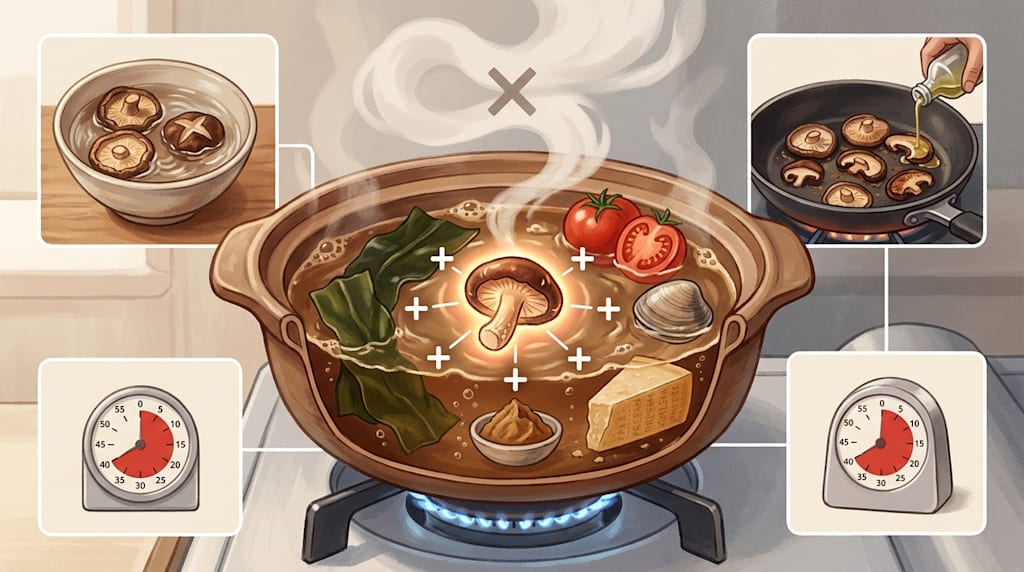
Once I made chicken soup with shiitake mushrooms. The chicken was tender and the broth had flavor, but the umami sat on the surface. You tasted it at the front, and it disappeared as you swallowed. Later I threw two slices of kelp and half a tomato into the same pot. Twenty minutes later, the thickness was completely different. The soup suddenly stood up.
That was when I started looking into it properly. Umami is not one substance. It is a group of substances working together. Mushrooms happen to hold only half the hand.
Umami rests on three cards
The taste we call “umami” mainly comes from three types of substances.
Glutamate provides the base. It is the main component of MSG, and it is also the “savory” note in tomatoes, kelp, cheese, soy sauce, and fermented bean paste. It is broad, flat, and spread out, like a piece of cloth.
5'-GMP is most abundant in dried shiitake and dried porcini. On its own it barely tastes savory. Its job is amplification.
5'-IMP is abundant in meat, poultry, and fish and shellfish. Its job is also amplification.
When glutamate meets either GMP or IMP, the umami is not added. It is amplified synergistically. This is why Japanese dashi uses kelp with bonito flakes. Kelp gives glutamate, bonito gives IMP. Each alone is flat. Together they produce thickness.
Mushrooms are rich in GMP and contain almost no glutamate. So the answer to “what should mushrooms be cooked with for the deepest umami” is: cook them with something high in glutamate. The mushroom amplifies. The other ingredient provides the base. Missing one side, the soup stays thin.
Dried shiitake are more savory than fresh shiitake
When shiitake are dried, nucleic acids inside break down and produce 5'-GMP, while the enzymes that would break it down are deactivated. The GMP is preserved. Dried shiitake contain an order of magnitude more GMP than fresh shiitake.
Fresh shiitake lean toward aroma and texture. Dried shiitake lean toward umami thickness. For a thicker broth, use dried. For aroma right out of the pan, use fresh.
Keep the mushroom-soaking water. GMP is water-soluble, and a large amount moves into the water during soaking. Pouring it out is pouring umami down the drain. Use 30 to 40°C warm water and soak for forty minutes. Do not use boiling water. Aromatic compounds will escape. After soaking, let it sit for five minutes and take the upper clear liquid. Leave the sandy layer at the bottom.
Five pairings, ordered by who provides the base
Shiitake with chicken: classic, but it can be better
Chicken contains glutamate and also IMP, so it is a “half-card” player. It has a bit of both sides. The soup is savory, but it is not the strongest combination. To push it up, add one high-glutamate ingredient: a small piece of ham, a few dried scallops, two slices of kelp, or a spoonful of fermented soybean paste. The thickness will immediately rise.
Watch the shiitake quantity. If dried shiitake exceed 3% of the soup’s weight, excess GMP can make the broth dull and slightly medicinal. One chicken with six or seven dried shiitake is about right.
Mushrooms with tomato: a pairing people skip
Tomatoes rank high among vegetables for glutamate, and heating ruptures the cells and releases more. Mushrooms plus tomato is the vegetarian combination closest to the thickness of meat broth.
There is an order to the method. First fry the tomato in oil until it breaks down and turns sandy, three to five minutes. Then add the mushrooms and stir-fry together. Then add water. Tomato lycopene and aroma need oil to come out. Boiling directly in water makes it thin.
Too much tomato turns sour, and sourness suppresses umami. 500 g mushrooms with two medium tomatoes is the upper limit.
Mushrooms with kelp: the highest-glutamate combination
Kelp is one of the most glutamate-concentrated natural ingredients. Soak it in cold water, heat gently over low heat until just about to boil, then turn off the heat. Do not let it roll. A hard boil pulls out kelp’s slimy texture and fishy note together. Add the mushrooms later. Ten minutes is enough.
Kelp cooked too long turns slimy and clouds the broth. The white frost on dried kelp is mannitol, not dirt. Rinse it briefly. Do not scrub it off.
Mushrooms with clams: the highest umami density at home
Clams, cockles, and dried scallops are very high in IMP and also bring sweet-tasting amino acids. Mushroom and clam soup has the highest umami density among ordinary home combinations.
Use 500 g clams, purged in light salt water for two hours. Adding an iron spoon to the water speeds it up. Start them in cold water, and remove them as soon as they open. Keep the broth. Cook the mushrooms separately for ten minutes, then return the clams to the pot at the end.
Cooking clams and mushrooms together in cold water for a long time shrinks the clam meat to rubber and makes the broth fishy. Remove them as soon as they open.
Mushrooms with miso, fermented bean paste, or cheese
Fermentation breaks proteins into free amino acids, so bean paste, miso, and Parmesan-type cheeses are extremely high in glutamate. Just before turning off the heat, dissolve a small spoonful of miso into mushroom soup. Do not boil it, or the aroma will escape. Or shave a little hard cheese over the soup before serving. The thickness changes immediately.
Miso and cheese are both salty. Halve the salt, or leave it out entirely.
First dry-sear, then add oil
No matter what you pair mushrooms with, the first minute in the pan should be a dry sear without oil. Heat the pan, put sliced mushrooms straight in over medium heat, and wait for the sizzle, the release of water, the drying of that water, and the edges beginning to brown. Then add oil.
Mushrooms are about 90% water. If they go straight into oil, the oil temperature drops and you end up “boiling mushrooms in oil,” with no aroma development. Drive off the water first so the surface can reach above 140°C. Only then do Maillard reactions and aroma compounds begin to form.
Do not add salt during the dry sear. Salt makes mushrooms release a lot of water early, and they will never sear dry.
Washing mushrooms: rinse, do not soak
Mushrooms are sponge-structured. Soaking makes them absorb a lot of water. Their weight can increase by about ten percent. That water comes back out in the pan, diluting the umami, and the mushrooms will never sear dry or fry up fragrant.
The right method: rinse quickly under running water, or wipe with a damp paper towel. Shiitake gills can hold grit. Cut off the stem, hold the cap gill-side down in water, swish quickly, and lift out. Do not throw away fresh shiitake stems. Slice and stir-fry them with the caps. Their umami is more concentrated than the cap.
Soaking in salt water for ten minutes “to kill bugs” is not worth it. The mushrooms turn soft and collapsed, and the flavor is diluted.
Why long cooking makes it less savory
Umami substances do not increase the longer you cook. GMP in shiitake partially degrades under prolonged high heat, and aromatic compounds volatilize even earlier. For a pot of shiitake soup, forty minutes is the peak. Two hours is the downhill slope.
For dried shiitake soup, simmer over medium-low heat for 40 to 50 minutes. For fresh shiitake, 15 to 20 minutes. Beyond that, the soup turns woody and the umami becomes blunt. After three hours, everything that could come out in the first hour has already come out. What you are cooking after that is collagen and fat.
One more dish: steamed chicken with shiitake
Cut 300 g chicken thigh into pieces. Marinate for fifteen minutes with 10 ml soy sauce, 5 ml oyster sauce, 8 g starch, and 5 ml oil. Soak four dried shiitake, slice them, and keep 50 ml of the soaking water. Mix the sliced shiitake with the chicken and add 30 ml of the mushroom soaking water. Steam over high heat for twelve minutes after the steam rises. Scatter chopped scallion over the top before serving.
The chicken should spring back when pressed and release no bloody water. Five extra minutes makes it dry.
Let the mushroom soaking water sit for five minutes and take only the upper clear liquid. Do not pour in the sandy bottom layer.
Quick reference in prose
For dried shiitake with chicken, chicken provides the base, though only half a card. Use one chicken with six or seven dried shiitake and return the soaking water to the pot. Too much shiitake makes the soup dull.
With tomato, the tomato supplies glutamate. Fry it until it breaks down, three to five minutes, before adding mushrooms. Too much tomato turns the broth sour and suppresses umami.
With kelp, kelp supplies glutamate. Heat gently to just below a boil, then turn off the heat. Add mushrooms later. A hard boil pulls out kelp’s fishy, slimy notes.
With clams, clams supply IMP. Remove them as soon as they open and return them to the pot at the end. Cooking them together for a long time makes the meat tough and the broth fishy.
With miso or cheese, fermentation supplies free amino acids. Dissolve miso after turning off the heat and halve the salt. Boiling loses aroma, and both ingredients are already salty.
For soaking dried shiitake, GMP dissolves into the water. Use 35°C water for forty minutes and take the upper layer. Boiling water lets the aroma escape.
About MSG
MSG is sodium glutamate, the same substance as the umami in kelp, tomato, and cheese. Being afraid of it while happily drinking a three-hour broth does not hold together logically.
About the Creator
Jin
Writer of reamstories
https://reamstories.com/jin
Enjoyed the story? Support the Creator.
Subscribe for free to receive all their stories in your feed. You could also become a paid subscriber, letting them know you appreciate their work.
Comments
There are no comments for this story
Be the first to respond and start the conversation.