
Why Chinese Chefs Say “Some” While Bakers Say 120 Grams
A pork trotter, a bottle of soy sauce, and a digital scale explain more than culture ever could.
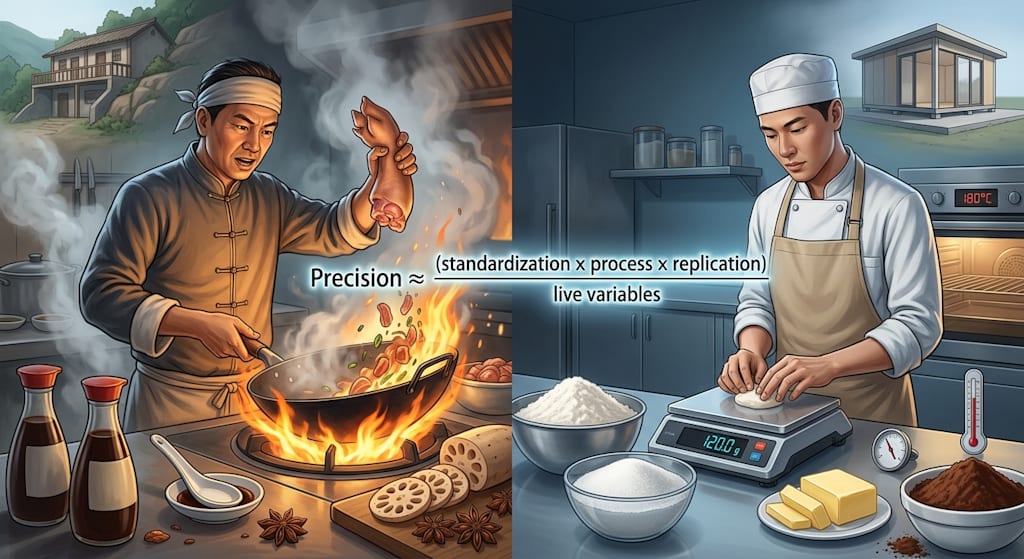
The cook picks up the pork trotter. You ask him how much rock sugar to use.
He turns it over in his hand. The skin is cold and slick. He presses the fat with his thumb. He looks at the bone.
“How heavy is it?” he says. “How thick is the skin? How much fat under it? Which breed? How old was the pig? What pot are you using? Gas or charcoal?”
He sets it down on the board.
“Some.”
That answer counts variables. The trotter is not a standard part. It has no batch number. It has no protein percentage printed on its side. It is a piece of an animal, and the animal was not built to a spec. Tell someone to add 15 grams of rock sugar, and you have told them almost nothing. Their trotter is not your trotter. Their pot is not your pot. Their fire is not your fire.
The Soy Sauce
You buy a bottle of soy sauce. Brand A pours dark and salt-heavy. Brand B is thin, sweet, almost like caramel water. First-draw. Second-draw. High-salt dilute-state. Low-salt solid-state. The same 10 milliliters lands differently in the pan.
A recipe that says “10 ml soy sauce” assumes a standard bottle. Your bottle is not standard. The cook pours a little into a spoon, tastes it, and decides. Then he pours again. The spoon is the measuring tool. The tongue is the scale.
The Scale
Flour 120 g. Sugar 80 g. Butter 60 g. Egg 50 g. Cocoa 15 g.
The scale blinks. The baker zeros it, adds, zeros it, adds. Why do these numbers hold? Flour has a protein range. Sugar has a crystal size. Butter has a fat percentage. Eggs are graded. The oven holds 180°C. The inputs are uniform. The numbers can control the output.
The baker is not more scientific than the wok cook. The baker is working with standard parts. The wok cook is working with a pig.
Closed Loop, Open Loop
In a wok, the cook tastes. Steam rises. The sauce reduces. The edge of the liquid bubbles. He adds half a spoon of sugar. A splash of vinegar. A pinch of salt. He tastes again. The recipe is a map, not a track.
In a bakery, the batter goes into the oven. You cannot taste it at 180°C. If the ratio is wrong, the cake falls. The baker uses a scale, a thermometer, a timer. No tasting mid-bake. The oven door stays closed.
One system adjusts while it runs. The other locks the inputs before it starts.
Sauce and Ingredient
Western cooking often builds the sauce as a separate part. Sear the steak. Let it rest. Emulsify the sauce. Reduce it. Season it to a measured standard. The plate combines them.
Chinese cooking often sends the seasoning into the ingredient. The pork belly braises with soy sauce, sugar, ginger, star anise. The cook tastes the braise, not the sauce alone. The ingredient is the ground. The cook adjusts to the ground.
A hillside house and a prefab pavilion need different drawings. One is poured into a slope. The other is bolted to a slab. Neither drawing is a moral failure.
The Apprentice
An apprentice eats the master’s food. Not once. Hundreds of times. The tongue learns.
Today’s lotus root is starchy, so less sugar. Today’s soy sauce is saltier, so less salt. Today’s pork is fattier, so more vinegar. The notebook has no grams. The notebook has dates, dishes, and a line: “more sour today.”
A baker can pass down grams and degrees. A wok cook passes down a calibration. Different tools. The apprentice who only reads the recipe will miss the trotter. The apprentice who tastes the trotter will learn the recipe.
The Chain
A chain opens in Beijing and Shenzhen. The central kitchen weighs salt 5 g, sugar 8 g, soy sauce 12 ml, Sichuan pepper 2 g. The wok line follows a card. The customer gets the same bowl.
An Italian family still writes q.b., quanto basta. An American recipe still says “to taste.” Precision and vagueness belong to scenes, not civilizations. The chain needs replication. The family kitchen needs dinner.
The Equation
Precision ≈ (standardization of ingredients × standardization of process × need for replication) ÷ number of live variables.
When the denominator is large, grams lie. When the numerator is large, grams work. The cook with the trotter is not vague. The baker with the scale is not superior. They are solving different equations.
The scale reads 120.0 g. The wok hisses. The cook tastes.
“Some,” he says.
About the Creator
Jin
Writer of reamstories
https://reamstories.com/jin
Enjoyed the story? Support the Creator.
Subscribe for free to receive all their stories in your feed. You could also become a paid subscriber, letting them know you appreciate their work.
Comments
There are no comments for this story
Be the first to respond and start the conversation.