
I Stopped Soaking My Instant Noodles and Started Boiling Them. Here Is What Changed.
A home-kitchen test on heat, water movement, and the small timing choices that make a cheap packet taste better.
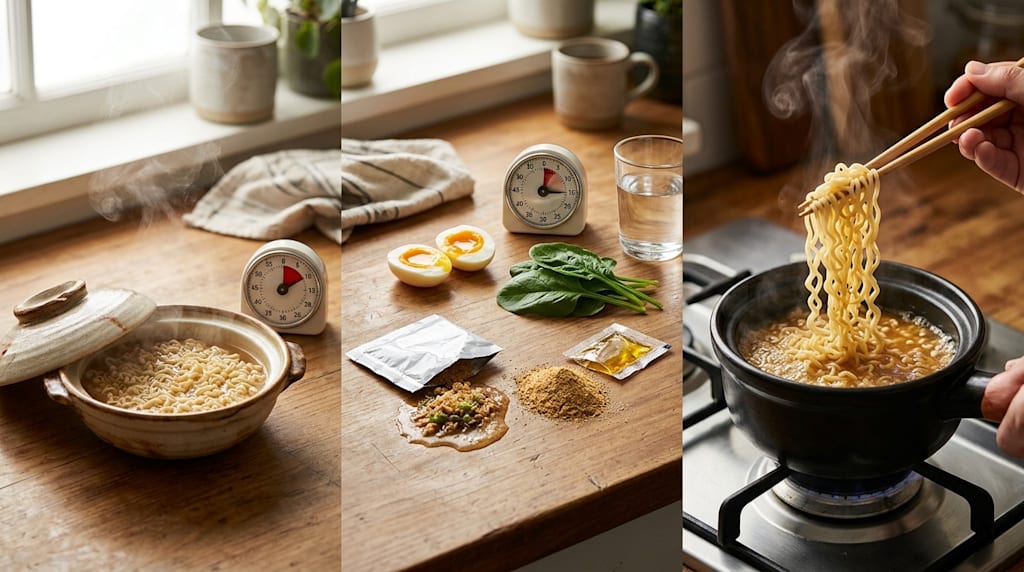
The same packet of instant noodles can taste like two different meals. Soak it and the center stays slightly firm. The aroma hits once when you open the lid, then drops. Boil it and the smell reaches you before the first bite. The noodles have more spring. The broth and noodles hold together.
People often say boiling works because it cooks longer. That misses the point. Boiling changes how heat enters the noodle cake.
Boiled instant noodles usually smell and taste stronger because steady, near-boiling water rehydrates the cake more evenly, keeps the surface starch in better shape, and pushes the fat and spice aromas into the air above the broth. The product definition and classification can be checked against GB/T 40772-2021, Instant Noodles. For starch gelatinization, fat flavor, and aroma release, I referred to the noodles, starch, and seasoning sections of On Food and Cooking. The water amounts, times, and temperatures below are starting points from a few tests with the same 1.5 L pot and the same batch of noodle cakes. They do not replace the package instructions.
Heat and water
A bowl of noodles has two kinds of aroma. One is the scent that rises into your nose. Temperature, movement, and surface area affect it. The other is the taste when broth and noodles enter your mouth together. That depends on even rehydration, surface starch, and how well the seasoning clings. A bowl can smell strong and taste thin. It can also smell mild and taste full.
Boiling lifts both sides at once. The pot keeps adding heat. The water circulates. The noodle cake gets washed by moving water. Soaking has only the hot water you pour at the start. After that, the bowl, the cake, and the air pull heat away. One bowl is still being heated. The other is cooling. The gap opens in the first minute.
When you soak noodles, even water close to boiling loses heat fast. The container and the cold cake absorb it. A lid slows the drop. It cannot add heat. A pot on a stove can. The water falls, then returns to a simmer.
A noodle cake is a dried, cooked structure full of pores. Hot water enters the outer pores first, then moves inward. A steadier temperature means the water and starch move faster and more evenly.
In my test, each portion used one cake and 500 ml of water. The soak group got water at about 95°C in a large covered bowl and sat for 4 minutes. The boil group got cold water brought to a boil, then noodles added and kept at a simmer for 3 minutes. The soak group still had a slightly hard core. The boil group was closer to the same texture inside and out. This was a home test. Your cake may differ. The direction is still clear: soaking is hot-water immersion. Boiling is continuous hot-water action.
At a simmer, hot water rises from the bottom. Surface water moves down. A loop forms. The noodles loosen. Curled layers that were stuck together separate. If you soak without turning the cake, the bottom softens first. The top may still float.
Boiling adds water motion. The mistake is a hard rolling boil. A violent boil makes noodles collide. Too much surface starch falls off. The broth turns cloudy and thick. The noodles break. My starting point: after the water boils, turn the heat to medium. Keep a string of small bubbles on the surface. Do not let the noodles fly around.
Still soak: water does not move; top and bottom rehydrate differently. Gentle convection: small bubbles; noodles loosen and rehydrate more evenly. Violent rolling: large bubbles hit the noodles; surface starch sheds.
Soaking can improve with motion. After adding water, turn the cake over at 30 seconds. At 2 minutes, loosen it with 6 strokes. It still trails a pot on the stove, but it beats leaving it alone.
Surface and seasoning
Instant noodles are already cooked and dried at the factory. Home heating is rehydration, not cooking raw dough. When the water stays hot and the time is right, the surface starch absorbs water and becomes supple. Broth can cling in a thin layer.
Under-soaked noodles feel soft outside and tight inside. The broth and noodles seem separate. Over-boiled noodles shed too much starch. The broth gets thick. The noodles lose their spring. So “more fragrant when boiled” has a limit. Eight minutes is worse than three.
I compared 2, 3, and 5 minutes with the same batch. The 2-minute bowl had a hard center. The 3-minute bowl had a bright surface and some spring in the center. The 5-minute bowl had thicker broth and noodles that broke easily. Treat that as a first-hand marker. Follow the package and the thickness of the noodle.
The fat and spices in the packet need hot broth to spread. Some aroma molecules then move from the surface into the air. Boiling gives heat and motion. Oil droplets break smaller. The smell keeps rising while you stand at the stove. That is why the boiled bowl feels stronger.
When you soak, powder dumped on top of the cake creates strong and weak patches. Oil can float in large slicks. The first smell when you open the lid is strong. After stirring, the broth may not be as even as a boiled pot.
Fat oxidation also matters, but do not overread it. Fat oxidizes in storage and changes flavor. The mechanism is covered in the fat chapter of On Food and Cooking. Weak aroma in a soaked bowl does not prove the packet oxidized. Water temperature, seasoning spread, and rehydration can all explain it. You cannot judge quality by smell alone.
If you boil all the seasoning for 4 minutes, fast aromas escape into the kitchen. The room smells great. The bowl may taste weaker. If you add everything after turning off the heat, more aroma stays, but powder may clump.
A safer method: add about two-thirds of the powder at the 2-minute mark. Turn off the heat. Add the last third and the oil packet. Stir for 20 seconds. The pot smells good and the bowl keeps flavor.
The smell you notice comes from volatilization. The flavor in the broth comes from dissolving and dispersion. Longer boiling does not create a straight line of more aroma.
Three bowls, same packet
Use 3 cakes from one batch. Use 500 ml water per bowl. Divide the seasoning into 3 equal parts. No scale? Spread the powder on white paper and split it into 3 similar strips. Stir the oil packet in a small bowl and divide it into 3.
Bowl A, soak: preheat the bowl with hot water for 30 seconds. Pour it out. Add cake and powder. Pour in 500 ml near-boiling water. Cover for 4 minutes. Turn the cake once at 2 minutes.
Bowl B, boil: bring 500 ml water to a boil. Add noodles. Simmer on medium for 3 minutes. Add two-thirds of the powder at 2 minutes. Turn off heat. Add the rest.
Bowl C, steep: bring water to a boil. Add noodles. Boil on medium for 2 minutes. Turn off heat. Cover and steep for 1 minute. Add all seasoning at the end.
Taste all three within 60 seconds. Smell the broth. Pick up 3 noodles. Take 1 spoon of broth. Note four things: hard core, sticky surface, broth cling, and whether aroma peaks at the lid or lasts. One test beats an argument.
Boiling steps
Bring 500 ml water to a boil. Add the cake. Press it under the water for 15 seconds. Turn heat to medium. Turn the cake at 45 seconds. Loosen it at 90 seconds. Add most of the powder at 2 minutes. Turn off heat at 3 minutes. Add the rest of the powder and the oil. Stir.
Egg? For a whole poached egg, add it at a gentle simmer. Cook 90 seconds. Then add noodles. For egg ribbons, pour in 1 beaten egg at 2 minutes. Wait 20 seconds. Push gently. Add 80 g greens 40 seconds before turning off heat.
Too many toppings drop the pot temperature. Cold vegetables, eggs, and meat all at once slow rehydration. In a 1.5 L pot, keep toppings under 150 g for one cake.
If you can only soak
Preheat the container with hot water for 30 seconds.
Use a deep bowl with a lid. Water should cover the cake by at least 1 cm.
After pouring water, turn the cake at 30 seconds. At 2 minutes, loosen it with 6 strokes.
Mix the powder with 30 ml hot water into a paste. Pour it in. Add the oil packet in the last 30 seconds. Stir 15 seconds. Cover again.
Cold room? Add 30 to 60 seconds. Do not just add water. Once the noodles are soft, open the lid. More time under cover makes the surface sticky. Use cooked or quick-cooking toppings. Thick meat slices will slow the bowl.
Common mistakes
Hard center: keep a steady simmer and give it a little more time. Do not just soak longer. Uneven broth: add powder in two stages. Do not dump it in one lump. Aroma fades: add oil last. Do not boil on high heat the whole time. Sticky surface: cut 30 seconds. Do not keep it covered. Raw toppings: cook them first. Do not add everything at once.
Boiling stacks four things: steady heat, moving water, even rehydration, and continuous aroma release. Overcooking still ruins the spring. The useful rule: make water temperature, time, and seasoning timing serve the texture you want.
I spent a week making the same packet soaked, boiled, and steeped. Boiled won on aroma. Steeped gave the best return: boil water, add noodles, cover for 3 minutes. The temperature falls slowly. Rehydration is even enough. It trails boiling by a small margin and saves a pot. Busy nights, I steep. Free nights, I boil.
The pot is still on the stove. The noodles are in the bowl. Add the last of the powder. Stir 20 seconds. Carry it to the table. Eat.
About the Creator
Jin
Writer of reamstories
https://reamstories.com/jin
Enjoyed the story? Support the Creator.
Subscribe for free to receive all their stories in your feed. You could also become a paid subscriber, letting them know you appreciate their work.
Comments
There are no comments for this story
Be the first to respond and start the conversation.