
Everyone Is Chasing Matcha. Japan Is Already Moving On to Hojicha.
The matcha boom is retiring Japan's roasted everyday tea — just as the world starts searching for it. Notes from inside the squeeze.
Disclosure: I write from Japan and check Japanese sources and official announcements for the stories I publish. This article was drafted with AI assistance and reviewed and fact-checked by me.
Here is a strange detail hiding inside the matcha shortage. When Ippodo Tea — the Kyoto house founded in 1717 — announced in February 2026 that it was discontinuing five of its everyday teas to cope with the matcha boom, the casualties were not exotic. They were hojicha: Japan's roasted everyday tea, in its premium form and in several ordinary ones.
The world's cafés are fighting over a green powder that Kyoto now rations at two tins per customer. Meanwhile, the tea Japan itself reaches for after dinner is quietly becoming the next obsession abroad — and the same shortage that made matcha famous is already squeezing it.
Two teas, one field
Matcha begins as tencha, a shaded leaf whose producer price rose 2.6 times in a year, according to Ippodo's own notice. At auction, tencha has been worth more than ten times the everyday leaf it competes with for space in the ground. So growers are doing the rational thing: pulling up ordinary tea and replanting for matcha, knowing new fields take roughly five years to produce.
Hojicha is made from exactly the ordinary side of that equation — mature leaves and stems, the harvest nobody abroad used to ask about. When those fields convert, the raw material for roasted tea shrinks with them. Tea fields are not light switches: a replanted field that stops giving hojicha leaf this year will not give matcha leaf for years either, so the squeeze lands on both teas at once. That is how a house founded in 1717 ends up retiring its hojicha lines not because hojicha failed, but because matcha succeeded too well.
And the world is arriving right on schedule. Search-interest trackers reported hojicha interest up roughly 130% in the UK and 90% in the US across 2025 — matcha-scale numbers they are not, but the curve is bending the same way.
The tea Japan drinks after dark
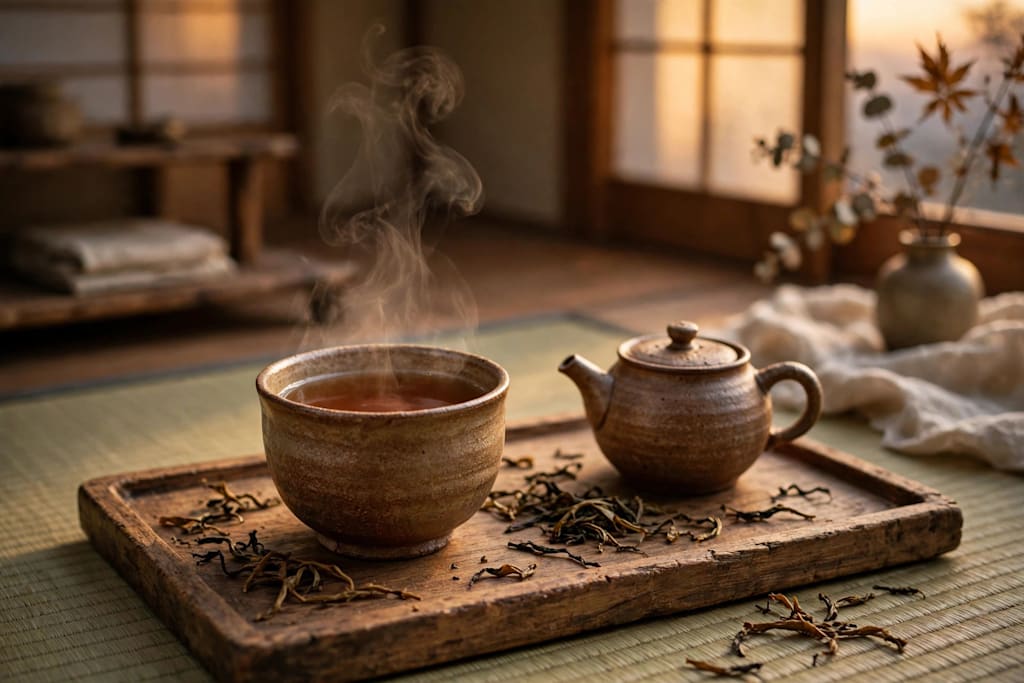
Take ordinary Japanese green tea — leaves, and often the stems too — and roast it until it turns the colour of autumn leaves. The grassy brightness of sencha becomes something toasty and rounded: roasted nuts, warm wood, a hint of cocoa. The bitterness softens. And the roasting burns off most of the caffeine.
That is hojicha's whole identity in Japan. It is the evening tea — what restaurants pour after a meal, what is served to children and grandparents, what you drink at 9 p.m. without negotiating with your future sleep. No whisk, no ceremony, no grades to decode. A teapot, hot water, and a tea that forgives you.
It also happens to travel well. The roast stands up to milk instead of disappearing under it, which is why the hojicha latte keeps appearing wherever matcha lattes already sell. Where matcha in milk tastes like a garden, hojicha tastes like toasted dessert. It takes boiling water without complaint, refuses to turn bitter if you forget it for a minute, and tastes like itself iced. For drinkers who tried green tea once and found it grassy and unforgiving, this is the friendliest door back in.
There is a menu logic to it, too. Matcha owns the morning — vivid colour, calm energy, a small ceremony to start the day. Every café that built its afternoons on matcha lattes eventually needs something for the hours after: a Japanese tea with the caffeine mostly roasted away. Hojicha is built for exactly that end of the day, and it arrives just as the morning tea gets scarce and expensive.
Bottom line
The matcha story taught the world to look at Japan's tea shelf. What it finds there next is the roasted tea Japan never exported with any fanfare, because at home it never needed any. Now the fields it grows in are being replanted for the green powder, the old houses are retiring the lines, and the searches abroad climb month by month. The next wave is being squeezed before it has even crested — a shortage in the making, visible early only if you read the notices coming out of Kyoto.
Tell me in the comments — has the brown, toasty alternative reached the cafés where you live yet, or is matcha still the only Japanese tea in town?
If this story made you think, a heart helps other readers find it — thank you for reading.
About the Creator
JIM | Japan Finds
From Nagoya, Japan. I write about the three Japanese products the world is quietly obsessed with — washlet bidet seats, Japanese kitchen knives, and real Uji matcha — checked against Japanese sources and domestic prices.
Enjoyed the story? Support the Creator.
Subscribe for free to receive all their stories in your feed.
Comments
There are no comments for this story
Be the first to respond and start the conversation.