
Bubur: Malaysia's Comforting Porridge (But Not Our Favourite)
Ah yes the bubur sweet and warm hugs the soul

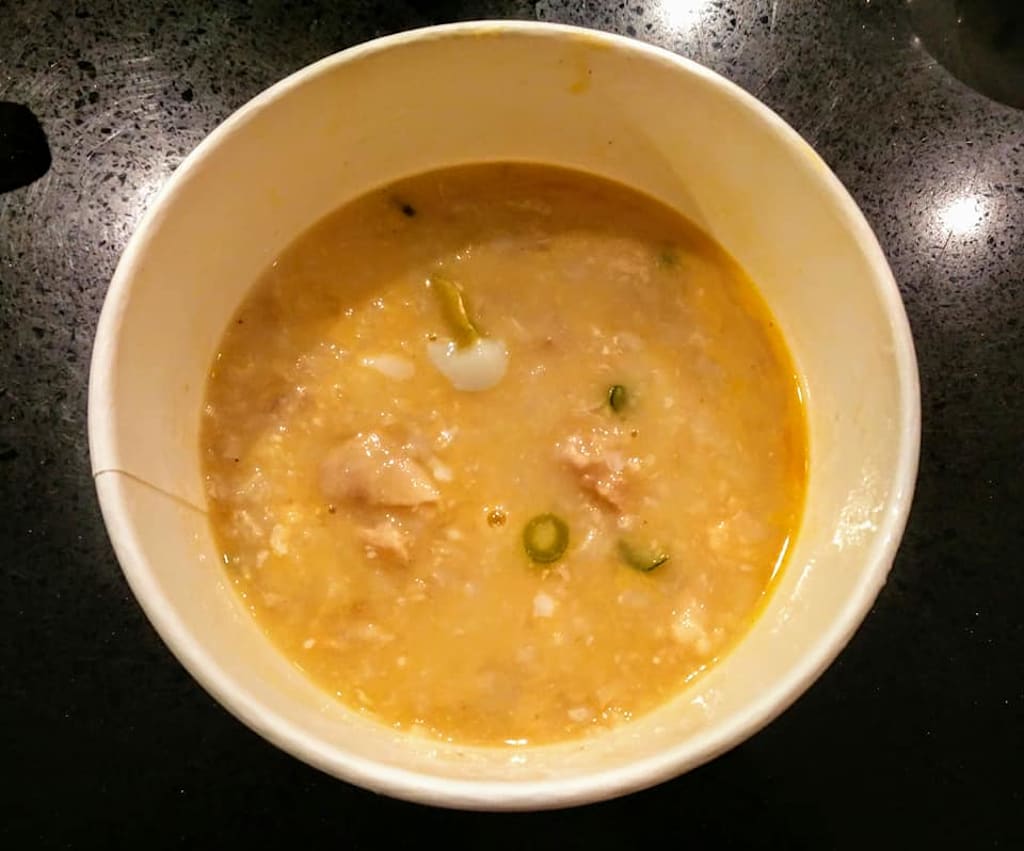
There are dishes that inspire passion, and then there are dishes that inspire a polite nod. Bubur falls into the latter category at least for us. It is not that we dislike it. We simply do not love it. And in a country as rich with culinary treasures as Malaysia, "OK" can feel like a disappointment.
Bubur is Malaysian porridge, a coconut-milk-based, sometimes sugary soup that includes various vegetables and meats. The version in the picture had chicken slices, floating in a pale, creamy broth that looked comforting but, to our palates, lacked the punch we have come to expect from Malaysian cuisine .
A Dish Without a Standard
The challenge with bubur is that there is no standard recipe. Each region, each village, each family has its own specialty. Some versions are savoury, packed with chicken, fish, or vegetables, and eaten as a meal. Others are sweet, flavoured with palm sugar and coconut milk, and served as a dessert. The only constants are the coconut milk and the rice everything else is negotiable .
This lack of a fixed identity makes bubur difficult to evaluate. A bowl in Penang may be rich and fragrant, while a bowl in Johor may be thin and watery. A bowl from one stall may be heavily spiced; from another, barely seasoned at all. The variation is a strength for those who grew up with the dish, accustomed to its many forms. For outsiders, it can be confusing—a dish that never quite settles into a recognizable shape .
The Coconut Milk Factor
The coconut milk is what distinguishes bubur from other rice porridges. Congee, the Chinese version, is made with water or stock and is savoury, often topped with century egg, pork, or preserved vegetables. Bubur replaces the water with coconut milk, resulting in a creamier, richer base. This works well when the bubur is sweet the coconut milk pairs beautifully with palm sugar, pandan, and banana. In savoury versions, however, the coconut milk can be overwhelming, muting the flavours of the meat and spices rather than enhancing them .
The bubur we tried had a pleasant creaminess, but the chicken was bland, and the broth lacked the aromatic punch we had hoped for. The vegetables were soft, almost mushy, and the overall effect was one of muted comfort a dish that soothes but does not excite .
The Texture Debate
Texture is another point of contention. Some prefer bubur that is smooth, almost like a puree, where the rice has broken down completely. Others prefer it chunky, with distinct grains and pieces of meat and vegetable. The version we tried leaned toward the smooth side, which may explain why we found it less satisfying. There is something about a chunky porridge that feels more substantial, more like a meal and less like a soup .
The coconut milk also affects the texture, adding a viscosity that water-based porridges lack. This can be pleasant a thick, creamy bowl of bubur on a rainy day is undeniably comforting. But it can also be cloying, particularly if the dish is not well-balanced by salt, spice, or acid .
Our Verdict: OK, But Nothing to Wow About
We wanted to love bubur. We wanted to understand why it holds such a cherished place in Malaysian cuisine. But after several attempts, across different regions and different stalls, we have concluded that it is simply not for us. It is not bad. It is not offensive. It is just... OK.
The flavours are muted. The textures are soft. The overall impression is one of gentle comfort rather than bold excitement. For those seeking a soothing, mild dish, bubur may be exactly what they need. For those seeking the vibrant, complex flavours that define Malaysian cooking, there are better options.
Michal, who loves the intensity of char kuey teow and the heat of laksa, found bubur particularly underwhelming. "It's like a whisper," he said. "I want food that shouts."
Who Might Enjoy Bubur
To be fair, bubur has its place. For children, the elderly, or anyone recovering from illness, its mild flavours and soft textures are ideal. It is easy to digest, gentle on the stomach, and can be packed with nutrients depending on the ingredients. It is also a common breakfast dish in some regions, served alongside roti canai or other morning staples.
For travellers seeking to explore the full range of Malaysian cuisine, bubur is worth trying at least once. It offers insight into the country's diversity, its regional variations, and its capacity for subtlety. But it is unlikely to be the dish you dream about after you return home.
Bubur is Malaysian porridge: coconut-milk-based, sometimes sweet, sometimes savoury, and endlessly variable. It is a dish of comfort and tradition, but it lacks the bold, vibrant flavours that make so many other Malaysian dishes unforgettable. We found it to be OK pleasant enough, but not something we would seek out.
If you are curious, by all means, try it. Order a bowl, take a spoonful, and decide for yourself. You may love it. You may find it comforting in a way that we did not. But if you are looking for the dish that will make you fall in love with Malaysian cuisine, look elsewhere. There is nasi lemak, satay, laksa, char kuey teow, and a hundred other dishes waiting to capture your heart. Bubur, for us, is not one of them .
About the Creator
Mark Lim
Hi I am mark an automotive student and a car, tech and food enthusiast ! Im gonna try and post daily & hope you enjoy what I write and do share my page with people you know. I would gladly appreciate it! Cheers
Enjoyed the story? Support the Creator.
Subscribe for free to receive all their stories in your feed.
Comments
There are no comments for this story
Be the first to respond and start the conversation.