
Almas Caviar: A Taste of Rarity, Luxury and Time
"best meal"

There are meals that satisfy hunger, and there are meals that become stories. Almas caviar belongs firmly to the second kind. It is not a dish that arrives at the table simply to fill a plate. It arrives with history, mystery, craftsmanship, and a price tag capable of making even experienced food lovers pause for a second.
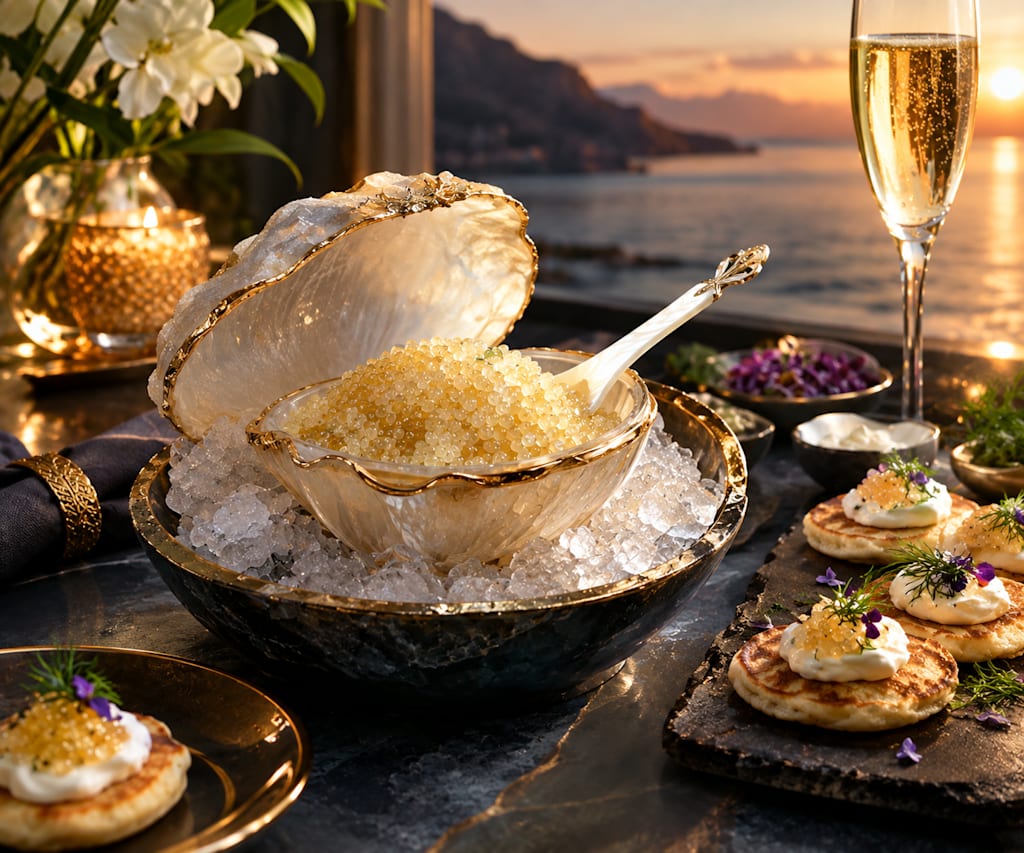
Imagine a beautifully dressed dining table beneath the soft glow of candlelight. Crystal glasses catch the light, polished silverware rests neatly beside porcelain plates, and somewhere in the background a bottle of champagne is being opened. Then, almost quietly, a small chilled container is placed before the guests.
Inside are tiny, pale pearls.
They are delicate. Almost impossibly elegant.
This is Almas.
The name itself is often associated with the Persian word for “diamond,” an appropriate description for a caviar famous for its exceptionally pale appearance and extraordinary rarity. Traditional accounts have connected Almas with rare albino Beluga sturgeon from the Caspian Sea, particularly exceptionally old fish. The idea that a luxury ingredient could come from a fish that may have spent decades growing beneath the water gives the food a remarkable story before it is even tasted.
And perhaps that is where the fascination begins.
Why Does Almas Caviar Cost So Much?
At first glance, the price of Almas caviar can seem almost unreasonable. Why would anyone pay an enormous amount of money for a small quantity of fish eggs when there are countless other delicious foods available for a fraction of the cost?
The answer is rarity.
Caviar has never been simply about eating. It has long been associated with celebration, wealth, prestige, and special occasions. But Almas occupies an even more exclusive corner of that world.
Beluga sturgeon are slow-growing fish, and females require many years to reach maturity and produce roe. Exceptional traditional Almas has been associated with unusually old and rare albino sturgeon. That means the production of such caviar is connected to an extraordinary amount of time.
Imagine waiting decades for an ingredient to become ready.
That changes the meaning of patience.
The fish grows. The years pass. Seasons come and disappear. The world changes around it. Then, eventually, the roe becomes part of a luxury dining experience somewhere thousands of kilometres away.
Historically, Guinness World Records has listed Almas caviar at around £20,000 per kilogram, although prices vary depending on the particular product, provenance, quality, availability, and market.
It is therefore not the size of the portion that determines the value.
It is everything behind it.
Rarity.
Time.
Craftsmanship.
Limited supply.
And the extraordinary story of where it came from.
A Tiny Pearl With a Delicate Personality
One of the most beautiful things about fine caviar is that it does not need to shout.
Almas does not arrive covered in sauce. It does not need mountains of herbs or complicated decorations. Its natural appearance is part of its appeal.
The pearls can have a pale golden, cream, or almost white appearance, depending on the product. They look more like tiny jewels than something that came from the sea.
When the container is opened, the caviar should be treated with care. The roe is fragile, and the experience is designed around preserving its delicate qualities.
The preparation itself is remarkably restrained. After the roe is carefully collected, the eggs are separated, cleaned, graded, and lightly salted. This process, traditionally known as malossol when referring to lightly salted caviar, allows the natural character of the roe to remain at the center of the experience.
There is no need to drown it in seasoning.
There is no need to cook it again.
There is no need to transform it into something else.
The beauty is already there.
The Art of Serving Almas
Serving luxury caviar is almost a ceremony.
The caviar is kept chilled, commonly presented over crushed ice. A mother-of-pearl spoon is traditionally used because it is considered better suited to preserving the delicate tasting experience than many metal utensils.
Then comes the moment everyone has been waiting for.
The first taste.
A small amount is enough.
The pearls rest gently on the tongue. At first, there is the clean sensation of salt from the sea. Then the texture begins to reveal itself. The eggs are delicate but distinct, and as they soften, they release a subtle combination of briny freshness, creaminess, and buttery richness.
It is not an aggressive flavor.
It is refined.
Quiet.
Almost shy.
And that can surprise people.
When someone hears that a food costs thousands of pounds per kilogram, they may expect an explosion of flavor powerful enough to make the walls shake. But exceptional caviar often works differently. Its pleasure lies in balance.
The saltiness should not overwhelm.
The oceanic character should remain fresh.
The texture should be delicate.
And the finish should make you want another small taste.
That is the trick.
You never really need a mountain of it.
What Should You Eat With Almas Caviar?
The answer is wonderfully simple: foods that know when to step aside.
Traditional accompaniments include small blinis, lightly toasted bread, crème fraîche, and sometimes simple potatoes or eggs. These foods provide softness and richness without competing with the caviar.
Picture a tiny golden blini, still slightly warm. A delicate spoonful of cool crème fraîche is placed on top. Then comes the Almas.
The pale pearls sit against the white cream like tiny pieces of edible jewellery.
You take the bite.
The blini provides warmth and gentle texture.
The crème fraîche brings coolness and richness.
Then the caviar arrives with its subtle salty character.
For a moment, everything works together.
That is the beauty of a carefully prepared luxury bite. It does not need twenty ingredients. Sometimes three good ingredients can create something far more memorable than twenty competing flavors.
Some enthusiasts prefer their caviar almost completely alone. A small spoonful, nothing else, allows the palate to experience the roe without interruption. Others enjoy tasting it directly from the back of the hand, a traditional method that allows the caviar to be experienced without the influence of a serving utensil.
Either way, restraint is important.
The caviar should remain the star.
A Drink Worthy of the Occasion
A feast involving Almas would hardly feel complete without something elegant to drink.
Traditionally, chilled vodka has been paired with caviar for generations. The clean, cold character of vodka can refresh the palate between bites. Dry sparkling wine is another popular companion, especially when the occasion calls for something celebratory.
Imagine the scene: a spoonful of pale caviar, a small warm blini, a glass of sparkling wine catching the candlelight.
It is not a meal designed to be rushed.
It is a meal designed to be remembered.
The Feast of Almas
There is something almost theatrical about serving a food this rare.
The guests may already know what they are about to taste, but curiosity still fills the room.
The lid is lifted.
The caviar is revealed.
Someone leans forward.
Another person smiles.
The first spoonful is served.
And suddenly the room becomes quiet.
That silence is interesting.
People usually talk when they eat. They tell stories, laugh, argue about recipes, complain about the weather, and reach across the table for another piece of bread.
But when people are tasting something unfamiliar and expensive, they sometimes become unusually attentive.
They want to understand it.
They notice the texture.
They think about the flavor.
They compare it with other caviar they have tasted.
And then someone inevitably asks the question:
“Is it really worth the money?”
There is no universal answer.
If you measure food by calories, fullness, or affordability, Almas will probably lose the argument immediately.
For the price of a small serving, you could prepare an enormous feast.
You could roast a beautiful piece of meat. You could serve fresh seafood, creamy potatoes, vegetables, warm bread, fruit, and an extravagant dessert. You could invite a whole family to dinner.
Almas does not compete with that kind of feast.
It belongs to another category.
It is about the experience.
When Food Becomes a Story
Luxury food has always fascinated people because it represents more than eating.
A rare wine can tell you about a vineyard and generations of winemaking.
A rare cheese can tell you about a region and an old tradition.
A precious spice can tell you about ancient trade routes.
And Almas caviar tells a story about sturgeon, water, time, rarity, craftsmanship, and our fascination with things that are difficult to obtain.
There is also an important modern lesson behind the luxury.
Wild sturgeon populations have suffered greatly from overfishing and demand for caviar. Responsible modern production increasingly relies on controlled aquaculture and conservation rather than treating wild populations as an endless source of luxury food.
That matters because rarity should never become an excuse for destruction.
The future of fine caviar depends on protecting the fish that make it possible.
The Last Spoonful
Eventually, every luxurious feast reaches the same destination.
The last bite.
The final spoonful of Almas disappears.
The ice begins to melt around the empty serving dish. A few crumbs remain on the blinis. The glasses are slowly emptied, and the conversation becomes louder again.
Someone says they loved it.
Someone else says they expected something more dramatic.
Another guest laughs and says, “Perhaps the expensive part is the story.”
Maybe they are right.
Because Almas caviar is fascinating precisely because it is so small.
It does not overwhelm the table.
It does not arrive in enormous portions.
It does not try to prove its worth through quantity.
Instead, it asks you to slow down.
Look closely.
Taste carefully.
And appreciate something that took an extraordinary amount of time and effort to reach your plate.
That is the strange beauty of Almas.
It is a luxury built around patience.
It is a food where the story begins long before the dinner table and continues long after the last pearl has disappeared.
Perhaps you would love it.
Perhaps you would find it too subtle.
Perhaps you would decide that no food should cost that much.
But if you ever find yourself sitting at an elegant table with a tiny dish of pale Almas caviar in front of you, one thing is certain.
You will probably take that first bite slowly.
Because when something has taken decades to become possible, it seems only fair to give it a moment of your time.
About the Creator
Enjoyed the story? Support the Creator.
Subscribe for free to receive all their stories in your feed.
Comments
There are no comments for this story
Be the first to respond and start the conversation.