
5 Costly Matcha Buying Mistakes in a Shortage Year
In a shortage year, the expensive mistakes are the quiet ones — bulk tins, mystery grades and the wrong matcha in the wrong drink. Lessons from inside Japan's tea squeeze.
Disclosure: I write from Japan and check Japanese sources and official announcements for the stories I publish. This article was drafted with AI assistance and reviewed and fact-checked by me.
In Kyoto this year, the most honest sign in the tea business is handwritten: two tins per customer. Ippodo Tea, a house founded in 1717, caps how much of its own matcha you may buy. On 19 February 2026, Ippodo explained the arithmetic to its customers: producer prices for matcha's raw leaf had risen 2.6 times in a single year, and from March it would discontinue five of its everyday teas as growers converted their fields to matcha leaf. Shortages make buyers spend badly. These are the five mistakes this one is teaching, the expensive way.
Mistake one: believing the adjective
"Ceremonial grade" has no legal definition in Japan. None. It is a phrase any seller can print on any powder. Run the numbers behind it: machine-picked tencha, the leaf matcha is milled from, averaged ¥14,141 per kilo at Kyoto auction for the 2025 crop, and the leaf is stone-milled at roughly 30–40 grams per hour. A vivid-green "ceremonial" powder sold suspiciously cheap at scale fails that arithmetic — it is old stock, blended leaf, or an origin the label only implies. What counts is duller: who blended it, and where it sits in that house's own ranking, because every Kyoto house orders its blends from everyday to top. The houses rationing their stock are the market's honesty signal. They limit you because they will not dilute.
Mistake two: stockpiling against the shortage
The instinct, when something scarce gets expensive, is to hoard. With matcha, hoarding is the waste. Real matcha oxidises after opening: every opened tin is going stale, losing exactly the freshness the record prices paid for. There is a reason Marukyu Koyamaen, grinding in Uji since 1704, stopped selling matcha in 100-gram and larger packs entirely — small is not a marketing tier, it is how the product survives. A modest tin finished within the month beats a bargain bag every time. In a shortage, restraint is the connoisseur's move, not a compromise.
Mistake three: the right powder in the wrong drink
Because the grade words mean nothing legally, think in matches instead of ladders. The top of a great house's range is blended for one purpose: whisked straight with water, where the umami is the whole event. Milk and sugar bury precisely what that grade costs. The reverse error is just as wasteful. A robust everyday matcha whisked straight tastes harsh and thin, and the drinker concludes, wrongly, that they don't like matcha. Neither powder failed. The pairing did. Grade is not a status to buy up; it is a match to make with how you actually drink.
Mistake four: blaming the tea for the missing tools
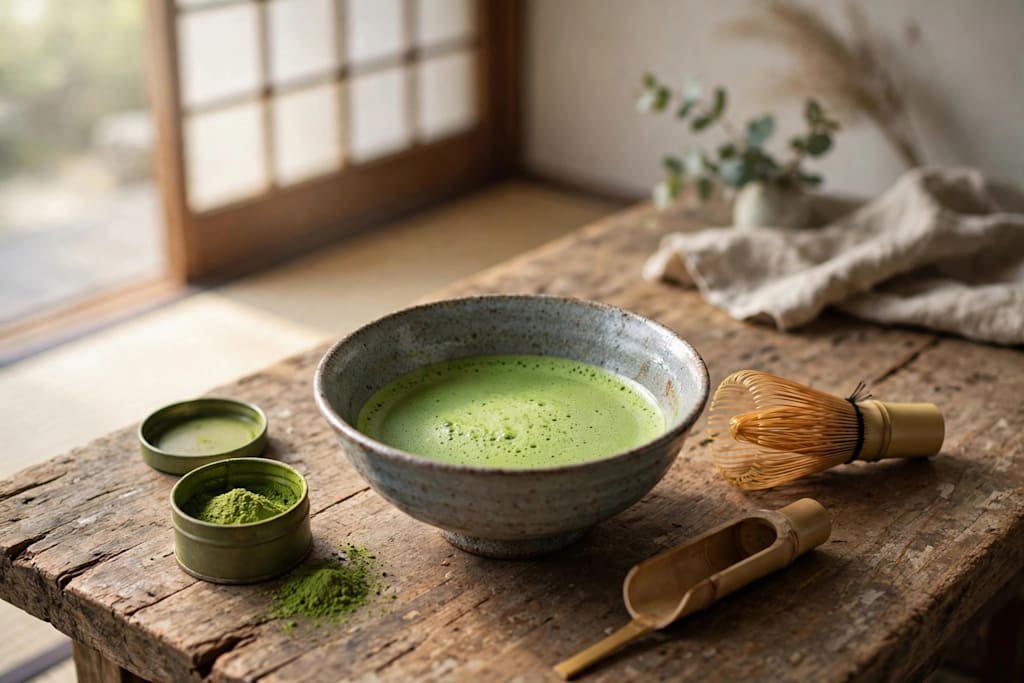
Matcha is a suspension, not a solution. The stone-milled powder has to be whisked into a fine foam, and the bamboo chasen exists precisely for that job; without it you get clumps, and the leaf takes the blame for a preparation problem. The tools are also the calm purchase in a shortage market. A whisk, a bowl, a scoop — none of them depends on this year's harvest. Buy them once, at a sensible level, and let the leaf be the only recurring expense. (The whisk itself is a consumable — replace it every few months of daily use; a tired whisk, not tired tea, causes most disappointing bowls.)
Mistake five: waiting for prices to come back
They won't, on any useful timeline. New tencha fields take roughly five years to produce, so plantings made in response to today's prices reach shelves around 2030. Hand-picked Uji tencha volume fell roughly 40% across 2024–2025 on heat and erratic rain, and the workforce behind it has shrunk and aged for thirty years. Japanese tea prices, once reset, historically do not come back down. Waiting is not patience here; it is paying the same new prices later.
What the shortage teaches
Strip the five mistakes down and they are one lesson in five costumes: in a shortage, buy information, not adjectives. A named house and its own ranking, instead of a grade word. A small tin finished fresh, instead of a hoard going stale. The grade matched to the drink. The tools bought once. The old houses rationing their tins are not creating the scarcity; they are refusing to fake their way through it. Tell me in the comments — what is the most expensive buying mistake a shortage has ever talked you into?
If this story made you think, a heart helps other readers find it — thank you for reading.
About the Creator
JIM | Japan Finds
From Nagoya, Japan. I write about the three Japanese products the world is quietly obsessed with — washlet bidet seats, Japanese kitchen knives, and real Uji matcha — checked against Japanese sources and domestic prices.
Enjoyed the story? Support the Creator.
Subscribe for free to receive all their stories in your feed.
Comments
There are no comments for this story
Be the first to respond and start the conversation.