Latest Stories
Most recently published stories in Families.
Holding Water in Open Palms
There is a strange kind of motherhood that has no name. It looks like love, sounds like responsibility, feels like devotion — but it carries no authority. I pour myself into children who are not mine, love them as though they were born from my own breath, yet I remain a guest in their lives. I am close enough to love them fiercely, close enough to worry, to nurture, to care, but never close enough to truly belong. There is always a line, however invisible, that reminds me where my place begins and ends.
By Gladys Kay Sidorenko3 months ago in Families
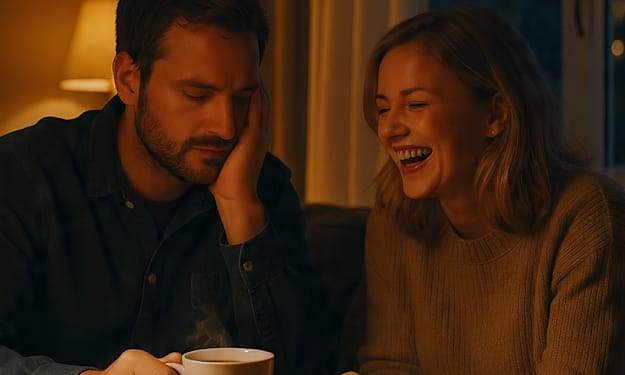
The man who mapped her laughs
He liked interesting stories. She was his favorite kind. That’s how Noah explained it to his sister the night she caught him talking to an empty chair. He wasn’t crazy. He was practicing. The woman who sat in that chair every Thursday for two years was gone. Cancer, fast and unfair. But the stories weren’t. And he wasn’t ready to stop listening. Her name was Lina. She was his neighbor in the building with the broken elevator and the roof that leaked when it really meant it. She moved in with two suitcases and a plant she swore was unkillable. It died in three weeks. She laughed harder at that than anyone else. “I collect interesting people,” she told him the first time they met in the hallway. He was carrying groceries, she was carrying a toolbox. “You look like you have good ones.” “I’m an accountant,” he said. “Perfect,” she grinned. “Boring job, interesting person. That’s the best combo. Means you chose to be interesting instead of just falling into it.” Noah didn’t think of himself as interesting. Numbers lined up. Spreadsheets balanced. His life was predictable in the way that felt safe after his divorce. But Lina had a way of turning ordinary into plot. She’d stop him to ask why he always bought two apples when he lived alone. He’d mumble something about leftovers. She’d say, “So the second apple is for who you might become tomorrow. I like him already.” Every Thursday she knocked on his door at 7 p.m. sharp. No reason. No plan. Just “story time.” She’d bring tea. He’d bring the kind of silence he was comfortable with. She’d fill it. She told him about the year she lived on a cargo ship because she wanted to see where things came from before they got to stores. About the summer she worked as a clown for kids’ parties even though she was terrified of makeup. About her brother who stopped speaking to her and how she wrote him letters anyway, even when he never wrote back. He told her about his dad’s watch that didn’t work but he wore anyway. About the first time he balanced a company’s books and felt like he’d solved a puzzle the world needed. About how he was afraid that if his life was quiet, it meant it was empty. “You’re wrong,” she said, stirring honey into his tea. “Quiet isn’t empty. Quiet is where the good stuff gets heard.” After she died, the Thursdays felt heavier than the rest of the week. Her chair stayed. Her plant stayed, replaced with a fake one because he killed it too. He started writing the stories down. Not for anyone. For himself. For the version of him that needed to remember that interesting wasn’t loud. It was present. He liked interesting stories, yes. But Lina taught him he liked them because he liked the people brave enough to live them. She’d shown up with no audience, no applause, and told him the truth: that a life worth telling is just a life where you notice things and you don’t pretend you didn’t. Six months after she was gone, a girl moved into Lina’s old apartment. Twenty-two, art student, brought in more plants than furniture. She knocked on Noah’s door on a Thursday at 7:03 p.m. “Hi,” she said. “I found this in the wall. I think it’s yours.” It was a notebook. Lina’s handwriting. Stories she never told him. The last page had his name. _For Noah. In case you think I left. I didn’t. I just ran out of Thursdays. Keep the chair warm. Someone will need it. And if they do, tell them a story. That’s how we keep each other alive._ He didn’t cry. Lina hated when people cried over endings. She said tears were for salt, and stories needed salt to last. So he invited the girl in. Made tea. Pulled out the chair. “What kind of stories do you like?” she asked. He smiled. The first real one since Lina left. “The interesting kind. The kind where someone shows up, listens, and doesn’t leave.” And he started telling her about a woman who taught an accountant that the best plot twist is deciding to stay. He still likes interesting stories. But now he knows why. Because she was one. And because every Thursday, he gets to add a new chapter.
By Khalil Ullah3 months ago in Families
SSDI Appeal: What to Do After a Disability Denial
Getting denied for Social Security Disability Insurance (SSDI) can feel discouraging, especially when your health already makes daily life harder. The good news is that an SSDI appeal gives you another chance to show Social Security why your condition keeps you from working.
By Jay Rodriguez3 months ago in Families
The Symphony of the Sewing Machine
Elena hated the clutter of her grandmother’s attic, a dusty, crowded repository of forgotten decades, discarded furniture, and fading memories that smelled heavily of mothballs and old paper. But after Esther passed away quietly in her sleep, the monumental and emotionally draining task of sorting through the remnants of her long, quiet life fell entirely on Elena’s shoulders. Amidst the yellowed photographs, stacks of old handwritten letters, and heavy wool coats sat a heavy, cast-iron Singer sewing machine from the early 1950s. It featured intricate gold decals fading on its black body, housed within a dark walnut wooden cabinet. It was a stark, jarring contrast to Elena’s minimalist, fast-paced life as a graphic designer in the city, where everything was disposable, digital, perfectly clean, and easily replaceable with the click of a button. Elena reached out and touched the cold, heavy black metal wheel. Her grandmother had spent decades sitting behind this exact machine, repairing winter coats for the neighborhood children, tailoring wedding dresses for young brides, and stitching together the literal fabric of their family’s life during lean years. Elena, caught up in the modern rush of fast fashion, online shopping, and instant gratification, had never truly understood the immense patience required for such tedious, manual labor. To her, a torn shirt or a missing button was something you simply threw into the recycling bin, not something you spent an hour meticulously mending by hand. On a whim, driven by a sudden, overwhelming wave of grief and a desire to keep a piece of Esther close, Elena decided to hire movers to transport the heavy machine back to her modern, open-concept apartment. It sat in the far corner of her living room for weeks, an awkward, silent monument to the past that didn't fit the sleek aesthetic of her Scandinavian furniture. One rainy Tuesday evening, deeply stressed by a looming corporate design deadline and overwhelmed by the constant, aggressive pinging of client emails on her dual monitors, Elena found herself drawn to it. The digital world felt cold and demanding. She opened the wooden cabinet, unfolded the machine, and found a woven basket of fabric scraps her grandmother had left behind. With trembling fingers, she followed the etched guides to thread the ancient needle, placed a piece of denim under the foot, and pressed her bare foot down on the heavy iron treadle pedal. The machine didn't just start; it roared to life with a rhythmic, mechanical cadence clack-clack-clack-clack that echoed through the quiet apartment. It was an incredibly grounded, tactile experience that demanded her complete attention. Unlike the smooth, silent, and forgiving glide of her digital stylus on a glass tablet, where an error could be erased with a simple undo command, the sewing machine demanded her absolute physical presence and total concentration. The needle was real, the sharp metal was dangerous, and the fabric was unforgiving. If her mind wandered to her work anxieties or client feedback, the fabric bunched up immediately. If she rushed the pace, the thread snapped cleanly in half, forcing her to stop and start the delicate threading process all over again. As the late-night hours dissolved into the early morning, the rain beating a steady rhythm against her window, Elena watched disparate pieces of floral cotton and old denim slowly transform into a simple, structured tote bag. The lines weren't perfectly straight, and the stitching was noticeably uneven and messy in certain places, but it was entirely real, holding a physical weight in her hands. She felt a profound, unexpected wave of closeness to her grandmother, as if Esther were standing right behind her shoulder, guiding her posture. She finally understood the quiet, meditative peace of creating something slowly, piece by piece, through deliberate physical effort. Elena realized that her grandmother wasn't just mending clothes out of economic necessity all those years ago; she was practicing mindfulness long before it became a commercialized modern wellness trend. The old machine became Elena's daily sanctuary from the digital noise of her design career. It was a beautiful, functional reminder that the finest, most resilient things in life cannot be automated or rushed; they require time, patience, and deliberate human care to truly hold together.
By Asghar ali awan3 months ago in Families
How to Throw a Vintage Disney Channel Party
Although the Disney Channel first debuted in 1983, it wasn't until the early 2000s that it really hit its stride with programming. Some of the most popular hits from this era included Hannah Montana, The Suite Life of Zack and Cody, That's So Raven, Kim Possible, and the blockbuster movie High School Musical.
By Janis Masyk-Jackson3 months ago in Families
My Dog Accidentally Locked Himself Inside a Room: What We Did and What UK Pet Owners Should Know
A few days ago, I had a stressful situation at home when my dog, Milo, accidentally locked himself inside a bedroom. The door had closed behind him, the latch caught, and the handle would not open from the outside. Milo started barking and scratching near the door, and it was clear he was becoming unsettled.
By James Hartshorn3 months ago in Families