
The 3 A.M. Kitchen Is the Real Test for AI Baby Gear
A startup with 59 products planned says it can fix feeding. First, it has to prove a smart bottle is worth trusting at 3 a.m.
The Kitchen at 3 A.M.
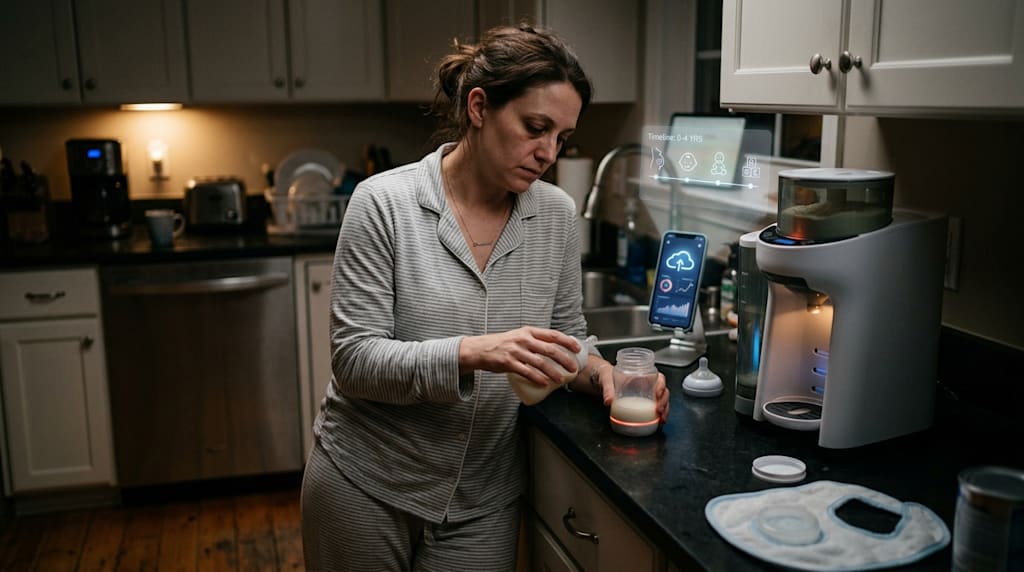
At 3 a.m., the kitchen light is on.
Someone presses a bottle against the inside of a wrist to test the temperature. Someone else levels off a scoop of formula and counts the markings again. The baby cries. The kettle whistles. The back of a hand gets scalded. After feeding, burping, changing, and coaxing to sleep, the adult has forgotten how many milliliters were fed last time, at what temperature, and for how long.
This scene repeats in countless homes. Feeding is the most frequent action in maternal and infant households. It is also the least recorded. The bottle is a container. The formula maker is a tool. Records rely on memory. Judgment relies on experience. Products do not share data. Feeding experience cannot accumulate. New parents face more information than the previous generation, but the tools in the late-night kitchen still do basic jobs.
China’s maternal and infant consumer market has passed 5 trillion yuan, with annual growth of about 12%. The global market is worth about 2 trillion U.S. dollars. Smart feeding, development monitoring, and pregnancy and childbirth technology are among the fastest-growing categories worldwide. Yet overall smart penetration in maternal and infant care is below 1%.
Qishi Intelligence was founded in 2026. Its team began developing maternal and infant products in Silicon Valley in 2022. It chose scientific feeding as its entry point and will soon launch a smart baby bottle and a smart formula maker. Founder Li Zhigang draws a line for smart hardware: capture data, process and analyze it, then respond on its own. Bluetooth and a data display do not make a product smart. The bottle should know how much the baby drank, whether the baby drank comfortably, and when the next feeding should be. Parents get fewer guesses and less late-night scrambling.
The smart bottle: from container to terminal
In Qishi Intelligence’s plan, the smart bottle is not a container. It is a terminal with multiple sensors.
During feeding, an invisible sensor module at the bottom of the bottle identifies milk volume, milk temperature, and feeding duration. If the temperature is too high or too low, red and blue lights warn the parent. With a dedicated heating module, the bottle can keep milk warm. The data syncs to the cloud in real time. Combined with the baby’s weight and age in months, AI generates a feeding report and pushes a customized plan before the next feeding.
The key word is closed loop. Data capture, processing and analysis, and proactive response. None of the three can be missing. Bluetooth and an App display only digitize a traditional product. They do not change the feeding decision. Qishi Intelligence wants the bottle to move from passive tool to active participant.
The hard part is everything else. A bottle goes into a baby’s mouth. Parents will scrutinize material safety, ease of cleaning, resistance to high-temperature sterilization, service life, and fit for different ages more than they will scrutinize smart features. The sensor must survive high-temperature sterilization. The module must be removable and washable. The battery must be safe. Temperature and volume readings must stay accurate. The cost must stay within what parents will pay. Until those questions are answered, smart features are an add-on, not a reason to buy.
Maternal and infant users are far more sensitive to safety than ordinary consumer electronics users. A smart bottle must first be a good bottle. Only then can it be a smart bottle.
Bionic nipple: 45:55 and mammary channels
Beyond the smart bottle, Qishi Intelligence is trying to differentiate the nipple.
The team reviewed academic literature on how humans and mammals breastfeed. It found that traditional nipples are too easy to suck. That can cause gas, spitting up, and even affect oral development. Qishi developed a bionic solid nipple. Its outer shape mimics the 45:55 offset ratio of breast milk. Its inner structure imitates the microscopic channels of human mammary glands. The goal is to recreate the natural resistance a baby needs when sucking at the breast.
This is a common direction for maternal and infant hardware: skip the gimmick and return to the baby’s physiology. If the bionic nipple reduces gas, spitting up, and oral development problems, it becomes more than a marketing concept. It becomes a core component with technical barriers and user reputation.
But the nipple goes into the mouth. Material safety, ease of cleaning, resistance to high-temperature sterilization, service life, and fit for different ages are again the first concerns. The bionic design must be mass-produced reliably. The resistance curve has to change by age. Residue must not remain in the internal channels after cleaning. The supply chain and quality control have to answer those questions.
Formula maker: one touch instead of a mess
The smart formula maker paired with the bottle solves another frequent problem: preparing formula is tedious and easy to get wrong.
Qishi Intelligence’s design asks users to keep the powder chamber and water tank filled. The machine then dispenses powder, mixes it without bubbles, and outputs milk at the right temperature for the baby. It follows the best ratio and temperature for different formula brands. Some formulas need 70-degree water. The machine handles that, then cools the milk to about 40 degrees. It also cleans itself and uses UV sterilization. The messy, error-prone process becomes one touch.
The value is certainty. At night, water temperature, ratio, bubbles, and cleaning can push parents to the edge. If the machine handles those steps reliably, it saves time and emotion. For maternal and infant families, emotional value is part of the purchase decision.
59 products and a team of fewer than 30
What stands out about Qishi Intelligence is not one product. It is the plan: 59 smart maternal and infant products covering prepregnancy, pregnancy, childbirth, postpartum recovery, breastfeeding, and infant care and early education from 0 to 4 years old.
For a startup with fewer than 30 people, that is heavy. The obvious path is to polish one or two hit products and expand after making money. Li Zhigang says many people in this industry are just joining the fun. Qishi is not. The team spent nearly three years in Silicon Valley on product planning and technical pre-research. They see maternal and infant care as a continuous three-to-four-year journey, not a set of isolated purchase moments.
“If we only make one hit product, such as a smart stroller, users leave when the baby grows up. With a full product line, pregnancy products become the entry point for postpartum products. Breastfeeding products become the entry point for early education products. Users move through our system instead of out of it,” Li Zhigang said.
Data is the other reason. Only full-cycle data can help AI understand how a mother’s sleep connects to a baby’s development. A single hardware product is easy to replace. A family health data system can keep accumulating. Customer lifetime value rises. The company builds a data moat.
Qishi Intelligence will bring products to market one by one. This year, the bottle and formula maker come first. Li Zhigang argues that without a full product vision and long-term architecture from the start, the company will never stitch together fragmented data and experiences later. He wants to solve core pain points for decades, not make quick money.
The business math: hardware, algorithms, cloud
The business logic is complete on paper.
At the front end, the smart bottle and formula maker enter a high-frequency feeding routine and create a data entry point. In the middle, AI algorithms and cloud services provide feeding reports, plans, and warnings. At the back end, the company extends into pregnancy, postpartum, and early education to form a full-cycle product matrix. Hardware captures data. Algorithms process it. The cloud provides ongoing service. The more people use the products, the richer the data, the more precise the recommendations, and the higher the switching cost.
If that loop holds, Qishi Intelligence is not a maternal and infant hardware company. It is a maternal and infant data and service company. Its upside is not selling bottles. It is owning the entry point to a family health data system. Maternal and infant scenarios last for years. From prepregnancy to age four, users pass through countless decision points. Whoever provides value at those points gets more repurchases and a longer customer life.
Qishi Intelligence focuses on AI and maternal and infant smart hardware. It covers prepregnancy, pregnancy, and breastfeeding worldwide. Its three-part model combines hardware terminals, AI algorithms, and cloud services. The company wants a systematic smart solution for the full maternal and infant cycle, adapted to parenting philosophies and consumption habits in different countries.
Risks: small team, large product plan
Execution risk sits on the other side of the opportunity.
Team size does not match the product plan. Fewer than 30 people planning 59 products puts pressure on the supply chain, quality control, certification, channels, and cash flow. Every hardware product needs tooling, testing, certification, and inventory. One bad link can drag down an early-stage company. A grand vision is fine. Resources still have to focus.
The smart bottle has engineering problems. The sensor must survive high-temperature sterilization. The module must be removable and washable. The battery must be safe. Temperature and volume readings must be accurate. Costs must stay under control. Until then, smart features are an add-on. Parents will not tolerate a bottle that is hard to wash, hard to sterilize, and easy to break just to get an AI report.
Compliance and data privacy are next. If AI feeding advice involves health judgments, it may touch medical device or health advice rules. Infant feeding, sleep, and development data are highly sensitive. Global operations face children’s data rules in different countries. A deeper data moat means heavier compliance responsibility.
Competition is crowded. Traditional maternal and infant brands have channels, supply chains, and trust. Smart hardware companies know electronics and algorithms. Postpartum nannies, doctors, and parent communities own the professional advice space. Qishi Intelligence has to balance safety and smart convenience. Otherwise it lands in the gap where traditional brands are not smart and smart brands are not professional.
Then there is willingness to pay a smart premium. Maternal and infant users are sensitive to safety and cautious about flashy features. If the smart bottle cannot clearly reduce gas, spitting up, and night waking, and cannot make feeding easier, parents may choose a traditional major-brand bottle and a reliable postpartum nanny. If the AI report is novel for three days, retention disappears.
Validation metrics: the first bottle must stand
If Qishi Intelligence is tracked going forward, the slide deck of 59 products matters less than a few hard metrics:
The price, pre-order performance, and return rate of the smart bottle and formula maker. Sensor accuracy, ease of cleaning, and lifespan after sterilization. Whether the AI feeding report is used continuously or turned off after the novelty fades. Data authorization rate and long-term retention. Whether the products enter postpartum care centers, hospitals, and maternal and infant channels. Whether the company has core patents, stable supply chain partners, and continued fundraising capacity. Whether the 59 products are a real road map or a product story.
Those metrics answer one question: whether Qishi Intelligence is solving a real pain point or wrapping traditional hardware in AI.
The first bottle must prove itself first
Qishi Intelligence’s direction is not wrong. The market is large. The feeding pain point is real. Smart penetration is low. Entering through the smart bottle and formula maker, building a data entry point, and extending into a full-cycle product line is a logical path.
The danger for an early startup is using a grand product story to hide an unvalidated first product. 59 products are a vision, not a moat. An AI report is a feature. Connected data is an outcome.
Qishi Intelligence has to make the first smart bottle a product parents use every day and trust late at night. Only when the bottle and formula maker prove they are clearly better than traditional feeding will the 59-product plan hold. Only then will the maternal and infant AI platform be more than a nice story.
The first bottle must prove itself first.
About the Creator
Jin
Writer of reamstories
https://reamstories.com/jin
Enjoyed the story? Support the Creator.
Subscribe for free to receive all their stories in your feed. You could also become a paid subscriber, letting them know you appreciate their work.
Comments
There are no comments for this story
Be the first to respond and start the conversation.