
Every Child May Need a Third Adult
What psychological function may disappear when the village disappears?

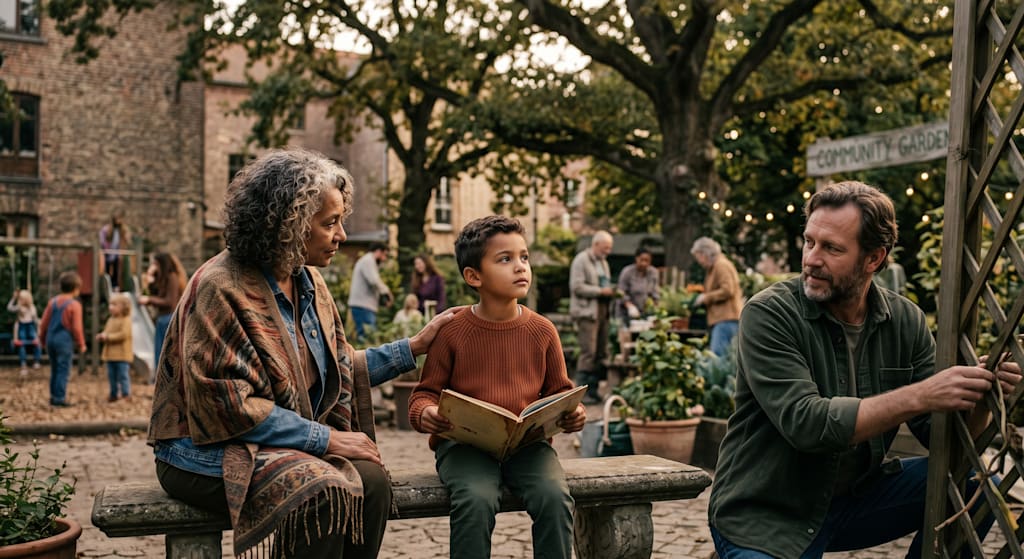
There is something unusual about a grandmother's house.
The rules are softer there. Dinner arrives at the wrong hour. A story you have already told three times somehow deserves a fourth telling, and the person listening leans in as if hearing it for the first time.
And for a few hours, you may not have to become anything.
Your parents have to think about who you are becoming. They carry your grades, your friendships, your manners, the habits you are forming and the mistakes you keep making. They are responsible not only for the child in front of them but for the adult that child will one day be. That responsibility is a form of love. It is also a weight, and children feel its pressure even when it is applied gently.
A grandparent can sometimes afford a different luxury. They can simply be glad you arrived.
Not every grandparent, of course. Some are cold, critical, or cruel. Some grandmothers' houses are not refuges but places a child learns to endure. Many children never knew their grandparents at all, or knew them only through distance, illness, estrangement, or photographs. The scene above is not a universal memory. It describes a particular kind of relationship, one that some children find in a grandparent, some in an aunt or a neighbor, and some never find. What interests me is not the grandmother herself but the psychological position she sometimes occupies.
The question underneath
The question returned to me after reading a ScienceDaily feature, published in June 2026, on Kenneth Barish, a clinical psychologist at Weill Cornell Medicine, and his new book, The Art and Science of Parenting and Grandparenting. Drawing on four decades of clinical work, Barish argues that the thinning of extended-family life has left many American children with less support than they need, and that a cultural fixation on individual achievement has come at an emotional cost. He also suggests that humans did not evolve to raise children with so little help.
These are a clinician's arguments, not the conclusions of a particular study, and the evolutionary claim in particular deserves care. But beneath them sits a question worth pursuing on its own terms: what psychological function may disappear when the village disappears?
To think about it, I will use a phrase that belongs to this essay and not to science: the third adult. It is not a clinical or research term. It is shorthand for a stable, emotionally invested adult in a child's life who does not carry the full weight of the parental role. "Third" does not assume two parents. For a child raised by one parent, this person may be the second adult; for a child whose home is unstable, the first steady one. The number matters less than the position: close enough to matter, far enough from daily authority to relate to the child differently.
A very old arrangement
Begin with history, because the expectation that one or two parents should meet all of a child's emotional needs is, by the standards of our species, unusual.
Anthropologists describe human childrearing using the language of cooperative breeding, a term borrowed from biology for systems in which individuals other than the parents help raise the young. In her 2010 review for the Annual Review of Anthropology, the evolutionary anthropologist Karen Kramer described how, in traditional societies, relatives and non-relatives of different ages and sexes contribute both to caring for young children and to feeding older ones. When the demographers Rebecca Sear and Ruth Mace reviewed studies from 45 mostly pre-industrial or natural-fertility populations in 2008, they found that in almost every one, at least one relative besides the mother improved children's chances of survival. Maternal grandmothers tended to help. Other relatives were less consistent, and which kin mattered depended heavily on ecological conditions.
Among the Aka foragers of the Central African Republic, the anthropologist Courtney Meehan and her colleague Sarah Hawks documented young children being cared for by a wide circle of people, and reported that children commonly sought comfort from several of them when distressed. Yet mothers remained the primary attachment figures. The network surrounded the central bond rather than replacing it.
It is worth being precise about what this research can and cannot tell us. Most of it measures survival and nutrition in high-mortality settings, not emotional well-being in modern ones. It supports the claim that shared caregiving has been common, and often consequential, across human societies. Whether our evolutionary history makes children psychologically dependent on extended networks in any strict sense is a much harder claim, and the evidence reviewed here does not establish it. What the anthropological record does offer is a corrective to a modern assumption: the isolated nuclear household is not the historical default. The village is not a sentimental invention. It was, in many places, simply how children were raised.
More than one secure place
Developmental psychology arrived at a related idea through a different door. Early attachment research focused almost entirely on mothers, but children clearly form bonds with more than one caregiver, and researchers eventually asked what happens when those bonds differ. In a 1992 paper that named the "multiple caretaker paradox," Marinus van IJzendoorn, Abraham Sagi, and Mirjam Lambermon examined what it means for development when a child forms different kinds of attachment relationships with different caregivers. Their work helped shift attachment research toward considering a child's network of relationships rather than assuming that a single caregiver tells the whole developmental story.
A 2021 individual-participant meta-analysis led by Or Dagan pooled raw data from nine studies of children's attachments to both mothers and fathers. Children who were insecurely attached to one or both parents were at higher risk for internalizing problems than children securely attached to both parents, while children whose relationships with both parents were classified as disorganized showed more externalizing problems. The study concerned mothers and fathers only, so it cannot speak directly to grandparents or mentors. But its logic points in a suggestive direction: security may be something a child accumulates across relationships, not something housed in a single one.
That logic has limits. In the technical sense, an attachment figure is someone a child turns to for protection and comfort under stress. Not every important adult becomes one. A beloved uncle who visits twice a year may shape a child's sense of the world without ever occupying that role. Much of what a third adult offers probably lies outside attachment in the strict sense, in the broader territory of support, interest, and belonging.
What the grandparent studies actually show
When researchers look specifically at grandparents, the picture is encouraging but uneven.
In a 2009 study in the Journal of Family Psychology, Shalhevet Attar-Schwartz and colleagues surveyed adolescents aged 11 to 16 in England and Wales. Greater grandparent involvement was associated with fewer emotional and behavioral difficulties, and the association was stronger for young people in lone-parent and stepfamilies than for those living with both biological parents. Sarah Ruiz and Merril Silverstein, studying late adolescents and young adults in the United States, found that closer relationships with grandparents were associated with fewer depressive symptoms, particularly among those raised in single-parent households. Yet they also found that close grandparent ties were associated with greater benefit when the young person's relationships with parents were also strong. The grandparent appeared to complement parents more than replace them.
Other work is less tidy. A 2012 study by Rachel Dunifon and Ashish Bajracharya, using a large U.S. sample, found that the quality of youths' relationships with grandparents depended on factors such as distance and the parent's own relationships, but found little evidence that grandparents influenced the dimensions of youth well-being it measured. And when Aalyia Sadruddin and colleagues at Yale systematically reviewed 206 studies worldwide in 2019, they found effects in both directions and concluded that the field is limited by thin data on what grandparents actually do.
Nearly all of this evidence is observational. Families with warm grandparent relationships may differ from other families in ways no study fully captures, from stability and income to the temperament of the parents who make those relationships possible. The defensible reading is not that grandparents make children healthier. It is that, under certain conditions, a close relationship with a grandparent tends to travel alongside better adjustment, and that it may matter most where family life has been disrupted.
The evidence broadens when we stop asking about grandparents in particular. In a 2019 study published in JAMA Pediatrics, Christina Bethell and colleagues asked 6,188 Wisconsin adults about positive experiences in childhood. One of the seven experiences was having at least two adults other than their parents who took a genuine interest in them. The more of these experiences people recalled, the less likely they were to report depression or poor mental health as adults, even after accounting for childhood adversity. The design was cross-sectional and relied on memory, and that single item cannot be isolated from the others. Still, the finding sits comfortably beside research on so-called natural mentors, the teachers, coaches, neighbors, and relatives who form informal bonds with young people. Using national longitudinal data, David DuBois and Naida Silverthorn found that adolescents who reported such a mentor were more likely to show favorable outcomes across several domains in young adulthood, though the protective associations were smaller than the harms linked to serious risk. A 2018 meta-analysis led by Levi van Dam found that the mere presence of a natural mentor had a modest association with youth outcomes, while the quality of the relationship, its warmth, support, and respect for the young person's autonomy, showed a stronger one.
That last point may be the most important in this essay. What seems to matter is not that an extra adult exists, but what the relationship is like.
A different position, not a better one
So what might a third adult offer that is psychologically distinct? Here I move from findings to interpretation, and I want to mark the transition clearly.
Parents occupy a complicated role. They must love their children and also discipline them, monitor them, make unpopular decisions, and prepare them for a world that will judge them. Much of this work is future-oriented. A parent is always partly looking at the adult the child is becoming.
An adult who shares the love but not the full responsibility may be freer to attend to the child who is here now: to listen without steering, to enjoy the child's company for its own sake, to tell stories about the family before the child existed, to offer a second perspective on a conflict at home. None of this is beyond parents. Many parents do it beautifully. The point is not that parents cannot offer unhurried delight, but that one more relationship built around it gives a child another place to find it.
Research on achievement pressure suggests why that might matter. In a pair of meta-analyses published in 2022, Thomas Curran and Andrew Hill found that American, Canadian, and British college students' perceptions of their parents' expectations and criticism rose steadily between 1989 and 2019, and that these perceptions were associated with perfectionism, most strongly with the sense that others demand perfection of you. Suniya Luthar and colleagues have documented elevated rates of distress and substance use among students in high-achieving, largely affluent schools, and describe excessive pressure to excel as a recognized risk factor for adolescent mental health.
Expectations themselves are not the problem. Children benefit from adults who believe they are capable of growth. The sharper finding concerns conditionality. In a 2004 series of studies, Avi Assor, Guy Roth, and Edward Deci found that young people who felt their parents' affection depended on meeting expectations were more likely to comply, but did so with a sense of inner compulsion, greater resentment, and poorer well-being. The behavior arrived; the emotional cost came with it.
No study I could find tests whether a grandparent's or mentor's unconditional warmth buffers a child against achievement pressure. That connection remains a hypothesis. But it is a reasonable one. If the felt experience of contingent love carries a cost, then a relationship in which a child's worth is visibly not on the line may offer something like a counterweight: a place where being enough does not have to be earned first.
When the third adult is the problem
That same logic cuts the other way. An additional adult who is critical, intrusive, or manipulative does not add security. It adds another source of pressure, sometimes with less accountability than a parent. Grandparents can undermine parents, violate boundaries, reopen old family wounds, or treat grandchildren as instruments in adult conflicts. Some children are safer and better off without particular relatives in their lives, and parents who limit contact are often making a protective choice.
Biological title predicts little on its own. The evidence, such as it is, points to something closer to this: an additional adult who is stable, responsive, and emotionally available may become another source of security, belonging, and perspective. Even that claim rests largely on associations rather than demonstrated causes. But it is a far more honest proposition than the comfortable equation of grandparent with healthier child.
Which is why the third adult need not be a grandparent at all. Perhaps she is an aunt who takes your side at the dinner table. Perhaps he is a coach who notices you are quiet before practice. A teacher who asks about the book you mentioned last month. A neighbor who waves every morning and would notice if you stopped appearing. A family friend whose house smells the same every year. A grandfather who always answers the phone. Someone who remembers what you said last week, and brings it up, and turns out to have been thinking about it.
There may even be something in it for the adult. In a longitudinal study following three- and four-generation American families across nearly two decades, Sara Moorman and Jeffrey Stokes found that greater emotional closeness between grandparents and adult grandchildren was associated with fewer depressive symptoms over time in both generations. Research on grandparents' cognition is more tentative: a European study by Bruno Arpino and Valeria Bordone, using methods designed to approach causal inference, found a benefit on only one of four cognitive measures. The evidence is thin, but the possibility is worth holding lightly. A relationship in which one person is glad to see another may not flow in only one direction.
Witness
Perhaps what children need is not always another person directing their development. Parents do that work, and it is necessary work. Perhaps what children sometimes need is another person witnessing it: someone who watches them grow without needing the growth to prove anything, who keeps the stories, who is there when the child walks back through the door at twelve and at twenty and at forty.
Most of us, if we are lucky, can name one. The adult whose kitchen was always open. The teacher who wrote back. The relative who never once asked about our grades, only about us.
We rarely remember what they taught us. We remember that, in their company, our existence required no justification. Not our grades, our usefulness, our obedience, or our promise.
Only that we had arrived, and someone was glad.
Bibliography
Scientific sources relied upon in the essay.
Arpino, B., & Bordone, V. (2014). Does grandparenting pay off? The effect of child care on grandparents' cognitive functioning. Journal of Marriage and Family, 76(2), 337–351. https://doi.org/10.1111/jomf.12096
Assor, A., Roth, G., & Deci, E. L. (2004). The emotional costs of parents' conditional regard: A self-determination theory analysis. Journal of Personality, 72(1), 47–88. https://doi.org/10.1111/j.0022-3506.2004.00256.x
Attar-Schwartz, S., Tan, J.-P., Buchanan, A., Flouri, E., & Griggs, J. (2009). Grandparenting and adolescent adjustment in two-parent biological, lone-parent, and step-families. Journal of Family Psychology, 23(1), 67–75. https://doi.org/10.1037/a0014383
Bethell, C., Jones, J., Gombojav, N., Linkenbach, J., & Sege, R. (2019). Positive childhood experiences and adult mental and relational health in a statewide sample: Associations across adverse childhood experiences levels. JAMA Pediatrics, 173(11), e193007. https://doi.org/10.1001/jamapediatrics.2019.3007
Curran, T., & Hill, A. P. (2022). Young people's perceptions of their parents' expectations and criticism are increasing over time: Implications for perfectionism. Psychological Bulletin, 148(1–2), 107–128. https://doi.org/10.1037/bul0000347
Dagan, O., Schuengel, C., Verhage, M. L., van IJzendoorn, M. H., Sagi-Schwartz, A., Madigan, S., et al., & The Collaboration on Attachment to Multiple Parents and Outcomes Synthesis. (2021). Configurations of mother-child and father-child attachment as predictors of internalizing and externalizing behavioral problems: An individual participant data (IPD) meta-analysis. New Directions for Child and Adolescent Development, 2021(180), 67–94. https://doi.org/10.1002/cad.20450
DuBois, D. L., & Silverthorn, N. (2005). Natural mentoring relationships and adolescent health: Evidence from a national study. American Journal of Public Health, 95(3), 518–524. https://doi.org/10.2105/AJPH.2003.031476
Dunifon, R., & Bajracharya, A. (2012). The role of grandparents in the lives of youth. Journal of Family Issues, 33(9), 1168–1194. https://doi.org/10.1177/0192513X12444271
Kramer, K. L. (2010). Cooperative breeding and its significance to the demographic success of humans. Annual Review of Anthropology, 39, 417–436. https://doi.org/10.1146/annurev.anthro.012809.105054
Luthar, S. S., Kumar, N. L., & Zillmer, N. (2020). High-achieving schools connote risks for adolescents: Problems documented, processes implicated, and directions for interventions. American Psychologist, 75(7), 983–995. https://doi.org/10.1037/amp0000556
Meehan, C. L., & Hawks, S. (2013). Cooperative breeding and attachment among the Aka foragers. In N. Quinn & J. M. Mageo (Eds.), Attachment reconsidered: Cultural perspectives on a Western theory (pp. 85–113). Palgrave Macmillan. https://doi.org/10.1057/9781137386724_4
Moorman, S. M., & Stokes, J. E. (2016). Solidarity in the grandparent–adult grandchild relationship and trajectories of depressive symptoms. The Gerontologist, 56(3), 408–420. https://doi.org/10.1093/geront/gnu056
Ruiz, S. A., & Silverstein, M. (2007). Relationships with grandparents and the emotional well-being of late adolescent and young adult grandchildren. Journal of Social Issues, 63(4), 793–808. https://doi.org/10.1111/j.1540-4560.2007.00537.x
Sadruddin, A. F. A., Ponguta, L. A., Zonderman, A. L., Wiley, K. S., Grimshaw, A., & Panter-Brick, C. (2019). How do grandparents influence child health and development? A systematic review. Social Science & Medicine, 239, 112476. https://doi.org/10.1016/j.socscimed.2019.112476
Sear, R., & Mace, R. (2008). Who keeps children alive? A review of the effects of kin on child survival. Evolution and Human Behavior, 29(1), 1–18. https://doi.org/10.1016/j.evolhumbehav.2007.10.001
van Dam, L., Smit, D., Wildschut, B., Branje, S. J. T., Rhodes, J. E., Assink, M., & Stams, G. J. J. M. (2018). Does natural mentoring matter? A multilevel meta-analysis on the association between natural mentoring and youth outcomes. American Journal of Community Psychology, 62(1–2), 203–220. https://doi.org/10.1002/ajcp.12248
van IJzendoorn, M. H., Sagi, A., & Lambermon, M. W. E. (1992). The multiple caretaker paradox: Data from Holland and Israel. New Directions for Child and Adolescent Development, 1992(57), 5–24. https://doi.org/10.1002/cd.23219925703
Inspiration (not cited as evidence): Taylor & Francis Group. (2026, June 13). Why grandparents matter more than ever for children's mental health. ScienceDaily. https://www.sciencedaily.com/releases/2026/06/260613034206.htm Barish, K. The Art and Science of Parenting and Grandparenting: Raising Emotionally Healthy Children in a Challenging World. Routledge. https://www.routledge.com/The-Art-and-Science-of-Parenting-and-Grandparenting-Raising-Emotionally-Healthy-Children-in-a-Challenging-World/Barish/p/book/9781032759289
About the Creator
Khali Sollis
Khali Sollis is a writer and independent researcher exploring the science of the human mind and behavior. Her work examines questions at the intersection of neuroscience, psychology, cognition, mental health, and everyday human experience.
Enjoyed the story? Support the Creator.
Subscribe for free to receive all their stories in your feed.
Comments
There are no comments for this story
Be the first to respond and start the conversation.