
China’s Infidelity Rate Is Climbing Fast. The “It Surpassed America” Claim Is a Mess.
The numbers are rising. The comparison is shaky. Here’s what the headlines leave out about Chinese marriage.
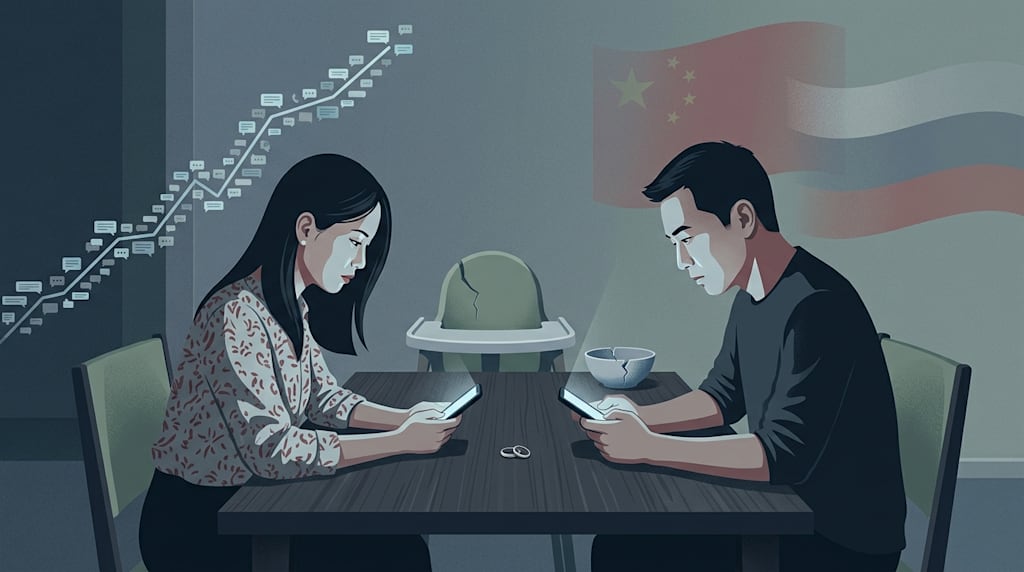
The First Half of My Life has gone viral again. The clip of Xue Zhenzhu storming into an office to confront her daughter’s husband’s mistress has been endlessly rewatched and remixed. People love a good mistress-fight scene. Extramarital affairs have never been just a plot device. They are also the most sensitive, most private, and most easily amplified wound in real marriages.
So a claim keeps circulating online: China’s infidelity rate has already passed America’s.
It sounds shocking. It fits the anxiety many people feel about marriage today. It also fits social media’s appetite for stories about moral decline. But when you take the data apart, the conclusion comes too fast.
First, the numbers
The claim that China has surpassed the US comes from comparing two sets of data.
On the Chinese side, Pan Suiming’s national surveys show that from 2000 to 2015, the share of Chinese men who reported extramarital sex rose from 11.8% to 34.0%. The share of women rose from 4.1% to 13.4%. A 2020 Fudan University study found that among respondents, 35% of men and 26% of women admitted to extramarital sex during their current marriage.
On the American side, the General Social Survey shows that in 2016 about 20% of married men reported extramarital sex. By 2018, that figure had fallen to 14%. By 2021–2022, it had fallen to 13%.
Looking at those numbers alone, it is easy to conclude: Chinese men 34%, American men 13%. But the Chinese surveys usually ask, “Have you ever done this in your life?” The American GSS asks, “Have you done this in the past 12 months?” Lifetime data is naturally much higher than annual data. Convert both to a lifetime measure, and the lifetime rate for married American men is roughly 22% to 25%. For women, it is roughly 11% to 15%. The gap with Chinese data is not as large as the headline suggests.
The Fudan survey also sampled 4,017 married respondents and collected questionnaires online. That likely skews toward big cities, higher incomes, and internet-active groups. Using a biased sample’s lifetime data to compare with America’s annual data makes the “surpassed” conclusion fragile.
A more careful statement: China’s extramarital sex rate has risen fast. Chinese men’s lifetime rate may already exceed the American lifetime level. Chinese women’s rate is approaching it. But “China’s overall infidelity rate has surpassed America’s” is not a factual judgment you can directly establish.
The rise is measurable, and women are catching up faster
In 1989, China’s self-reported infidelity rate was only 6.4%. By 2000, 11.8% of men and 4.1% of women reported extramarital sex. By 2015, the figures had risen to 34.0% for men and 13.4% for women. That is an increase of about 189% for men and about 227% for women. Women’s growth rate was faster.
More recent surveys suggest women’s infidelity rate is rising much faster than men’s. Some surveys say that in 2000 only about 2% to 8% of married women had had extramarital sex. By 2025, that figure had climbed to 21.3%, roughly three times the increase for men. Different surveys use different definitions, but the gender gap is clearly narrowing. Multiple data sets confirm the trend.
Extramarital sex is no longer just a story about men getting rich and turning bad. As women gain economic independence, education, and awareness of their emotional needs, they no longer have only endurance as a response to marital dissatisfaction. They also begin to cross boundaries when the marriage is unbalanced.
Constraints withdrew, technology lowered costs, and expectations shifted
The surge in extramarital sex in China has structural causes. Three forces overlap.
Administrative constraints withdrew, and the acquaintance society dissolved. From the 1950s to the 1970s, Chinese society controlled extramarital sex through administrative means. Social humiliation, workplace punishment, and even a child’s future could be affected. That pressure kept the self-reported infidelity rate at only 6.4% in 1989. Reform and opening up largely dismantled that system. Neighbors stopped interacting. Work units stopped managing private morality. The moral constraints once maintained by face and watchful eyes almost disappeared within a single generation.
Social apps pushed costs to a historic low. After 2010, location-based stranger social apps such as WeChat’s Shake and Momo became widespread. Before 2010, a married man looking for an extramarital partner had to enter specific offline venues, rely on introductions through acquaintances, or depend on accidental contact at work. Social apps pushed information costs, time costs, and exposure risks to historic lows. Install an app, browse profiles, identify a target, start a conversation, meet offline, have sex. What once took months of social effort can now be done in a day. When the cost of a behavior falls, more people participate. That includes people who would never have considered it under the old conditions.
Marital expectations transformed. Marriage is now asked to provide too much. The core functions of traditional marriage were economic cooperation and reproduction. Sexual pleasure was long marginalized. With economic development and educational expansion, people’s expectations of marriage changed. Romantic love, sexual satisfaction, and personal happiness gradually came to be seen as legitimate, even primary, purposes of marriage. People expect higher quality inside marriage. When marital needs are unmet, women’s emotional needs, men’s sexual satisfaction needs, the psychological legitimacy of seeking compensation outside also grows. Research finds that men are more likely to cheat because of physical dissatisfaction in marriage. Women are more likely to cross the line because of emotional dissatisfaction. The more functions marriage carries, the greater the risk it fails. In 2000, 74% of Chinese couples said they were very satisfied with their marriage. By 2015, only 53% did.
She rises, he feels threatened
Women’s education levels and economic status have risen rapidly in a short period. The power structure inside marriage has not adjusted in sync. Research finds that when the wife is more educated than the husband but the husband still earns more, the husband’s probability of cheating jumps to 66%. The man tries to use economic power to compensate for educational disadvantage and reassert his dominant position in the family.
Chinese women are rising quickly in education and the economy. The power contract inside many marriages remains traditional. Since 2009, women have outnumbered men among Chinese university undergraduates and graduate students. The share of wives more educated than their husbands rose from 6.9% in the 1950–1954 birth cohort to 25.8% in the 1990–1994 birth cohort.
This mismatch creates tension. Men feel their authority is threatened. Women feel their efforts are not reciprocated. Within this tension, infidelity sometimes becomes a distorted reassertion of power or an emotional outlet.
Infidelity does not equal divorce, but it often echoes a marital crack
The probability of infidelity keeps rising. 81% of people say they cannot tolerate a partner’s infidelity. Yet couples do not simply leave.
Civil affairs data from the first quarter of 2026 show that among divorce agreements, only 8.7% listed extramarital affair as the main reason. The vast majority of divorces involved emotional discord and loss of trust. Infidelity is often not the cause of divorce. It is the result or accelerator of cracks that already existed in the marriage.
After surveying more than 2,600 divorced young women, Fudan University found that the main reasons these young women divorced were bearing more housework and living with parents, especially the husband’s parents. Women’s own resource levels and resource independence also accelerate divorce, unless the couple is relatively well matched in this regard.
What destroys marriages is more likely to be family division of labor, intergenerational relationships, resource allocation, and other everyday reasons. Research from Hong Kong confirms this. Extramarital affairs raise the probability of divorce. But whether there are minor children in the family and the quality of the marriage before the affair was discovered are the key factors determining whether the couple ultimately divorces.
Today, Chinese family hollowing-out is becoming more serious. Household size continues to shrink. The smaller the household, the more it depends on the emotional bond between husband and wife. Once trust collapses, there is no buffer zone, such as children, so the probability of divorce rises. In the standard nuclear family, children were once an important bond holding the marriage together. As the standard nuclear family itself shrinks, the presence of that bond also weakens.
Back to the question
Has China’s infidelity rate surpassed America’s? There is no simple yes.
Chinese marriage is undergoing a deep structural shift. The infidelity rate is only a surface indicator. Behind it are the withdrawal of constraints, technology lowering costs, gender mismatch, and rising expectations.
Marriage is expected to provide more emotional satisfaction, sexual satisfaction, and personal happiness than ever before. The structural support it relies on is shrinking. People enter marriage with higher expectations. Marriage itself becomes more fragile, more isolated, and less able to withstand cracks.
Loyalty used to be enforced. Now it has to be chosen.
About the Creator
Jin
Writer of reamstories
https://reamstories.com/jin
Enjoyed the story? Support the Creator.
Subscribe for free to receive all their stories in your feed. You could also become a paid subscriber, letting them know you appreciate their work.
Comments
There are no comments for this story
Be the first to respond and start the conversation.