Challenge
The Power of Resilience: Navigating Life's Challenges
Introduction: Life is an excursion loaded up with highs and lows, wins, and hardships. Regardless of what your identity is or where you come from, difficulty is an all inclusive encounter. At these times of misfortune, the influence of strength sparkles the most splendid. Flexibility isn't simply a trendy expression; a powerful power helps people get by as well as flourish despite life's difficulties. In this article, we'll investigate the significant effect of strength, the characteristics that make an individual versatile, and how to develop this priceless quality in ourselves.
By Katie Poppy3 years ago in BookClub
A Book that change my thoughts
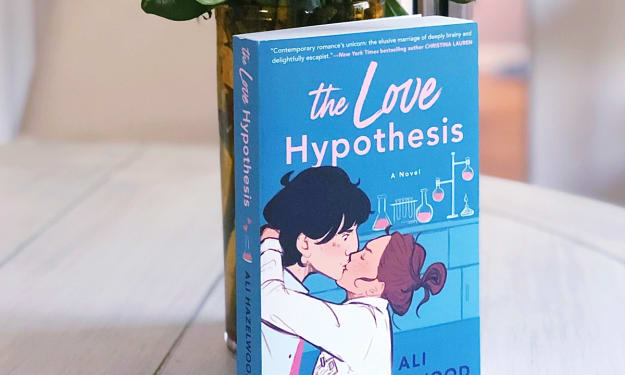
I want to say this is a case of “It’s not the book, it’s me.” But then again, isn’t that the case for every book we end up disliking that everyone else enjoyed? The Love Hypothesis follows Olive, a PhD student who wants to prove to her best friend that she has moved on and is dating. With no way to prove it, she kisses the first man she sees, which ends up being none other than Dr. Carlsen, known as one of the most unapproachable and critical professors. With his own reasoning, he agrees to become Olive’s fake boyfriend. But what starts as a fake relationship and fake feelings later turns into what Olive wishes were real instead. Olive is a woman in STEM, but that is really all she is. I admit, I loved this representation, and her experience as a scholar conducting research felt realistic, especially considering she’s not American (she’s Canadian), she’s not male, and she’s pretty young (26). Most of these end up being boundaries for young folk pursuing PhD careers in America, and it’s impressive to see representation like this. This was probably my favorite part of the book because Olive tells us how it’s been difficult for her to participate in a rigorous program like this, from being denied opportunities, not being believed in, to being seen as inferior, all because she’s a young woman in a predominantly male-dominated curriculum. While I’m not a STEM student, I even see it myself in the political field I study in. Men teach most classes, most advisors and major professors are also male, most students in classes end up being men, and everything else is usually male-dominated. Other than that, there was nothing. One part of the problem is Adam himself. Adam felt very, very bland. It was difficult to understand his personality and the type of person he was other than moody and sullen because it’s something we are constantly and repeatedly told, especially from Olive. I usually like fictional men like him, even if the way he acts and looks is nothing new, but this case didn’t work for me. You could say he needed much more seasoning. Not only that, but by visualizing what I read, I couldn’t picture Olive for the life of me. All I remember from her is that she is a PhD student in the Biology Department at Stanford University, is Canadian, 5”8, and I guess she has brown hair based on the cover. And . . . yeah, that’s it. Visually, I could envision Adam more than Olive, yet we spend the entire book in Olive’s mind (since it’s told from her point of view). This all ties back to the writing and how difficult it was to enjoy the book more because of how little description was given to the characters. Adam, for instance, felt like he needed more personality. I understand him being sullen and broody is part of it (which, as I’ve said before, is perfectly fine with me and understandable), but I feel like it has to do less with that and more with just the mere fact that Adam is just . . . Adam. The whole book, we don’t really know what Olive looks like or what she likes, and all we know about Adam is that he is a young, hot-shot professor who hardly ever smiled and went through tough situations as a PhD student himself. Oh, and we can’t forget that he’s big, especially when you’re reminded every fucking page. That was it. Speaking of, Olive’s personality also felt a little childish sometimes. The situation that led to Olive kissing Adam (without knowing, of course) is completely unrealistic, so it’s one you need to put your logic to the side for. It made no sense to me how a PhD student, one who is researching pancreatic cancer in one of the best Biology departments of the United States, would kiss a random man she saw in the hallway because she wants to prove to her best friend that she truly is over the boy her best friend wants to date. Because . . . yeah, that’s the actual situation. Olive’s best friend, Anh, wants to date Jeremy, Olive’s ex. Olive is over him and wants nothing to do with him, but Anh thinks it’s breaking the girl code by dating Jeremy, even though Olive knows Anh really likes Jeremy. So to prove that she’s over him and is dating someone else, she kisses Adam when she sees the opportunity that Anh can see them. Pretty unrealistic scenario for a PhD student, if you ask me. Also, it’s not exactly stated, but Olive may or may not be in the asexual spectrum, specifically demisexuality. It’s briefly mentioned in the beginning (even the term is used) and when she and Adam are about to have sex, she mentions to Adam, “It’s not that I want to not have sex. I just . . . don’t particularly want to have it. There is something weird about my brain, and my body, and—I don’t know what’s wrong with me, but I don’t seem to be able to experience attraction like other people. Like normal people. I tried to just . . . just to do it, to get it over with, and the guy I did it with was nice, but the truth is that I just don’t feel any . . .” She closed her eyes. This was difficult to admit. “I don’t feel any sexual attraction unless I actually get to trust and like a person, which for some reason never happens. Or, rarely. It hadn’t, not in a long time, but now—I really like you, and I really trust you, and for the first time in a million years I want to—” For starters, I literally got second-hand embarrassment, and second, I can’t help but wish it was was expanded more on. It was as if the author just wanted to add more to Olives lacking personality so she sprinkled some pretty damn humiliating ace representation. Many people might not realize how ignorant it really is when you take a misrepresented and underrepresented sexual orientation and make your character say “there is something wrong with [her] brain,” making it seem like she “isn’t normal” because she experiences sexual attraction differently than “normal people”. Saying this is stereotypical, ignorant, and generally rude.
By Kajal Ghosh3 years ago in BookClub
Mick Harte Was Here by Barbara Park
I knew as soon as I saw this challenge, what book I would choose. I’m going way back for this, about 15 years. I’ve loved reading since I was a kid. I was always good at reading. Back in my elementary school days, my grandma who I had lived with along with my mother and father and two siblings, worked at a book factory. A place where they sewed the books together.
By Tiffany Fairfield3 years ago in BookClub
Arte y Poesia
This book I carry with me a lot it is already eaten almost by the time I have spent with Her already. The back cover of it doesn't exist it is missing as well as some pages in the very end of it are kind of eaten or taken away maybe in the play of a cat that was living with me during that time He loved to damage all I have been working with and on but it was like that from the very beginning with the paperbook version I got and I knew that I will need to use the pdf anyway later on.
By Antea Lumina Kala Matylda 3 years ago in BookClub
Love: The Universal Language of the Human Connection
Love, the universal language that transcends boundaries and binds us together, is a force as ancient as humanity itself. In the following exploration of love, we will delve into its many facets, from the passionate intensity of romantic love to the enduring bonds of familial love and the cherished connections of friendship. We will also consider the scientific underpinnings of love, its profound impact on our well-being, and its enduring legacy throughout history. Romantic love, characterized by intense attraction and emotional connection, is perhaps the most celebrated form of love. It has inspired poets, artists, and writers throughout history, giving rise to some of the most beautiful expressions of human emotion. Shakespeare, in his timeless sonnets, captured the essence of romantic love with lines like "Love is not love which alters when it alteration finds." This enduring quality of love, which remains steadfast in the face of change and adversity, is what makes it so compelling. Familial love, the love shared among family members, serves as the foundation of our support systems. It encompasses the bonds between parents and children, siblings, and extended family. This love is often characterized by its unconditional nature, where acceptance and care are constants. A parent's love for their child is a powerful example of familial love. It is a love that transcends time and circumstance, providing a sense of security and belonging that lasts a lifetime. Friendship, often described as platonic love, is a profound connection that forms between individuals who share common interests, values, and experiences. Friends become our confidants, adventure partners, and pillars of support. Their love is a testament to the beauty of non-romantic connections. A true friend is there in times of need, offering a listening ear, a comforting presence, and a shared laugh during moments of joy. Friendship enriches our lives, reminding us that we are never alone on our life's journey. The scientific exploration of love has revealed its biological and psychological underpinnings. Neuroscientists have conducted studies that show the intricate workings of the brain when experiencing love. The release of oxytocin, often called the "love hormone," plays a significant role in bonding and attachment. These findings highlight the biological basis of love, demonstrating that it is deeply ingrained in our human nature. Moreover, love's impact on our well-being extends beyond emotions. Numerous studies have shown that individuals who experience love and support from their social networks tend to be healthier, both mentally and physically. Love provides us with a sense of purpose, belonging, and security, offering solace during times of stress and adversity. The healing power of love is evident in the comfort a parent provides to a child's scraped knee, the solace a friend offers during a breakup, or the unwavering support of a partner through life's challenges. Love's enduring legacy is evident throughout history, art, and literature. Consider the legendary love story of Romeo and Juliet, penned by William Shakespeare. Despite the tragic ending, their love has endured for centuries, a testament to love's power to transcend even death itself. Love, as portrayed in this timeless tale, serves as a reminder that it can conquer all obstacles, even those imposed by society and circumstance. In conclusion, love is not merely an emotion; it is a universal language that connects us, enriches our lives, and leaves an enduring legacy. It is a force that shapes our individual experiences and influences the course of human history. Embracing love in all its forms can lead us toward a more harmonious and fulfilling existence. In a world that sometimes seems divided, love has the power to unite usu s.
By Lauretta Adebajo 3 years ago in BookClub
My Waystone: or, Echoes in Three Parts. Runner-Up in Book Club Challenge.
The Waystone was his, just as the third silence was his. This was appropriate, as it was the greatest silence of the three, wrapping the others inside itself. It was deep and wide as autumn’s ending. It was heavy as a great river-smooth stone. It was the patient, cut-flower sound of a man who is waiting to die. Patrick Rothfuss, prologue to The Name of the Wind
By Mackenzie Davis3 years ago in BookClub
Mara, Daughter of the Nile. Runner-Up in Book Club Challenge.
I came flying out of a back alley in Egypt, close to Mara's heels. Time was running short and everything was falling to pieces. I was expecting someone to jump out at us from every corner, and so was she. When she was blacking out on a palace floor, half dead, I was screaming silently from the shadows.
By Lydia Stewart3 years ago in BookClub
On Forgetting the Lessons of The Hobbit
As part of a nationwide literacy campaign, a pledge was passed out when I was in fifth-grade. It was the mid-eighties and each student was asked to sign an agreement promising to abstain from television for a month in an effort to encourage them to read. I was the only one who refused. My first memory is of being carried into a movie theater, and television provided a similar fix. I liked the after-school cartoons and the slate of classic 70’s shows that ran after them, followed by the “Big Movie at 8,” which, even then, I could feel filling the voids of my mind like water into a glass of rocks. I wasn’t going to give that up without a fight. Later in life, applying to film school, I recognized that these nightly cinematic forays were an education unto themselves, and those films sit on a shelf in my head next to the books I’ve read.
By J. Otis Haas3 years ago in BookClub
The Power Now by Eckhart Tolle
Title: "The Power Now" by Eckhart Tolle: A transformative journey from present-day awareness "The Power of Now" by Eckhart Tolle is a revolutionary book that has had a profound impact on my life. Through Tolle’s insightful teachings that guided me through a journey of self-discovery, mindfulness, and a deeper awareness of the importance of being in the present moment, I learned to let go of the burden of past regrets and of worrying about the future and embracing the beauty and peace that lies in the present.
By Lizbeth olaedo3 years ago in BookClub