Book of the Year
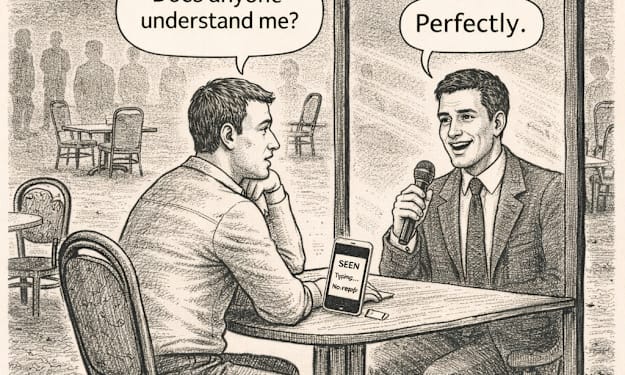
Cognition and Recognition, THE MISCOMMUNICATION TRILOGY “The Conspiracy of Speech, Vol. I.” Part 13
The Architecture of Misunderstanding: A Critical Review of Cognition and Recognition Cognition and Recognition, as a culminating movement within the broader project, advances a radical yet carefully constructed claim: language is not the foundation of thought, but a secondary system that both stabilizes and distorts it. What might initially appear as a familiar critique of linguistic limitation becomes, over the course of the work, a systematic reordering of how cognition, perception, and communication are understood. The book does not simply argue that language fails at times—it demonstrates that miscommunication is structurally embedded in the very mechanisms that make communication possible.
By Peter Ayolov6 months ago in BookClub
Argot, Slang, Jargon, THE MISCOMMUNICATION TRILOGY “The Conspiracy of Speech, Vol. I.” Part 12
Review Argot, Slang, Jargon, THE MISCOMMUNICATION TRILOGY “The Conspiracy of Speech, Vol. I.” Part 12 The Machinery of Misunderstanding: A Review of Argot, Slang, Jargon
By Peter Ayolov6 months ago in BookClub
Unpopular Opinion: This Bestseller Didn’t Change Your Life—It Just Felt Like It Did
There’s a moment after finishing a book that feels almost sacred. You close it slowly. You stare at the wall. You sit in silence longer than usual. And you think—this changed me.
By Mariana Farias6 months ago in BookClub
The Grammar of Banality, THE MISCOMMUNICATION TRILOGY “The Conspiracy of Speech, Vol. I.” Part 11
The Grammar of Banality presents itself as a decisive and uncompromising intervention in contemporary thinking about language, communication, and social life. Situated within The Miscommunication Trilogy, the book develops with remarkable consistency a central and provocative claim: that modern language is undergoing a process best described not as decay, but as planned obsolescence. This formulation alone signals a shift in perspective. Where traditional critiques of language lament its corruption, simplification, or ideological capture, this work insists on something more structural and more unsettling—language is not merely failing; it is being reconfigured to function without the very element that once justified its existence, namely meaning. From the opening pages, the book situates itself against a long intellectual tradition that treated language as a medium of truth, representation, or rational exchange. Instead, it reframes language as a system of operations whose primary function is no longer the transmission of information but the maintenance of social contact. This reorientation is achieved through a sustained engagement with the concept of phatic communication, a notion originating in the work of Bronisław Malinowski and later expanded by Roman Jakobson. However, the book does not simply repeat these theories; it radicalizes them. What earlier thinkers described as a marginal or secondary function of language is here elevated to the central principle governing contemporary communication.
By Peter Ayolov7 months ago in BookClub
TALKING TO OURSELVES, THE MISCOMMUNICATION TRILOGY “The Conspiracy of Speech, Vol. I.” Part 10
The Exhaustion of Speech: A Review of a Book About Talking to Ourselves This book, part of The Miscommunication Trilogy, offers a sustained and uncompromising investigation into the condition of language in its most advanced and most unstable form. It does not treat language as a transparent medium of communication, nor as a neutral tool at the disposal of human intention. Instead, it presents language as an autonomous and self-transforming system—one that has expanded beyond its original function and now operates according to a logic that increasingly undermines the very possibility of shared meaning. At the center of this inquiry stands Homo Loquens, not simply as the being who speaks, but as the being constituted by speech, shaped by it, and ultimately trapped within its proliferating structures.
By Peter Ayolov7 months ago in BookClub
How Mark J. Jacobs Brings Nostalgia to Life:
The fast-moving world of today finds readers who seek stories which allow them to experience slower time while they remember important past events. Mark J. Jacobs demonstrates this ability through his genuine storytelling approach. His writing shows how people experience the warmth of their local surroundings and the joy of their social circle and the hidden beauty that exists in everyday situations. The Quirky Heart of Ted the Grocer serves as Jacobs' permanent reminder about the power of nostalgia which exists throughout literary works.
By Mark J.Jacobs7 months ago in BookClub
Language Origin Theories, THE MISCOMMUNICATION TRILOGY “The Conspiracy of Speech, Vol. I.” Part 9
Review The Origin of Words, The Collapse of Meaning: A Radical Rewriting of Language’s Beginning Language Origin Theories, part of THE MISCOMMUNICATION TRILOGY “The Conspiracy of Speech, Vol. I.”, stands as an ambitious, intellectually confrontational, and philosophically charged rethinking of one of humanity’s oldest questions: how did language begin—and what has it become? Rather than offering a conventional survey of competing hypotheses, this volume performs something far more daring. It dismantles the premise that language has a single origin, a stable function, or even a coherent trajectory. What emerges instead is a sweeping reinterpretation of language as a tool forged in evolutionary pressure, shaped by social conflict, and now drifting toward its own obsolescence.
By Peter Ayolov7 months ago in BookClub
EVOLUTION OF SPEECH, THE MISCOMMUNICATION TRILOGY “The Conspiracy of Speech, Vol. I.” Part 8
Review The Collapse of Meaning: Language at the Edge of Its Own Excess This book presents an ambitious and unsettling argument: language, humanity’s most powerful invention, is not simply evolving—it is unraveling under the weight of its own success. What begins as an interdisciplinary exploration of language evolution gradually transforms into a philosophical diagnosis of contemporary communication. The central thesis, that language undergoes a form of planned obsolescence, is not framed as a conspiracy or intentional design, but as a structural consequence of biological evolution, cultural transmission, and cognitive limitations. The result is a work that moves confidently across disciplines while maintaining a unified and provocative conceptual core.
By Peter Ayolov7 months ago in BookClub
7 Books Where You Never Know Who’s Lying Until the End. AI-Generated.
What if everything you believed in a story was carefully designed to mislead you? What if the narrator guiding you through each page was not telling the full truth—or worse, was unaware of it themselves?
By Diana Meresc7 months ago in BookClub
7 Books That Are Small Miracles Between the Covers. AI-Generated.
Some books don’t just tell stories—they transform the reader. They arrive in our lives at the right moment, gently shift our perspective, and stay with us long after the final page. These are the books we call “small miracles between the covers.”
By Diana Meresc7 months ago in BookClub