
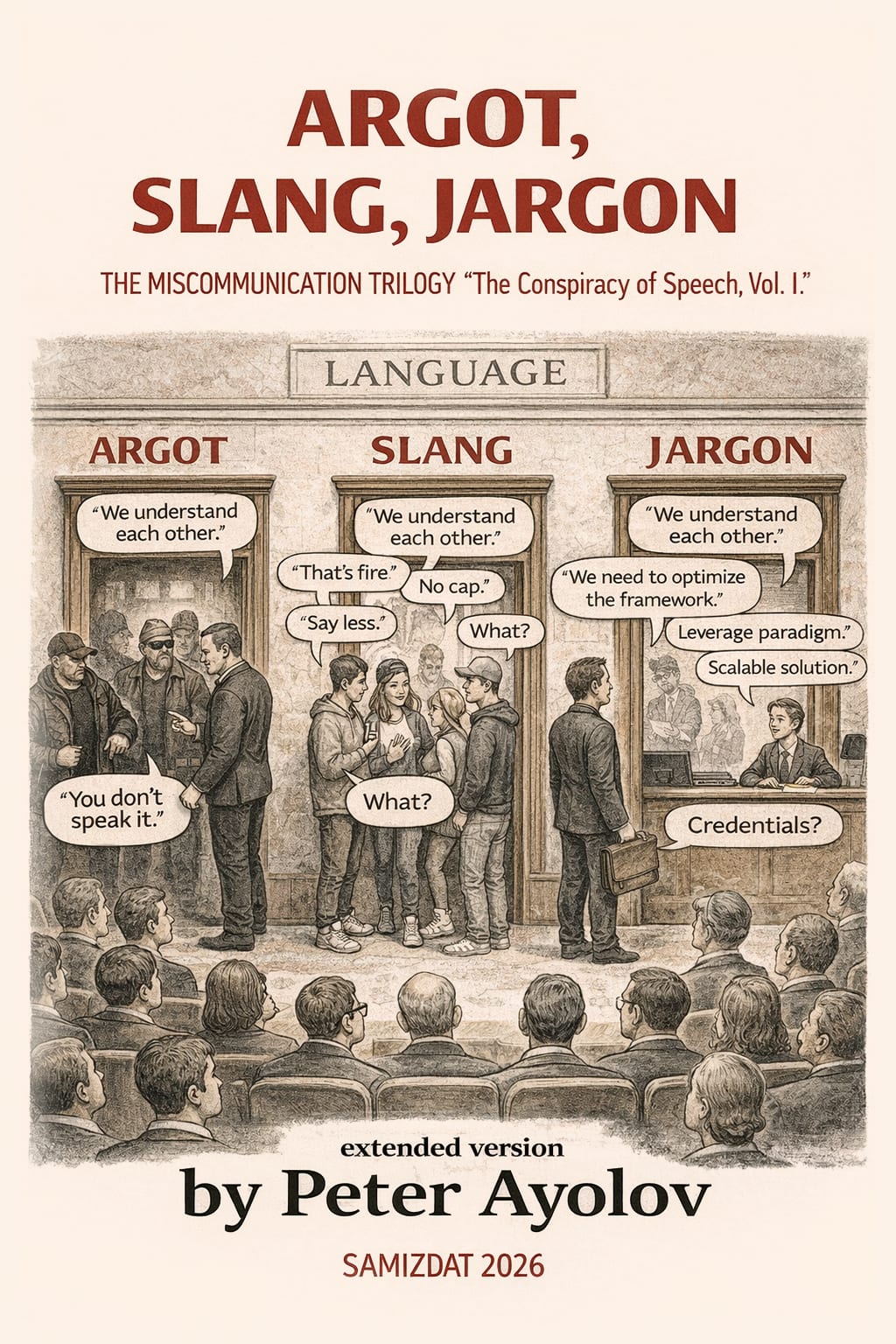
Argot, Slang, Jargon, THE MISCOMMUNICATION TRILOGY “The Conspiracy of Speech, Vol. I.” Part 12
Book Review

Review
Argot, Slang, Jargon, THE MISCOMMUNICATION TRILOGY “The Conspiracy of Speech, Vol. I.” Part 12
The Machinery of Misunderstanding: A Review of Argot, Slang, Jargon
Argot, Slang, Jargon, a volume within the broader architecture of The Miscommunication Trilogy, stands as a relentless interrogation of one of humanity’s most cherished assumptions: that language exists to clarify. What unfolds instead is a sustained philosophical dismantling of that belief. This is not a book that refines communication—it destabilizes it. It does not polish rhetoric; it exposes its fractures. In doing so, it situates itself not merely within linguistics, but at the intersection of cultural theory, cognitive science, and social critique, offering a vision of language as a system perpetually working against its own promise. At the core of the book lies a simple but unsettling proposition: language does not primarily function to transmit meaning, but to organize difference. Every chapter reinforces this idea by tracing how linguistic forms emerge not out of a need for clarity, but from pressures of identity, hierarchy, exclusion, and survival. Argot conceals, slang bonds, jargon excludes—and all three, in their different ways, produce worlds that are only partially accessible even to those who inhabit them.
The book’s structure mirrors its thesis. Rather than presenting a linear argument, it accumulates perspectives, examples, and domains, each revealing a different failure of communication. The result is not fragmentation for its own sake, but a deliberate method: the reader experiences the very condition the book describes. Meaning is not given—it must be reconstructed, negotiated, and often abandoned. This stylistic choice reinforces the argument that language is not a transparent medium but an opaque system that resists stabilization. One of the most compelling aspects of the book is its treatment of jargon. Traditionally dismissed as technical vocabulary or professional shorthand, jargon is here reinterpreted as a mechanism of power. It is not merely about efficiency—it is about control over interpretation. In corporate environments, in academic discourse, in bureaucratic systems, jargon functions less as a tool for precision and more as a filter that determines who can participate and who must remain excluded. The text draws attention to how jargon creates an illusion of competence and authority, allowing individuals to appear knowledgeable while often obscuring the absence of concrete action or understanding. In this sense, jargon becomes not a failure of communication but its strategic manipulation.
Slang, by contrast, is framed as a form of linguistic rebellion, yet one that paradoxically reproduces its own exclusions. It is dynamic, inventive, and often playful, but its primary function is not expression—it is belonging. To speak slang is to signal membership; to misunderstand it is to reveal one’s outsider status. The book emphasizes how slang evolves rapidly precisely to maintain this boundary. The moment it becomes widely understood, it loses its function and must be replaced. This constant renewal is not a sign of linguistic vitality alone, but of a deeper instability: language must continuously escape itself to remain meaningful within a group. Argot, perhaps the most striking category explored in the book, represents language at its most deliberate and strategic. It is language designed not just to exclude, but to resist. Whether in criminal subcultures, prisons, or marginalized communities, argot emerges as a response to surveillance and control. It encodes experience in ways that are deliberately opaque to outsiders, transforming language into a tool of both secrecy and identity. The book’s analysis of argot highlights a crucial tension: the more effective it is at concealing meaning, the more it depends on shared understanding within the group. It is both barrier and bond, isolation and cohesion.
What elevates the book beyond a purely sociolinguistic study is its integration of cognitive and neurological perspectives. The discussion of speech processing, brain localization, and language acquisition introduces a deeper layer to the argument: the instability of language is not merely social—it is biological. The brain does not process language as a fixed system but as a distributed, context-dependent network. Words are not stored in a single location; meanings are not retrieved intact. Instead, language emerges through complex interactions across neural systems, each subject to variation, disruption, and reinterpretation. Cases of aphasia, category-specific language loss, and bilingual switching illustrate how fragile and contingent linguistic competence truly is. This neurological dimension reinforces one of the book’s central claims: misunderstanding is not an accident but a structural condition. Even before language enters the social world, it is already unstable within the individual mind. Communication, therefore, is not the transmission of a fixed message but the alignment of multiple, often incompatible systems of interpretation. The fact that communication works at all becomes less a given and more a remarkable, temporary coincidence.
The book’s engagement with public speaking and business communication extends this critique into contemporary contexts. Here, language is no longer merely a medium—it becomes a commodity. Words are packaged, performed, and evaluated not for their truth, but for their impact. The analysis of presentation culture, particularly the rise of visual communication tools, reveals a shift from argument to appearance. Ideas are not necessarily better when they are understood—they are more persuasive when they are seen. This transformation underscores the book’s broader thesis: communication increasingly prioritizes effect over meaning. Humor, too, is examined not as a peripheral feature of language but as a central mechanism of engagement. It captures attention, diffuses tension, and enhances memorability—but it also reveals the instability of meaning. A joke depends on shared assumptions, timing, and context; remove any one of these elements, and it collapses. Humor, in this sense, becomes a microcosm of communication itself: a fragile alignment of expectations that can easily fail.
The concept of the “smart-talk trap” serves as a particularly incisive critique of contemporary discourse. The book identifies a tendency within organizations and institutions to substitute language for action, to equate articulation with accomplishment. In this environment, the ability to speak convincingly becomes more valuable than the ability to act effectively. Language, rather than facilitating change, becomes a substitute for it. This phenomenon illustrates a broader paradox: the more sophisticated our language becomes, the less it necessarily corresponds to reality. Perhaps the most provocative dimension of the book is its articulation of what might be called the planned obsolescence of language. Borrowing a concept from industrial design, the text suggests that language, like consumer goods, is structured to become outdated. New terms replace old ones, meanings shift, and clarity is continuously deferred. This is not simply a natural evolution—it is a systemic feature of communication. Language must change to remain functional, but in doing so, it ensures that understanding is always temporary. The result is a perpetual cycle of innovation and breakdown, where meaning is constantly produced and undermined.
This idea resonates most strongly in the book’s closing reflections, where language is framed not as a stable system but as a dynamic process of erosion and reconstruction. The metaphor of Babel, whether invoked explicitly or implicitly, captures this condition: a proliferation of languages that simultaneously expands expression and fragments understanding. Unity is not lost once—it is lost continuously, in every act of speech that fails to align perfectly with its interpretation. Despite its critical intensity, the book does not descend into nihilism. It does not argue that communication is impossible, but that it is inherently limited. Meaning can be approximated, negotiated, and shared—but never fully secured. This perspective invites a different kind of engagement with language, one that acknowledges its constraints without abandoning its possibilities. Communication becomes not a problem to be solved, but a condition to be understood.
Stylistically, the book maintains a balance between analytical rigor and philosophical reflection. It moves fluidly between empirical examples and abstract arguments, allowing each to illuminate the other. The absence of overt didacticism is notable; the text does not instruct the reader on how to communicate more effectively. Instead, it exposes the underlying dynamics that make such instruction both necessary and insufficient. For readers expecting practical guidance, this may prove disorienting. But that disorientation is precisely the point. The book challenges the assumption that communication can be mastered through technique. It suggests instead that mastery is always provisional, contingent on contexts that are themselves unstable. In this sense, the book functions less as a manual and more as a mirror, reflecting the complexities and contradictions of language back to the reader.
Argot, Slang, Jargon ultimately succeeds because it refuses comfort. It does not reassure us that better words will lead to better understanding. Instead, it reveals that misunderstanding is embedded in the very structure of language. This revelation is not a failure of the book—it is its achievement. By confronting the limits of speech, it opens a space for a more nuanced, critical engagement with communication. In the end, the book leaves us with a paradox that cannot be resolved: language is both indispensable and insufficient. It is the only medium through which we can attempt to understand one another, yet it is also the medium that ensures we never fully will. To recognize this is not to abandon language, but to approach it with a different awareness—one that accepts ambiguity, anticipates failure, and continues to speak nonetheless.
That is the quiet, enduring power of this work. It does not teach us how to escape miscommunication. It teaches us how to see it.
About the Creator
Peter Ayolov
Peter Ayolov’s key contribution to media theory is the development of the "Propaganda 2.0" or the "manufacture of dissent" model, which he details in his 2024 book, The Economic Policy of Online Media: Manufacture of Dissent.
Enjoyed the story? Support the Creator.
Subscribe for free to receive all their stories in your feed.
Comments
There are no comments for this story
Be the first to respond and start the conversation.