
Cognition and Recognition, THE MISCOMMUNICATION TRILOGY “The Conspiracy of Speech, Vol. I.” Part 13
Review

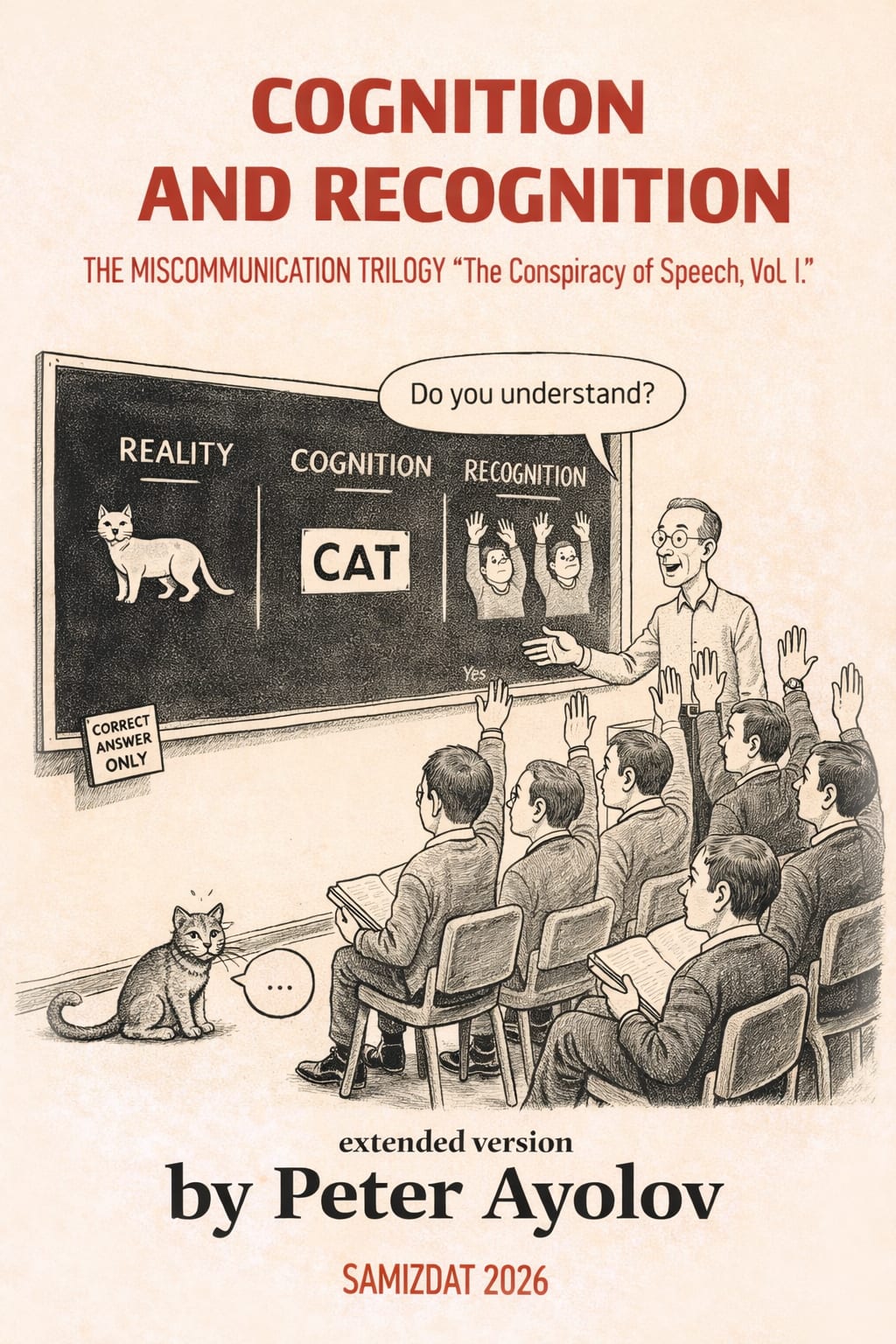
The Architecture of Misunderstanding: A Critical Review of Cognition and Recognition
Cognition and Recognition, as a culminating movement within the broader project, advances a radical yet carefully constructed claim: language is not the foundation of thought, but a secondary system that both stabilizes and distorts it. What might initially appear as a familiar critique of linguistic limitation becomes, over the course of the work, a systematic reordering of how cognition, perception, and communication are understood. The book does not simply argue that language fails at times—it demonstrates that miscommunication is structurally embedded in the very mechanisms that make communication possible.
At its core, the book dismantles the long-standing assumption that thinking is fundamentally verbal. Drawing on a wide range of sources—from cognitive linguistics and sociocultural theory to neuropsychology and studies of animal cognition—it presents a layered model of the mind in which perceptual structures precede linguistic articulation. Thought, in this account, is not a sequence of words but a field of relations: spatial, dynamic, and embodied. Language enters this field as an organizing tool, imposing linear order on what is originally simultaneous and multidimensional. One of the book’s most compelling contributions lies in its treatment of this transformation. The shift from perceptual simultaneity to linguistic sequence is not described as a neutral translation but as a process of reduction. When thought is rendered into language, it is necessarily simplified. Relations are broken into parts, categories replace continua, and dynamic processes are converted into static descriptions. This is not merely a practical limitation—it is a structural one. Language cannot fully capture the richness of cognition because it operates according to fundamentally different principles. This insight is developed with particular clarity in the discussion of linearity. The book shows how language forces multidimensional structures into one-dimensional sequences, reshaping not only how we communicate but how we think. Equality becomes sequence, interaction becomes causation, and coexistence becomes narrative. These transformations are so deeply embedded in linguistic practice that they often go unnoticed, yet they have profound implications for reasoning and interpretation. The reader is left with the unsettling realization that much of what is taken for logical clarity may in fact be an artifact of linguistic constraint.
Equally important is the book’s exploration of metaphor as a central mechanism of thought. Rather than treating metaphor as a decorative feature of language, the text aligns with cognitive linguistic theories that position it as foundational to conceptualization. Abstract domains—time, emotion, causation—are understood through mappings grounded in bodily experience. This perspective is not presented as a speculative idea but as a necessary consequence of the earlier argument: if thought is rooted in perception, then abstraction must rely on perceptual structures. However, the book does not romanticize metaphor. It emphasizes that metaphors are selective, highlighting certain aspects of a concept while obscuring others. As metaphors become conventional, they lose their visibility and begin to function as implicit frameworks. This naturalization contributes to the rigidity of conceptual systems, making it difficult to think beyond established patterns. The analysis here is particularly effective in showing how language both enables and constrains thought, offering tools for abstraction while simultaneously limiting the directions that abstraction can take. The discussion of inner speech further complicates the relationship between language and cognition. Rather than confirming the idea that thinking is simply silent speaking, the book presents inner speech as a transformed system—condensed, fragmented, and highly context-dependent. It operates in close interaction with non-verbal processes, drawing on perceptual and conceptual structures that exist outside language. This treatment is consistent with the broader argument and is supported by references to sociocultural theory, particularly the work of Vygotsky and his successors.
The inclusion of second-language cognition adds another dimension to this analysis. By examining how inner speech develops in an L2 context, the book demonstrates that thought is not tied to a single linguistic system. The transition from reliance on a first language to more integrated bilingual cognition illustrates the flexibility of the mind and the auxiliary role of language. This section is particularly valuable in grounding the theoretical claims in observable processes, showing how language functions as a tool that can be adopted, adapted, and eventually internalized. The book’s engagement with animal cognition is also noteworthy. By highlighting examples of non-linguistic problem-solving and reasoning, it challenges the assumption that language is necessary for thought. This is not presented as a denial of the importance of language but as a correction to its overestimation. The contrast between human and animal cognition is handled with nuance, acknowledging both the similarities and the limitations of non-linguistic thought. Where the book becomes especially provocative is in its extension of these ideas into social and political domains. Language is shown to function not only as a cognitive tool but as a mechanism of framing and alignment. Words do not merely describe reality; they shape how it is perceived and interpreted. In political contexts, this shaping becomes strategic. Terms are chosen for their ability to activate particular frameworks, often at the expense of precision. The result is a fragmentation of shared understanding, where the same vocabulary can support radically different interpretations.
This analysis resonates strongly with contemporary discussions of polarization, but the book avoids reducing the issue to ideology. Instead, it situates the problem within the structure of language itself. Miscommunication arises not because individuals are irrational or dishonest, but because they operate within different conceptual systems that are only partially aligned. This perspective shifts the focus from blame to structure, offering a more nuanced understanding of why communication often breaks down. The treatment of meaning as reconstructive is another strength of the book. Communication is described not as the transmission of fixed content but as a process of interpretation and rebuilding. Each individual reconstructs meaning based on context, prior knowledge, and expectation. This view is consistent with the earlier arguments about perception and language, reinforcing the idea that understanding is always partial and provisional. However, this emphasis on reconstruction also raises questions. While the book convincingly demonstrates the instability of meaning, it offers less detail on how stable communication is nevertheless achieved in practice. The existence of shared languages, scientific discourse, and coordinated action suggests that some degree of alignment is possible. The book acknowledges this through the concept of overlap, but the mechanisms of achieving and maintaining that overlap could be explored further.
Another potential limitation lies in the level of abstraction. While the theoretical framework is coherent and well-supported, there are moments where the argument could benefit from more concrete examples or case studies. The inclusion of illustrative scenarios, particularly in the sections on political language and inner speech, helps to ground the discussion, but a more systematic integration of such examples would strengthen the overall impact. Despite these points, the book succeeds in its primary aim: to reframe the relationship between cognition and language in a way that exposes the structural roots of miscommunication. It does not offer easy solutions, and this is one of its strengths. Rather than proposing techniques for clearer communication, it challenges the assumption that such clarity is fully attainable. This shift from solution to understanding is both intellectually rigorous and philosophically significant. The writing itself reflects the content of the argument. It is dense, precise, and at times deliberately challenging, requiring the reader to engage actively with the material. This is not a text that can be passively absorbed; it demands reconstruction, mirroring the processes it describes. For some readers, this may be a barrier, but for others it will be an integral part of the experience.
In the end, Cognition and Recognition stands as a compelling contribution to the study of language and thought. It brings together diverse strands of research into a coherent framework that challenges deeply held assumptions. By showing that miscommunication is not an error but a condition, it invites a reconsideration of what it means to understand and be understood. The book does not resolve the tension between thought and language, nor does it attempt to. Instead, it reveals that this tension is the very space in which human cognition operates. It is within the gap between perception and word, between intention and interpretation, that meaning is continuously constructed and reconstructed. This recognition does not eliminate misunderstanding, but it transforms it from a problem to be solved into a phenomenon to be understood. For readers willing to engage with its arguments, the book offers a profound shift in perspective. It challenges the comfort of linguistic certainty and replaces it with a more complex, but more accurate, account of how minds connect. In doing so, it fulfills the broader aim of the project: not to perfect communication, but to expose its limits and, in that exposure, deepen our understanding of what it means to think, to speak, and to recognize one another.
About the Creator
Peter Ayolov
Peter Ayolov’s key contribution to media theory is the development of the "Propaganda 2.0" or the "manufacture of dissent" model, which he details in his 2024 book, The Economic Policy of Online Media: Manufacture of Dissent.
Enjoyed the story? Support the Creator.
Subscribe for free to receive all their stories in your feed.
Comments
There are no comments for this story
Be the first to respond and start the conversation.