
The Grammar of Banality, THE MISCOMMUNICATION TRILOGY “The Conspiracy of Speech, Vol. I.” Part 11
Book Review

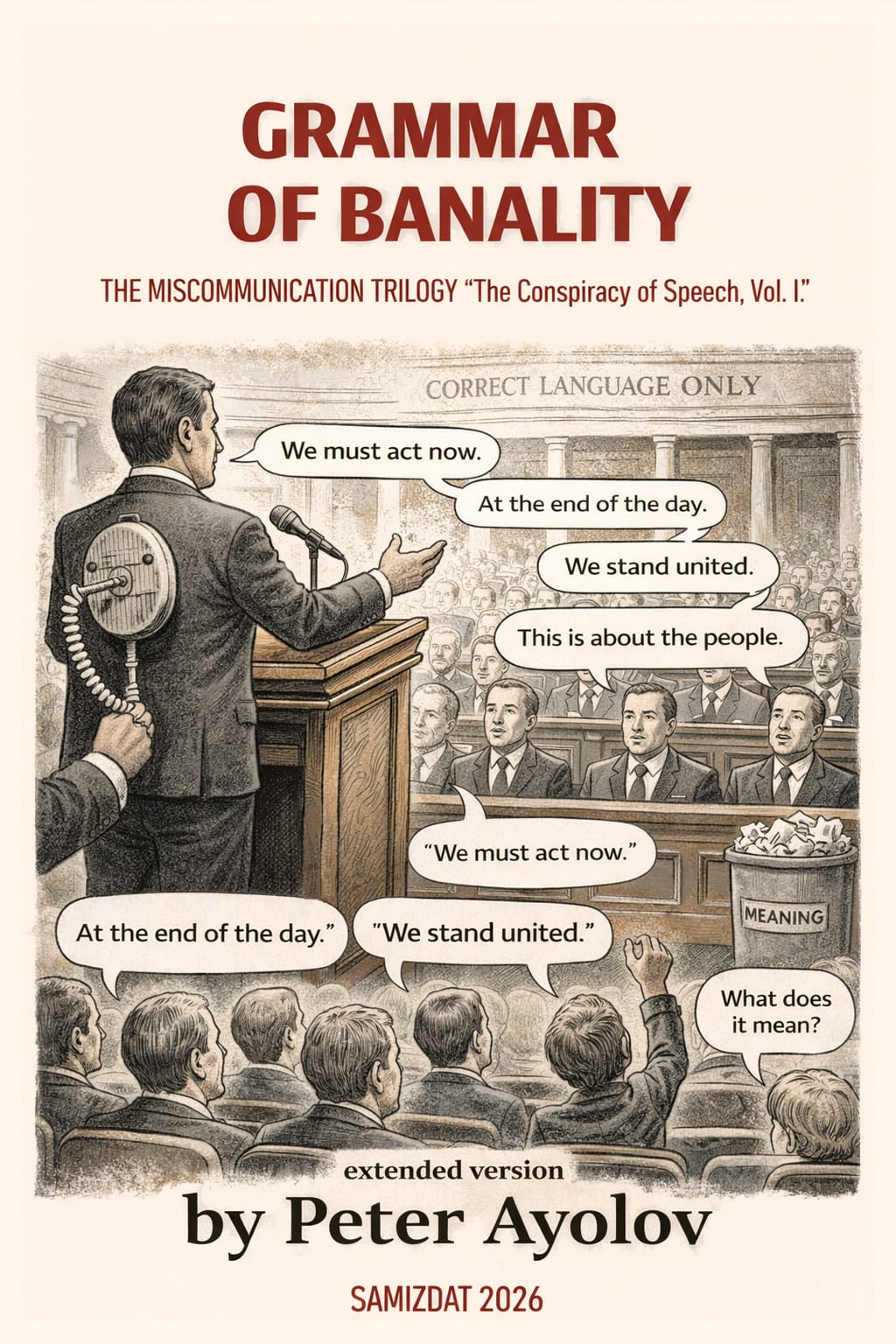
The Grammar of Banality presents itself as a decisive and uncompromising intervention in contemporary thinking about language, communication, and social life. Situated within The Miscommunication Trilogy, the book develops with remarkable consistency a central and provocative claim: that modern language is undergoing a process best described not as decay, but as planned obsolescence. This formulation alone signals a shift in perspective. Where traditional critiques of language lament its corruption, simplification, or ideological capture, this work insists on something more structural and more unsettling—language is not merely failing; it is being reconfigured to function without the very element that once justified its existence, namely meaning. From the opening pages, the book situates itself against a long intellectual tradition that treated language as a medium of truth, representation, or rational exchange. Instead, it reframes language as a system of operations whose primary function is no longer the transmission of information but the maintenance of social contact. This reorientation is achieved through a sustained engagement with the concept of phatic communication, a notion originating in the work of Bronisław Malinowski and later expanded by Roman Jakobson. However, the book does not simply repeat these theories; it radicalizes them. What earlier thinkers described as a marginal or secondary function of language is here elevated to the central principle governing contemporary communication.
The strength of the book lies in its ability to transform what appears trivial into something conceptually decisive. Greetings, polite exchanges, casual remarks about the weather, the habitual “How are you?”—these are not treated as insignificant residues of communication, but as the very core of linguistic practice in late modernity. The author demonstrates that such expressions do not merely accompany meaningful communication; they increasingly replace it. In doing so, the book offers a powerful reinterpretation of everyday speech as a system of signals that operate independently of informational content. One of the most compelling aspects of the analysis is the way it connects this linguistic transformation to broader social and technological developments. The rise of digital communication, with its constant flow of messages, notifications, and minimal responses, provides a fertile ground for the expansion of phatic language. The book convincingly shows how platforms that promise connection instead produce an endless circulation of empty signals—likes, emojis, brief acknowledgments—that sustain interaction without deepening it. Communication becomes continuous but shallow, immediate but forgettable, ubiquitous yet strangely insubstantial. The notion of planned obsolescence, borrowed from economic discourse, proves particularly effective in capturing this paradox. Just as products are designed to become outdated in order to sustain consumption, language appears to be evolving in a way that ensures its perpetual use by shedding the weight of meaning. This is one of the book’s most original contributions: it reframes the apparent impoverishment of language not as a failure, but as a functional adaptation. Language survives precisely because it becomes easier to use, less demanding, and more compatible with the speed and volume of contemporary life.
The argument is developed with a strong sense of conceptual coherence. The book does not rely on isolated observations but constructs a cumulative case in which each chapter reinforces the central thesis. Phatic communication is examined from multiple angles—pragmatic, sociolinguistic, cultural—revealing its role in establishing solidarity, managing interpersonal distance, and maintaining social harmony. Yet what emerges is not a celebration of these functions, but a critical awareness of their consequences. The more language serves to maintain social bonds, the less it seems capable of articulating complex thought or genuine experience. At the same time, the book avoids a simplistic opposition between meaningful and meaningless language. It recognizes that phatic communication has always been a necessary component of human interaction. What has changed is not its existence, but its dominance. The subtlety of this distinction is important. The book does not argue that meaning has disappeared entirely, but that it has been displaced, marginalized, and increasingly overshadowed by forms of communication that prioritize continuity over content. A particularly striking dimension of the work is its attention to the emotional and psychological implications of this shift. The replacement of meaningful exchange with phatic signals creates a peculiar form of sociality in which individuals remain constantly connected yet rarely understood. The rituals of communication provide reassurance—proof that one is not alone—but they also mask a deeper absence. The book suggests that the proliferation of speech may in fact be a response to the fear of silence, a way of avoiding the confrontation with emptiness. In this sense, phatic communication appears not only as a social mechanism but as an existential strategy.
The style of the book reflects its subject matter in a deliberate and effective way. The prose is dense, reflective, and at times deliberately repetitive, mirroring the very patterns it analyzes. This stylistic choice reinforces the argument, as the reader becomes increasingly aware of the tension between expression and redundancy. The text does not simply describe the grammar of banality; it enacts it, drawing the reader into the experience it seeks to explain. However, this same stylistic intensity may also present challenges. The insistence on the central thesis, while intellectually coherent, can at times feel overwhelming. The argument is so thoroughly developed that alternative perspectives receive limited attention. For instance, the possibility that digital communication might also enable new forms of meaning, creativity, or community is largely set aside. While this does not weaken the core argument, it does suggest a certain rigidity in the analytical framework. Another point of potential critique lies in the generalization of the concept of planned obsolescence. While the analogy with economic processes is illuminating, it raises questions about intentionality. Is language truly being “designed” to become obsolete in its meaningful functions, or is this a metaphor for more diffuse social dynamics? The book tends to favor the latter interpretation, yet the terminology sometimes implies a level of deliberate control that remains theoretically ambiguous. This ambiguity, however, may also be part of the book’s strength, as it invites further reflection rather than closing the debate.
Despite these reservations, the overall achievement of The Grammar of Banality is considerable. It offers a compelling and original framework for understanding the transformations of language in contemporary society. By focusing on the most ordinary aspects of communication, it reveals a profound shift in the way language operates, challenging deeply ingrained assumptions about its purpose and value. The book’s significance extends beyond linguistics. It speaks to broader concerns about culture, technology, and the nature of social life. In a world increasingly defined by constant communication, it raises a fundamental question: what does it mean to speak when speech no longer carries meaning? This question resonates across disciplines, from media studies to philosophy, and gives the work a wide intellectual relevance. Perhaps the most lasting contribution of the book is its capacity to alter the reader’s perception of everyday language. After engaging with its arguments, it becomes difficult to hear a casual greeting or a routine exchange in the same way. What once seemed natural and transparent now appears as part of a complex system of social signals. This shift in perception is a mark of genuine intellectual impact. The book does not simply provide answers; it changes the way questions are asked.
In conclusion, The Grammar of Banality stands as a bold and thought-provoking exploration of the contemporary condition of language. Its central thesis of planned obsolescence offers a powerful lens through which to understand the proliferation of empty yet functional communication. While its argument may at times appear uncompromising, it is precisely this intensity that gives the work its distinctive force. It challenges readers to reconsider the role of language in their own lives and to confront the possibility that communication, far from being a transparent medium of meaning, has become an autonomous system sustained by its own emptiness.
About the Creator
Peter Ayolov
Peter Ayolov’s key contribution to media theory is the development of the "Propaganda 2.0" or the "manufacture of dissent" model, which he details in his 2024 book, The Economic Policy of Online Media: Manufacture of Dissent.
Enjoyed the story? Support the Creator.
Subscribe for free to receive all their stories in your feed.
Comments
There are no comments for this story
Be the first to respond and start the conversation.