
EVOLUTION OF SPEECH, THE MISCOMMUNICATION TRILOGY “The Conspiracy of Speech, Vol. I.” Part 8
Book Review

Review
The Collapse of Meaning: Language at the Edge of Its Own Excess
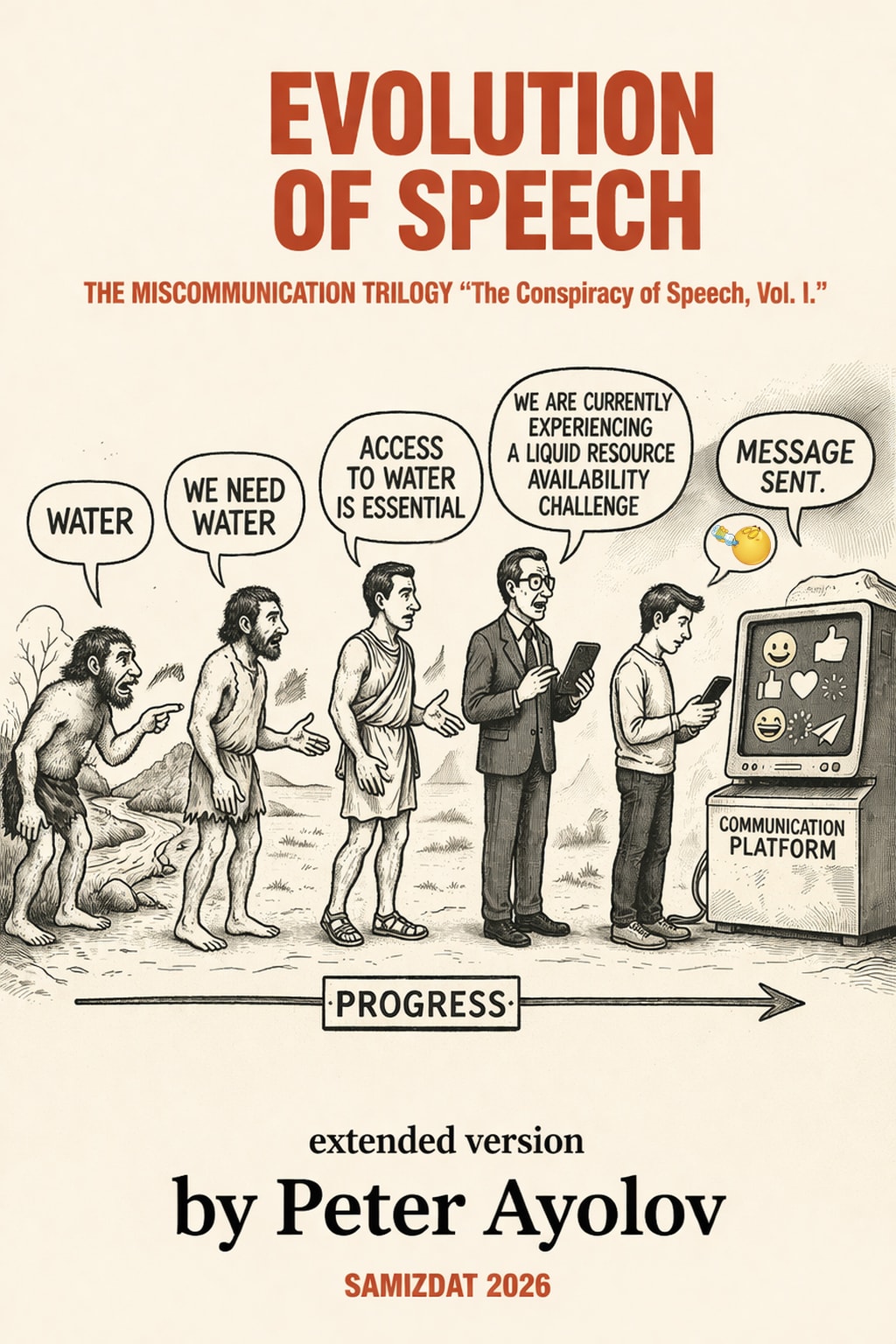
This book presents an ambitious and unsettling argument: language, humanity’s most powerful invention, is not simply evolving—it is unraveling under the weight of its own success. What begins as an interdisciplinary exploration of language evolution gradually transforms into a philosophical diagnosis of contemporary communication. The central thesis, that language undergoes a form of planned obsolescence, is not framed as a conspiracy or intentional design, but as a structural consequence of biological evolution, cultural transmission, and cognitive limitations. The result is a work that moves confidently across disciplines while maintaining a unified and provocative conceptual core.
At its foundation, the book situates language within the broader evolutionary framework of communication systems. Drawing on classical and contemporary research—from Darwinian accounts of emotional expression to modern theories of signaling and game theory—it demonstrates that communication is never merely about truth transmission. Instead, it is shaped by adaptive pressures, balancing cooperation and competition. Signals evolve not only to inform but to influence, not only to clarify but to manipulate. This insight provides a crucial starting point: language inherits the ambiguities and tensions of earlier communication systems while vastly amplifying their scope. The transition from animal signaling to human language is presented not as a clean rupture but as an intensification of existing dynamics. Human language introduces combinatorial structure, displacement, and narrative capacity, enabling an unprecedented expansion of communicative possibilities. Yet the book resists the temptation to celebrate this expansion uncritically. Instead, it insists on examining its consequences. By allowing an infinite number of expressions, language creates a system in which meaning is no longer fixed but constantly negotiated. This flexibility is the source of both human creativity and communicative instability. One of the book’s major strengths lies in its integration of cultural evolution into the analysis of language. Drawing on models of iterated learning, self-organization, and transmission bottlenecks, it convincingly shows that language is not a static system imposed by biology, but a dynamic product of social interaction. Languages adapt to the constraints of learning and memory, becoming more regular, more compositional, and more efficient. However, this efficiency is double-edged. As linguistic structures become optimized for transmission, they also become more standardized and more detached from lived experience. Meaning becomes compressed, conventionalized, and increasingly abstract.
The discussion of grammaticalization is particularly illuminating in this regard. The transformation of concrete expressions into abstract grammatical markers exemplifies the broader trajectory of language: from embodied reference to relational structure, from direct experience to symbolic mediation. This process enables the complexity of modern language but also contributes to its distance from reality. Language becomes a system that refers increasingly to itself, a network of signs whose connection to the world is mediated by layers of convention. The book’s engagement with cognitive science deepens this analysis. It challenges the assumption that language is primarily a tool for representing truth, arguing instead that it is shaped by cognitive processes oriented toward survival rather than accuracy. Perception, memory, and reasoning are shown to be constructive rather than reflective, producing narratives that serve psychological and social functions. Language, as an extension of these processes, inherits their biases and distortions. It becomes a medium not only for communication but for self-deception and social manipulation. This perspective is reinforced by the discussion of consciousness and decision-making. By drawing on experimental findings that suggest decisions are made unconsciously before entering awareness, the book undermines the idea of language as a transparent expression of rational thought. Instead, language is presented as a post hoc system of explanation, a way of organizing and justifying actions that originate elsewhere. This view aligns with the broader argument: language does not simply convey meaning; it constructs it.
The role of imagination further complicates the picture. Language creates a space for hypothetical and fictional representations, allowing humans to explore possibilities beyond immediate reality. This capacity is essential for planning and creativity, but it also introduces a fundamental instability. The boundary between reality and representation becomes porous, enabling both innovation and illusion. Narratives can organize experience, but they can also distort it, creating shared fictions that shape social life. The book’s analysis of large-scale societies provides a compelling extension of these ideas. As human groups expand, communication must operate across greater distances and among strangers. Language becomes more formalized, more abstract, and more dependent on institutional frameworks. Trust is mediated by systems rather than personal relationships, and communication is embedded in complex networks. These conditions amplify the challenges already present in language: the multiplication of signals, the competition for attention, and the difficulty of maintaining shared meaning. The concept of scale-free mechanisms is particularly effective in explaining how language enables the growth of large societies while simultaneously introducing new vulnerabilities. Language, reputation, and specialization allow complex systems to emerge from simple interactions, but they also create feedback loops that can amplify errors and distortions. Communication becomes both the foundation of social order and a source of instability.
The book’s treatment of social learning and imitation is another highlight. By examining the dynamics of innovation and copying, it reveals how knowledge spreads through populations and how errors can propagate. The idea that copying can be more successful than innovation under certain conditions challenges common assumptions about human rationality. It also underscores the central role of language in these processes. Language transmits not only information but also strategies, beliefs, and behaviors, shaping the collective dynamics of societies. In this context, the phenomenon of collective ignorance emerges as a powerful concept. Individuals rely on others for guidance, while others do the same, creating systems in which no one has full knowledge. Language mediates this process, enabling coordination but also facilitating the spread of uncertainty. The distinction between knowledge and belief becomes blurred, and communication becomes a mechanism for navigating ambiguity rather than resolving it. The book’s engagement with contemporary communication systems is implicit rather than explicit, but its relevance to the digital age is unmistakable. The proliferation of media, the acceleration of information flow, and the fragmentation of audiences all exemplify the dynamics described in the text. Language is produced at unprecedented rates, and meanings shift rapidly. Communication becomes continuous but often shallow, abundant but unstable.
This leads to the book’s central concept: the planned obsolescence of language. The argument is subtle but powerful. Language is not deliberately designed to become obsolete, but its evolutionary and cultural dynamics produce a similar effect. Words lose their durability, meanings become transient, and communication becomes disposable. The system continues to function, but its outputs are increasingly ephemeral. What makes this argument compelling is its grounding in multiple disciplines. The book does not rely on a single theoretical framework but integrates insights from biology, linguistics, psychology, and sociology. This interdisciplinary approach allows it to capture the complexity of language as a phenomenon that cannot be reduced to any one domain. At the same time, the book maintains a clear conceptual focus. The notion of entropy serves as a unifying metaphor, capturing the movement from order to disorder, from clarity to noise. This metaphor is not used loosely but is developed through detailed analysis of linguistic and social processes. It provides a powerful lens through which to understand the transformations of language in both historical and contemporary contexts.
However, the book is not without its challenges. Its ambition can at times lead to a certain density, as it moves rapidly between different fields and levels of analysis. Readers may find themselves needing to navigate complex theoretical terrain, particularly in sections that engage with technical models of language evolution. Yet this density is also a reflection of the book’s strength: its refusal to simplify a deeply complex subject. Another potential limitation is the absence of sustained empirical case studies of contemporary communication systems. While the theoretical framework is highly relevant to digital media and global communication, these connections are often left implicit. A more explicit engagement with current examples could have strengthened the argument and made its implications more immediately tangible. Despite these challenges, the book succeeds in offering a profound rethinking of language. It challenges the assumption that language is a stable medium of communication and instead presents it as a dynamic, evolving system characterized by both creativity and instability. It invites readers to reconsider the role of language in shaping human experience, not as a transparent tool but as a complex and often unpredictable force.
The concluding vision is both sobering and generative. Language is not collapsing in the sense of disappearing, but it is transforming in ways that complicate its traditional functions. Communication becomes less about transmitting fixed meanings and more about navigating a fluid environment of signals. Miscommunication is not a failure but a condition, an inherent feature of a system that generates more meaning than it can stabilize. In this sense, the book offers not a pessimistic conclusion but a call for awareness. By understanding the dynamics of language, we can better navigate its complexities. We can recognize the limits of communication, the role of interpretation, and the importance of context. We can approach language not as a guarantee of understanding but as a space of possibility, negotiation, and continual transformation. Ultimately, this work stands as a significant contribution to the study of language and communication. It combines theoretical rigor with conceptual originality, offering a framework that is both deeply informed and provocatively new. Its central insight—that language’s greatest strength may also be its greatest weakness—resonates across disciplines and invites further exploration. In an age defined by the proliferation of communication, this is a book that speaks directly to the conditions of our time, challenging us to rethink what it means to speak, to understand, and to be understood.
About the Creator
Peter Ayolov
Peter Ayolov’s key contribution to media theory is the development of the "Propaganda 2.0" or the "manufacture of dissent" model, which he details in his 2024 book, The Economic Policy of Online Media: Manufacture of Dissent.
Enjoyed the story? Support the Creator.
Subscribe for free to receive all their stories in your feed.
Comments
There are no comments for this story
Be the first to respond and start the conversation.