
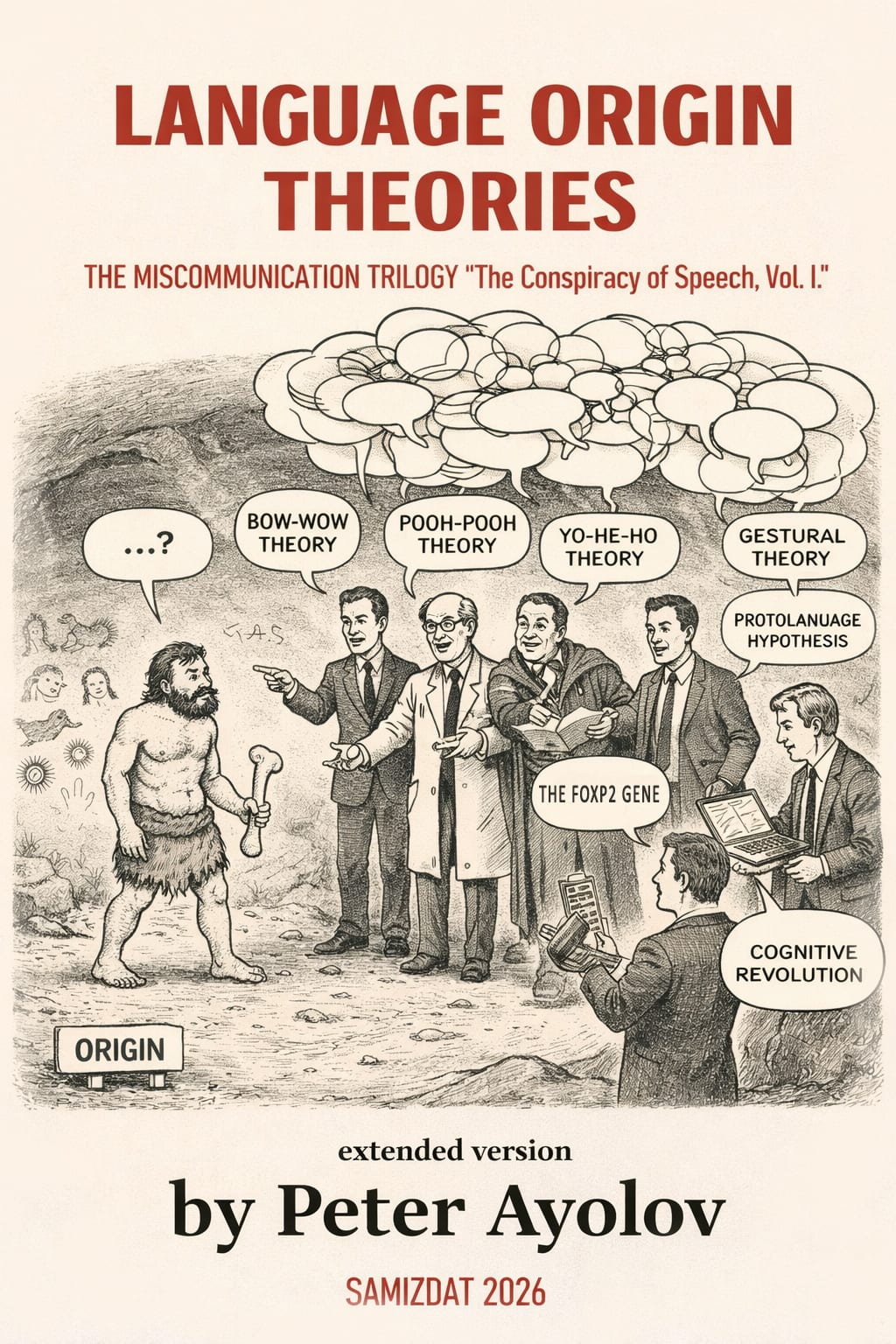
Language Origin Theories, THE MISCOMMUNICATION TRILOGY “The Conspiracy of Speech, Vol. I.” Part 9
Book Review

Review
The Origin of Words, The Collapse of Meaning: A Radical Rewriting of Language’s Beginning
Language Origin Theories, part of THE MISCOMMUNICATION TRILOGY “The Conspiracy of Speech, Vol. I.”, stands as an ambitious, intellectually confrontational, and philosophically charged rethinking of one of humanity’s oldest questions: how did language begin—and what has it become? Rather than offering a conventional survey of competing hypotheses, this volume performs something far more daring. It dismantles the premise that language has a single origin, a stable function, or even a coherent trajectory. What emerges instead is a sweeping reinterpretation of language as a tool forged in evolutionary pressure, shaped by social conflict, and now drifting toward its own obsolescence.
From the very beginning, the book rejects the comforting myth that language evolved to tell the truth. This is its first and most decisive break with traditional narratives. Instead of treating language as a transparent medium for the transmission of information, the text reframes it as a social technology—one designed not for clarity, but for survival. Communication, in this account, is less about accuracy and more about coordination, persuasion, and influence. Language is not a mirror of reality; it is an instrument for navigating it. This shift in perspective allows the book to reassemble the entire field of language origin theories under a new light. Classical debates—gesture versus speech, innateness versus cultural emergence, monogenesis versus polygenesis—are not dismissed but repositioned. They become fragments of a larger puzzle whose central insight is that language cannot be reduced to a single cause. It is the product of overlapping forces: biological constraints, cultural innovation, social necessity, and cognitive limitation. The result is not a clean origin story but a layered, unstable process.
One of the book’s most compelling contributions lies in its synthesis of evolutionary theory with linguistic function. Drawing on the work of Robin Dunbar, the text situates language within the context of primate social bonding. Grooming, the primary mechanism of cohesion in non-human primates, is reinterpreted as the precursor to human communication. As group sizes expanded beyond what physical grooming could sustain, language emerged as a scalable alternative—a form of “verbal grooming” that allowed individuals to maintain social bonds at a distance. This insight is developed with remarkable consistency throughout the volume. Gossip, laughter, storytelling, ritual—these are not peripheral aspects of language but its core functions. They are the mechanisms through which humans construct and maintain social reality. The emphasis on gossip, in particular, is especially striking. Far from being trivial or parasitic, gossip is presented as a crucial evolutionary innovation, enabling communities to monitor behavior, enforce norms, and manage reputations. In this sense, language becomes a system of distributed social control.
Yet the book does not romanticize this process. If language binds, it also divides. The same mechanisms that allow for cooperation also enable deception, manipulation, and exclusion. The co-evolution of lying and lie-detection is treated as a central dynamic in the development of human cognition. Theory of mind, higher-order intentionality, and the capacity for complex social reasoning are all linked to this evolutionary arms race. Language, therefore, is not a neutral ground but a contested space—a battleground where competing intentions are negotiated. This duality—language as both bonding and weapon—is one of the book’s most persistent themes. It reappears in the analysis of reputation management, where everyday conversation is shown to function as a form of self-presentation and strategic signaling. It reappears again in the discussion of gendered communication patterns, where differences in conversational style are linked to evolutionary pressures related to mating strategies and social positioning. These sections are particularly effective in demonstrating how deeply language is embedded in the logic of human behavior.
The engagement with Daniel Everett’s work provides another crucial axis of the book’s argument. Everett’s challenge to universal grammar, based on his research with the Pirahã people, is not treated as a marginal controversy but as a foundational rupture. By presenting language as a cultural tool rather than an innate biological system, Everett’s perspective aligns closely with the book’s broader thesis. The Pirahã case becomes a powerful counterexample to the idea of linguistic universals, illustrating how language can be shaped by specific cultural constraints and values. What makes this engagement especially significant is that it extends beyond linguistics into epistemology. If language is culturally constructed, then the categories through which we understand the world are also contingent. The discussion of linguistic relativity, including the influence of language on perception and cognition, reinforces this point. The absence of number words, color terms, or recursive structures in certain languages is not treated as a deficiency but as evidence of alternative cognitive and cultural priorities. Language, in this sense, is not a fixed system but a flexible adaptation.
The book’s treatment of religion represents one of its most ambitious and thought-provoking sections. Religion is analyzed not as a metaphysical system but as an evolutionary solution to the problem of large-scale social cohesion. Rituals, shared beliefs, and moralizing deities are interpreted as mechanisms for bonding, trust, and cooperation in groups that exceed the limits of direct interpersonal interaction. The concept of “mental grooming” is extended here, with religious practices functioning as large-scale simulations of intimacy and connection. At the same time, the book does not ignore the darker aspects of religion. Its capacity for manipulation, control, and division is acknowledged as an extension of the same communicative mechanisms that enable cohesion. The rise of doctrinal religions in the Neolithic is linked to the increasing complexity of human societies, where new forms of social regulation became necessary. Religion, like language itself, is both a solution and a source of tension. The exploration of morality further deepens this analysis. Drawing on contemporary research in moral psychology and neuroscience, the book argues that moral judgments are rooted in emotional and cognitive processes rather than purely rational deliberation. The role of intentionality, empathy, and context in shaping ethical decisions underscores the complexity of human moral systems. Language plays a central role here, not as a repository of moral truths but as a medium through which moral frameworks are constructed and negotiated.
Perhaps the most original and unifying concept in the book is the idea of the planned obsolescence of language. This notion reframes the entire evolutionary narrative in a profoundly unsettling way. Language, like any tool, is subject to cycles of innovation and decay. Words lose meaning through repetition, concepts become diluted through abstraction, and communication systems expand beyond the capacity of their users. What once functioned effectively in small, tightly bonded groups becomes increasingly unstable in large, complex societies. This argument is developed with a sense of cumulative inevitability. The very success of language—its ability to scale, to abstract, to proliferate—contains the seeds of its breakdown. As communication becomes more widespread and more rapid, the gap between signal and meaning widens. Language begins to circulate without anchoring, producing a condition in which understanding is no longer guaranteed but constantly negotiated. Miscommunication, in this context, is not an anomaly but the default state. The stylistic approach of the book reinforces its conceptual ambition. It moves seamlessly between empirical research and philosophical reflection, between detailed case studies and broad theoretical claims. The integration of diverse sources—anthropological observations, linguistic data, evolutionary models, and historical examples—creates a dense but coherent narrative. The tone is assertive, at times polemical, but always driven by a clear intellectual purpose.
There are moments when the scope of the argument risks overextension. The attempt to unify so many domains under a single conceptual framework may invite skepticism from readers who prefer more narrowly defined analyses. Yet this expansiveness is also what gives the book its distinctive power. It is not content to describe language; it seeks to reinterpret it at the most fundamental level. In its final effect, Language Origin Theories is less a book about beginnings than about trajectories. It asks not only where language came from, but where it is going—and whether its current path is sustainable. By linking the origins of language to its potential obsolescence, the book creates a temporal arc that is both illuminating and unsettling. It forces the reader to confront the possibility that the very tool that made human civilization possible may also be contributing to its fragmentation.
This is not a pessimistic conclusion in the conventional sense. It does not call for the abandonment of language, nor does it propose a return to some imagined pre-linguistic harmony. Instead, it offers a more nuanced insight: that language is inherently unstable, and that this instability is both its strength and its weakness. To understand language is to accept this paradox—to recognize that communication is always incomplete, always provisional, always at risk. As part of THE MISCOMMUNICATION TRILOGY, this volume succeeds in establishing a powerful conceptual foundation. It redefines language not as a solved problem but as an ongoing process—one that reflects the deepest tensions of human existence. In doing so, it transforms the study of language origins into something far more consequential: an inquiry into the limits of understanding itself.
This is a work that does not simply inform; it unsettles. It challenges the reader to rethink what language is, what it does, and what it might become. And in that challenge lies its greatest achievement.
About the Creator
Peter Ayolov
Peter Ayolov’s key contribution to media theory is the development of the "Propaganda 2.0" or the "manufacture of dissent" model, which he details in his 2024 book, The Economic Policy of Online Media: Manufacture of Dissent.
Enjoyed the story? Support the Creator.
Subscribe for free to receive all their stories in your feed.
Comments
There are no comments for this story
Be the first to respond and start the conversation.