
TALKING TO OURSELVES, THE MISCOMMUNICATION TRILOGY “The Conspiracy of Speech, Vol. I.” Part 10
Book Review

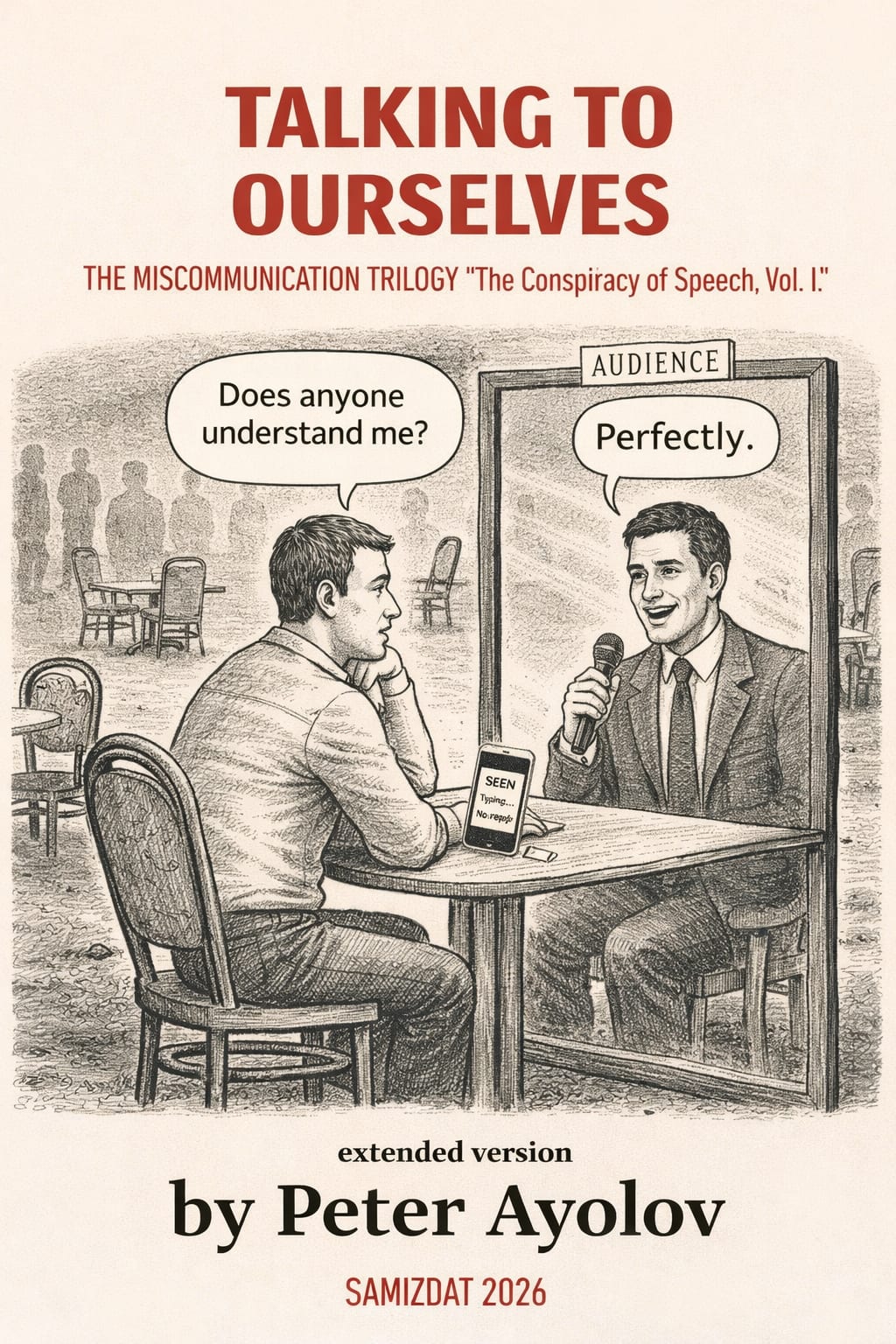
The Exhaustion of Speech: A Review of a Book About Talking to Ourselves
This book, part of The Miscommunication Trilogy, offers a sustained and uncompromising investigation into the condition of language in its most advanced and most unstable form. It does not treat language as a transparent medium of communication, nor as a neutral tool at the disposal of human intention. Instead, it presents language as an autonomous and self-transforming system—one that has expanded beyond its original function and now operates according to a logic that increasingly undermines the very possibility of shared meaning. At the center of this inquiry stands Homo Loquens, not simply as the being who speaks, but as the being constituted by speech, shaped by it, and ultimately trapped within its proliferating structures.
The book’s central thesis—the Planned Obsolescence of Language—is both provocative and rigorously developed. It challenges the deeply ingrained assumption that linguistic evolution leads toward greater clarity, precision, and communicative efficiency. On the contrary, the argument unfolds along a different trajectory: the more language expands, the less it stabilizes meaning. The growth of vocabulary, the multiplication of contexts, and the increasing mediation of communication through technological systems all contribute to a condition in which language becomes saturated, overloaded, and internally contradictory. Meaning is not lost because language fails, but because it succeeds too well—because it produces more signification than it can organize. What distinguishes this book from conventional linguistic or philosophical studies is its refusal to isolate language as a discrete object of analysis. Language here is inseparable from cognition, perception, temporality, and social organization. Each chapter extends the argument into a different domain, demonstrating how language structures not only communication but the very conditions under which reality is experienced. The cumulative effect is a portrait of Homo Loquens as a being whose relationship to the world is fundamentally mediated, and whose increasing reliance on language leads not to greater mastery but to deeper entanglement.
One of the book’s most compelling contributions lies in its treatment of cognition. Language is not presented as a passive reflection of thought but as an active force that shapes and constrains it. The speaking human does not simply use language; they think through it, and often cannot think outside it. This dependency becomes problematic when the system itself becomes unstable. As meanings proliferate and contexts multiply, the cognitive burden increases. The mind must constantly navigate ambiguity, reinterpret signals, and compensate for the gaps between intention and understanding. What emerges is a form of cognitive fragmentation, where attention is dispersed across competing interpretations and the capacity for sustained coherence is diminished. The analysis of attention is particularly incisive. In a linguistic environment characterized by excess, attention becomes a scarce resource. The book convincingly argues that modern forms of communication—rapid, continuous, and multi-channel—encourage a mode of engagement that is shallow, reactive, and discontinuous. Language, instead of organizing thought, begins to disrupt it. The result is a paradox: a world saturated with communication that produces less and less understanding. The phenomenon of “talking to ourselves” is not merely metaphorical but structural. Communication becomes increasingly self-referential, circulating within closed loops where meaning is generated but not stabilized. The book’s engagement with temporality adds another layer to this argument. Language introduces delay, mediation, and projection. It allows humans to operate beyond the immediate present, to construct narratives and anticipate futures. However, this temporal expansion also introduces distortion. The more language intervenes between perception and action, the more it alters the experience of time itself. The present becomes fragmented, stretched across layers of interpretation and anticipation. This temporal dislocation contributes to the overall instability of meaning, as communication is always slightly out of sync with the reality it seeks to capture.
A particularly striking aspect of the book is its treatment of imagination. Rather than celebrating imagination as a purely creative faculty, it is examined as a by-product of linguistic mediation. Language enables the construction of hypothetical worlds, but these constructions can detach from reality, creating systems of belief and representation that are internally coherent yet externally ungrounded. The result is not simply error or illusion, but a proliferation of parallel realities, each sustained by its own linguistic framework. In such a context, the question is no longer what is true, but which interpretation prevails. The social dimension of language is equally central to the book’s argument. Language binds individuals into communities, but it also introduces divisions. As linguistic systems expand and diversify, they produce distinct regimes of meaning, each with its own norms, assumptions, and internal logic. Communication across these regimes becomes increasingly difficult, as shared reference points erode. The book does not reduce this phenomenon to ideology or power, although both are clearly implicated. Instead, it presents it as an inherent consequence of linguistic expansion: the more language differentiates, the more it fragments. One of the most original and conceptually daring moves in the book is the introduction of chanting as a counterpoint to this process. At first glance, chanting appears as a regression—a return to a pre-linguistic or ritualistic form of expression. However, the book convincingly reinterprets it as a post-linguistic phenomenon. Chanting emerges not before language, but after its saturation. It represents a mode of linguistic operation in which meaning is suspended, and repetition takes precedence over novelty. In chanting, language ceases to function as a carrier of information and becomes instead a mechanism for regulating attention and reorganizing consciousness.
This shift from communication to modulation is one of the book’s most important insights. It suggests that language does not simply disappear when it becomes obsolete in its communicative function. Rather, it is repurposed. Its residual capacities—rhythm, sound, repetition—are mobilized in new ways. Chanting is not presented as a solution to the problems of language, but as an adaptation to them. It creates temporary zones of coherence within a fragmented cognitive landscape, stabilizing attention by reducing variability. In doing so, it reveals a different potential of language, one that operates below the level of meaning. The discussion of chanting also serves to highlight the limits of the book’s own framework. While the Planned Obsolescence of Language is a powerful and persuasive concept, it raises questions about the possibility of renewal. If language is inherently prone to excess and instability, can it ever be stabilized again? The book does not offer a definitive answer, and this may be one of its strengths. It resists the temptation to propose solutions where none are readily available. Instead, it remains within the tension it has identified, exploring its implications without resolving it. Stylistically, the book is consistent with its theoretical ambitions. The prose is dense, continuous, and deliberately structured to reflect the processes it describes. There is no reliance on simplification or didactic explanation. Instead, the argument unfolds through accumulation, each section building on the previous one, creating a sense of intellectual pressure. This approach may be demanding for the reader, but it is also appropriate. A book about the saturation of language cannot be written in a way that pretends simplicity.
At the same time, this stylistic choice is not without risks. The absence of clear breaks and the insistence on continuous exposition can create moments of opacity. There are passages where the density of the argument threatens to obscure its clarity. However, these moments are relatively rare, and they can be seen as part of the book’s overall strategy. The reader is not merely receiving information but is being immersed in a process, one that mirrors the complexity and instability of the subject matter. The book’s interdisciplinary scope is another of its strengths. It draws on linguistics, philosophy, cognitive science, and cultural analysis without being confined to any one of these fields. This allows it to address language in its full complexity, as a phenomenon that cannot be reduced to a single domain. At the same time, this breadth requires a careful balance, and the book generally succeeds in maintaining coherence across its various strands. In evaluating the book as a whole, it is important to recognize the ambition of its project. It does not seek to contribute incrementally to an existing field but to reframe the question of language itself. The concept of Homo Loquens is not simply descriptive but diagnostic. It identifies a condition in which the defining feature of humanity—speech—has become a source of instability. The Planned Obsolescence of Language is the logical extension of this diagnosis, a framework that explains not only the current state of communication but its trajectory.
The implications of this framework are far-reaching. If language is indeed moving toward obsolescence, then many of the structures built upon it—knowledge systems, institutions, forms of social organization—are also subject to transformation. The book does not fully explore these implications, but it points toward them, suggesting that the crisis of language is also a crisis of modernity. Ultimately, this is a book that demands to be taken seriously. It is not content with describing the symptoms of miscommunication but seeks to uncover their underlying causes. It does so with a level of conceptual rigor and originality that is rare. Whether one agrees with all its conclusions or not, it is difficult to ignore the force of its argument. The figure of Homo Loquens, speaking endlessly yet understanding less, is both unsettling and illuminating. It captures a paradox at the heart of contemporary existence: that the expansion of communication does not necessarily lead to greater connection. On the contrary, it may produce isolation, fragmentation, and a sense of disorientation. The book does not resolve this paradox, but it makes it visible.
In the end, what this work offers is not a solution but a perspective—a way of seeing language not as a stable foundation but as a dynamic and unstable system. It invites the reader to reconsider their own relationship to language, to recognize its limits, and to explore its possibilities beyond communication. In doing so, it fulfills one of the highest functions of critical thought: not to provide answers, but to transform the way questions are asked.
About the Creator
Peter Ayolov
Peter Ayolov’s key contribution to media theory is the development of the "Propaganda 2.0" or the "manufacture of dissent" model, which he details in his 2024 book, The Economic Policy of Online Media: Manufacture of Dissent.
Enjoyed the story? Support the Creator.
Subscribe for free to receive all their stories in your feed.
Comments
There are no comments for this story
Be the first to respond and start the conversation.