Process
Can I Publish A Book In A Day?
Introduction I have about fifteen self-published books on Amazon, so I should be able to do this in my sleep. My last one, inspired by Annie Kapur and reviewed by Ali Smith here, has got a lot of good responses, so I decided I would do a Volume II.
By Mike Singleton 💜 Mikeydred a day ago in Writers
Details Can Make Your Characters Even Better
When most artists design characters, they tend to design each character individually. That is, while they may pick a theme for specific sets of characters, in general, each character is designed by itself without keeping other factors in mind, such as the overall theme of the piece, foreshadowing issues, and sometimes even other characters. While the characters created can be good, possibly even iconic, it can create a disconnect between the characters, sometimes even a disconnect between the characters and the overall piece. By considering various factors, the characters can be better linked to each other and the piece in question.
By Jamais Jochim2 days ago in Writers
Notes from the Mind Palace
I am tired as fuck. Not "I need a nap" tired. Not "it's been a long week" tired. I mean soul tired. The kind of tired that doesn't sit in your muscles or behind your eyes. The kind that slowly seeps through the cracks and settles somewhere much deeper until one day you realize it has moved into the foundation and started paying rent. Probably in your butt-hole.
By Syl De'Vil2 days ago in Writers
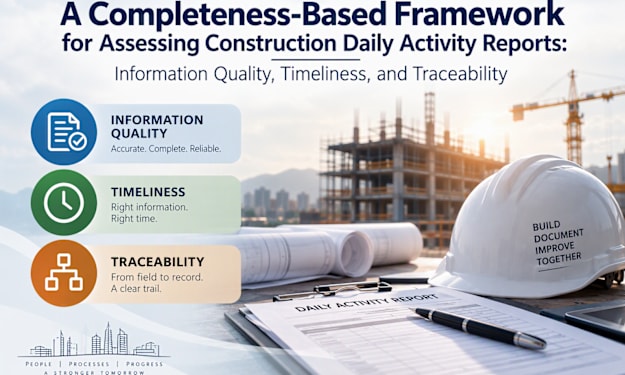
A Completeness-Based Framework for Assessing Construction Daily Activity Reports: Information Quality, Timeliness, and Traceability
Domingo Gaces Samontina, Jr. Independent Researcher, Construction Information Management Abstract— Daily Activity Reports (DARs) are contemporaneous construction records used to document site activities, resources, working conditions, progress, inspections, safety events, delays, instructions, and other factors affecting project execution. This paper proposes a structured framework for assessing DAR completeness and information quality. The framework introduces a weighted DAR Completeness Score (DCS) based on fourteen categories: report identification; weather and site conditions; work activities; quantitative progress; manpower; plant and equipment; materials; quality and inspection; safety and environmental information; delays and constraints; instructions and communications; photographic evidence; action ownership; and verification. Each category is rated on a five-level scale and converted into an overall score from 0 to 100. Submission timeliness and reporting continuity are assessed separately to distinguish document availability from content completeness and punctuality. The framework is grounded in literature on construction daily-report analytics, multimodal evidence, quality knowledge management, intelligent information systems, and electronic document management. It is intended to strengthen progress verification, productivity assessment, quality and safety monitoring, delay analysis, claims substantiation, and data-driven project control.
By Domingo Añasco-Gaces Samontina, Jr.2 days ago in Writers
Tinipak River and Limestone Rock Formations in Daraitan, Tanay, Rizal: A Photo-Assisted Field Observation of Karst Landscape, River Processes, and Ecotourism Management
(2) Tinipak River and Limestone Rock Formations in Daraitan, Tanay, Rizal: A Photo-Assisted Field Observation of Karst Landscape, River Processes, and Ecotourism Management
By Domingo Añasco-Gaces Samontina, Jr.2 days ago in Writers
Shocking read about Noodles . AI-Generated.
The Dark Side of Instant Noodles: A Health Report Introduction In today's fast-paced world, many individuals seek convenience in their meals, leading to the widespread consumption of instant noodles. Though they may offer a quick and easy option, the negative implications of regular consumption on one's health warrant a careful examination.
By ♿ V+ Marie381Uk 3 days ago in Writers
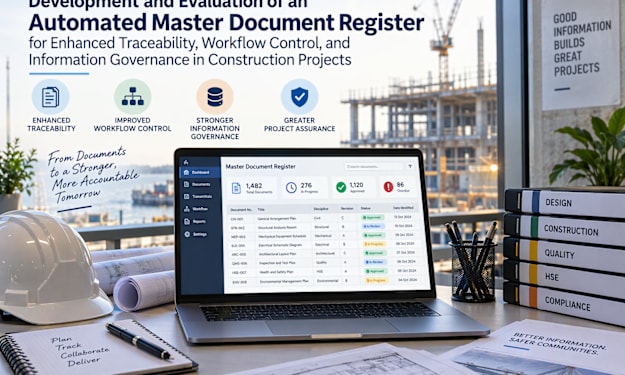
Development and Evaluation of an Automated Master Document Register for Enhanced Traceability, Workflow Control, and Information Governance in Construction Projects
Domingo Gaces Samontina, Jr. - Documentation Advisor, Developer, and Register Owner, Automated Comprehensive Master Document Register (ACMDR)
By Domingo Añasco-Gaces Samontina, Jr.3 days ago in Writers
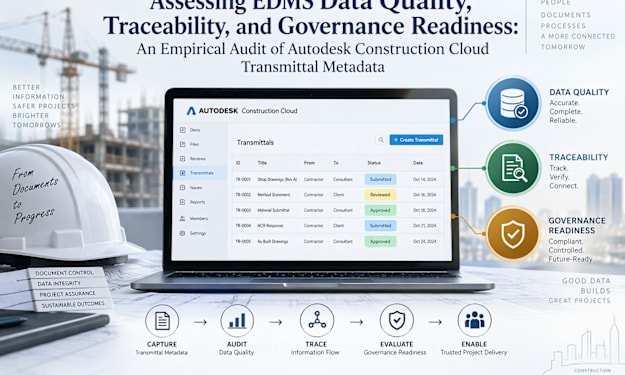
Assessing EDMS Data Quality, Traceability, and Governance Readiness: An Empirical Audit of Autodesk Construction Cloud Transmittal Metadata
IEEE-STYLE EMPIRICAL RESEARCH PAPER Domingo Gaces Samontina, Jr. November 2026 DATA AND CONFIDENTIALITY NOTE - This study uses an anonymized Autodesk Construction Cloud (ACC) transmittal export as its empirical source. Findings are bounded by the fields and snapshot available in that export. Project organizations are represented only as Contractor, Consultant/Engineer, and Client/Employer. Personal names, document identifiers, transmittal numbers, file paths, and project-identifying details are excluded.
By Domingo Añasco-Gaces Samontina, Jr.3 days ago in Writers
Paul's Super Fun, Multi-part Unofficial Challenge
Important Update and Deadline Extension. So you still have time. I want to start by saying I am completely bowled over, bent over, knocked for six and fucking ecstatic at the response I've received to this unofficial challenge. You're all fucking awesome.
By Paul Stewart3 days ago in Writers
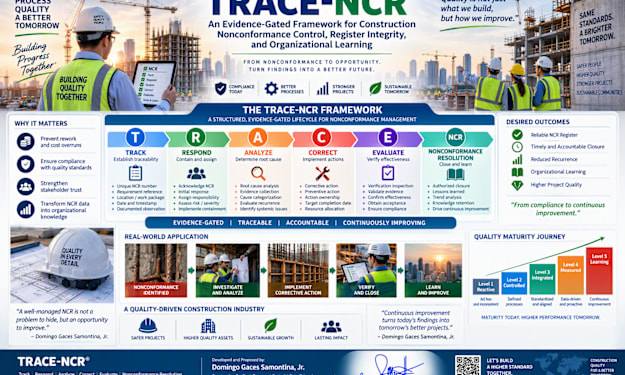
TRACE-NCR: An Evidence-Gated Framework for Construction Nonconformance Control, Register Integrity, and Organizational Learning
Domingo Gaces Samontina, Jr. Independent Researcher, Construction Information Management Abstract— Nonconformance report (NCR) systems frequently record deviations without ensuring that response, causal analysis, corrective action, verification, and closure evidence are complete. This paper develops TRACE-NCR, an evidence-gated framework that makes register integrity the control surface for nonconformance management. A retrospective audit of seven construction NCR observations was used as a bounded diagnostic case. Five records had calculable response dates, with intervals of 0, 1, 2, 3, and 9 calendar days (median 2; mean 3.0). Root cause, corrective action, and preventive action were documented in 85.7%, 71.4%, and 57.1% of records. Although all records were marked closed, only one contained a closeout acceptance date. Two identifiers were reused, and the elapsed-time formula was reversed. TRACE-NCR organizes six gated stages—Identify, Contain, Analyse, Act, Verify, and Close and Learn—around four information-quality dimensions: timeliness, completeness, uniqueness, and status–evidence consistency. A conceptual model, five-level maturity model, audit checklist, and managerial roadmap are proposed. The contribution is not population inference from a small case; it is a transferable control architecture for converting passive registers into auditable quality intelligence.
By Domingo Añasco-Gaces Samontina, Jr.4 days ago in Writers