
Development and Evaluation of an Automated Master Document Register for Enhanced Traceability, Workflow Control, and Information Governance in Construction Projects
Enhanced Traceability, Workflow Control, and Information Governance in Construction Projects

Domingo Gaces Samontina, Jr. - Documentation Advisor, Developer, and Register Owner, Automated Comprehensive Master Document Register (ACMDR)
Abstract—Construction and infrastructure projects generate large volumes of controlled technical and administrative information. This paper presents the development and design evaluation of the Automated Comprehensive Master Document Register (ACMDR), an author-developed spreadsheet framework created and maintained by Domingo Gaces Samontina, Jr. The framework integrates document registration, revision and supersession control, transmittal tracking, audit-history recording, controlled metadata, automated review-date calculations, overdue and due-soon indicators, governance classifications, repository references, and dashboard reporting. A register-design evaluation was performed through workbook inspection, functional decomposition, formula and validation review, control mapping, and scenario-based assessment. The evaluation indicates that the ACMDR provides a coherent structure for improving visibility of status, review obligations, revision currency, and traceability. The current workbook contains limited illustrative data; therefore, the paper evaluates design functionality rather than claiming statistically demonstrated project-performance gains. The results establish a basis for future empirical validation using populated construction-project datasets.
Index Terms—Audit trail, construction document control, document register, information governance, metadata, revision control, traceability, transmittal management, workflow monitoring.
I. INTRODUCTION
Construction and infrastructure delivery depends on controlled exchanges of drawings, specifications, calculations, reports, material submittals, requests for information, inspection records, correspondence, and transmittals. These records may pass through several revisions and workflow states before approval, construction, closeout, or archival retention. ISO 19650 emphasizes structured information identification, status, revision, responsibility, and exchange within managed information environments [1], [2]. Records-management standards similarly emphasize authenticity, reliability, integrity, usability, and documented controls [3].
Projects nevertheless continue to use combinations of common data environments, electronic document management systems (EDMS), collaboration platforms, e-mail, and spreadsheet registers. An inadequately structured register can create revision ambiguity, inconsistent metadata, missing transmittal references, weak review monitoring, and limited management visibility. The ACMDR addresses these operational needs through a deliberately structured and partially automated workbook for construction projects. It is not proposed as a replacement for an enterprise EDMS or CDE; rather, it is evaluated as a practical information-index and monitoring layer where spreadsheet-based control remains necessary.
II. BACKGROUND AND RELATED LITERATURE
A. Information Management and Metadata
The usefulness of project information depends on its accuracy, accessibility, context, status, and traceability. Structured metadata supports identification, classification, retrieval, reporting, and governance. Controlled values are especially important for aggregation because minor terminology variations can fragment dashboard counts. BIM and digital collaboration research likewise identifies information interoperability, coordination, and reliable exchange as persistent project-delivery concerns [5]–[14].
B. Revision, Workflow, and Records Governance
Revision control enables users to distinguish current information from superseded information while preserving historical evidence. Workflow monitoring adds operational visibility to preparation, submission, review, response, approval, and closeout. Records governance extends these controls through confidentiality, retention, accountability, and controlled disposition [3], [15]–[17].
III. RESEARCH GAP AND OBJECTIVES
Many spreadsheet registers provide basic document identification but do not integrate revision currency, review deadlines, transmittal relationships, audit history, confidentiality, retention, and management indicators. The objective of this study is to develop and evaluate a spreadsheet-based master register that consolidates these controls for construction-project information. The study asks how structured metadata and automation can support traceability, workflow monitoring, exception management, and governance, and what limitations must be addressed before production deployment.
IV. RESEARCH METHODOLOGY
A. Register Design Evaluation
The ACMDR workbook is treated as the primary subject of evaluation. Six sheets—Master Register, Dashboard, Transmittal Log, Revision History, Lookups, and Instructions—were examined through functional decomposition, control mapping, formula inspection, validation review, and scenario-based assessment. The scenarios covered initial registration, submission, deadline calculation, overdue identification, comment receipt, revised issue, supersession, transmittal linkage, audit recording, and dashboard review.
B. Evaluation Boundary
The workbook currently contains no populated production dataset. Accordingly, the findings concern observed structure and functional logic. No survey results, productivity percentages, user-satisfaction scores, or statistical performance gains are claimed.
V. ACMDR FRAMEWORK DESIGN
The ACMDR is an author-developed construction-project document-control framework created and maintained by Domingo Gaces Samontina, Jr., Documentation Advisor. Table I summarizes its six-component architecture. The attribution identifies development and maintenance of the evaluated workbook and does not assert registered patent, trademark, copyright, or other formal legal protection.
TABLE I ACMDR FUNCTIONAL ARCHITECTURE
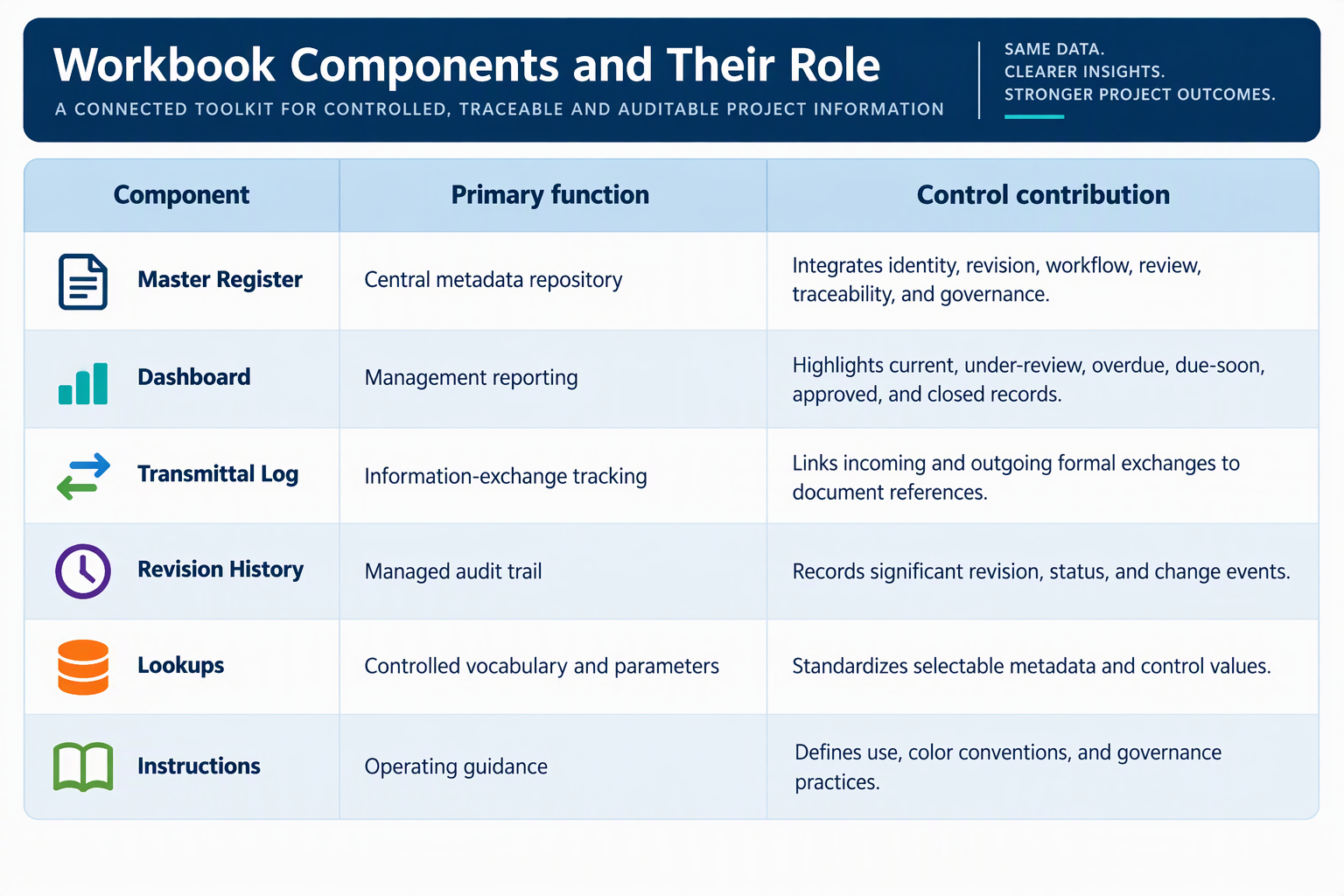
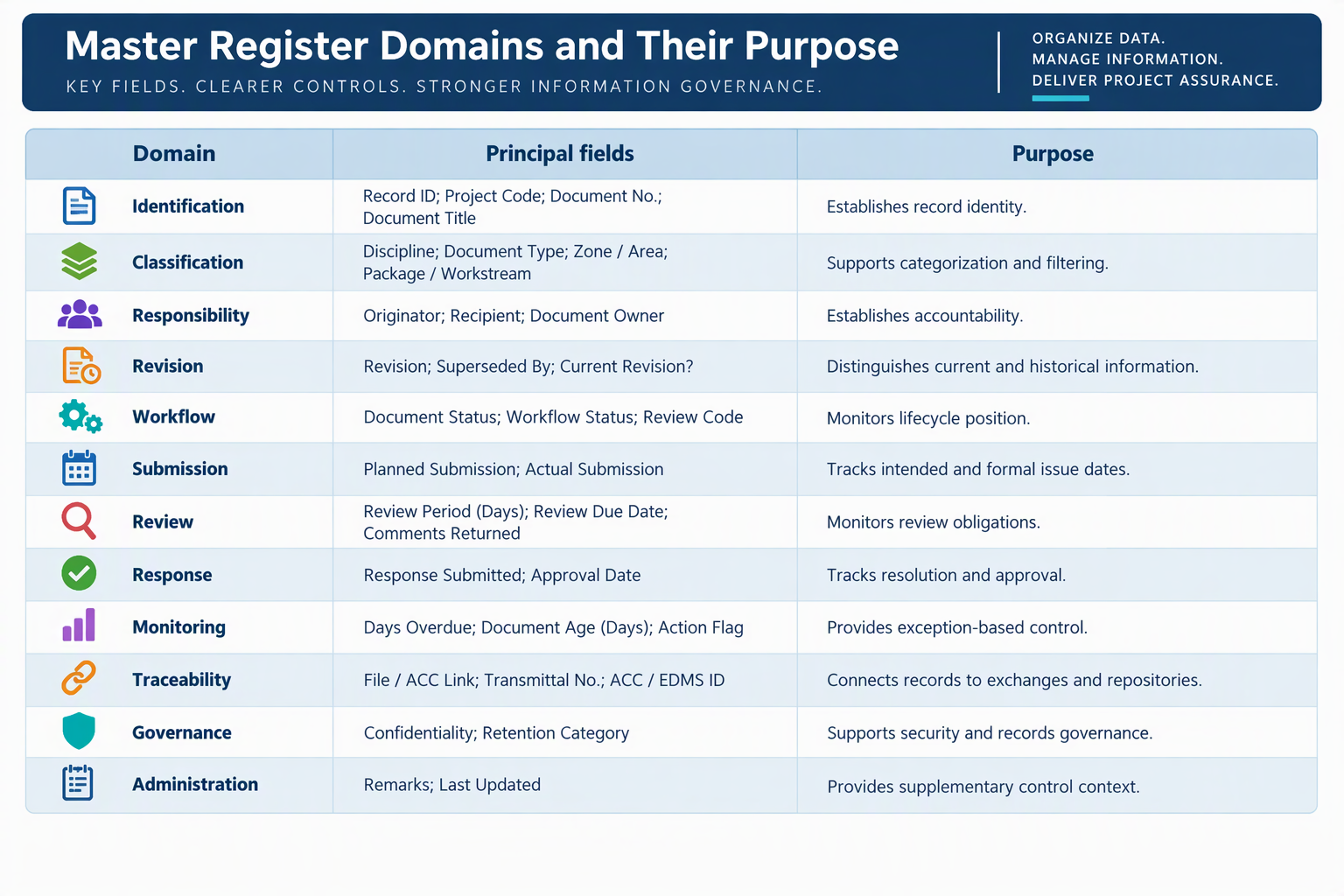
The Master Register combines 34 fields across identification, classification, responsibility, revision, workflow, submission, review, response, monitoring, traceability, governance, and administration. The information-control structure is summarized in Table II.
TABLE II MASTER REGISTER INFORMATION-CONTROL STRUCTURE
VI. AUTOMATION AND CONTROL LOGIC
The default review period is configurable through the Lookups sheet and is set to 14 days in the evaluated workbook. The due-soon threshold is set to three days. The review due date is conceptually calculated as T_r = T_s + P_r, where T_s is the actual submission date and P_r is the review period. Days overdue is represented by D_o = max(0, T_c − T_r), subject to workflow exclusions for approved, closed, or cancelled records. Table III summarizes the implemented controls.
TABLE III AUTOMATED CONTROL LOGIC
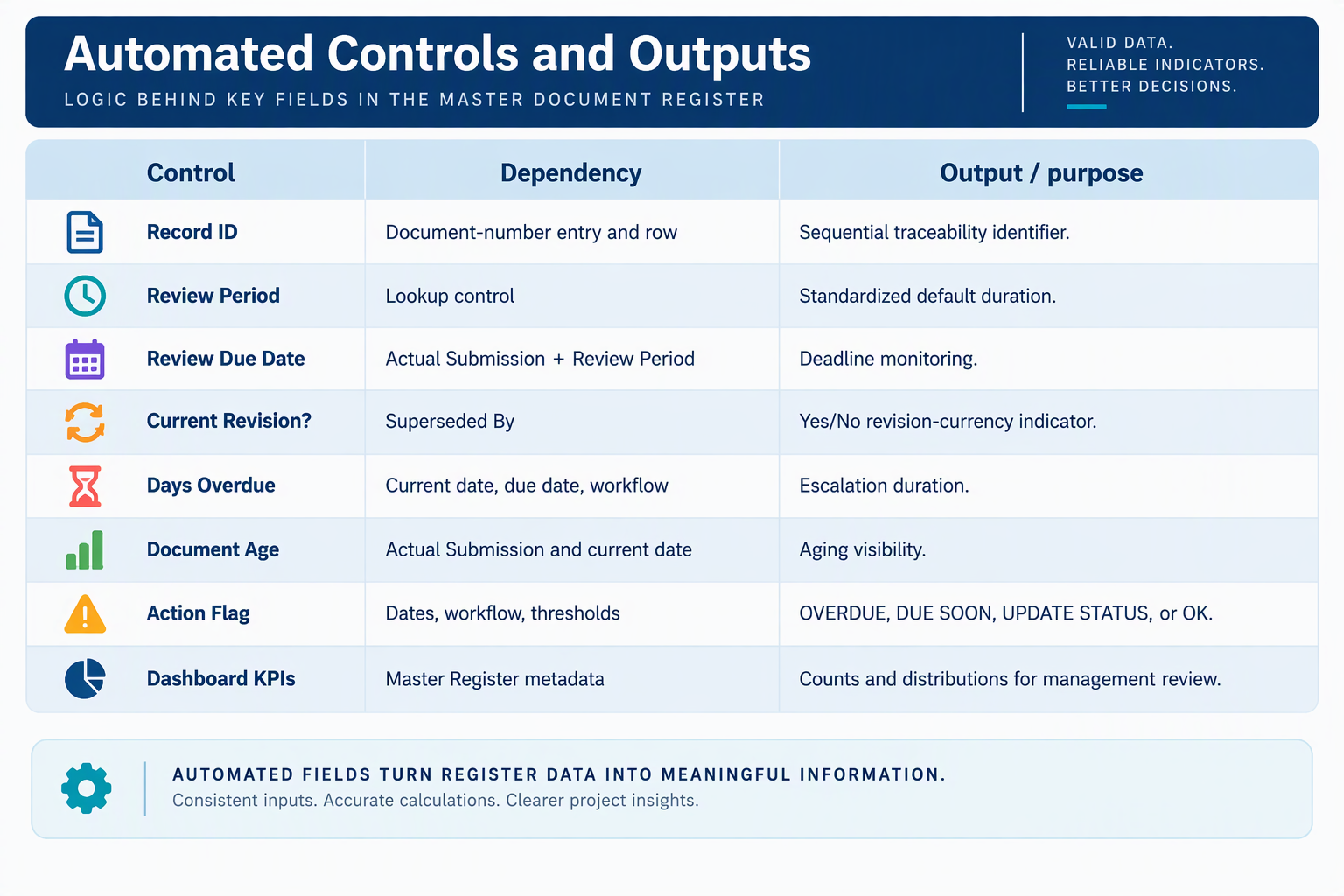
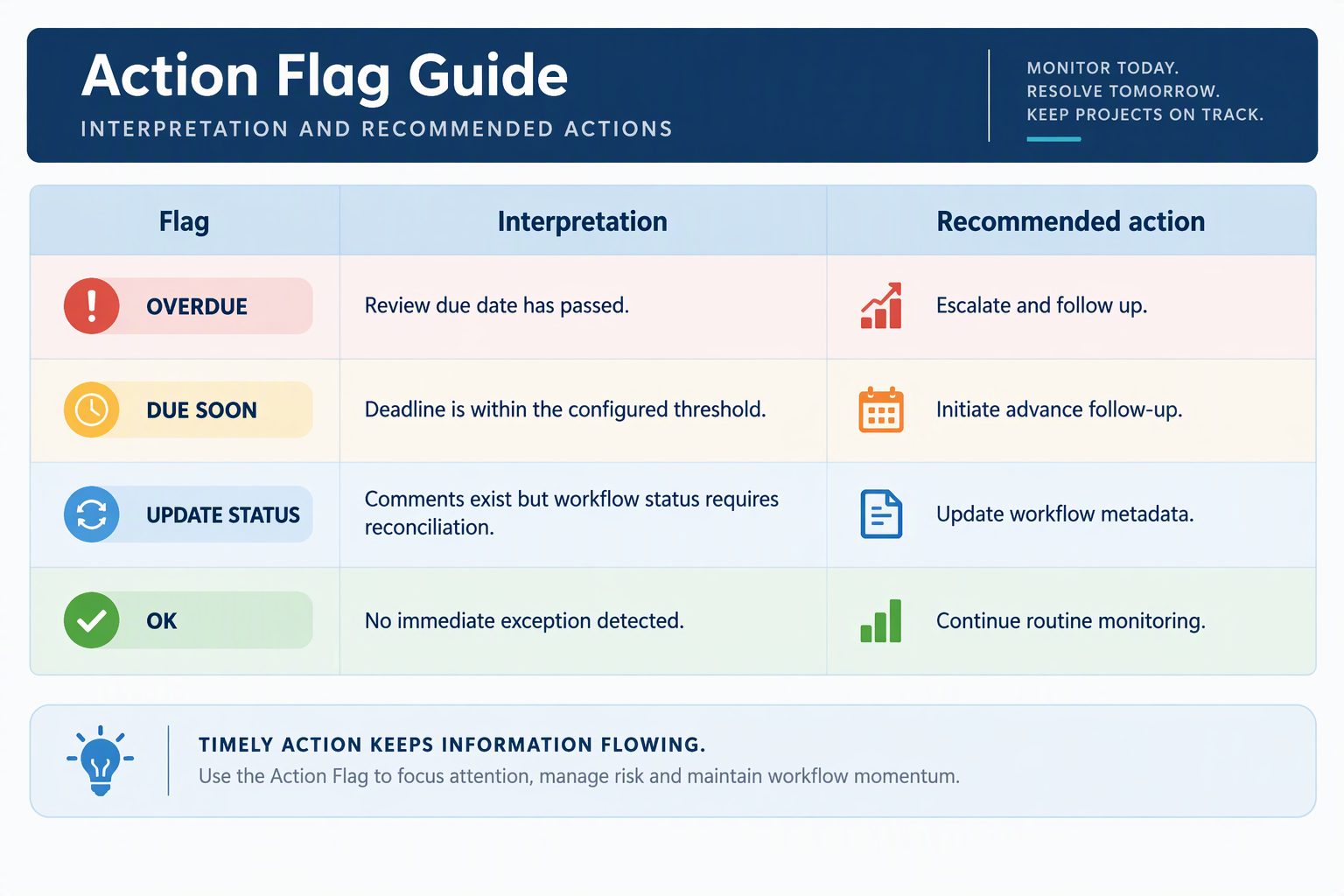
The Action Flag transforms date and workflow conditions into operational categories. Table IV provides the interpretation and recommended response for each flag.
TABLE IV ACTION-FLAG INTERPRETATION
VII. METADATA STANDARDIZATION
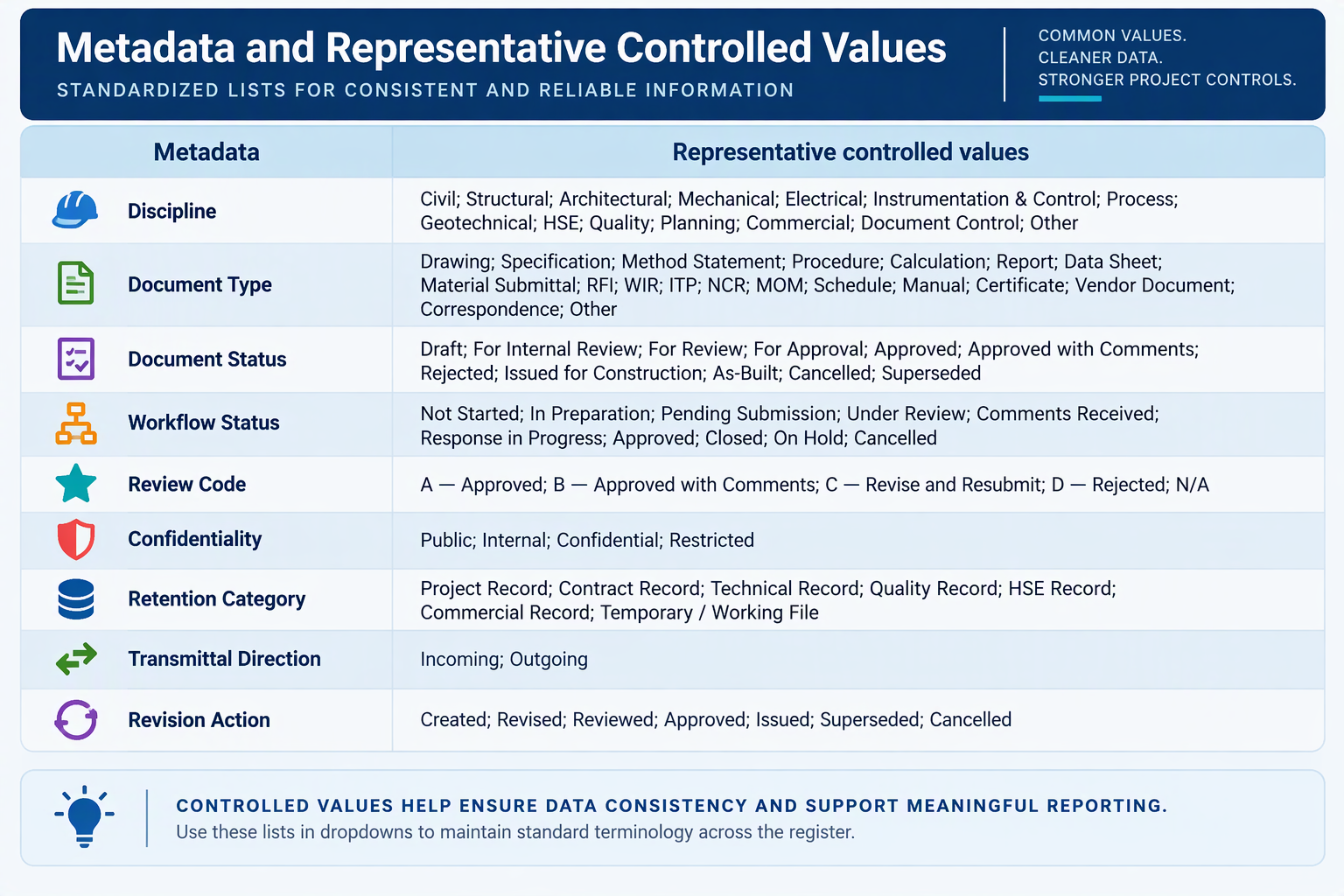
The workbook uses data validation for discipline, document type, document status, workflow status, review code, confidentiality, and retention category. The Transmittal Log and Revision History use additional controlled lists. Table V summarizes the principal vocabularies. Controlled lists improve consistency but do not guarantee semantic correctness; users may still select an inappropriate approved value.
TABLE V CONTROLLED METADATA LISTS
VIII. TRANSMITTAL MANAGEMENT
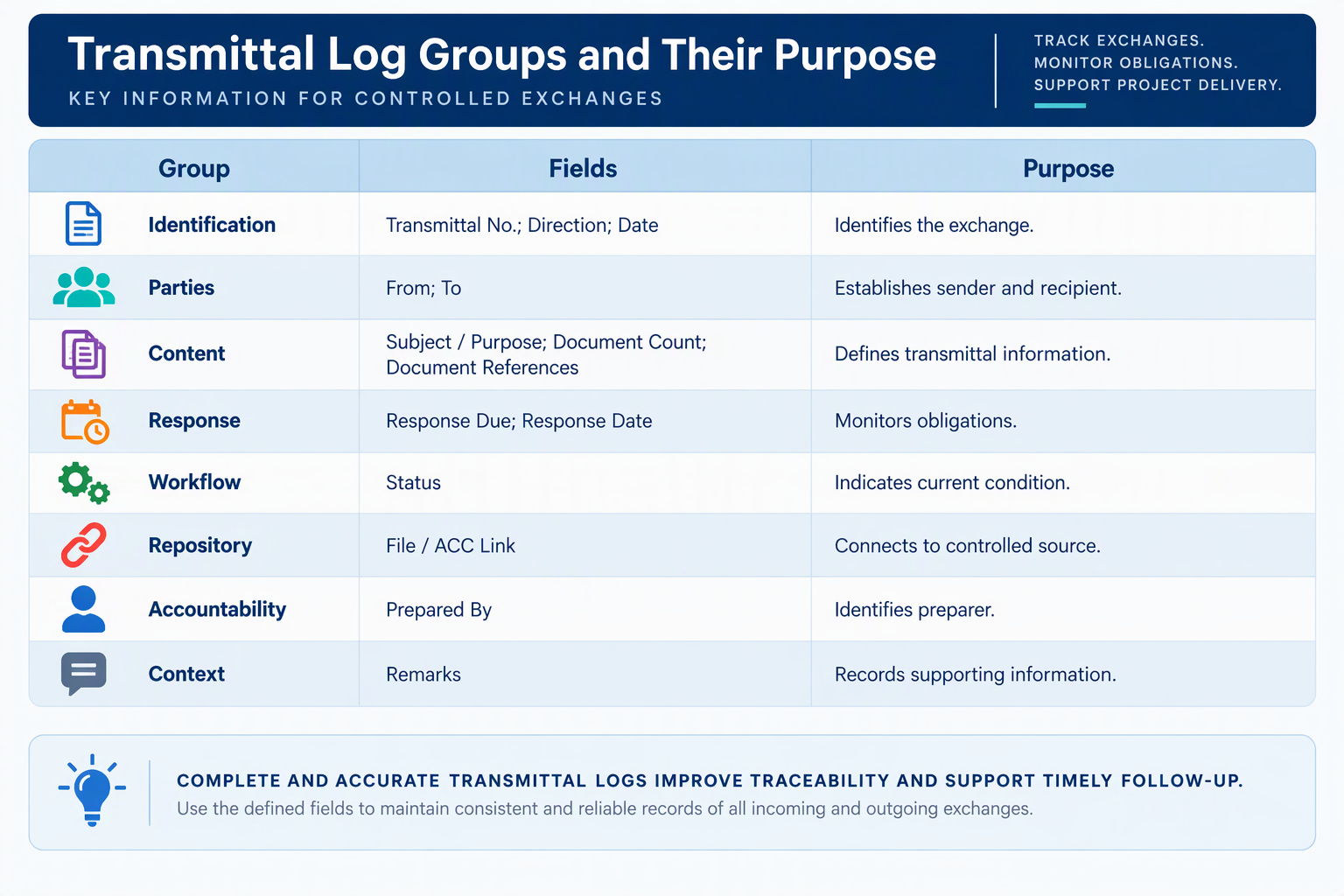
The Transmittal Log records formal incoming and outgoing information exchanges and uses the same transmittal number that may be referenced in the Master Register. This creates a logical Document → Transmittal → Information Exchange relationship. Table VI shows the traceability structure
TABLE VI TRANSMITTAL TRACEABILITY STRUCTURE
IX. REVISION HISTORY AND AUDITABILITY
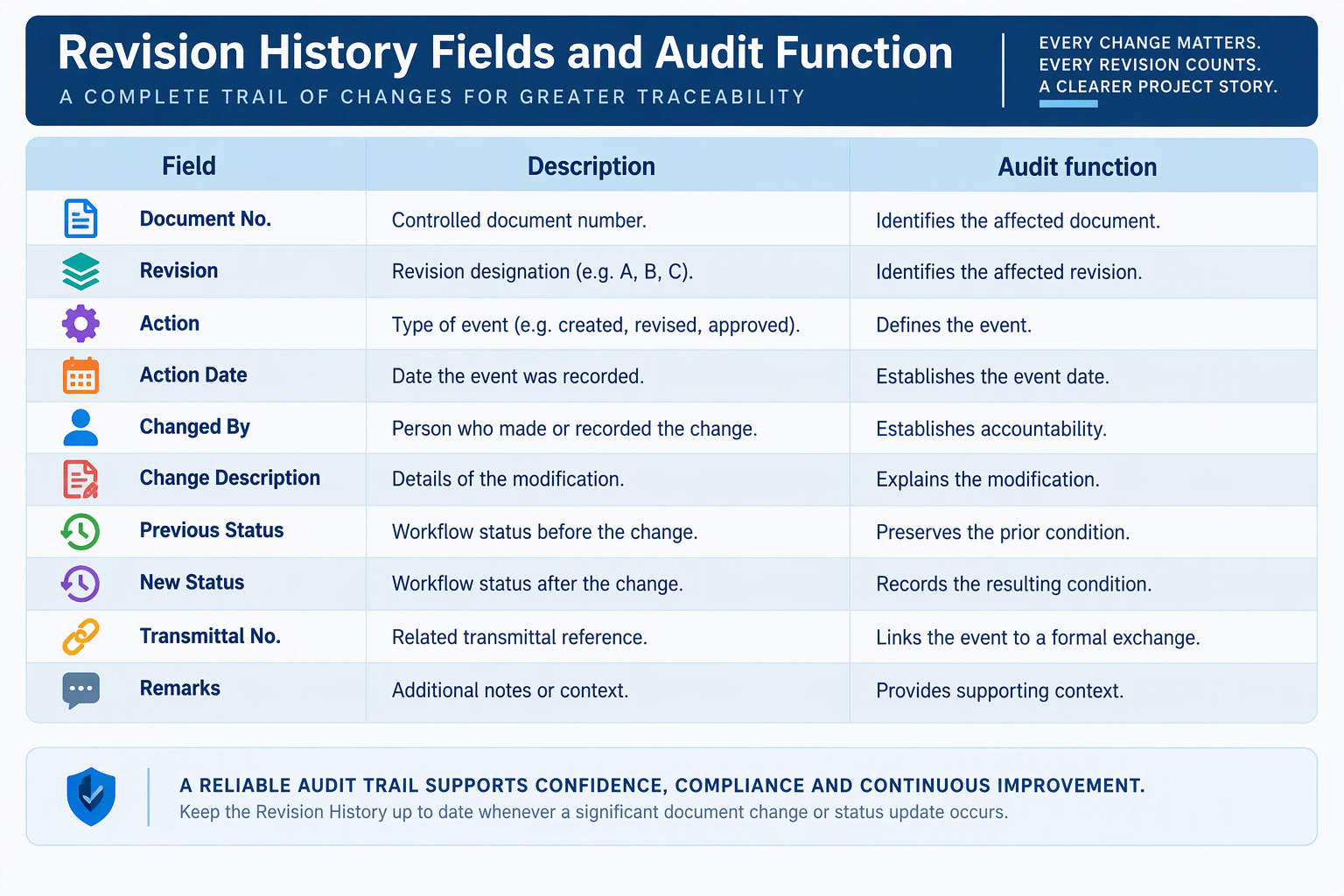
The Revision History complements the current-state Master Register by recording significant change events. It is a managed audit-trail mechanism rather than an immutable enterprise-system log. Its effectiveness depends on consistent procedural use. Table VII describes the audit function of each field.
TABLE VII REVISION HISTORY AND AUDIT-TRAIL STRUCTURE
X. MANAGEMENT DASHBOARD
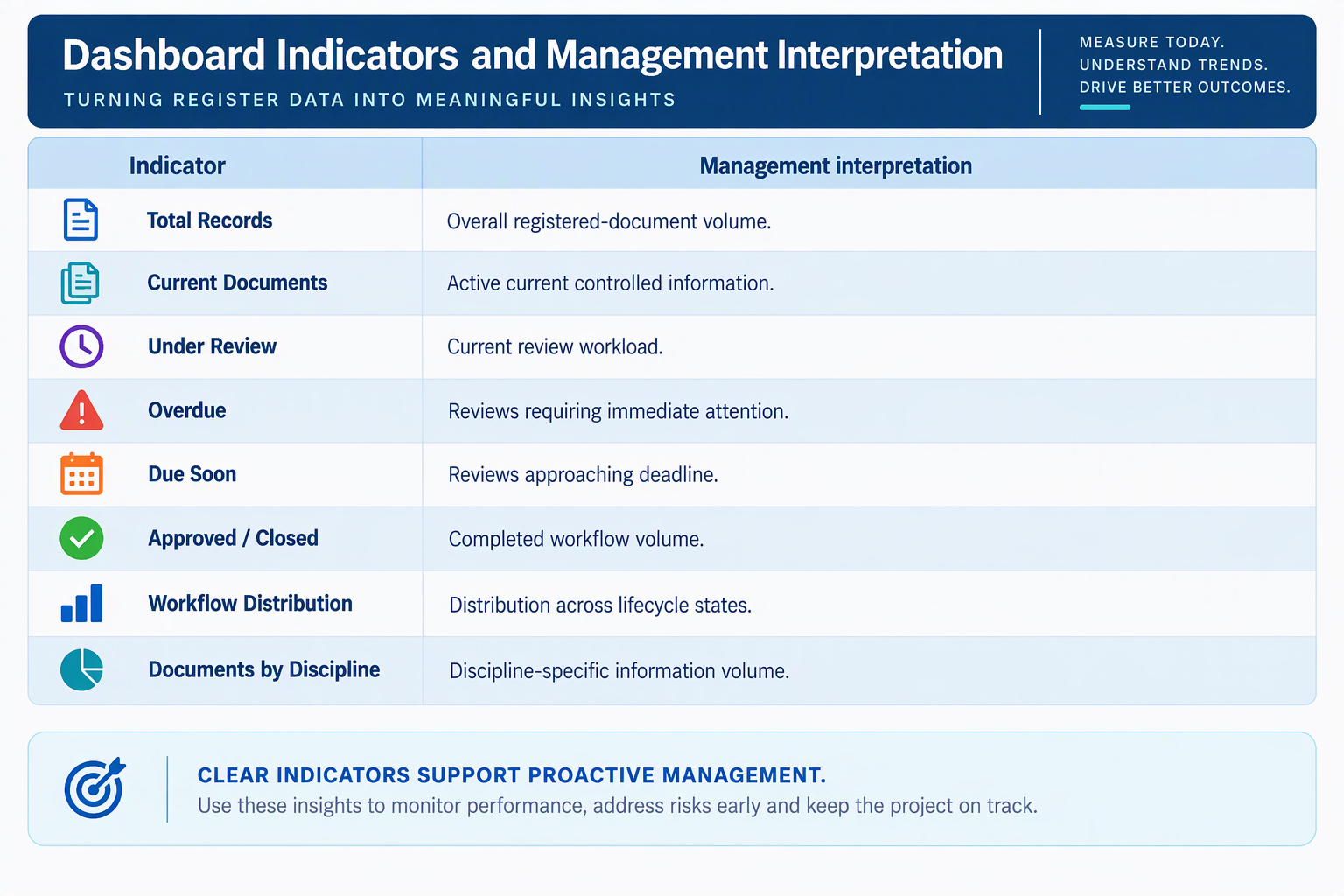
The Dashboard converts source metadata into exception-oriented indicators. It reports total records, current documents, under-review records, overdue items, due-soon items, approved/closed records, workflow distribution, and documents by discipline. Table VIII summarizes the management interpretation. Dashboard reliability remains dependent on source-data quality.
TABLE VIII DASHBOARD MANAGEMENT INDICATORS
XI. HOW TO USE THE ACMDR
A. Initial Setup and Data Entry
Users first confirm the construction-project identity, register owner, approved lookup values, default review period, and due-soon threshold. Blue-font cells are user inputs, black-font cells are formulas or derived values, green font indicates linked/imported information, orange fill indicates review or caution, and light-red fill indicates an error or overdue condition. Each controlled revision occupies a separate row and follows the approved project document-numbering convention.
B. Submission, Review, and Approval
Enter planned and actual submission dates. The workbook calculates the review due date and applies the action flag. When comments are returned, record the date, review code, and updated workflow status. Enter the response-submitted date when a response or revision is issued. Where a response creates a new controlled revision, add a new row rather than overwriting the earlier revision. On approval, update the statuses, enter the approval date, and verify the controlled repository link.
C. Supersession, Links, and Audit History
When a revision is replaced, retain the earlier row, enter the replacement reference in Superseded By, verify that Current Revision? changes to No, create the replacement revision, and record the event in Revision History. File / ACC Link should point to an approved SharePoint, Autodesk Construction Cloud, or EDMS location rather than an uncontrolled local path. The ACC / EDMS ID provides a cross-reference to the authoritative platform. Applicable documents should also be linked to their formal transmittal.
D. Routine Review
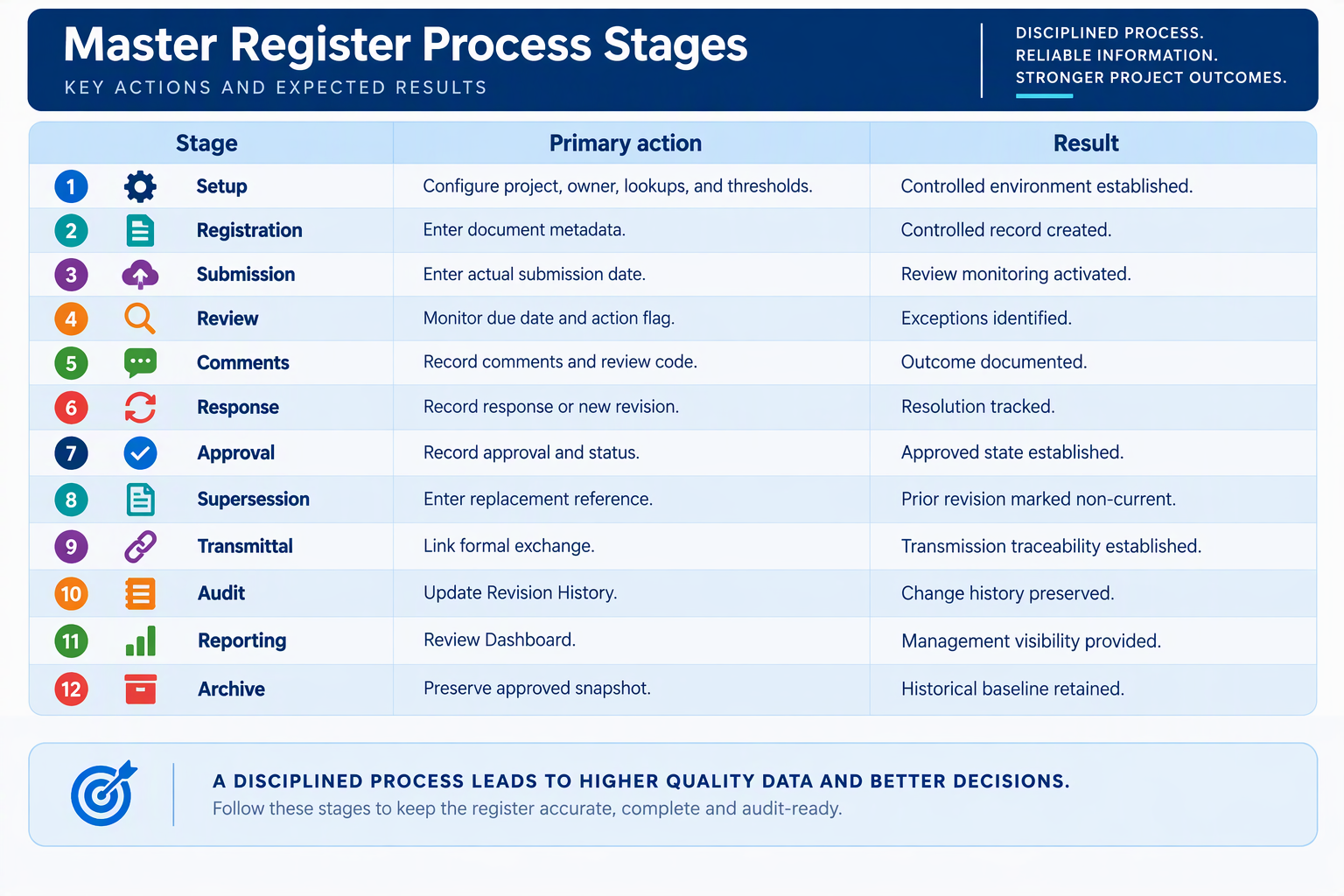
A practical weekly routine is to review overdue and due-soon records, comments awaiting response, superseded revisions, transmittal reconciliation, missing links, incomplete metadata, dashboard trends, and archival snapshots. The full operating sequence is summarized in Table IX.
TABLE IX ACMDR OPERATING SEQUENCE
XII. RESULTS AND DISCUSSION
The register evaluation indicates that the ACMDR integrates identity, classification, revision, workflow, submission, review deadlines, comments, response, approval, supersession, transmittal, EDMS identifier, repository location, owner, and audit history in one framework. This provides broader traceability than a basic document-number/title/status list. The combination of Superseded By and Current Revision? distinguishes active and historical information, while Days Overdue and Action Flag convert raw dates into operational priorities.
Data validation supports consistent filtering and dashboard aggregation. The Transmittal Log enables reconstruction of when, how, and to whom information was formally exchanged. The Revision History preserves significant events, although it depends on disciplined maintenance. Dashboard indicators enable exception-based review but inherit any deficiencies in the underlying metadata.
XIII. GOVERNANCE AND IMPLEMENTATION
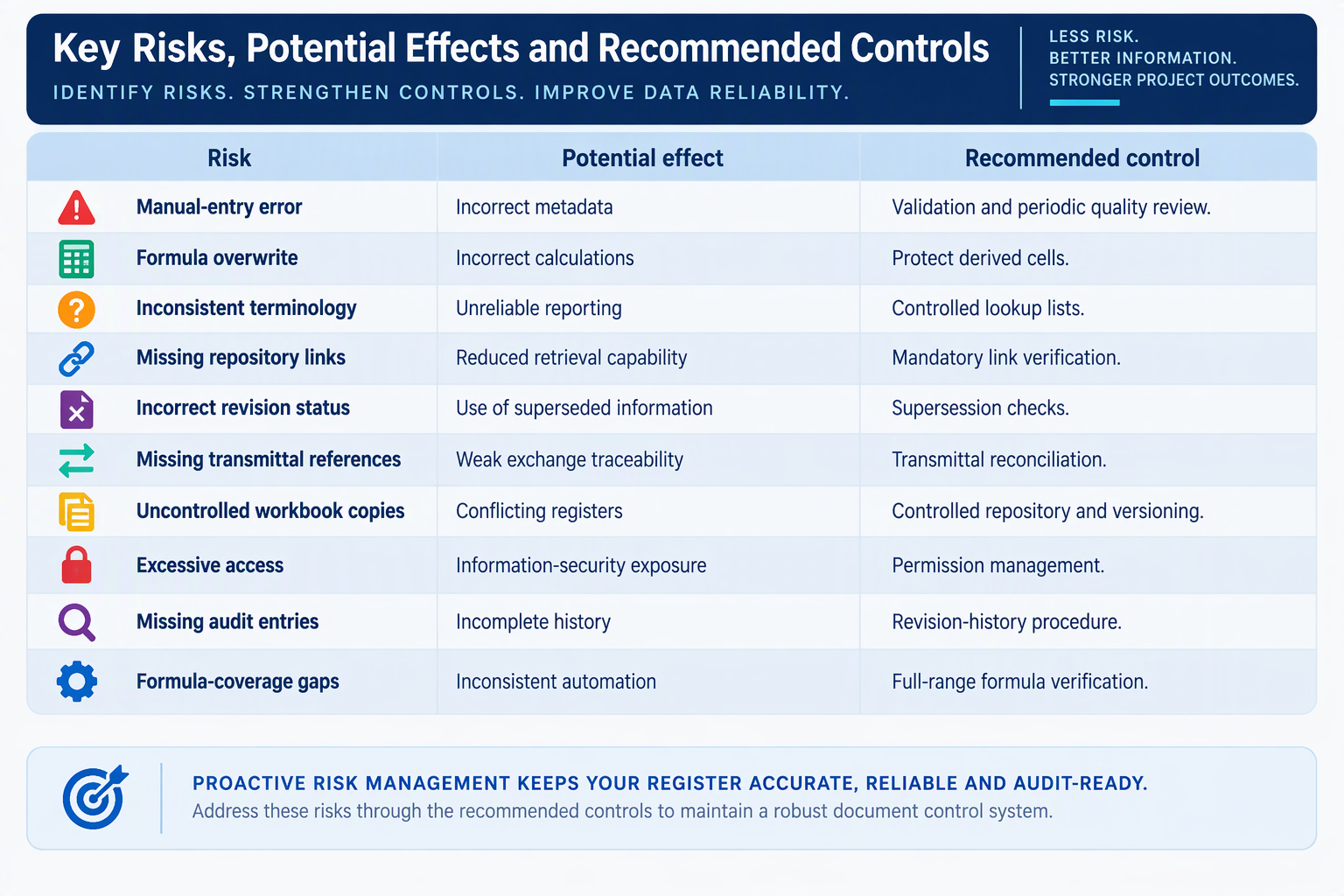
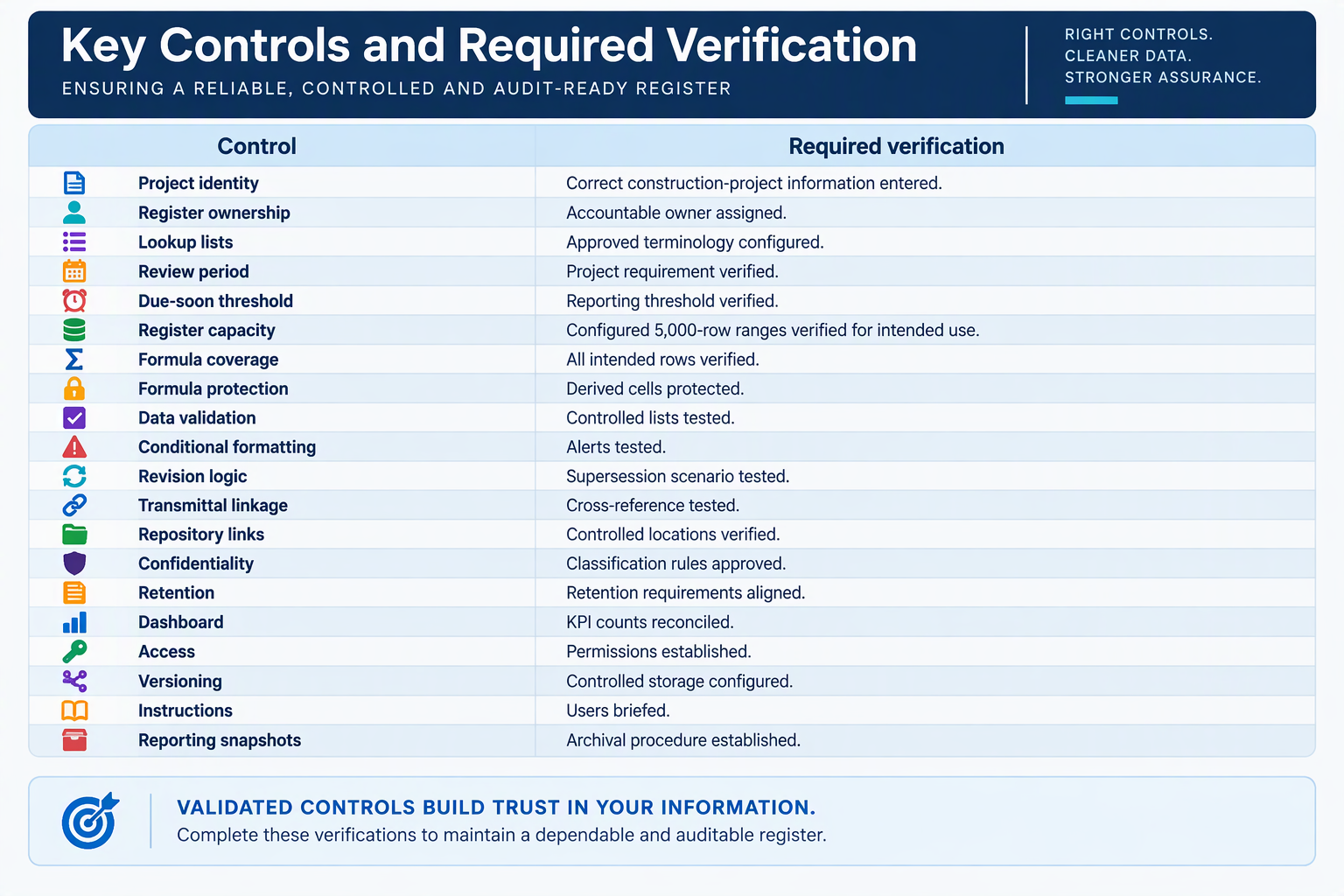
Production use requires formula protection, controlled storage, permissions, version history, an accountable register owner, and periodic data-quality checks. Table X maps principal risks to recommended controls.
TABLE X GOVERNANCE RISKS AND CONTROLS
XIV. LIMITATIONS
The workbook currently contains limited illustrative data, so the study cannot establish statistically significant performance improvements. The framework depends on manual entry, does not automatically synchronize with external EDMS/CDE platforms, and may face concurrency and version-governance challenges. Revision History is procedural rather than immutable. The updated workbook configures the register and supporting tables for up to 5,000 records; practical performance and governance requirements should still be assessed for large or multi-package construction projects.
Inspection also identified a formula-coverage consistency issue in the displayed workbook ranges: certain derived formulas appear continuous only across portions of their intended ranges, with isolated subsequent cells populated, even though the Master Register table and validation ranges extend to row 5,000. Before deployment, formulas for Record ID, Review Due Date, Current Revision?, Days Overdue, and Document Age should be verified and propagated across the complete intended register range. This is a production-readiness requirement, not evidence that the framework concept is invalid.
XV. PROPOSED EMPIRICAL VALIDATION
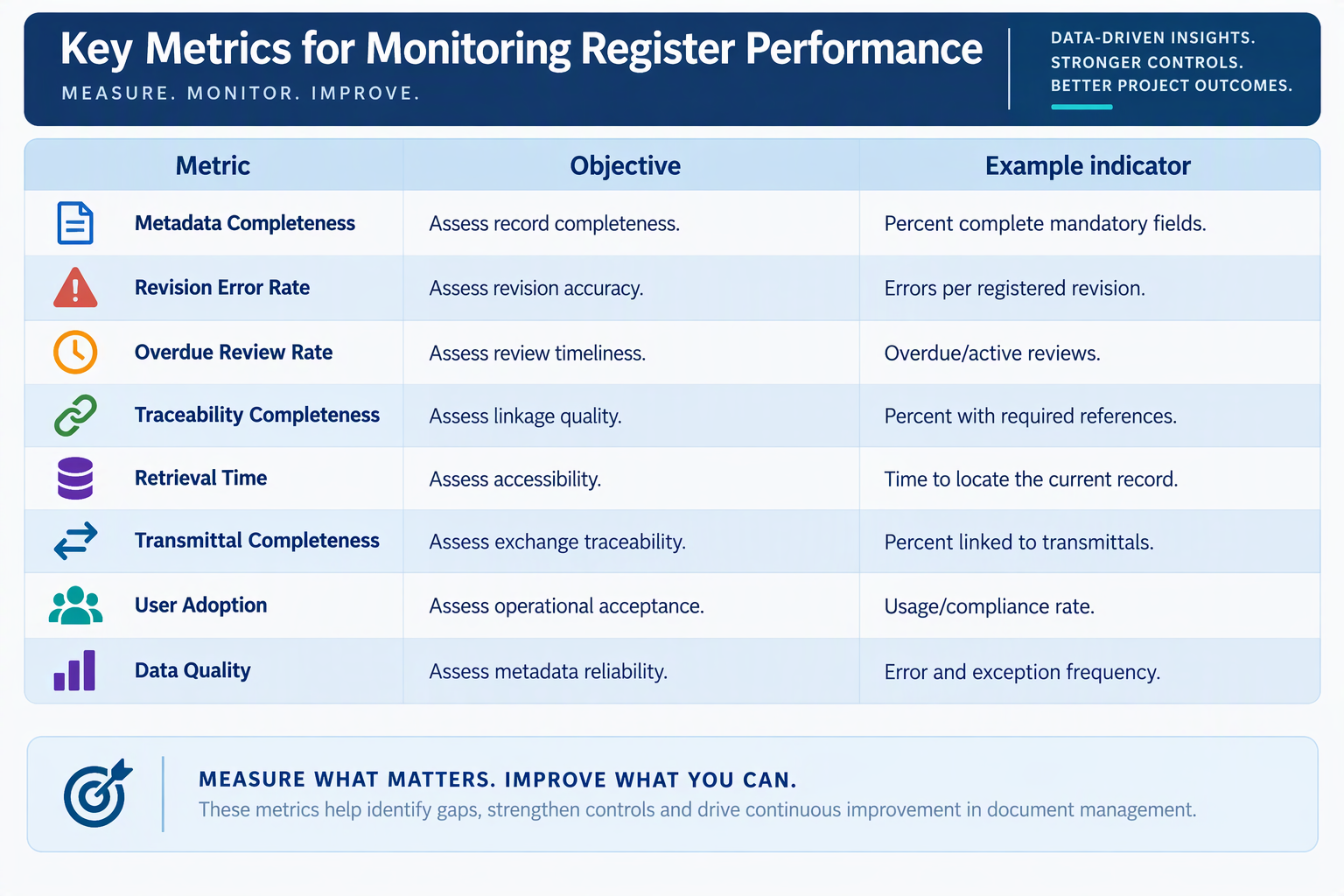
Future research should use populated construction-project datasets. Metadata completeness may be expressed as C_m = (N_c/N_r) × 100, where N_c is the number of records meeting mandatory-field criteria and N_r is the applicable record count. Revision error rate and overdue review rate may be defined similarly. Table XI consolidates the proposed indicators.
TABLE XI PROPOSED EMPIRICAL VALIDATION METRICS
XVI. FUTURE DEVELOPMENT
Future versions may investigate approved integration with Autodesk Construction Cloud, SharePoint, enterprise EDMS platforms, Power Automate, and Power BI; automated notifications for approaching or overdue reviews; duplicate and revision-sequence detection; mandatory-field and hyperlink checks; transmittal reconciliation; and database-backed scaling. These are recommendations and are not existing capabilities of the evaluated workbook.
XVII. PRODUCTION READINESS
Table XII provides a final deployment checklist. All controls should be verified before the workbook is released as a production register for a construction project.
TABLE XII ACMDR PRODUCTION-READINESS CHECKLIST
XVIII. PRACTICAL CONTRIBUTION
The practical contribution is the integration of identification, classification, revision, workflow, review, transmittal, audit, governance, and reporting within a single structured operational model for construction-project document control. Its significance lies less in spreadsheet calculation alone than in translating document-control knowledge into controlled metadata, relationships, alerts, and management indicators. The structure can also inform requirements for future system migration.
XIX. CONCLUSION
This paper presented the development and design evaluation of the ACMDR, an author-developed construction-project document-control framework created and maintained by Domingo Gaces Samontina, Jr. The workbook integrates a Master Register, Dashboard, Transmittal Log, Revision History, Lookups, and Instructions. Its controls support metadata standardization, revision currency, review-deadline monitoring, exception flags, formal-exchange traceability, repository referencing, governance classification, and management reporting.
The evaluation indicates that the ACMDR provides a coherent foundation for strengthening traceability, workflow visibility, revision governance, and information-management discipline. Its effectiveness nevertheless depends on accurate data entry, protected formulas, controlled terminology, access governance, audit-history maintenance, and organizational procedures. Future empirical work should evaluate completeness, revision errors, overdue rates, retrieval time, traceability, and adoption using populated construction-project datasets.
ACKNOWLEDGMENT
The author acknowledges the professional construction-project document-control and information-management practices that informed the development of the ACMDR.
REFERENCES
[1] International Organization for Standardization, ISO 19650-1:2018, Organization and Digitization of Information About Buildings and Civil Engineering Works, Including Building Information Modelling—Information Management Using Building Information Modelling—Part 1: Concepts and Principles. Geneva, Switzerland: ISO, 2018.
[2] International Organization for Standardization, ISO 19650-2:2018, Organization and Digitization of Information About Buildings and Civil Engineering Works, Including Building Information Modelling—Information Management Using Building Information Modelling—Part 2: Delivery Phase of the Assets. Geneva, Switzerland: ISO, 2018.
[3] International Organization for Standardization, ISO 15489-1:2016, Information and Documentation—Records Management—Part 1: Concepts and Principles. Geneva, Switzerland: ISO, 2016.
[4] International Organization for Standardization, ISO 9001:2015, Quality Management Systems—Requirements. Geneva, Switzerland: ISO, 2015.
[5] R. Sacks, C. Eastman, G. Lee, and P. Teicholz, BIM Handbook: A Guide to Building Information Modeling for Owners, Designers, Engineers, Contractors, and Facility Managers, 3rd ed. Hoboken, NJ, USA: Wiley, 2018.
[6] B. Succar, “Building information modelling framework: A research and delivery foundation for industry stakeholders,” Automation in Construction, vol. 18, no. 3, pp. 357–375, 2009.
[7] S. Azhar, “Building information modeling (BIM): Trends, benefits, risks, and challenges for the AEC industry,” Leadership and Management in Engineering, vol. 11, no. 3, pp. 241–252, 2011.
[8] R. Volk, J. Stengel, and F. Schultmann, “Building Information Modeling (BIM) for existing buildings—Literature review and future needs,” Automation in Construction, vol. 38, pp. 109–127, 2014.
[9] A. Miettinen and S. Paavola, “Beyond the BIM utopia: Approaches to the development and implementation of building information modeling,” Automation in Construction, vol. 43, pp. 84–91, 2014.
[10] C. Merschbrock and B. E. Munkvold, “Effective digital collaboration in the construction industry—A case study of BIM deployment in a hospital construction project,” Computers in Industry, vol. 73, pp. 1–7, 2015.
[11] A. Grilo and R. Jardim-Goncalves, “Value proposition on interoperability of BIM and collaborative working environments,” Automation in Construction, vol. 19, no. 5, pp. 522–530, 2010.
[12] J. Whyte and A. Lobo, “Coordination and control in project-based work: Digital objects and infrastructures for delivery,” Construction Management and Economics, vol. 28, no. 6, pp. 557–567, 2010.
[13] J. Whyte, “How digital information transforms project delivery models,” Project Management Journal, vol. 50, no. 2, pp. 177–194, 2019.
[14] International Organization for Standardization, ISO 19650-3:2020, Information Management Using Building Information Modelling—Part 3: Operational Phase of the Assets. Geneva, Switzerland: ISO, 2020.
[15] International Organization for Standardization, ISO 19650-5:2020, Information Management Using Building Information Modelling—Part 5: Security-Minded Approach to Information Management. Geneva, Switzerland: ISO, 2020.
[16] International Organization for Standardization, ISO 30301:2019, Information and Documentation—Management Systems for Records—Requirements. Geneva, Switzerland: ISO, 2019.
[17] Autodesk, “Autodesk Construction Cloud,” product documentation, Autodesk, San Francisco, CA, USA.
[18] Microsoft, “SharePoint documentation,” Microsoft Learn, Redmond, WA, USA.
[19] D. G. Samontina, Jr., Automated Comprehensive Master Document Register (ACMDR), author-developed spreadsheet-based construction-project document-control framework, 2026.
The complete PDF of this paper is available below:
About the Creator
Domingo Añasco-Gaces Samontina, Jr.
.Professional Member of the Mechatronics and Robotics Society of the Philippines
.Certified Documented Information Controller with TUV Rheinland Qualifications
.Master of Science in Engineering (on-going) with Professional Teacher Certificate
Enjoyed the story? Support the Creator.
Subscribe for free to receive all their stories in your feed.
Comments
There are no comments for this story
Be the first to respond and start the conversation.