
Assessing EDMS Data Quality, Traceability, and Governance Readiness: An Empirical Audit of Autodesk Construction Cloud Transmittal Metadata
An Empirical Audit of Autodesk Construction Cloud Transmittal Metadata

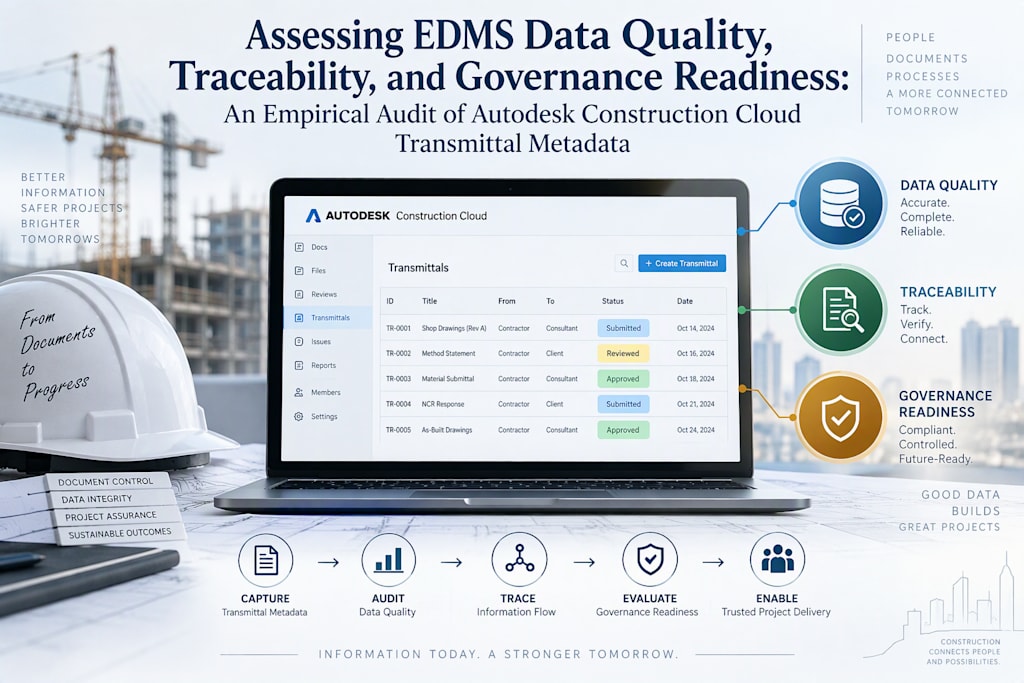
IEEE-STYLE EMPIRICAL RESEARCH PAPER
Domingo Gaces Samontina, Jr.
November 2026
DATA AND CONFIDENTIALITY NOTE - This study uses an anonymized Autodesk Construction Cloud (ACC) transmittal export as its empirical source. Findings are bounded by the fields and snapshot available in that export. Project organizations are represented only as Contractor, Consultant/Engineer, and Client/Employer. Personal names, document identifiers, transmittal numbers, file paths, and project-identifying details are excluded.
Prepared as an independent research case study
Abstract—Electronic document management systems (EDMSs) can preserve formal issue events while providing incomplete evidence of semantic quality, lineage, and accountable closure. This study presents an export-bounded empirical audit of an anonymized Autodesk Construction Cloud transmittal dataset comprising 1,668 unique transmittals and 7,972 transmitted-file records generated between December 16, 2025, and September 2, 2026. A descriptive case-study method was applied at transmittal and file levels using reconciliation checks, field-completeness and consistency measures, classification concentration, package-size and temporal distributions, recipient-action indicators, and a five-dimension governance-readiness diagnostic. Core identification, routing, path, version, and timestamp fields were complete or nearly complete, and transmittal-level file totals reconciled exactly to detail rows. However, file description and structured review-status fields were blank in the export, classification was strongly concentrated in a generic category, and view/download events could not establish acknowledgement, technical acceptance, or closure. The study contributes a reproducible method for distinguishing reliable transaction capture from weaker semantic and workflow evidence in an EDMS export. The findings support mandatory metadata, controlled vocabularies, explicit review states, lineage links, and exception-based assurance, while remaining bounded by the exported fields and a single project context.
Index Terms—Autodesk Construction Cloud, common data environment, construction information management, data quality, electronic document management system, information governance, metadata governance, traceability.
I. INTRODUCTION
Construction information has operational and evidentiary value only when it is identifiable, reliable, current, authorized for its intended use, and traceable to a business event. ISO 19650 establishes lifecycle-oriented requirements for organizing, exchanging, recording, versioning, and securing built-asset information [1]-[4], while ISO 15489, ISO 23081, and ISO 30301 frame records, metadata, responsibilities, monitoring, and management-system controls [5]-[7]. These standards imply that an electronic document management system (EDMS) should be evaluated not only as a repository, but also as a governed evidence environment.
Data-quality research similarly shows that fitness for use is multidimensional: completeness alone does not establish accuracy, consistency, contextual relevance, or accessibility [15]-[18]. Data governance further requires explicit decision rights, accountabilities, standards, and monitoring mechanisms [19], [20]. In construction, BIM and common data environment (CDE) research has repeatedly connected digital collaboration with information structures, process alignment, interoperability, and organizational change [21]-[33].
Autodesk Construction Cloud (ACC) supports formal transmittals with identifiers, recipients, file lists, versions, and recipient-action attributes [12]-[14]. However, the presence of a digital platform does not itself demonstrate that project metadata is semantically complete, consistently classified, traceable across review cycles, or adequate for accountable closure. The analytical question is therefore not merely whether information was sent, but whether the exported records preserve enough structured context to support reliable classification, review control, lineage, acknowledgement, audit, and management reporting.
This study moves beyond a directional comparison of incoming and outgoing traffic. It treats an ACC transmittal export as a bounded evidence object and asks: How effectively does the exported dataset support EDMS data quality, traceability, and information-governance readiness?
II. STANDARDS AND PLATFORM CONTEXT
ISO 19650-1 and ISO 19650-2 define concepts and delivery-phase processes for managing information across built-asset projects [1], [2]. ISO 19650-4 strengthens the exchange perspective by addressing decision criteria and processes for information exchange, while ISO 19650-5 introduces a security-minded approach [3], [4]. Records-management standards complement this framework: ISO 15489-1 addresses authoritative records and controls, ISO 23081-1 addresses metadata principles, and ISO 30301 specifies a management system for records [5]-[7]. ISO/IEC 25012 and ISO 8000-61 provide broader models for data-quality characteristics and process-oriented data-quality management [8], [9].
UK BIM Framework guidance translates ISO 19650 principles into practical CDE arrangements. It emphasizes defined responsibilities, competent information-management functions, metadata, revision, status, classification, and workflow design before technology configuration [10], [11]. These sources provide the normative basis for distinguishing transaction capture from semantic control, traceability, and assurance.
Within Autodesk Construction Cloud, transmittals are formal, traceable exchanges of project drawings, models, and documents. Official Autodesk documentation identifies attributes such as unique ID, sender, recipients, creation date, file count, view and download activity, path, version, description, and review status, and explains that exported reports preserve snapshots of transmittal, file, and recipient-action information [12]-[14]. The present study evaluates the analytical sufficiency of one ACC export; it does not rate every ACC module, the live configuration, or Autodesk Forma.
III. RELATED RESEARCH
The information-systems literature treats data quality as contextual and multidimensional. Wang and Strong identified intrinsic, contextual, representational, and accessibility dimensions [15]. Batini et al. synthesized methodologies for measuring and improving data quality [16], while Pipino et al. proposed practical assessment approaches that combine subjective and objective measures [17]. Lee et al. operationalized an information-quality methodology for organizational settings [18]. Together, these studies support the use of field completeness, consistency, concentration, and usability indicators while cautioning against reducing quality to a single missing-value rate.
Governance literature distinguishes data management activities from the allocation of decision rights and accountability. Khatri and Brown organized data governance around decision domains [19], and Abraham et al. developed an integrative framework linking structures, processes, relational mechanisms, and outcomes [20]. This distinction is material to EDMS evaluation: blank or inconsistent metadata may arise from configuration, process ownership, vocabulary design, training, or assurance, rather than software capability alone.
Built-environment research further shows that digital information management is socio-technical. Succar proposed an integrated BIM framework spanning technology, process, and policy [21]. Collaboration-platform research emphasized multidisciplinary model and information exchange [22], while adoption studies identified process and organizational requirements alongside technical capability [23]. Project studies have reported both benefits and implementation constraints [24]-[29]. Broader analyses of BIM development, lifecycle use, digitization, and interoperability likewise stress structured information, collaborative processes, and fit-for-purpose implementation [30]-[33]. These findings justify an export-bounded assessment that separates observable metadata from claims about the full platform or project organization.
IV. RESEARCH OBJECTIVES AND CONTRIBUTION
Profile the completeness, uniqueness, consistency, and analytical usability of transmittal- and file-level metadata.
Measure classification concentration, package complexity, temporal workload, recipient engagement, version visibility, and review-status capture.
Distinguish limitations of an export snapshot from weaknesses that require confirmation in the live platform or project procedure.
Introduce a reproducible, export-bounded information-governance readiness framework.
Translate the evidence into mandatory metadata, KPIs, exception controls, and staged implementation priorities.
The contribution is practical and methodological. It demonstrates how a routine EDMS export can be audited as a governance dataset without disclosing document-level project information or evaluating individual employees.
V. DATASET AND METHODS
A. Dataset and Unit of Analysis
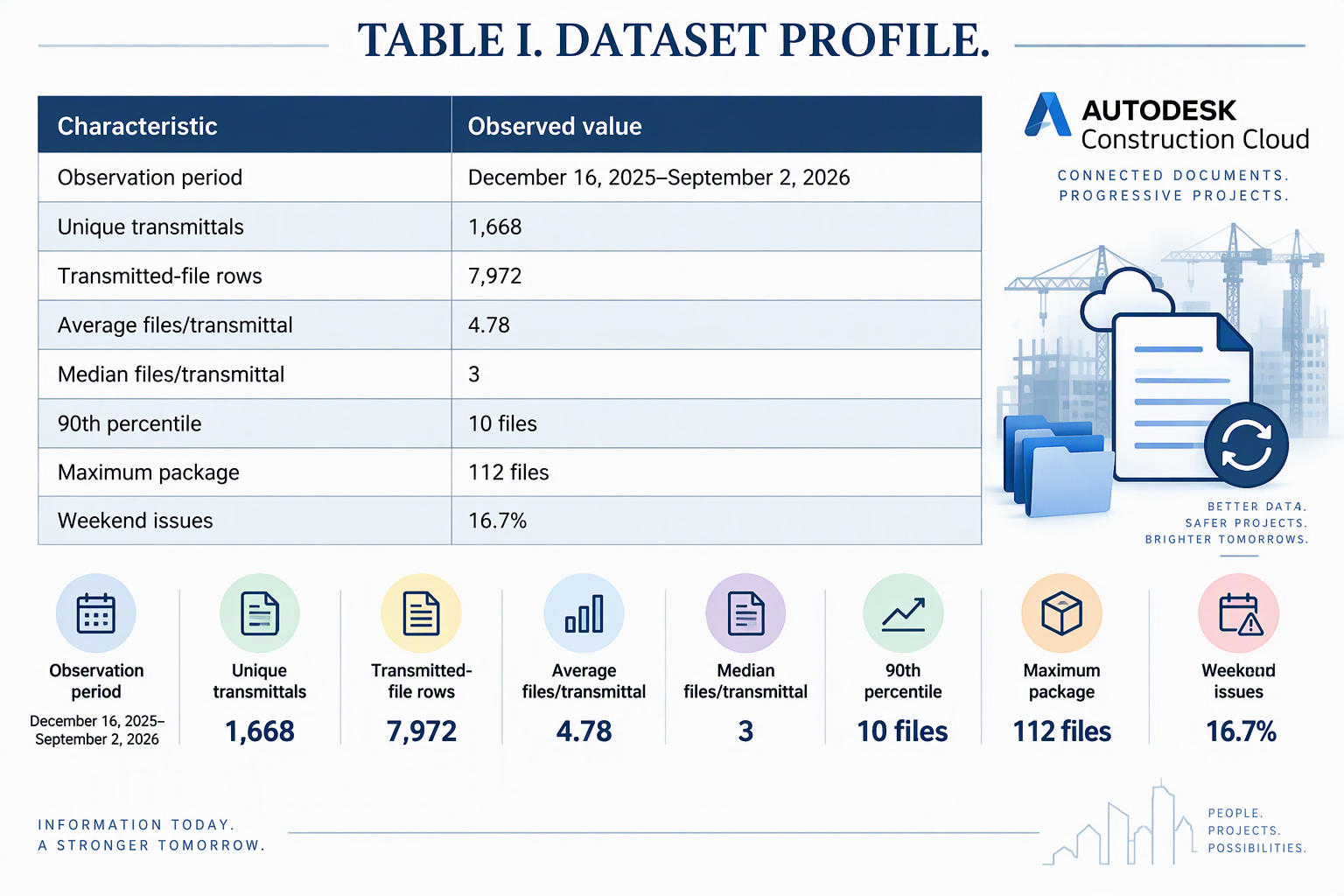
The anonymized empirical workbook [34] contained an Overview sheet and a Details sheet covering December 16, 2025, through September 2, 2026. Two units of analysis were retained: the transmittal, representing a formal issue event, and the transmitted-file row, representing one file included in that event. The Details sheet contained 7,972 file rows nested within 1,668 unique transmittals. To protect confidentiality, organization and person names, document identifiers, transmittal numbers, messages, and paths were excluded from reported outputs; analysis used only aggregate or role-based results. The unique transmittal sequence was complete from 1 through 1,668, all records were marked as sent, no void record appeared, and transmittal-level file totals reconciled exactly to the 7,972 detail rows.
TABLE I. DATASET PROFILE
B. Research Design
A retrospective descriptive case-study design was used because [34] is a complete platform export for the selected scope rather than a probability sample. Data preparation preserved the original workbook, interpreted the second Details-row as the field header, removed structural header rows, parsed dates and numeric counts, and deduplicated transmittal-level analysis by unique ID while retaining every file row for file-level measures. Missing values were not imputed. Statistics comprise counts, proportions, medians, percentiles, concentration measures, and monthly summaries, consistent with established multidimensional data-quality assessment approaches [15]-[18]. The analysis characterizes the exported evidence and does not estimate causal effects or contractual compliance.
C. Information-Quality Measures
Observed indicators were distinguished from derived indicators. Observed indicators included ID, status, sender and recipient attributes, creation and update timestamps, file name, path, platform version, description, review status, file count, and recipient actions. Field completeness was calculated as C_j = n_j/N, where n_j is the number of nonblank values for field j and N is the relevant number of transmittal or file records. Internal consistency was checked by ID-sequence continuity, uniqueness at transmittal level, and reconciliation of reported file totals to file-detail rows. Classification concentration was measured with the Herfindahl-Hirschman Index, HHI = Σs_k², where s_k is the share assigned to category k; values nearer 1 indicate stronger concentration but do not prove that a category is incorrect.
Recipient engagement was assessed using (1) the proportion of transmittals with at least one recorded view or download and (2) a weighted recipient-action rate, defined as total recorded actions divided by total listed recipient opportunities. Package complexity was summarized from transmittal file counts using the median, 90th percentile, and maximum, thereby limiting sensitivity to extreme bundles. Monthly activity was derived from creation timestamps; incomplete boundary months were retained but identified as partial periods. Title- and message-derived classifications or review codes were used only as transparent proxies where structured fields were absent and were not treated as authoritative project metadata.
D. Export-Bounded Readiness Framework
Drawing on metadata, records, information-exchange, data-quality, and assurance principles [1]-[11], [15]-[20], the study groups observable controls into five dimensions: Capture, Classify, Control, Trace, and Assure. The composite is an exploratory export diagnostic, not an ISO conformity assessment, software-capability score, or evaluation of the complete live ACC configuration. Each dimension is equally weighted and uses only reproducible indicators visible in the export. The classification component applies 100(1-HHI) as a concentration-sensitive proxy for coding differentiation, not category correctness. Reproducibility was supported by retaining the source workbook, documenting formulas and aggregation levels, reconciling counts independently at transmittal and file levels, and reporting assumptions wherever a derived proxy was used.
VI. RESULTS
A. Metadata Completeness
Core routing and audit fields were highly complete. Across 16 observed fields covering identification, sender, recipient, creation, file name, path, version, and update evidence, mean completeness was 100.0%. The transmittal message field was 99.9% complete. In contrast, file Description and structured Review status were blank across all 7,972 file rows.
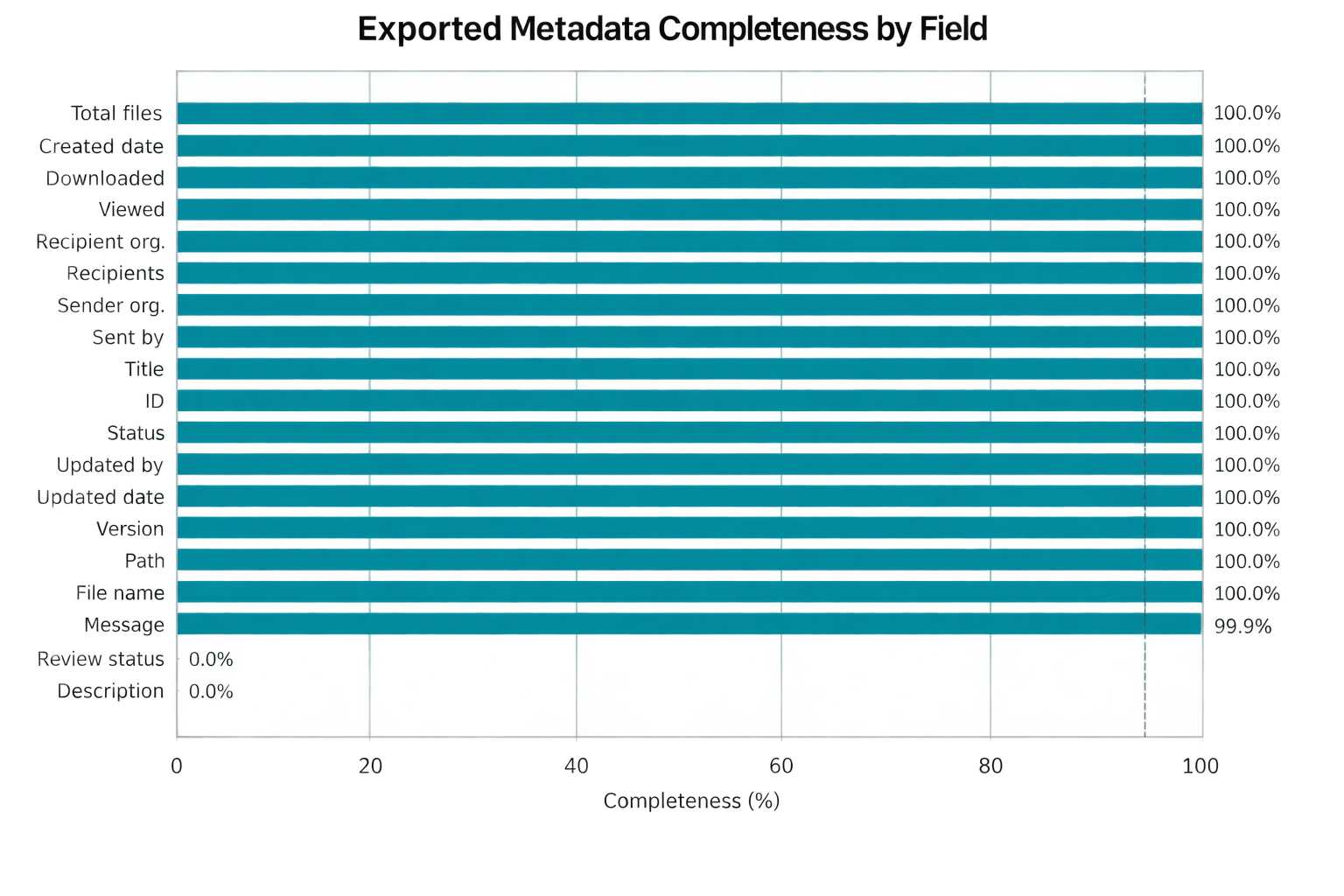
This contrast is central: the export is highly capable of proving that a package was formally issued and identifying where its files were stored, yet it provides limited structured evidence of what each file means or its review outcome. The blank fields may reflect non-use, non-applicability, a project configuration choice, or an export limitation. The export alone cannot identify which explanation is correct; a configuration and workflow audit is required.
B. Package Complexity and Format Profile
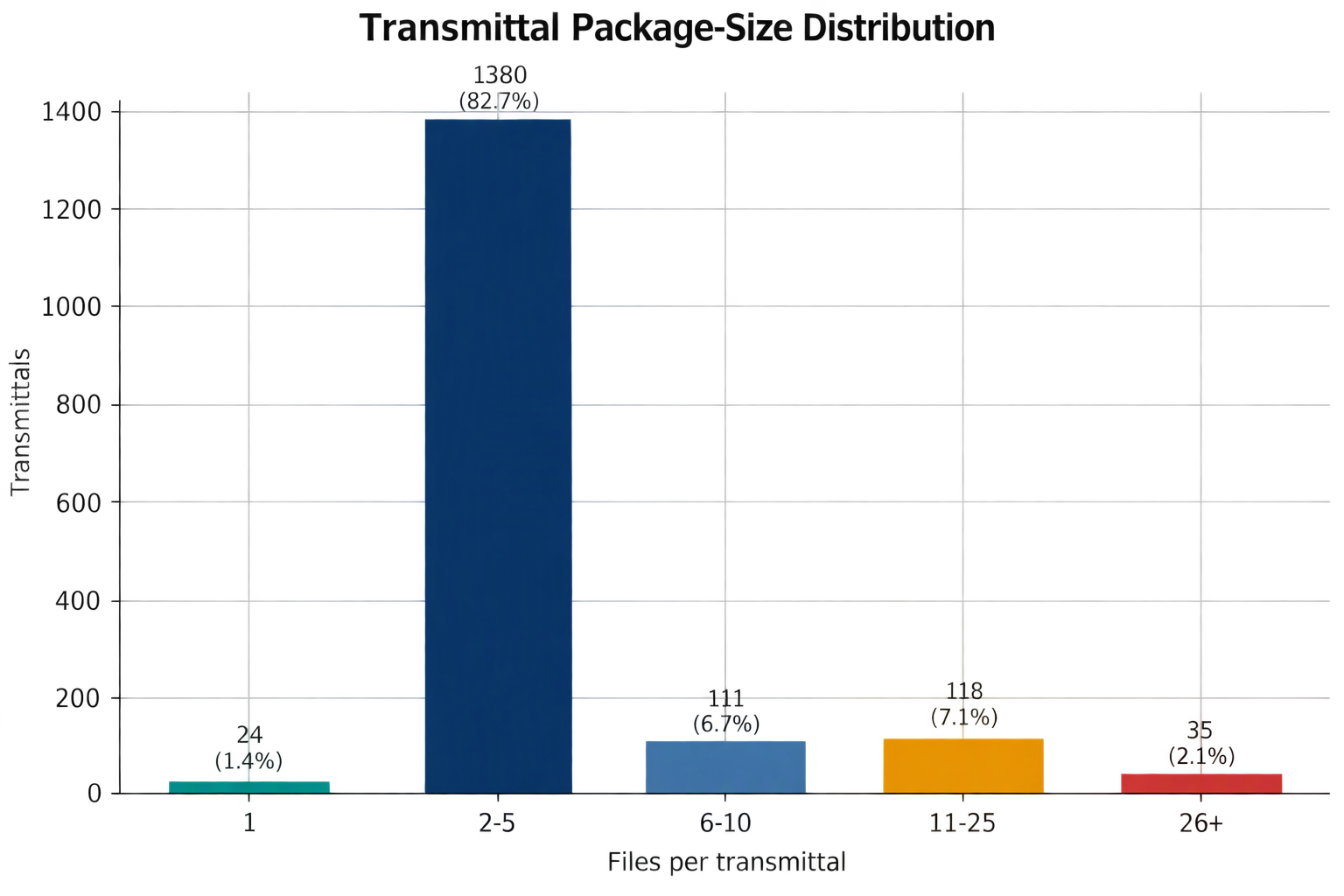
Package size was right-skewed. The median was three files, the mean was 4.78, the 90th percentile was 10, and the maximum was 112. A total of 1,380 transmittals (82.7%) contained two to five files, while 35 (2.1%) contained 26 or more. Large packages are not inherently defective, but they increase the importance of manifests, purpose-of-issue metadata, review scope, and partial-response controls, consistent with formal transmittal practices described by Autodesk [12]-[14] and information-exchange controls in ISO 19650-4 [3].
PDF files represented 89.2% of all transmitted files, followed by spreadsheet formats at 10.3%. The export showed platform versions V1 for 99.6% of file rows and V2 for 0.4%. These platform-version values should not be equated automatically with contractual document revisions, which may be encoded in file names or document metadata.
C. Temporal Workload
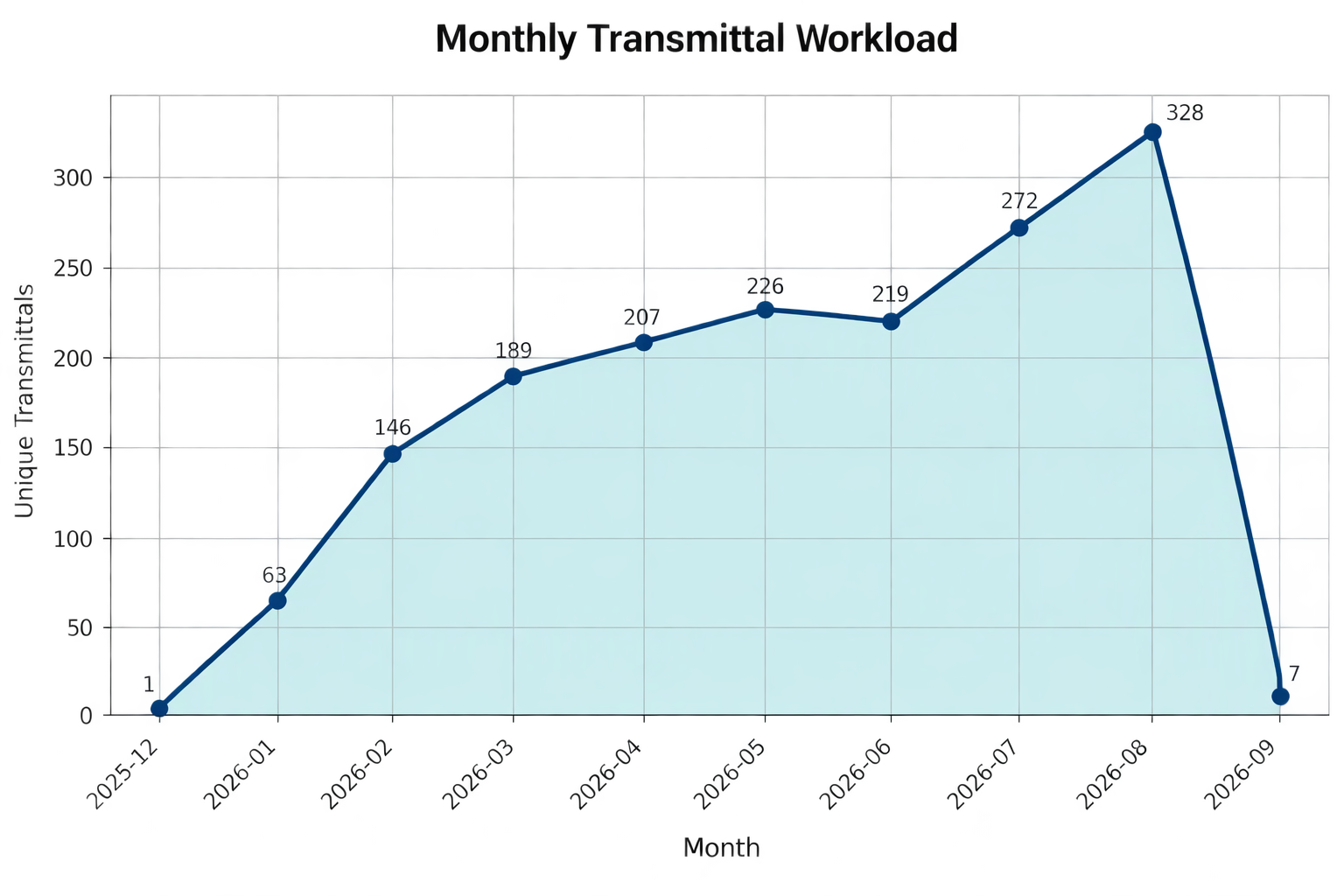
Monthly volume increased from 63 transmittals in January 2026 to 328 in August 2026. December 2025 and September 2026 are partial months. Weekend issues accounted for 16.7% of transmittals. The dataset does not contain staffing levels, deadlines, or urgency flags; therefore, the trend should be interpreted as workload exposure rather than proof of delay or under-resourcing.
D. Classification Concentration
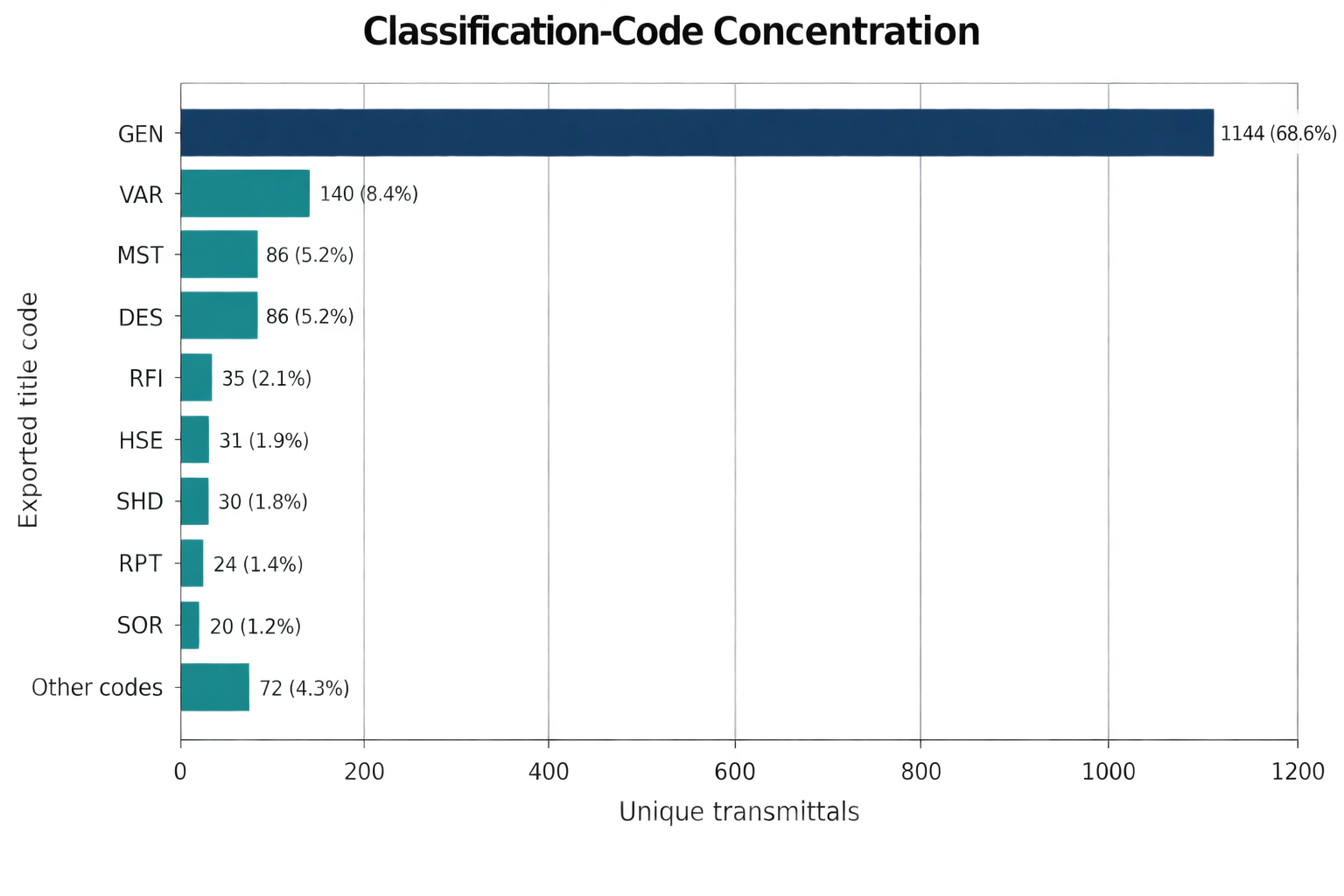
Title-based extraction identified 19 code groups. The generic GEN code accounted for 68.6% of transmittals, and the three most frequent codes accounted for 82.1%. The resulting HHI was 0.484, indicating strong concentration. Classification concentration is not automatically an error: the code may have been intentionally designed as a broad routing category. However, such concentration reduces the usefulness of the code for portfolio filtering, workload segmentation, retention rules, or discipline-specific exception reporting unless other controlled metadata provides the missing granularity.
E. Review-State Visibility and Recipient Engagement
The structured Review status field was unpopulated. Review codes could be extracted from free text in only 24.5% of unique transmittals: 77 Code 1, 159 Code 2, and 173 Code 3 records. Free text can support human interpretation, but it is difficult to validate and aggregate reliably. A controlled review-status field is preferable for machine-readable reporting and is consistent with CDE status-metadata principles [1]-[3], [10].
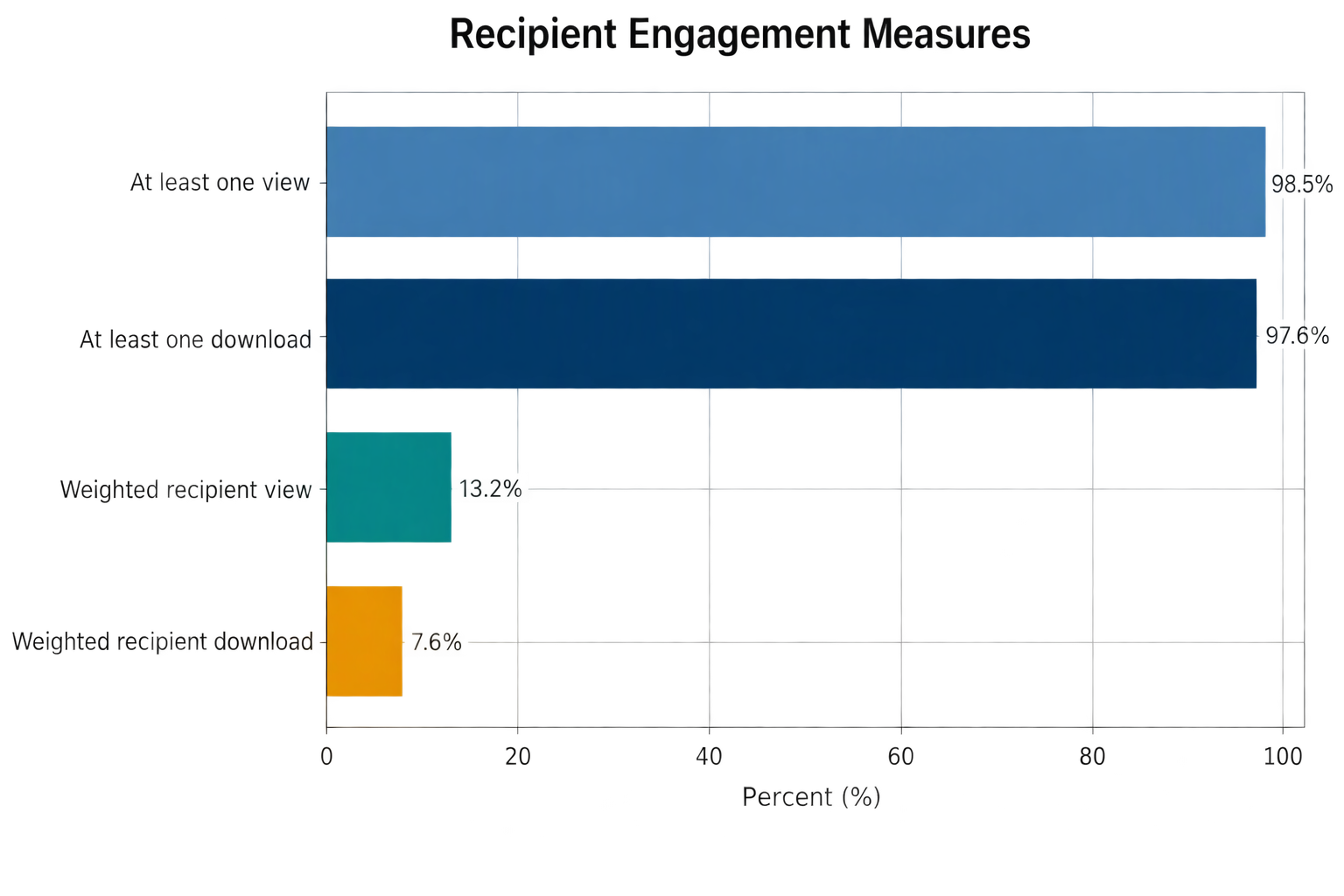
At least one recipient viewed 98.5% of transmittals, and at least one downloaded 97.6%. Weighted across all listed recipients, however, only 13.2% of view opportunities and 7.6% of download opportunities recorded an action. Wide distribution lists can make the first measure appear strong while the second remains low. Autodesk reports these as recipient activity attributes [13]; neither view nor download proves acknowledgement, understanding, acceptance, or completion of an action.
F. Information-Governance Readiness Profile
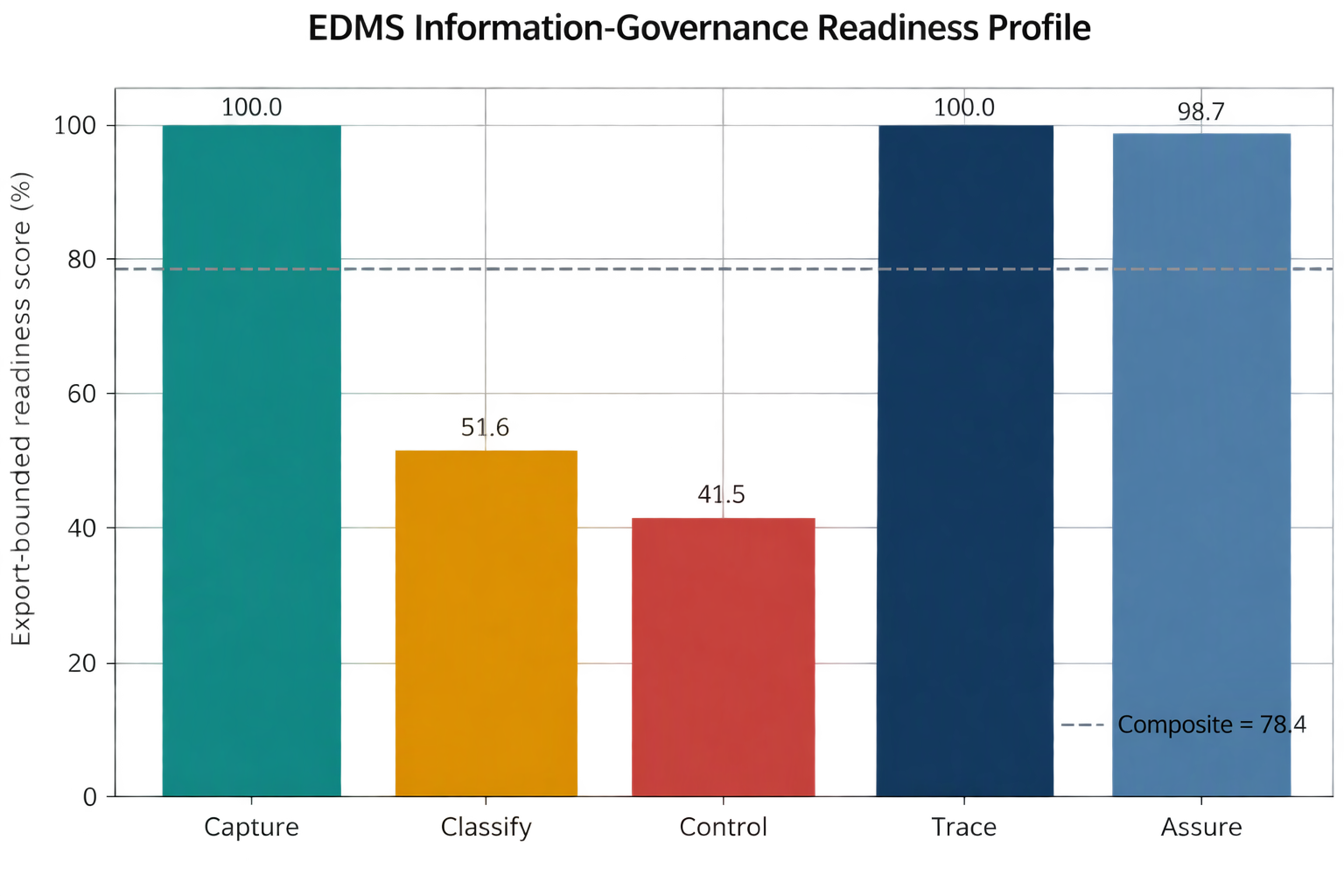
The export-bounded diagnostic produced a composite readiness value of 78.4%. Capture (100.0%) and Trace (100.0%) were strong because identifiers, routing, paths, timestamps, and update evidence were available. Assure (98.7%) was also high at the limited issue-and-engagement level. Classify (51.6%) was constrained by code concentration, while Control (41.5%) was reduced by the absence of structured review status and partial reliance on free-text review codes.
VII. DISCUSSION
A. Strong Issue Evidence, Weak Semantic State
Consistent with the distinction between transaction capture and fitness-for-use quality [15]-[18], the dataset preserves an excellent transmission skeleton: unique IDs, titles, senders, recipients, timestamps, file names, paths, versions, update information, and recipient actions. This supports retrieval and audit of formal issue events, which are core concerns of records and metadata standards [5]-[7]. The principal weakness is semantic: the exported rows do not consistently express document description, structured review state, response requirement, due date, action owner, parent submission, linked response, or closure.
B. Platform Capability Versus Project Configuration
Autodesk documents transmittal export attributes that include file description and review status [13]. Their presence as blank columns means the study must not conclude that the platform lacks these capabilities. The defensible conclusion is narrower: these values were not populated in the analyzed export. Causes may include process design, permissions, configuration, user practice, source-field non-use, or export context.
C. View and Download Are Not Closure
Recipient actions provide useful distribution evidence, but governance requires explicit responsibilities. Consistent with governance accountability and records-management principles [5]-[7], [19], [20], critical records should identify the action owner, information-only recipients, acknowledgement requirement, due date, decision, and closure. A low weighted recipient rate may be acceptable for broad courtesy distribution yet unacceptable for a small group of mandatory reviewers. Role-based denominators are therefore required.
D. Revisions Require Semantic Separation
The dominance of V1 in the export describes the platform file version visible at transmittal creation. It does not demonstrate that most engineering documents had no revisions. Contractual revisions, work-in-progress versions, status codes, and platform versions should be maintained as separate but linked concepts. UK BIM Framework guidance explicitly stresses metadata for revision, status, and classification within CDE workflows [10], [11].
VIII. PROPOSED GOVERNANCE FRAMEWORK
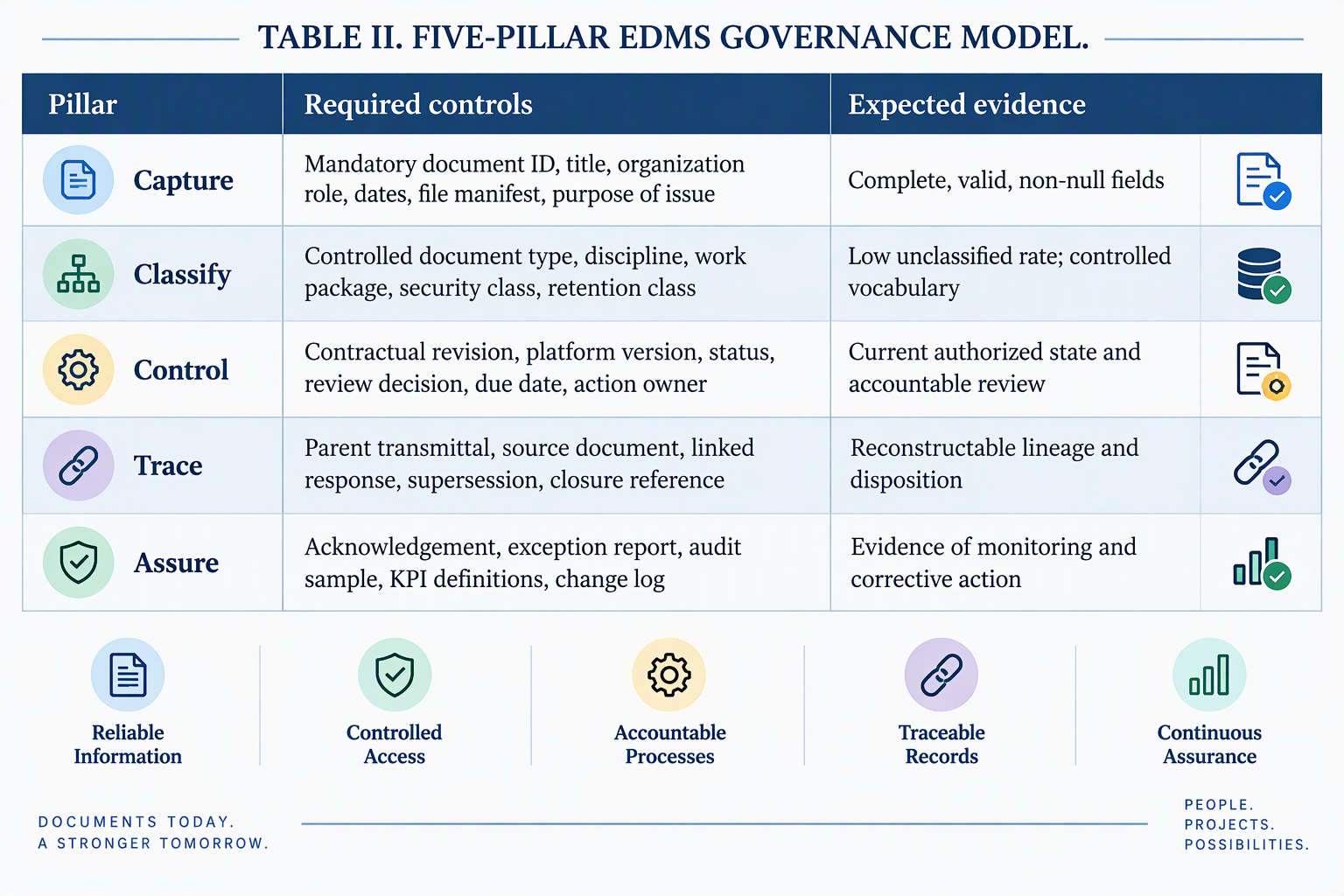
The recommended framework converts the transmittal report from a record of issue into a governed information asset. It operationalizes the metadata, records-control, status, revision, and audit principles established in [1]-[11], [19], [20] through five pillars: Capture, Classify, Control, Trace, and Assure.
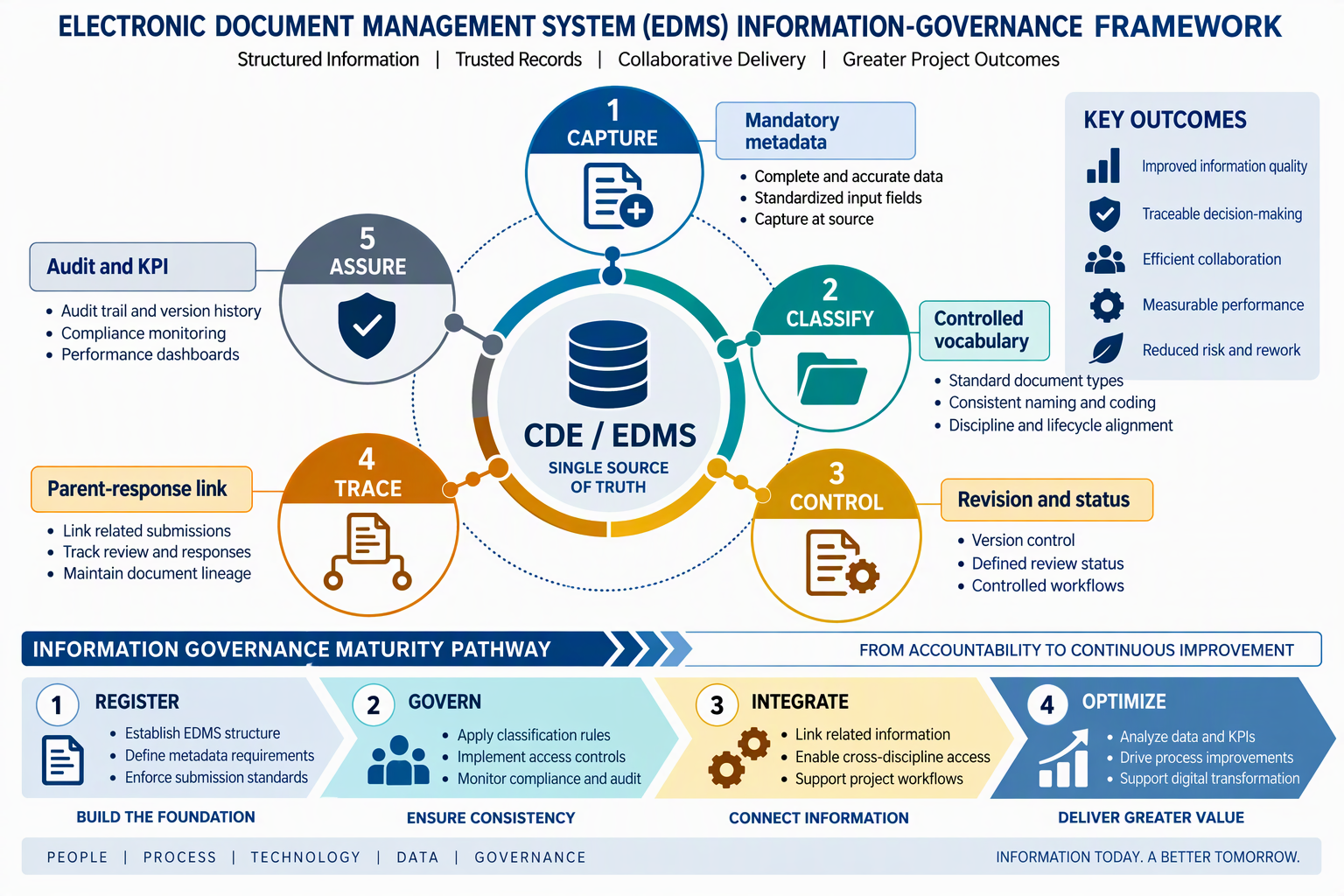
TABLE II. FIVE-PILLAR EDMS GOVERNANCE MODEL.
IX. KPI AND EXCEPTION-REPORTING DESIGN
TABLE III. RECOMMENDED KPI DATA DICTIONARY.
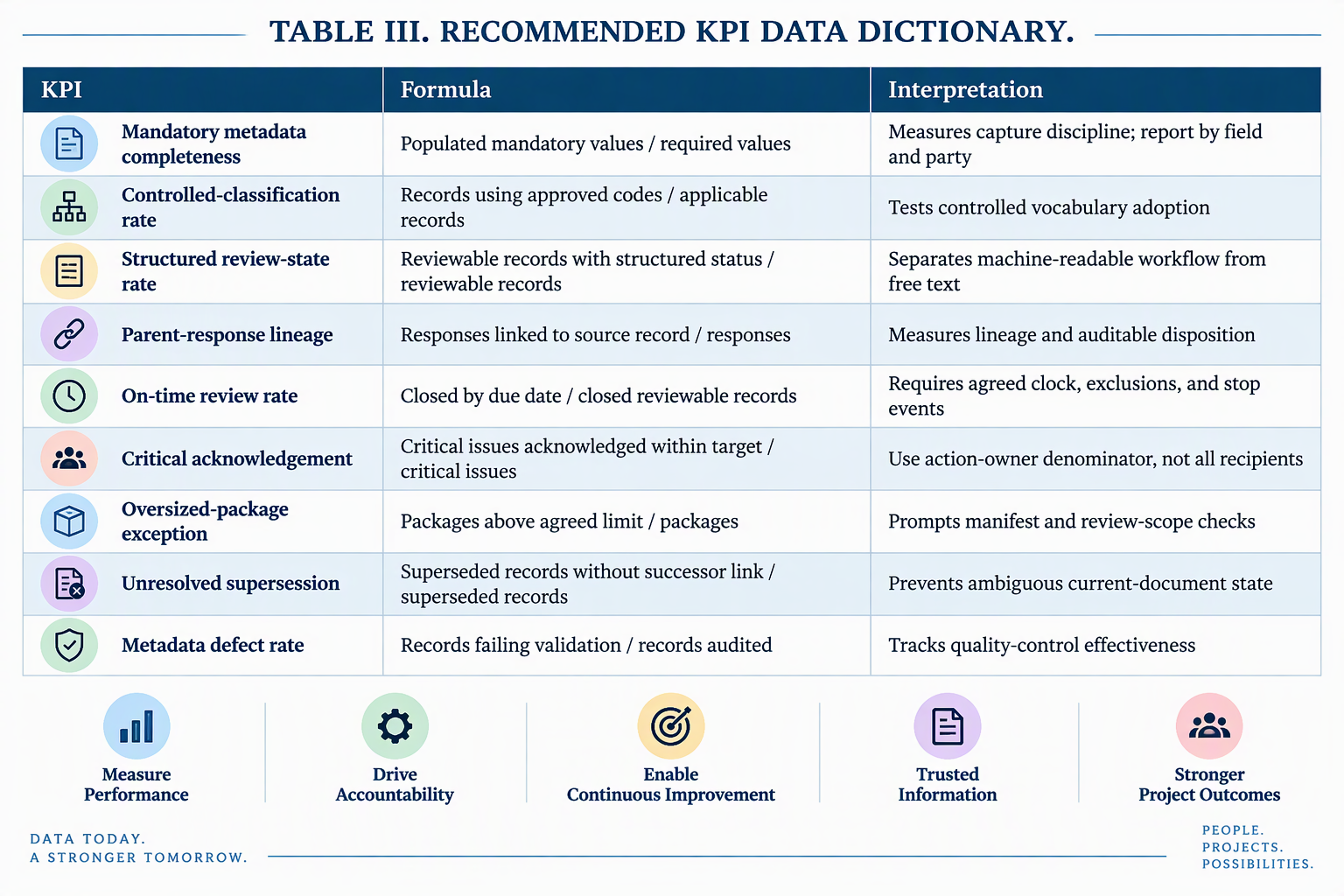
Targets should be approved through project information requirements, records policies, and contract procedures rather than inferred from this dataset [1]-[11], [19], [20]. A weekly exception report should prioritize missing mandatory metadata, invalid codes, reviewable items without owners or due dates, responses without source links, critical records without acknowledgement, unusually large packages, and superseded records without successor references.
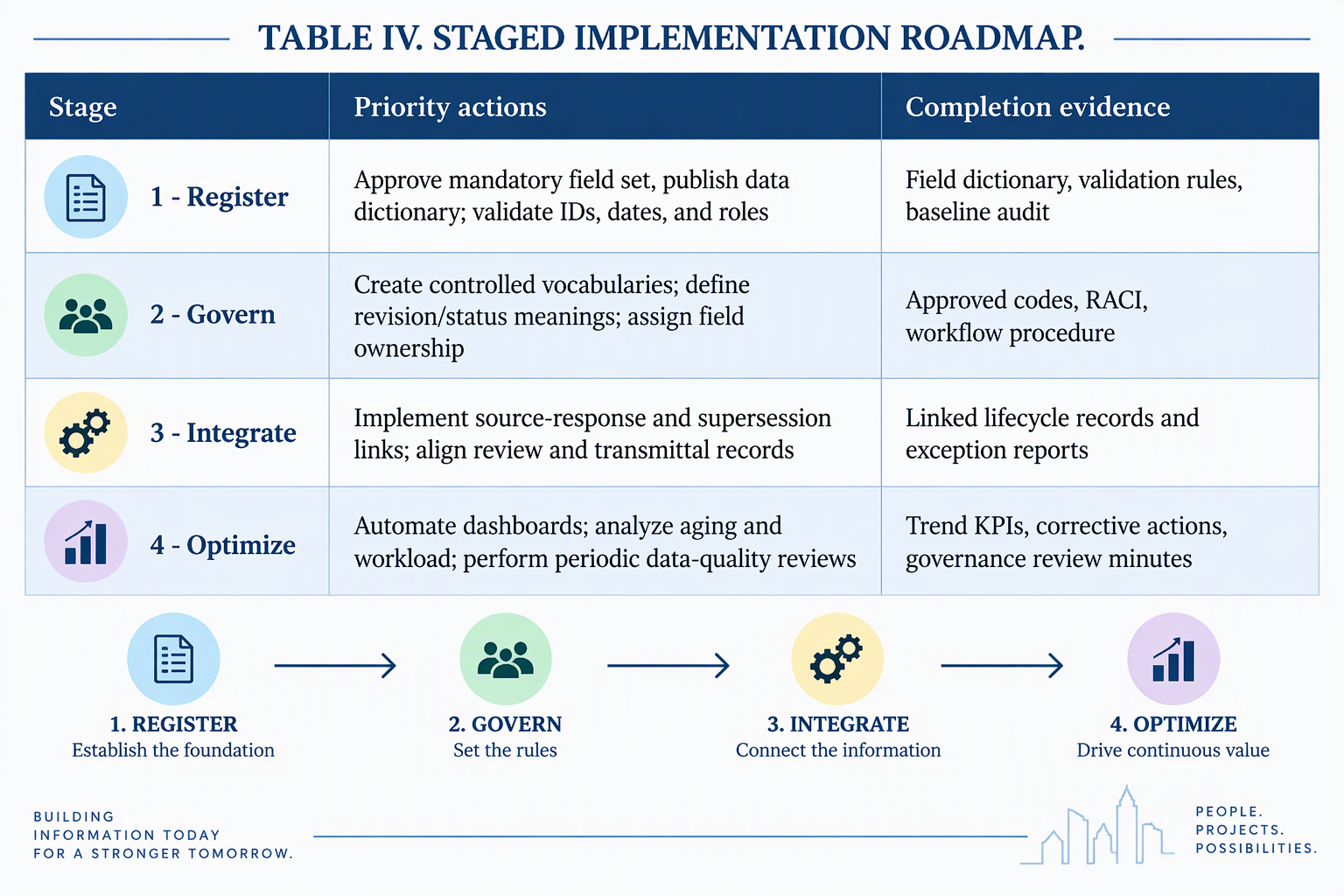
X. IMPLEMENTATION ROADMAP
TABLE IV. STAGED IMPLEMENTATION ROADMAP.
XI. LIMITATIONS AND VALIDITY
A. ACC Export Boundaries
This study is based on a static export generated from Autodesk Construction Cloud (ACC) rather than direct interrogation of the complete live project environment. Consequently, the analysis is limited to the fields, values, relationships, and platform activities represented in the exported dataset. The absence of a value in an exported field does not necessarily demonstrate the absence of the corresponding capability within ACC. Blank fields may result from project configuration, workflow design, permissions, non-use, non-applicability, or characteristics of the export process itself. Accordingly, findings concerning metadata availability should be interpreted as observations about the analyzed export rather than definitive assessments of the complete functionality of Autodesk Construction Cloud.
B. Dataset and Content Constraints
The empirical dataset comprises 1,668 unique transmittals and 7,972 transmitted-file records from a single anonymized construction-project environment over the defined observation period. Although the dataset provides substantial evidence of formal information exchanges, it does not contain every contextual variable required to reconstruct the complete document lifecycle. In particular, the export does not consistently provide structured information concerning action ownership, contractual due dates, acknowledgement requirements, review commencement, stop-clock events, final disposition, supersession relationships, or formal closure. Consequently, the study cannot independently determine whether every transmitted document required a response, whether a review was completed within a contractual period, or whether an information exchange was formally closed. The dataset should therefore be regarded as a bounded representation of EDMS activity rather than a complete project information-management record.
C. Methodological Constraints
The study employs a retrospective descriptive case-study methodology. Measures of metadata completeness, classification concentration, package complexity, recipient activity, temporal workload, and governance readiness are intended to characterize observable patterns rather than establish causal relationships. Where structured metadata was unavailable, title-derived classifications and free-text review codes were used as transparent analytical proxies. These derived indicators may not correspond exactly to the project’s authoritative data dictionary, classification system, or contractual review terminology. The five-pillar Capture-Classify-Control-Trace-Assure readiness framework is an original diagnostic developed for this study. Although its indicators are transparent and reproducible, the resulting readiness score should not be interpreted as an ISO certification, formal maturity rating, contractual compliance score, or assessment of Autodesk software capability. Similarly, the Herfindahl-Hirschman Index measures classification concentration rather than classification correctness. A highly concentrated structure may be intentional and therefore requires procedural verification before being characterized as a governance deficiency.
D. External Validity
The research represents a single-project empirical case study. Project governance arrangements, contractual requirements, document-control procedures, organizational structures, metadata configurations, and ACC implementations may differ substantially across projects and organizations. The numerical findings should therefore not be generalized automatically to other Autodesk Construction Cloud environments, construction projects, organizations, industries, geographic regions, or alternative EDMS/CDE platforms. Broader validation would require comparative studies involving multiple projects, organizations, contractual environments, and information-management configurations. The principal transferable contribution of this research is therefore the assessment methodology and governance framework, rather than the specific numerical results observed in the analyzed dataset.
E. Interpretation of Platform Activity
Platform-generated activity requires careful interpretation. A recorded view indicates that ACC registered viewing activity; it does not independently demonstrate acknowledgement, comprehension, technical review, approval, or acceptance. A recorded download demonstrates file-access activity but does not establish that the recipient reviewed the information, accepted responsibility for an action, or completed a required workflow. Likewise, a creation or update timestamp does not necessarily represent contractual receipt, review commencement, or contractual response time; a platform file version should not automatically be interpreted as the contractual engineering-document revision; transmittal volume does not independently measure productivity, workload efficiency, backlog, or document-control performance; missing structured review metadata does not prove that technical review did not occur; recipient activity should not be used to evaluate individual employee performance; high metadata completeness does not independently establish semantic accuracy or fitness for purpose; and a formally transmitted document is not necessarily approved, accepted, or closed. These distinctions are particularly important when EDMS data are used for dashboards, management reporting, contractual analysis, or performance measurement.
F. Boundary of Conclusions
Accordingly, the conclusions of this study are limited to the data-quality characteristics, traceability evidence, and information-governance signals observable within the analyzed ACC export. The findings support targeted verification of metadata configuration, classification practices, workflow rules, review-state capture, lineage controls, acknowledgement mechanisms, and project information-management procedures. They do not support conclusions regarding individual employee performance, technical document quality, contractual compliance, legal receipt, organizational effectiveness, or the overall capability of Autodesk Construction Cloud. The study should therefore be interpreted as an export-bounded EDMS governance assessment designed to identify opportunities for stronger metadata, traceability, auditability, and information-management controls.
XII. CONCLUSION
The ACC export demonstrates a mature ability to preserve formal issue events: 1,668 unique transmittals reconcile to 7,972 transmitted-file rows, with complete identifiers, routing information, paths, and timestamps. Its principal analytical constraint is not missing transaction evidence but missing structured semantics. File descriptions and review status were absent from the export, a generic code dominated classification, review outcomes were partly embedded in free text, and recipient activity could not establish accountable acknowledgement or closure.
The strongest improvement is to govern metadata as deliberately as documents. Mandatory capture, controlled classification, explicit revision and review state, parent-response lineage, role-based acknowledgement, and exception-led assurance would convert the export from a reliable issue register into a more complete information-governance dataset. Future research should compare successive exports after implementation and test whether improved structured metadata increases linkage coverage, reduces manual reconciliation, and strengthens review and closure reporting.
ACKNOWLEDGMENT
The author acknowledges the practical contribution of document-control and project-delivery personnel whose routine use of the CDE generated the operational dataset. All organization and personal identifiers were removed from the study.
REFERENCES
[1] International Organization for Standardization, Organization and Digitization of Information About Buildings and Civil Engineering Works, Including Building Information Modelling (BIM)—Information Management Using Building Information Modelling—Part 1: Concepts and Principles, ISO 19650-1:2018, Geneva, Switzerland, 2018.
[2] International Organization for Standardization, Organization and Digitization of Information About Buildings and Civil Engineering Works, Including Building Information Modelling (BIM)—Information Management Using Building Information Modelling—Part 2: Delivery Phase of the Assets, ISO 19650-2:2018, Geneva, Switzerland, 2018.
[3] International Organization for Standardization, Organization and Digitization of Information About Buildings and Civil Engineering Works, Including Building Information Modelling (BIM)—Information Management Using Building Information Modelling—Part 4: Information Exchange, ISO 19650-4:2022, Geneva, Switzerland, 2022.
[4] International Organization for Standardization, Organization and Digitization of Information About Buildings and Civil Engineering Works, Including Building Information Modelling (BIM)—Information Management Using Building Information Modelling—Part 5: Security-Minded Approach to Information Management, ISO 19650-5:2020, Geneva, Switzerland, 2020.
[5] International Organization for Standardization, Information and Documentation—Records Management—Part 1: Concepts and Principles, ISO 15489-1:2016, Geneva, Switzerland, 2016.
[6] International Organization for Standardization, Information and Documentation—Records Management Processes—Metadata for Records—Part 1: Principles, ISO 23081-1:2017, Geneva, Switzerland, 2017.
[7] International Organization for Standardization, Information and Documentation—Management Systems for Records—Requirements, ISO 30301:2019, Geneva, Switzerland, 2019.
[8] International Organization for Standardization and International Electrotechnical Commission, Software Engineering—Software Product Quality Requirements and Evaluation (SQuaRE)—Data Quality Model, ISO/IEC 25012:2008, Geneva, Switzerland, 2008.
[9] International Organization for Standardization, Data Quality—Part 61: Data Quality Management: Process Reference Model, ISO 8000-61:2016, Geneva, Switzerland, 2016.
[10] UK BIM Framework, “Information management according to BS EN ISO 19650: Guidance Part C—Facilitating the common data environment (workflow and technical solutions),” Sep. 2020. [Online]. Available: https://ukbimframework.org/wp-content/uploads/2020/09/Guidance-Part-C_Facilitating-the-common-data-environment-workflow-and-technical-solutions_Edition-1.pdf. Accessed: Nov. 6, 2026.
[11] UK BIM Framework, “Information management according to BS EN ISO 19650: Guidance Part A—The information management function and resources,” 2nd ed., Feb. 2021. [Online]. Available: https://www.ukbimframework.org/wp-content/uploads/2021/02/Guidance-Part-A_The-information-management-function-and-resources_Edition-2.pdf. Accessed: Nov. 6, 2026.
[12] Autodesk, “Transmittals,” Autodesk Knowledge Network. [Online]. Available: https://help.autodesk.com/cloudhelp/ENU/BIM360D-Document-Management/files/BIM360D_Document_Management_about_transmittals_html.html. Accessed: Nov. 6, 2026.
[13] Autodesk, “View and Manage Transmittals,” Autodesk Docs Help. [Online]. Available: https://help.autodesk.com/cloudhelp/ENG/Docs-Transmittals/files/View_Transmittal.html. Accessed: Nov. 6, 2026.
[14] Autodesk, “Create Transmittals,” Autodesk Docs Help. [Online]. Available: https://help.autodesk.com/cloudhelp/ENU/Docs-Transmittals/files/Create_Transmittal.html. Accessed: Nov. 6, 2026.
[15] R. Y. Wang and D. M. Strong, “Beyond accuracy: What data quality means to data consumers,” J. Manage. Inf. Syst., vol. 12, no. 4, pp. 5–33, 1996, doi: 10.1080/07421222.1996.11518099.
[16] C. Batini, C. Cappiello, C. Francalanci, and A. Maurino, “Methodologies for data quality assessment and improvement,” ACM Comput. Surv., vol. 41, no. 3, Art. no. 16, 2009, doi: 10.1145/1541880.1541883.
[17] L. L. Pipino, Y. W. Lee, and R. Y. Wang, “Data quality assessment,” Commun. ACM, vol. 45, no. 4, pp. 211–218, 2002, doi: 10.1145/505248.506010.
[18] Y. W. Lee, D. M. Strong, B. K. Kahn, and R. Y. Wang, “AIMQ: A methodology for information quality assessment,” Inf. Manage., vol. 40, no. 2, pp. 133–146, 2002, doi: 10.1016/S0378-7206(02)00043-5.
[19] V. Khatri and C. V. Brown, “Designing data governance,” Commun. ACM, vol. 53, no. 1, pp. 148–152, 2010, doi: 10.1145/1629175.1629210.
[20] R. Abraham, J. Schneider, and J. vom Brocke, “Data governance: A conceptual framework, structured review, and research agenda,” Int. J. Inf. Manage., vol. 49, pp. 424–438, 2019, doi: 10.1016/j.ijinfomgt.2019.07.008.
[21] B. Succar, “Building information modelling framework: A research and delivery foundation for industry stakeholders,” Autom. Constr., vol. 18, no. 3, pp. 357–375, 2009, doi: 10.1016/j.autcon.2008.10.003.
[22] V. Singh, N. Gu, and X. Wang, “A theoretical framework of a BIM-based multi-disciplinary collaboration platform,” Autom. Constr., vol. 20, no. 2, pp. 134–144, 2011, doi: 10.1016/j.autcon.2010.09.011.
[23] N. Gu and K. London, “Understanding and facilitating BIM adoption in the AEC industry,” Autom. Constr., vol. 19, no. 8, pp. 988–999, 2010, doi: 10.1016/j.autcon.2010.09.002.
[24] D. Bryde, M. Broquetas, and J. M. Volm, “The project benefits of building information modelling (BIM),” Int. J. Project Manage., vol. 31, no. 7, pp. 971–980, 2013, doi: 10.1016/j.ijproman.2012.12.001.
[25] K. Miettinen and S. Paavola, “Beyond the BIM utopia: Approaches to the development and implementation of building information modeling,” Autom. Constr., vol. 43, pp. 84–91, 2014, doi: 10.1016/j.autcon.2014.03.009.
[26] R. Volk, J. Stengel, and F. Schultmann, “Building Information Modeling (BIM) for existing buildings—Literature review and future needs,” Autom. Constr., vol. 38, pp. 109–127, 2014, doi: 10.1016/j.autcon.2013.10.023.
[27] P. Demian and D. Walters, “The advantages of information management through building information modelling,” Eng., Constr. Archit. Manage., vol. 21, no. 6, pp. 1153–1165, 2014, doi: 10.1108/ECAM-06-2013-0056.
[28] R. Davies and C. Harty, “Implementing ‘Site BIM’: A case study of ICT innovation on a large hospital project,” Autom. Constr., vol. 30, pp. 15–24, 2013, doi: 10.1016/j.autcon.2012.11.024.
[29] S. Azhar, “Building information modeling (BIM): Trends, benefits, risks, and challenges for the AEC industry,” Leadership Manage. Eng., vol. 11, no. 3, pp. 241–252, 2011, doi: 10.1061/(ASCE)LM.1943-5630.0000127.
[30] Z. Turk, “Ten questions concerning building information modelling,” Build. Environ., vol. 107, pp. 274–284, 2016, doi: 10.1016/j.buildenv.2016.08.001.
[31] J. Whyte and T. Hartmann, “How digitizing building information transforms the built environment,” Build. Res. Inf., vol. 45, no. 6, pp. 591–595, 2017, doi: 10.1080/09613218.2017.1324726.
[32] T. M. Froese, “The impact of emerging information technology on project management for construction,” Autom. Constr., vol. 19, no. 5, pp. 531–538, 2010, doi: 10.1016/j.autcon.2009.11.004.
[33] C. Eastman, P. Teicholz, R. Sacks, and K. Liston, BIM Handbook: A Guide to Building Information Modeling for Owners, Designers, Engineers, Contractors, and Facility Managers, 3rd ed. Hoboken, NJ, USA: Wiley, 2018.
[34] D. G. Samontina, Jr., “Anonymized Autodesk Construction Cloud transmittals export: 1,668 transmittals and 7,972 transmitted-file records,” unpublished operational dataset, Sep. 2, 2026.
APPENDIX A - REPRODUCIBLE ANALYTICAL RULES
A unique transmittal was identified by the exported transmittal ID; duplicate file rows were collapsed only for transmittal-level measures.
Completeness equals non-null observations divided by the relevant record count.
File-package size uses the Total files value on one deduplicated transmittal row.
Classification codes were parsed from the title pattern following “TRN”; unidentified patterns were labeled Unclassified.
Review codes were extracted from title and message text using explicit “Code 1,” “Code 2,” or “Code 3” patterns.
Weighted recipient engagement divides total recorded views or downloads by total listed recipient opportunities.
Organization roles replaced all organization names; no raw title, filename, path, document number, recipient list, or personal name is reproduced.
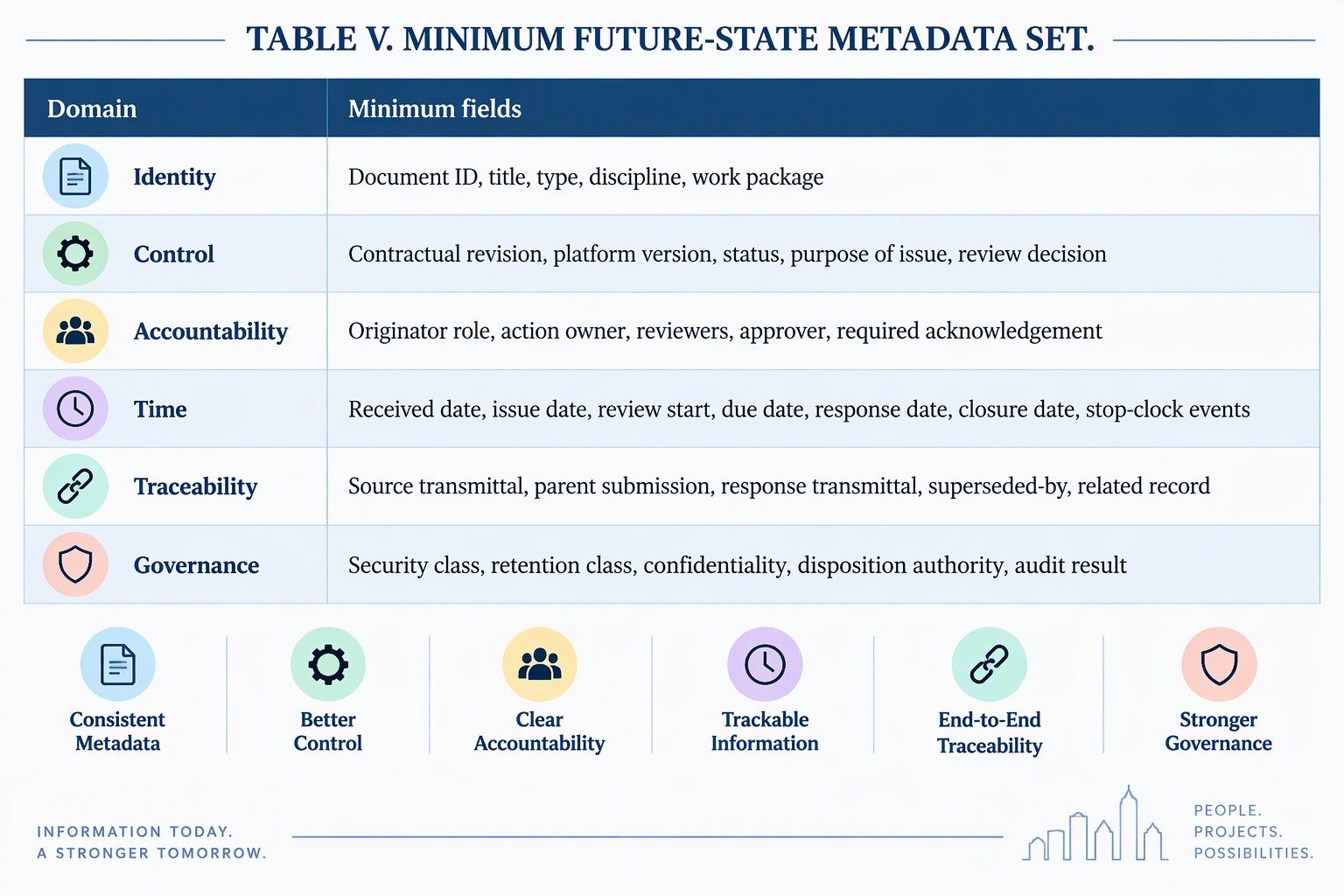
APPENDIX B - MINIMUM FUTURE-STATE METADATA
TABLE V. MINIMUM FUTURE-STATE METADATA SET.
The complete PDF of this paper is available below:
About the Creator
Domingo Añasco-Gaces Samontina, Jr.
.Professional Member of the Mechatronics and Robotics Society of the Philippines
.Certified Documented Information Controller with TUV Rheinland Qualifications
.Master of Science in Engineering (on-going) with Professional Teacher Certificate
Enjoyed the story? Support the Creator.
Subscribe for free to receive all their stories in your feed.
Comments
There are no comments for this story
Be the first to respond and start the conversation.