
The $9.99 Question: Can a Writer Actually Make Money on Vocal Media?
Follow one new writer through her first publishing decisions, the reality of reading payments, and the cost of turning an online writing habit into an income source.
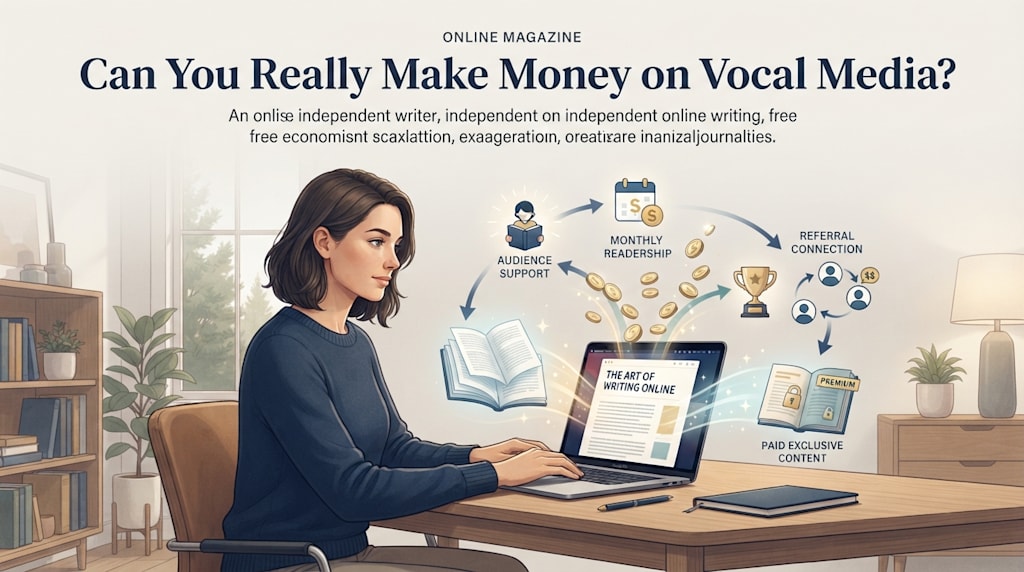
At 10:38 on a Sunday night, Claire had 742 words on her laptop screen and a question she had been thinking about for weeks.
Could writing on Vocal Media pay for itself?
She had spent the evening working on an article about a subject she knew well. She had corrected the introduction twice, removed a paragraph that sounded too much like an advertisement, and spent twenty minutes looking for an image that would fit the story.
The article was ready. The question of money came next.
A friend had told her about Vocal's payment system. Writers could earn from reads, receive tips, offer exclusive content, and enter competitions for cash prizes. It sounded like a reasonable way to turn a writing habit into something that might eventually pay for itself.
Claire opened another browser tab and looked at the Vocal+ membership price.
$9.99 per month.
She paused before clicking anything.
Before paying for a writing platform, she wanted to know what she would actually be buying.
The First Story Has to Find Its Readers
Claire's first surprise came when she started preparing her account.
Vocal is a publishing platform for writers and other creative people. It accepts fiction, creative nonfiction, opinions, reviews, and other forms of English-language content.
Articles are placed in topic-based Communities. Writers choose a suitable category when submitting a story, and Vocal's moderation team can adjust the placement if necessary.
The platform has a minimum length requirement of 600 English words for ordinary stories. Poetry has a 100-word minimum. Every submission also needs a title, subtitle, and featured image or video.
Claire's 742-word article met the length requirement. She still had to decide which Community suited it and find a featured image she had permission to use.
There was another requirement she could not skip.
Vocal's updated publishing rules require creators to connect a Stripe account before submitting or publishing stories. The platform uses this process to verify creators and prepare their payment accounts.
That meant Claire had to complete the payment setup before her article could go live.
She eventually submitted the story.
Now came the part that most new writers underestimate: waiting for somebody to read it.
An article can be published without receiving much attention. Appearing in a Community does not guarantee a large audience, and sharing a link does not guarantee that visitors will stay.
Claire began to understand that publishing and attracting readers were two separate tasks.
A Thousand Reads and the Question of Money
A few days after publishing, Claire returned to her account and opened the statistics.
She was looking for a number that would answer her original question. How much money could those reads produce?
Vocal does not treat every page visit as an eligible Read. Its engagement calculation considers how long a reader stays on the page and how far down the article they scroll.
Someone who opens a story and leaves immediately may not generate a qualifying Read.
This changes how Claire thinks about her next article.
A headline can attract a visitor, but the introduction has to give that person a reason to continue. The article needs to deliver what the headline promised.
She also learns something important about membership.
Under Vocal's updated Terms of Use, Read Earnings are reserved for Vocal+ members. Free creators can publish and receive tips, but they do not earn from article reads. The current payment rate for Vocal+ is published on the membership page and can change.
Claire now has a decision to make.
Should she pay $9.99 every month before knowing whether readers will return?
She leaves the upgrade page open and moves to another feature.
The Five-Dollar Tip
A reader can support a Vocal creator with a one-time tip.
Unlike Read Earnings, tips are available to both free and Vocal+ creators, provided they have connected Stripe.
Claire likes this option because she does not need to persuade someone to purchase a monthly subscription. A reader can simply decide that an article was useful enough to support.
The payment fees still matter.
Vocal charges a transfer fee of 7% for free creators and 2.9% for Vocal+ creators. Stripe also applies its own payment-processing fees.
On a hypothetical $5 tip, Vocal's transfer fee would be 35 cents for a free creator and 14.5 cents for a Vocal+ creator, before Stripe's separate processing fee.
The difference is small on one payment. Repeated transactions make it more noticeable.
But Claire sees a problem with relying on tips.
A reader might enjoy her article, finish it, and leave without sending anything. That is entirely normal. A tip is a voluntary payment, not an automatic reward for every person who visits a page.
She decides to keep writing useful public articles rather than build her income plan around money readers may or may not send.
The Subscription Question
A few days later, Claire visits another writer's profile and finds exclusive content.
This interests her more than the one-time tip.
Vocal+ creators can enable Creator Subscriptions, allowing readers to make recurring payments in support of their work. The platform also offers Exclusive Stories, which can be reserved for paying subscribers.
This changes the way a writer might organize their content.
Claire imagines publishing a public article that explains a subject clearly. A reader who wants more could subscribe for access to detailed research, extended case studies, serialized fiction, or behind-the-scenes material.
The idea sounds attractive, but it requires more than a payment button.
A subscription creates an expectation. Readers who pay regularly will expect the creator to continue producing material that gives them a reason to stay.
Vocal's rules also connect Exclusive Stories to an active Vocal+ membership and a Stripe account. If the creator disables the feature or cancels Vocal+, subscribers lose access to the exclusive content and the creator stops receiving subscription income.
Claire looks at her existing article again.
Would she pay a stranger every month for more of the same material?
She is not sure.
She decides that paid content can wait until she has readers who actually ask for more.
The Writing Competition That Might Pay
Claire then discovers Vocal Challenges.
These are writing competitions with individual themes, deadlines, entry requirements, and prize arrangements.
Some are open to free creators, while others are restricted to Vocal+ members. The eligibility rules and prize amounts depend on each competition.
A previously published article may also qualify for a Challenge if it meets the submission requirements.
Claire finds one with a topic related to an article she has already written. She considers submitting it, but the rules require a different angle.
She spends another evening revising the piece.
There is no guarantee she will win.
A competition can produce additional income, but it can also consume several hours of research and writing without generating a payment. The prize belongs in the category of possible earnings, not guaranteed monthly income.
Vocal also has a weekly Leaderboard. Its current Terms explain that creators on both free and paid plans may qualify for bonuses based on their placement. The reward amounts can change.
Claire adds these possibilities to her notes, but she does not include any of them in her expected monthly earnings.
What Does Vocal+ Actually Cost?
By now, the $9.99 question has returned.
Vocal's published Terms list a monthly membership at $9.99 and an annual membership at $99, before applicable taxes.
The annual option costs less than paying the monthly fee for twelve months. However, the membership renews automatically until cancelled, and the subscription fee is non-refundable.
Claire opens a calculator.
She knows the fee savings on tips alone would not justify upgrading unless she received enough payments.
At a 4.1-percentage-point difference in Vocal's transfer fees, she would need roughly $2.44 in monthly tips to offset a $9.99 membership through this saving alone, excluding Stripe processing fees and other costs.
There are other reasons to upgrade, particularly Read Earnings and paid subscriptions. Those features could change the calculation.
But there is one expense her calculator cannot solve.
Time.
Claire spent nearly three hours writing her first article. Another evening went into editing, choosing an image, and preparing the submission.
If she publishes twice a week, she will spend a considerable part of her free time maintaining the account.
Even when the membership is affordable, the work needs to produce something valuable.
She decides not to buy Vocal+ merely because it offers more features.
She wants evidence first.
The Money in the Wallet Is Not Yet in the Bank
While reading the payment rules, Claire notices another detail.
Vocal uses a Wallet to track creator earnings.
The withdrawal minimum is $35 for free creators and $20 for Vocal+ members. Once the relevant threshold is reached, a creator can request a withdrawal. An approved payment is sent to Stripe and should appear there within five business days, according to the current Terms.
The figures matter because a creator can see earnings accumulating without having the money in their bank account yet.
Claire writes two different figures in her notebook: money earned and money withdrawn.
She wants to know both.
She also makes a note to keep records of any payments for tax purposes. Vocal's Terms place responsibility for applicable taxes on creators.
What Claire Does Differently With Her Next Article
By the end of the week, Claire has stopped thinking about how many articles she can publish.
Instead, she looks at the one article she has already written.
The introduction takes too long to reach the subject. One paragraph repeats an explanation from the previous section. The image has little connection to the story.
She edits the opening and removes the unnecessary paragraph.
Then she starts drafting another article based on a question a reader raised.
She does not know whether this second article will receive more attention. She does know that it answers a question someone actually asked.
That gives her a better reason to publish than simply adding another title to her profile.
She plans to watch the reading activity, see whether anyone returns, and find out whether readers show interest in supporting her work.
Vocal gives her several ways to earn, but none of them removes the need to build a readership.
A writer needs people who want to read the next article, not just people who clicked the previous one.
So, Is Vocal Media Worth Trying?
Claire's first week has not made her rich. It has given her a clearer idea of what the platform expects.
There is a free publishing option, although all creators must connect Stripe before publishing. Read Earnings require Vocal+, while tips remain available to free creators. Paid subscriptions, eligible Challenges, and Leaderboard bonuses offer other opportunities under their respective conditions.
The important decision is when to take on the monthly membership cost.
A writer with no audience may prefer to understand the platform first. Someone with regular readers and a consistent publishing habit has more reason to examine the paid features.
The same applies to exclusive content. There is little point in preparing material for subscribers before knowing whether readers want it.
Claire returns to the membership page.
The $9.99 price is still there.
This time, she closes the tab.
She has another article to finish.
About the Creator
Jin
Writer of reamstories
https://reamstories.com/jin
Enjoyed the story? Support the Creator.
Subscribe for free to receive all their stories in your feed. You could also become a paid subscriber, letting them know you appreciate their work.
Comments
There are no comments for this story
Be the first to respond and start the conversation.