
The Invisible Hand: How Covert Influence Operates Behind the Public Record
Unmasking the Hidden Architects: How Covert Influence Shapes Events Beyond Public Evidence

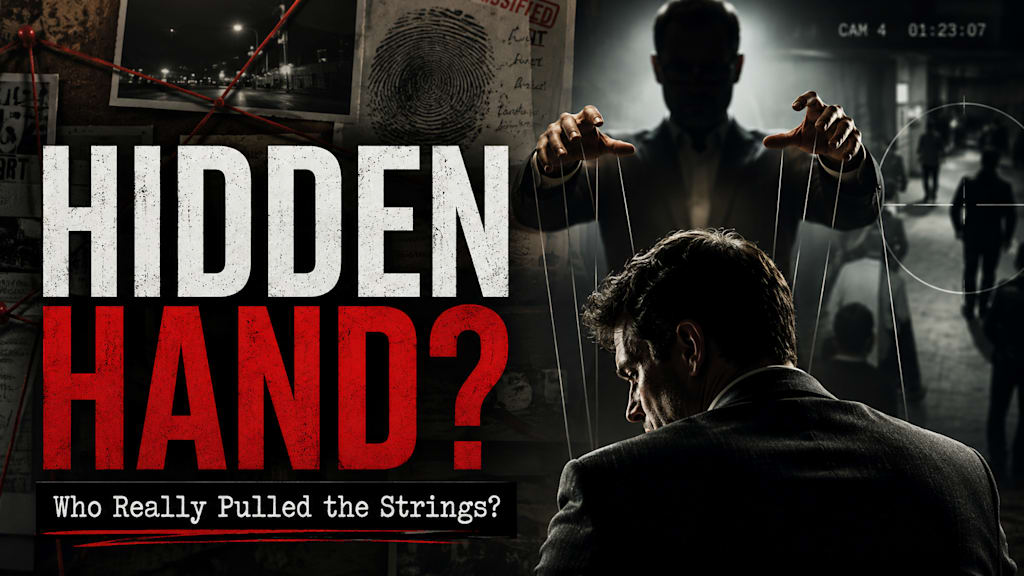
Covert Influence, Visible Perpetrators, and Hidden Causal Responsibility:
Introduction:
In analyzing high-profile acts such as assassinations, it is crucial to distinguish between what actually happened in reality and what can be publicly demonstrated or proven. Events are independent of evidence; a physical act occurs regardless of whether it is documented, understood, or acknowledged. Public validation is only one pathway to knowledge, not the ultimate source of truth.
The Nature of Evidence and Secrecy:
Reality vs. Proof
- An event either occurs or does not, regardless of whether evidence exists or is accessible.
- The absence of publicly available evidence can result from:
- The event not happening.
- Evidence being destroyed, lost, misunderstood, or classified.
- Investigators focusing only on immediate, observable facts, overlooking deeper causes.
Possibility, Plausibility, Probability, and Certainty
- Possible: A mechanism for influence or event exists.
- Plausible: Capable actors, motives, context, and opportunities align logically.
- Probable: Multiple independent indicators support the explanation.
- Established: Strong, corroborated evidence confirms the causal mechanism, actors, and sequence.
This framework allows rigorous analysis of covert possibilities without conflating logical possibility with confirmed fact.
Human Influence as a General Capability:
Means of Influence
- Human beings can be influenced through:
- Persuasion, deception, threats, coercion, blackmail.
- Ideological conditioning, emotional manipulation, social isolation.
- Financial pressure, drugs, exploitation of trauma, misinformation.
- Influence does not require total control; degrees of coercion or persuasion can lead to involuntary, constrained, or voluntarily motivated actions.
Agency and Causality
- Immediate Actor: The person physically performing the act.
- Causal Architect: The party shaping circumstances, beliefs, and pressures leading to the act.
- These roles can be occupied by different individuals or organizations.
Degrees of Influence
- Physical force or threats.
- Coercion, blackmail.
- Deception about motives or circumstances.
- Drugging or psychological destabilization.
- Exploiting existing mental vulnerabilities.
The influenced individual’s act may be:
- Involuntary (under force or threats).
- Heavily constrained (manipulated perceptions).
- Partially or subjectively voluntary (beliefs shaped to justify actions).
This creates a distinction:
- Immediate agency: The person who performs the physical act.
- Deeper causality: The influence which shaped their perceptions, motives, and decision-making.
The Hypothetical Structure of Covert Influence Operations:
Objective
- A hidden party aims to eliminate a high-profile individual for political, military, financial, ideological, or strategic reasons.
- Direct action carries high risks of exposure—personnel, communications, financial transactions, weapons, surveillance, and witnesses could reveal the operation.
The Physical Actor
- A separate individual is tasked with executing the act—obtaining the weapon, approaching the target, performing the attack, and leaving evidence.
- The act appears to originate with this visible actor, who believes they are acting independently or out of personal motives.
Deception and Motive
- The visible actor may seem motivated by ideology, grievance, or obsession.
- However, such motives can be fabricated or manipulated by the causal architect, who influences beliefs, perceptions, and emotional states.
- The actor’s subjective willingness does not necessarily reflect independent decision-making; it may be shaped by external influence.
Evidence and Investigation Dynamics:
Surface Evidence
- Forensic, digital, testimonial, and behavioral evidence directly linked to the physical act.
- Examples:
- Fingerprints, DNA.
- Surveillance footage.
- Digital searches and communications.
- Manifestos or confessions.
- This evidence is usually abundant, authentic, and straightforward to organize.
Deep Influence Evidence
- Distributed across communications, medical records, financial transactions, classified documents, intermediaries.
- Often fragmented, ambiguous, and inaccessible.
- Includes:
- Unusual contacts.
- Behavioral shifts.
- Inaccessible communications.
- Classified or encrypted data.
- Medical or psychological changes.
- Financial anomalies.
- Typically dispersed across agencies, institutions, and systems with limited or compartmentalized access.
Evidentiary Imbalance
- Surface evidence is dense and provable, enabling straightforward identification of the physical perpetrator.
- Deep influence evidence remains elusive, diffuse, and hard to prove, especially under secrecy constraints.
The Role of Motive and Public Perception:
- Visible motives (e.g., political extremism, revenge) serve as plausible narratives, making investigations easier.
- These motives are often sufficient to explain the physical act publicly.
- The deeper causal influence—who or what shaped the motive—is concealed behind:
- Institutional secrecy.
- Classified information.
- Compartmentalized operations.
- Dispersed communications.
Media and Public Focus
- Investigations and media tend to focus on:
- Who performed the act.
- Their motives.
- Foreign or domestic connections.
- Security lapses.
- These are topics supported by accessible evidence and familiar investigative frameworks.
Feedback Loop
- Limited evidence leads to limited reporting.
- Limited reporting results in low public awareness.
- Low awareness reduces political pressure for deeper investigation.
- Institutional incentives favor closure once the immediate perpetrator is identified.
- This cycle reinforces superficial explanations, making the deeper influence effectively invisible.
Challenges to Fully Uncovering the True Causal Chain:
Institutional and Legal Barriers
- Classification: Sensitive information remains protected for national security or diplomatic reasons.
- Fragmentation: Tasks are divided among agencies and personnel who only know their part, not the entire operation.
- Jurisdictional Limits: Different agencies have authority over different evidence types.
- Judicial and Legal Restrictions: Evidence may be inadmissible if it risks exposing classified information or ongoing operations.
Systemic and Structural Limitations
- Specialized Knowledge: Investigators lack the conceptual framework or access to recognize clandestine influence mechanisms.
- Death or Absence of the Actor: Eliminates interrogation and further investigation opportunities.
- Time Decay: Witnesses die, records are lost, technological artifacts become obsolete, and classified information may be destroyed or declassified too late.
Institutional Incentives
- Authorities may prefer closure with the visible perpetrator to avoid political, diplomatic, or security repercussions.
- Broader inquiries risk exposing misconduct, failures, or sensitive operations, which can be politically damaging.
Deception, Compartmentalization, and Classification
- Compartmentalization: Many personnel only understand their role, unaware of the larger influence operation, leading to truthful but incomplete testimonies.
- Classification: Official secrecy shields deeper causal mechanisms, making them inaccessible to outside investigators.
- Inter-agency Barriers: Different institutions may be unwilling or unable to share critical information, preventing a holistic understanding.
The Final Synthesis:
The Pattern of Evidence
- Abundant surface evidence points convincingly to the physical actor.
- Scarce, scattered, and ambiguous hidden influence evidence remains largely inaccessible.
The Probable Scenario
- The physical perpetrator is identified with high confidence due to tangible evidence.
- The true causal architect—who influenced and shaped circumstances—remains concealed behind layers of secrecy, compartmentalization, and institutional barriers.
The Implication
- The public record will accurately state who performed the act, but will be incomplete regarding why or how it was orchestrated.
- The perpetrator and the ultimate responsible party (the causal architect) are often different entities.
Conclusion:
In covert influence operations:
- The visible actor leaves a dense trail of evidence.
- The deeper causal entity remains hidden, fragmented, and protected by institutional design.
- Full accountability and understanding are therefore unlikely in practice, especially under conditions of secrecy, fragmentation, and death.
- Ultimately, the public record reflects what is discoverable and provable, not necessarily what really caused the event.
AI Use and Creative Attribution Disclaimer
(This article is based on original ideas, reasoning, hypotheticals, and conceptual framing developed by Peter Thwing. The central distinctions between observable conduct and deeper causal responsibility, the visible perpetrator and the causal architect, publicly accessible evidence and underlying reality, and the effects of secrecy, compartmentalization, classification, and institutional barriers originated from his analysis.
Artificial intelligence was used as a writing, organizational, and design-assistance tool. It helped summarize, structure, expand, refine, and present the original argument in a clearer and more cohesive form. AI assistance also contributed to the development of the accompanying thumbnail and visual presentation.
The thumbnail was generated through AI-assisted prompts derived from Peter Thwing’s original concepts and creative direction. Its imagery was inspired by the article’s themes of hidden influence, visible responsibility, manipulation, surveillance, fragmented evidence, classified information, and the distinction between the person who performs an act and any party that may have shaped the circumstances leading to it.
Because AI-assisted synthesis involves interpretation, the finished article may contain wording, organization, or emphasis introduced during the drafting process.
Readers evaluating whether this framework applies to a particular event should examine all available evidence, including primary records, official findings, expert analysis, timelines, behavioral changes, institutional relationships, anomalies, and case-specific circumstances.
Such materials should also be assessed with awareness that covert activity, classification, compartmentalization, jurisdictional fragmentation, destroyed records, and restricted access may leave the public record accurate at the surface while incomplete at the level of deeper causation.
The underlying thesis, core argument, conceptual framework, final editorial judgment, and responsibility for publication remain with the author.)
About the Creator
Peter Thwing - Host of the FST Podcast
Peter unites intellect, wisdom, curiosity, and empathy —
Writing at the crossroads of faith, philosophy, and freedom —
Confronting confusion with clarity —
Guiding readers toward courage, conviction, and renewal —
With love, grace, and truth.
Enjoyed the story? Support the Creator.
Subscribe for free to receive all their stories in your feed.
Comments
There are no comments for this story
Be the first to respond and start the conversation.