congress
A handy guide to all Congress happenings on both sides of the aisle. Thank goodness for this political body that keeps Presidential power in check.
What the Border Numbers Actually Show
The argument over whether the true number was 14 million, 16 million, or 20 million points to a larger failure. The government failed to give the public a reliable answer about who came in, who stayed, who was released, who disappeared, who gave false information, who had criminal history, who had foreign ties, who received meaningful vetting, and who could be found and removed later.
By Peter Thwing - Host of the FST Podcast4 months ago in The Swamp
Op-Ed: Calling Sin a Sin Is Not Bigotry (Part 5). Content Warning. AI-Generated.
Series Note: This article expands the argument beyond the specific dealership call and beyond female-coded social aggression. The earlier articles examined a particular example, then moved into the broader problem of social aggression and identity-based deflection. This article addresses the deeper moral principle: no person should be protected from accountability because of sex, race, religion, sexuality, nationality, political tribe, trauma, victim status, social class, or any other identity category. Evil conduct remains evil conduct, even when the person doing it belongs to a group society has been trained to protect.
By Peter Thwing - Host of the FST Podcast4 months ago in The Swamp
Op-Ed: The Behaviors We Are Not Allowed to Name (Part 4). Content Warning. AI-Generated.
Series Note: This article marks a shift in tone. Though the first three articles used this dealership call as a case study, this article moves beyond that specific call to addresses the larger cultural problem: harmful patterns of conduct that people often recognize privately but are not allowed to name publicly, especially when those behaviors are more commonly associated with women, social power, emotional framing, and non-physical aggression.
By Peter Thwing - Host of the FST Podcast4 months ago in The Swamp
Identity Is Not a Shield for Evil Conduct (Part 3). AI-Generated.
(Time-Stamped Video Clip Summary: From 18:34-22:39, the call shifts from a normal pricing question into something more revealing. Tomi is asking basic questions about a $40,000 vehicle: the rebate, the in-person discount, the actual out-the-door number, and whether the dealership will confirm the deal over the phone. Instead of simply clarifying the pricing, the manager personalizes the resistance, later calling him “difficult” and “combative” before introducing the “male manager” implication herself. The clip matters because it shows how quickly bad conduct can hide behind identity once someone turns a practical dispute into a moral accusation.)
By Peter Thwing - Host of the FST Podcast4 months ago in The Swamp
New Ceasefire Deal Tentatively Reached Between U.S. and Iran
A tentative ceasefire agreement between the United States and Iran has emerged as one of the most significant diplomatic developments in recent months, signaling a potential pause in a destructive conflict that has reshaped the Middle East and disrupted global energy markets.
By Victor Trammell4 months ago in The Swamp
The Outrage Economy
It is ironic how similar the structures are on both sides. ActBlue and WinRed may serve opposite political teams, but they operate within the same kind of incentive system: turn moral outrage into money, lists, mobilization, and political power.
By Peter Thwing - Host of the FST Podcast5 months ago in The Swamp
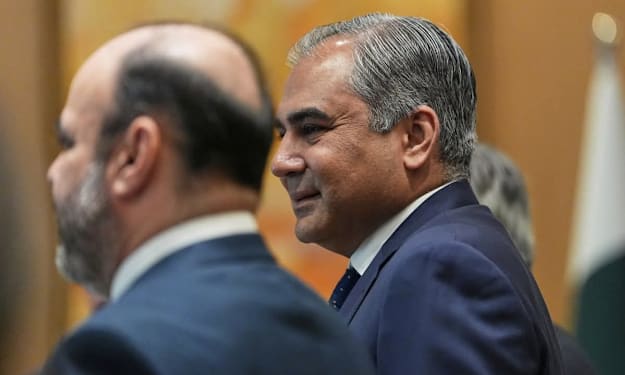
Pakistan’s Naqvi Visits Iran with Special Letter for Supreme Leader
Tehran, June 2026 — Pakistan’s Interior Minister Mohsin Naqvi arrived in Tehran on a significant diplomatic mission, carrying a special letter and message from Pakistan’s top civilian and military leadership to Iran’s Supreme Leader, Ayatollah Seyyed Mojtaba Khamenei. The visit comes at a time of heightened regional tensions and growing diplomatic efforts aimed at reducing instability across the Middle East.
By shaoor afridi5 months ago in The Swamp
America Is Handing the Keys to the Burglar
Given the recent events in our political system, it is completely logical to argue that the Department of Justice should not exist under the authority of the Executive Branch. Think about it for a moment. We have created a system in which the very office that may need to investigate the President ultimately answers to the President. How is that not a conflict of interest? The Treasury Department presents a similar problem. The institution responsible for safeguarding the nation's finances operates under the direct authority of the Executive Branch as well. If the purpose of government is to establish checks and balances, why are some of the most powerful agencies in the federal government effectively controlled by the very branch they may one day need to scrutinize? These are not radical ideas. They are common-sense observations. If the Department of Justice were accountable to the Judicial Branch and the Treasury were accountable to Congress, it would become significantly more difficult for corruption to gain a foothold. It would be harder for political influence to interfere with investigations. It would be harder for administrations to pressure institutions into serving political objectives rather than constitutional ones. Instead, we have created a system that increasingly resembles a bank handing the vault combination to a man already suspected of robbing it. What has been most disturbing is not merely the corruption itself, but the willingness of elected officials to watch it unfold and do absolutely nothing about it. Every member of Congress who sits quietly while constitutional guardrails are weakened shares responsibility for the outcome. I do not care whether the individual has an R or a D next to their name. I do not care whether they call themselves conservative, liberal, progressive, or moderate. If your duty is to protect the republic and you remain silent while its institutions are compromised, you are part of the problem. You do not get to claim innocence simply because you did not personally light the match. If you watched the fire spread and chose not to act, history will remember your role just the same. Jan 6th was such a period where inaction dominated one political party of the other. Too many Americans have been conditioned to believe that criticism of one party automatically means support for the other. That is exactly the kind of thinking corruption depends upon. The moment citizens stop demanding accountability from their own side is the moment political loyalty becomes more important than truth. Corruption thrives in tribalism. Once voters decide that winning matters more than principles, politicians learn they can get away with almost anything. They learn that outrage can be manufactured. They learn that scandals can be dismissed. They learn that supporters will excuse behavior they would have condemned if the other side had done the exact same thing. That is the true definition of fandom. And republics are not sustained by fans. We are living in a time of fans, followers, and celebrity. The Founding Fathers understood something that many Americans seem to have forgotten. Human beings are flawed. Ambitious people seek power. People who acquire power rarely volunteer to give it back. That is why the Constitution was built around limitations, restraints, and competing centers of authority. The Constitution assumes that power must be watched because power has a tendency to expand. Today, we are watching that expansion happen in real time. Congress increasingly behaves like a public relations department for whichever party happens to hold power. The Executive Branch continues to accumulate authority regardless of who occupies the Oval Office. The courts, which should serve as impartial referees, are now viewed by millions of Americans through a partisan lens. The result is predictable. Trust would collapse. And once trust collapses, everything else begins to follow. America's adversaries understand this better than many Americans do. China, Russia, Iran, North Korea and even Cuba are all watching and waiting. None of them need to launch an invasion fleet across the Pacific or land troops on American beaches. They simply need to wait. They need to watch as Americans turn against one another, as confidence in our institutions evaporates, and as political leaders place personal ambition ahead of national interest. The greatest strategic victory America's enemies could achieve wouldn’t come through military conquest, but from watching us destroy ourselves. History has shown us this pattern repeatedly. We learn this things beginning in grade school. The Roman empire did not disappear because a foreign army suddenly appeared at the gates. Long before Rome fell from external pressure, it had begun rotting from within. Political factions became obsessed with power. Institutions weakened. Public trust eroded. The republic slowly surrendered the very principles that had made it strong. And it began to crumble. The same lesson appears throughout history. Perhaps the most relevant modern example is the Soviet Union. The USSR did not collapse because American tanks rolled into Moscow. It collapsed because the institutions holding the country together had lost credibility. Citizens stopped believing what their leaders were saying. Government agencies became more concerned with preserving power than solving problems. Bureaucracy replaced accountability. Reality became increasingly disconnected from the narratives being pushed by those in charge. By the time Mikhail Gorbachev attempted to reform the system, the decay had already spread throughout the structure. The problems were no longer isolated. They were systemic. The foundation had already cracked. That is the lesson Americans should be studying. The danger is not that America becomes the Soviet Union. We are better than them, they made silly mistakes. The problem is evident that we believe that America is somehow exempt from the forces that brought down every great power that ignored its own warning signs. We have convinced ourselves that our institutions are permanent. They are not. See right now they are very fragile. We have convinced ourselves that our Constitution is indestructible. It is not indestructible, and we are not indivisible. We have convinced ourselves that the republic can survive indefinitely regardless of the quality of leadership entrusted with its care. But like a cancer in its 5th stage our institutions will be over ran by the most aggressive form of the disease. History has spoken time and time again. The recent military actions involving Iran should concern every American who still believes in constitutional government. The issue is not whether one supports or opposes Iran. The issue is whether the constitutional process still matters. The framers gave Congress the authority to declare war because they feared exactly what history had repeatedly demonstrated: concentrated power eventually seeks to expand itself. Yet modern presidents increasingly act first and ask constitutional questions later. They operate under the guise that military action is necessary, and that it is justified. Then they tell us it is limited. We won’t be drawn into an endless war. The bloodshed will be small but worth it. It serves our national interests. It protects the homeland. Those explanations may change from administration to administration, but the pattern remains remarkably consistent. Every president finds reasons to expand executive authority. Every president discovers new emergencies. Every president encounters circumstances that supposedly require exceptions to the rules. And every expansion becomes the starting point for the next one. Bit by bit. Year after year. Administration after administration. The boundaries continue to shift. That should alarm all of us, all of the ones who call themselves Americans, regardless of party affiliation. The Constitution was never intended to be an inconvenience for politicians to work around. The founders envisioned it to be a restraint on power itself. The republic survives only as long as the people demand that restraint remain intact. That whoever is guarding the hen house sounds the alarm when the wolves appear. This has never been a Republican problem, or a Democratic problem. This has always been an American problem. Someone fell asleep on their watch now the wolves are no longer outside the of hen house. They’re already inside. Some occupy elected office. Some wear expensive suits and sit in boardrooms. Some stand behind podiums. Some sit behind cameras and microphones. The worst part? Many others sit quietly in Congress pretending not to notice what is happening around them. The greatest threat facing the United States is not a foreign government. We have a strong and advanced military and our reach is broad and extensive. This threat is the growing number of people entrusted with protecting the republic who have decided that loyalty to party matters more than loyalty to country, loyalty to power matters more than loyalty to principle, and loyalty to ambition matters more than loyalty to the Constitution. While in the military, the teach God first, country second. Party affiliation doesn’t exist in the decree. History has issued this warning before. Countries like Rome received the warning but ignored it. So did The Soviet Union ignored it. There are countless nations dating back in history who received the warning but simply ignored it. Those inactions lead to their demise. Now the question stands with us, and whether we will ignore it too. Because by the time the walls begin to collapse, it will be far too late to ask why nobody sounded the alarm.
By Chris Ricks5 months ago in The Swamp
WW3 Coming Soon
WW3 Coming Soon The fear of a Third World War has returned to global discussions because of rising political tensions, military conflicts, economic rivalry, and growing mistrust between powerful nations. Many people wonder whether humanity is moving toward another devastating global conflict similar to World War I and World War II. While there are many causes of international tension, experts believe one major reason could again lead the world into great wars: the struggle for global power and dominance.
By Wings of Time 5 months ago in The Swamp
Is the U.S. Military Industrial Complex Past its Prime?
America’s defense establishment started as a small republic’s war offices. As history progressed, it blossomed into the world’s most powerful security machine. U.S. military might peaked in the Cold War and the post-9/11 era. Nowadays, it faces a period of strain marked by cost overruns, strategic drift, and fading relative influence. The CATO Institute published a critical chronology of that rise and decline. It begins with the Department of War in 1789, then the National Security Act’s creation of the Department of Defense in 1947, onto the long expansion after 1949, to its present-day decline. Experts say that decline is more so a collapse than it is a weakening of dominance under fiscal and geopolitical pressure.
By Victor Trammell5 months ago in The Swamp