
Is the U.S. Military Industrial Complex Past its Prime?
Assessing the declining influence, rising costs, and future challenges facing America's defense institutions.

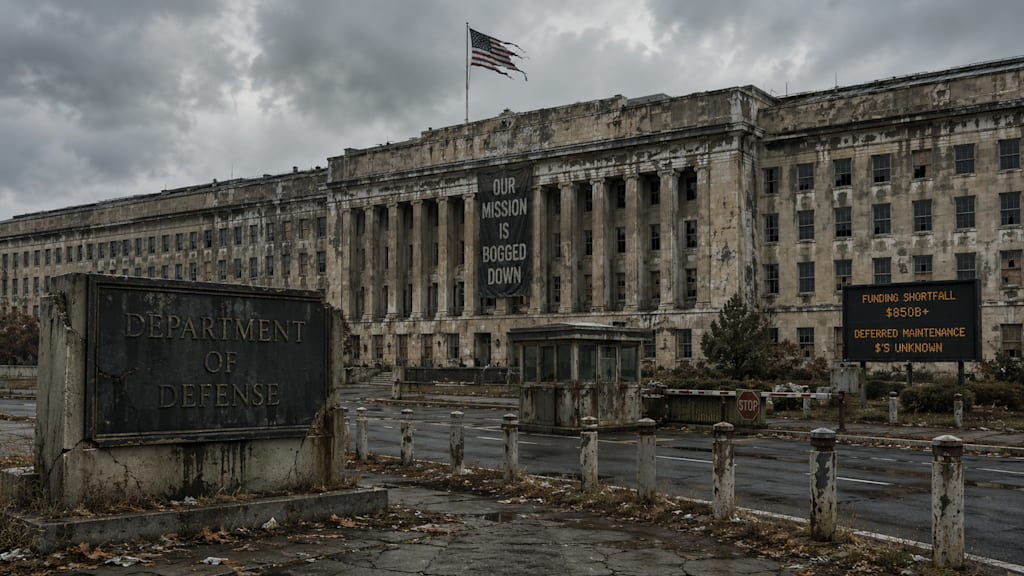
America’s defense establishment started as a small republic’s war offices.
As history progressed, it blossomed into the world’s most powerful security machine. U.S. military might peaked in the Cold War and the post-9/11 era. Nowadays, it faces a period of strain marked by cost overruns, strategic drift, and fading relative influence. The CATO Institute published a critical chronology of that rise and decline. It begins with the Department of War in 1789, then the National Security Act’s creation of the Department of Defense in 1947, onto the long expansion after 1949, to its present-day decline. Experts say that decline is more so a collapse than it is a weakening of dominance under fiscal and geopolitical pressure.
The Long Arc
The uncertainty of the history, which unfolds today makes the U.S. military’s institutional story easy to narrate as a rise, prime, and slowdown. As stated earlier, this began when a controversially-birthed nation created a War Department in 1789. Then the U.S. built separate naval and military institutions in the 18th and 19th centuries. It fused them into the modern defense bureaucracy in 1947, which was officially renamed the Department of Defense in 1949. America's status as a military superpower primed during World War II, the early Cold War, and the post-2001 era. Those eras represented when U.S. power projection, alliance management, and industrial scale made America's armed forces the central instrumentality of its global power. Today, that system still spends heavily. However, it no longer enjoys the same uncontested strategic margin.
What Changed
The problem is not simply that the Pentagon is expensive; it is that cost has outpaced confidence. Recent reporting by Forbes revealed that defense spending has passed $1 trillion. The Pentagon has failed audits repeatedly. Well-respected critics see the economic returns from military spending as grossly diminishing. At the same time, the defense industry has consolidated, procurement has become more concentrated, and the number of direct manufacturing jobs tied to weapons production has fallen sharply; in comparison to earlier decades. That combination makes the system politically durable but strategically brittle.
Macgregor’s Warnings
Retired Colonel Douglas Macgregor has become a popular voice arguing that Washington mistakes motion for strategy. In a recent GeoX Time podcast interview, Colonel Macgregor said the United States had “no plan for any kind of resolution” and warned that after an Iran war ceasefire “there’s a lot of talk… but there’s not a lot of evidence for systematic planning and execution." He also argued that America should “stop resorting to military power as the first option in diplomacy” and “bring our troops home” to address internal problems. His broader point is blunt: Today's U.S. leaders hide strategic weakness behind rhetoric about military greatness.
A Harder Budget
Macgregor’s critique lands because the financial case for endless force projection has weakened. During a number of other recent podcasts and news interviews, he has repeatedly pointed to debt, weak domestic capacity, and the limits of coercive power, saying the country is “going to go broke” and that its financial system is “very fragile." Those comments are provocative, but they align with a larger reality: Military power is no longer a free override for industrial decline, fiscal imbalance, or diplomatic failure. The Pentagon can still absorb vast resources, yet those resources buy less strategic certainty than they once did, writes Sean Manning, a Herbert Scoville Jr. peace fellow.
"Defense spending is rising dramatically as the United States struggles to justify the goal of that spending," Manning wrote in his December 2025 editorial published by The Equation.
Foreign Policy Drift
The deeper issue is that U.S. strategy has become reactive. The post-9/11 era normalized open-ended campaigns in Afghanistan, Iraq, Syria, and elsewhere, with enormous costs and mixed outcomes. Macgregor’s interviews remark reflect a wider frustration that the United States keeps confusing short-term strike capability with durable political results. When the military becomes the default answer to every crisis, it stops being a tool of policy and starts becoming a substitute for it.
The Next Test
The future challenge is not whether America can still build a formidable military. The real question is whether it can field a force that is affordable, auditable, industrially resilient, and strategically restrained. That will require smaller ambitions, more honest assessments of adversaries, and a willingness to treat diplomacy as more than a prelude to force. If the defense establishment cannot adapt, it will remain large but lose more of the influence that once justified its size. In that sense, the military-industrial complex is not past usefulness. However, it may be past its prime.
The institutions built for a 20th-century world are still immense, yet they now face a 21st-century environment where spending more no longer guarantees supremacy; where strength without strategy can become a costly illusion.
About the Creator
Victor Trammell
Mr. Trammell is an award-winning digital media producer, freelance journalist, and author. Formerly, he wrote national radio content for the Michael Baisden Show. He also served as Senior Editor for Your Black World's online news network.
Enjoyed the story? Support the Creator.
Subscribe for free to receive all their stories in your feed. You could also become a paid subscriber, letting them know you appreciate their work.
Comments
There are no comments for this story
Be the first to respond and start the conversation.