
Random Lottery Districts
The Maximum Equality Model That Removes Mapmakers Entirely

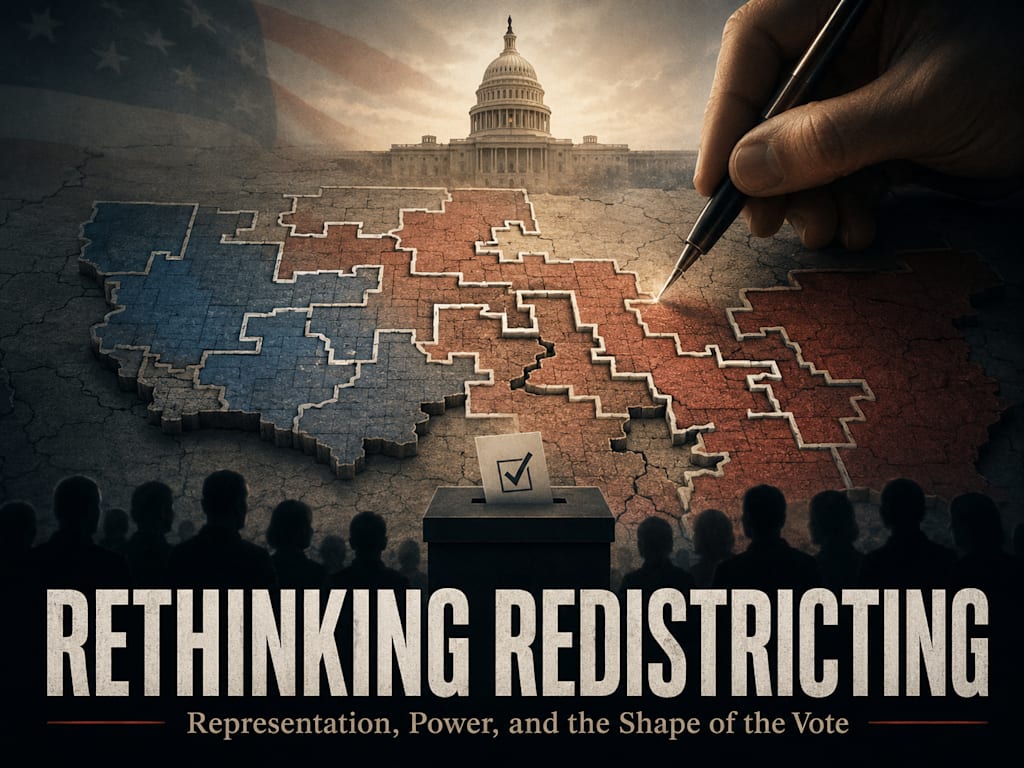
The Cleanest Way to End Map Manipulation Is to Remove the Map
A random lottery district system begins with the most direct attack on gerrymandering: remove the mapmaker. If the abuse comes from politicians, commissions, courts, consultants, or partisan actors deciding which voters belong together, then one solution is to stop letting anyone draw those containers at all. Instead of carving land into districts, voters would be randomly assigned to representative districts through a lottery process. No city could be cracked. No rural area could be diluted by a narrow urban attachment. No suburb could be split strategically. No district could snake across the map to capture the right voters. The map would no longer be the instrument of manipulation because the map would no longer be the basis of assignment.
This model is the maximum procedural-equality version of representation. Every voter receives a district assignment by the same method. The state does not ask where the voter lives beyond eligibility and administrative requirements. It does not ask which party the voter belongs to. It does not ask for ideological answers. It does not place voters into named value districts. It does not use a political compass test. It does not allow voluntary self-sorting. It simply assigns voters randomly into equal-population districts, like drawing numbered balls from a container.
The power of this model is its purity. It eliminates the most obvious source of redistricting abuse. No one can draw a district to favor one party if there are no geographic district lines. No one can attach city voters to rural territory through thin corridors. No one can pack opponents into one district or crack them across several. The old tools become useless. A random lottery system does not make politics pure, but it does make one specific kind of corruption much harder: pre-election manipulation of voter containers by map design.
How the Basic System Would Work
Imagine a state with ten representative seats. Every eligible voter in the state is placed into a pool. The system assigns each voter randomly to District 1 through District 10, with each district receiving the same number of voters or as close as mathematically possible. Once the assignment is complete, each district elects one representative. The district is not a territory. It is a randomly created voter group.
In a physical version, this could be imagined as drawing numbered balls from a container. In a modern version, it would be done through a public, auditable randomization process. Each voter receives a district number. The voter then participates in elections for that district. Candidates run within those randomly assigned districts, and each district elects a representative.
The population cap is built in. Each district can only receive its share of the voters. If there are one million voters and ten districts, each district gets roughly one hundred thousand voters. The system does not need to stretch boundaries, split counties, or balance neighborhoods. It balances people directly. The district is defined by equal assignment, not geographic shape.
Why This Is the Maximum Equality Model
The random lottery model treats every voter the same at the point of assignment. No voter is assigned based on partisan usefulness. No voter is placed into a district because of race, income, culture, party registration, neighborhood, ideology, or strategic value. Every voter goes through the same process. That is why it can be called the maximum equality model.
This does not mean every voter receives the most meaningful representation. Equality of assignment is not the same as representational alignment. But as a procedural matter, random assignment is extremely clean. The system does not prefer one region, party, ideology, or faction in the sorting process. It gives each voter the same chance of landing in any district, subject only to population balance.
That makes the system difficult to attack on the grounds of intentional district manipulation. A party may still campaign, persuade, organize, fund candidates, and influence elections. But it cannot engineer the electorate of a district before the campaign begins. The district electorate is not designed. It is drawn. That difference matters because the current redistricting problem begins before persuasion. It begins with who is placed together. A lottery system prevents that placement from being planned for partisan advantage.
Random Districts Become Statewide Samples
A lottery district would function like a sample of the state. If assignment is truly random and the districts are large enough, each district should roughly resemble the broader state population. Not perfectly. Randomness always creates variation. But generally, each district would contain a mix of urban, suburban, rural, left, right, moderate, independent, wealthy, poor, working-class, religious, secular, young, old, and culturally varied voters.
That is one of the strongest benefits and also one of the major weaknesses. The benefit is that each representative would need to appeal to a broad cross-section rather than a carefully engineered geographic bloc. A candidate could not rely only on one city fragment, one rural region, one suburb, or one packed partisan group. The district would likely contain many kinds of voters. The candidate would have to build a wider message.
This could reduce the incentive for extreme geographic pandering. A representative from a random district would not be able to say, “I only need this neighborhood,” or “I only need this rural block,” or “I only need the city slice attached to this district.” The constituency would be scattered and mixed. The representative would have to speak to voters as members of a broader public rather than as residents of one carved territory.
The Model Eliminates Cracking and Packing
In ordinary redistricting, cracking and packing are two of the most powerful tools. Cracking splits a group across multiple districts so it cannot form a majority. Packing concentrates a group into a small number of districts so its influence is contained. Both methods depend on controlling boundaries. They depend on knowing where voters live and arranging lines around them.
A random lottery system makes cracking and packing much harder because voters are not grouped by location. A mapmaker cannot crack a city because the city is not being drawn into geographic districts. A mapmaker cannot pack rural conservatives, urban progressives, suburban moderates, or any other group into predetermined districts by geography. The randomization process distributes voters without line-drawing intent.
This is the strongest technical case for lottery districts. They do not merely regulate gerrymandering. They remove much of the machinery that makes it possible. A compactness rule can limit absurd district shapes. A commission can reduce direct legislative control. A court can strike down extreme abuses. But all of those still operate within geographic districting. Random assignment changes the assignment principle completely.
Candidates Would Have to Campaign Differently
Random districts would transform campaigns. In a geographic district, a candidate can campaign in specific neighborhoods, towns, counties, or regions. The candidate can hold local events, speak to local issues, visit local businesses, and build relationships in a recognizable place. In a random district, the voters may be scattered across the state. Campaigning would become less place-based and more communication-based.
This could have benefits. Candidates would need to speak to broad state-level issues rather than narrow local interests. They would need messages that reach voters across urban, suburban, and rural life. They might be forced to explain principles more clearly because the district is not organized around one local identity. The representative would become less of a geographic delegate and more of a statewide sample representative.
But this also creates problems. Campaigning may become more expensive and media-driven. Candidates may rely more heavily on digital outreach, mailers, television, social media, statewide organizations, party networks, and donor support. That could advantage well-funded campaigns and weaken face-to-face accountability. A random district eliminates map manipulation, but it may increase the importance of communication infrastructure and political machinery.
The Main Weakness Is Loss of Place
The biggest weakness of random lottery districts is that they weaken geography almost completely. A district may include voters from distant cities, rural counties, suburbs, coastlines, mountains, farms, factories, and neighborhoods with little shared local reality. The representative may not know any specific place well enough to speak for it. The district may have equal assignment, but not a coherent physical community.
This is a serious weakness, especially for local and state offices. A city council member cannot represent a random statewide sample. A county commissioner cannot be detached from the county. A school board member must understand the schools and families in that area. A representative responsible for bridges, potholes, zoning, utilities, factories, business corridors, farms, emergency response, and local culture must know the place. Random assignment would be destructive if applied to offices that govern physical local conditions.
That is why random lottery districts fit best, if at all, at higher levels of government or in specialized bodies. They might make sense for certain federal representation experiments, statewide advisory assemblies, anti-corruption commissions, citizens’ panels, or oversight bodies. They are much weaker for local offices where place is the point of representation.
The Second Weakness Is Loss of Value Alignment
Random districts also weaken value alignment. A voter may be assigned to a district with people who do not share that voter’s values, priorities, or governing philosophy. The district may be procedurally equal, but not personally meaningful. A constitutionalist voter, progressive voter, libertarian voter, religious conservative voter, anti-war voter, labor voter, localist voter, or nonaligned voter could all be placed into a mixed district where no coherent constituency exists.
This is the opposite weakness from ideological districts. Ideological districts may create strong value alignment but weaker geographic unity. Random districts create procedural equality but weaker value alignment. They are fair in the sense that no one controls the sorting, but they may be less representative in the sense that voters are not grouped by shared purpose.
This distinction matters. A system can be equal and still feel alienating. Being randomly assigned may be less corrupt than being gerrymandered, but it does not guarantee that the representative speaks for the voter’s deepest priorities. The lottery model protects the assignment process from design. It does not guarantee meaningful political identity inside the district.
Randomness Must Be Auditable
A lottery system would only be legitimate if the randomization process is public, auditable, and secure. If the public does not trust the draw, the whole system collapses. Random assignment can be manipulated if the software is hidden, if the seed process is controlled, if voter rolls are altered, if district caps are adjusted, or if assignments are quietly changed after the draw. Removing the map does not remove the need for oversight.
A serious system would need public rules before the draw. It would need a verified voter pool. It would need equal district caps. It would need a transparent randomization method. It would need independent audits. It would need public aggregate reports. It would need strong protections against tampering. It would need a clear challenge process if errors occur. Randomness is only trustworthy when the process can be inspected.
The system should also avoid unnecessary secrecy in the method while protecting voter privacy. The public should be able to verify that the assignment process was fair without exposing every voter’s private information. The assignment method should be transparent. The individual voter’s ballot choices should remain secret. That balance is essential.
The Timing of the Lottery Matters
A random district system would need rules about timing. Are voters assigned once and kept in the same district for ten years? Are they reassigned every election cycle? Are new voters randomly added to existing districts? Are vacancies filled through new draws? The answer changes district stability.
If voters are reassigned every cycle, districts remain procedurally fresh, but representatives cannot build stable relationships with constituents. Campaigns become chaotic. Voters may not know their district identity for long. If voters are assigned for a longer period, such as ten years, the district becomes more stable, but the original random draw becomes more consequential. New voters must be added carefully so population balance is maintained.
A reasonable system might assign voters for a fixed period and update only at defined intervals. New voters could be randomly assigned into districts with available space. People who leave the state or become ineligible would be removed. The system would need a stable but adjustable structure. Too much movement damages accountability. Too little movement may create imbalance over time.
Random Districts Could Reduce Safe Seats
Because random districts would likely resemble the statewide population more closely than geographic districts, they might reduce some safe seats. If a state is politically competitive overall, each random district may be competitive too. That could force representatives to appeal to broader coalitions. It could reduce the ability of politicians to rely on packed partisan districts.
But this depends on the state. If the entire state strongly leans one direction, random districts will likely lean that direction too. Random assignment does not create ideological balance where the population itself is not balanced. It prevents designed concentration. It does not guarantee partisan competition. The result reflects the statewide voter pool.
This raises a deeper question. Is competition the goal, or is representation the goal? Random districts may create more competition in some states, but the stronger argument for them is not competition. It is procedural fairness. The system does not choose winners by designing districts. The voters still decide, but the containers are not engineered.
Random Districts Could Weaken Local Accountability
One cost of random districts is weaker local accountability. A geographic representative can be confronted with visible local problems. Voters can point to a bridge, road, school, business district, factory, water system, or neighborhood and demand action. A random district representative may have constituents scattered across the state, making it harder to define responsibility for specific places.
This could produce representatives who focus on general statewide messaging rather than concrete local problems. That may be acceptable for some federal issues, but it is a serious weakness for offices that handle material infrastructure. Even at the federal level, representatives often advocate for district-specific projects, local industries, military bases, ports, farms, universities, or disaster relief. A random district would complicate that role.
The solution may be to pair random representation with geographic representation rather than replace geography entirely. One chamber or set of seats could be random, while another remains geographic. That way, local accountability is preserved somewhere in the system, while random assignment provides an anti-gerrymandering check elsewhere.
The Model Could Fit Citizens’ Assemblies
Random assignment may be especially useful for citizens’ assemblies, advisory bodies, oversight commissions, constitutional review panels, or special anti-corruption bodies. These institutions often benefit from representative sampling rather than geographic campaigning. A randomly selected or randomly assigned body can reflect the broader population without being dominated by district lines.
This does not necessarily mean random voters become legislators. There are different versions. One version randomly assigns voters to electoral districts. Another version randomly selects citizens directly to serve in deliberative bodies. Another uses lottery assignment to create advisory panels that review maps, laws, budgets, or institutional failures. The principle is the same: randomness can reduce manipulation by removing the selection power from political actors.
For full legislative representation, random voter districts are more controversial. For advisory or oversight purposes, they may be much easier to justify. A state could experiment with random assignment in limited roles before considering broader use. That would allow the public to test whether random sampling improves trust, fairness, and deliberation.
The Abuse Risk Moves to Administration
A random lottery system removes mapmaking abuse, but it creates administrative abuse risks. Whoever controls the voter list, assignment algorithm, draw process, district caps, timing, and audit system can influence outcomes if safeguards are weak. The manipulation becomes less visible than a crooked map if the process is hidden inside software or bureaucracy.
This is why the system must be designed with suspicion of concentrated control. No single office should control the draw. The method should be public. The data should be verified. Independent observers should be present. Audit trails should exist. The process should be reproducible or externally verifiable. The public should know how errors are corrected. A secret lottery is no better than a secret map.
The rule is simple: if randomness is the safeguard, the random process must be more trustworthy than the map process it replaces. Otherwise the reform merely hides manipulation inside a new machine.
Why a State Might Want It
A state might want random lottery districts if map conflict has become too corrupted, too partisan, too legally unstable, or too destructive to public trust. If every redistricting cycle becomes a war over lines, courts, commissions, accusations, and partisan advantage, a lottery system offers a radical reset. It says no one gets to draw advantage anymore. The voters are distributed equally by chance.
This could reduce legal fights over compactness, contiguity, community splitting, partisan bias, and strange shapes. It could also reduce the incentive for parties to invest enormous resources into map control. The election would still be political, but the container would not be drawn for political advantage. That alone may appeal to citizens tired of watching districts become weapons.
A state might also use lottery districts for a limited portion of representation. For example, some seats could remain geographic while a smaller number are chosen through random statewide districts. That hybrid would test the anti-gerrymandering value of the lottery model without abandoning place-based representation entirely.
Why Citizens Might Want It
Citizens might want lottery districts because the process is visibly fair at the assignment stage. No voter is carved into a district to serve someone else’s plan. No city is sliced into spokes. No rural region is diluted by artificial attachments. No party gets to choose its voters. The district assignment is not based on political usefulness. It is based on the same random process for everyone.
This can restore a kind of trust. Even if voters dislike the final outcome, they can know the district was not drawn to produce that outcome. Losing an election in a randomly assigned district may feel more legitimate than losing in a district obviously engineered by partisan line-drawing. Procedural fairness matters because citizens are more likely to accept results when they trust the rules.
But citizens may also resist the model because it feels disconnected from community. A voter may ask, “How can this person represent my area if the district is scattered across the state?” That objection is strong. The best answer is not to dismiss it. The best answer is to use lottery districts only where procedural equality matters more than local coherence, or to combine them with geographic representation.
The Best Use Is Limited or Layered
Random lottery districts are probably not the best universal system. They are too weak on local geography and too weak on value alignment. They are strongest as an anti-manipulation mechanism. That means they may work best in a layered system, where some offices represent place, some represent values, and some use random assignment to prevent engineered control.
For example, local offices could remain compact and geographic. State offices could remain mostly geographic with strong community-of-interest rules. Federal representation could include some value-based or ranked-preference districts. A separate oversight body, commission, or limited set of seats could use random assignment to create a procedural equality check. That would let randomness do what it does best without forcing it to solve every representational problem.
The layered model is more honest because representation has multiple dimensions. People are residents of places. They are also holders of values. They are also equal citizens who deserve protection from manipulation. Geography, values, and randomness each represent one part of that reality. No single method should be forced to carry the whole burden.
The Lottery Model Teaches the Main Lesson
The greatest value of random lottery districts may be what they reveal. They expose how much power exists in the act of assignment. Before voters choose candidates, someone decides which voters belong together. In ordinary redistricting, that someone draws lines. In voter-selected districts, citizens choose constituencies. In ideological districts, categories define alignment. In random districts, chance decides. Each method answers the same underlying question: who gets to create the political container?
Lottery districts answer with maximum procedural equality. No one chooses the container for advantage. That is their strength. But they also reveal that equality alone is not the same as representation. A randomly assigned district may be fair in process and still weak in local identity. It may be impossible to gerrymander and still unable to speak for a coherent community of place or values.
That is why random lottery districts belong in the larger collection, but not as the final answer. They are the cleanest anti-gerrymandering tool. They remove mapmaker control. They equalize assignment. They make cracking and packing almost impossible by geography. But they also sacrifice geography and value alignment. They are powerful because they are simple, and limited for the same reason. They prove that representation can be organized without maps, but they also prove that a fair draw is not always the same as a meaningful voice.
About the Creator
Peter Thwing - Host of the FST Podcast
Peter unites intellect, wisdom, curiosity, and empathy —
Writing at the crossroads of faith, philosophy, and freedom —
Confronting confusion with clarity —
Guiding readers toward courage, conviction, and renewal —
With love, grace, and truth.
Enjoyed the story? Support the Creator.
Subscribe for free to receive all their stories in your feed.
Comments
There are no comments for this story
Be the first to respond and start the conversation.