
Political Segregation or Representational Accuracy?
The Moral Tradeoff Behind Ideological Districts

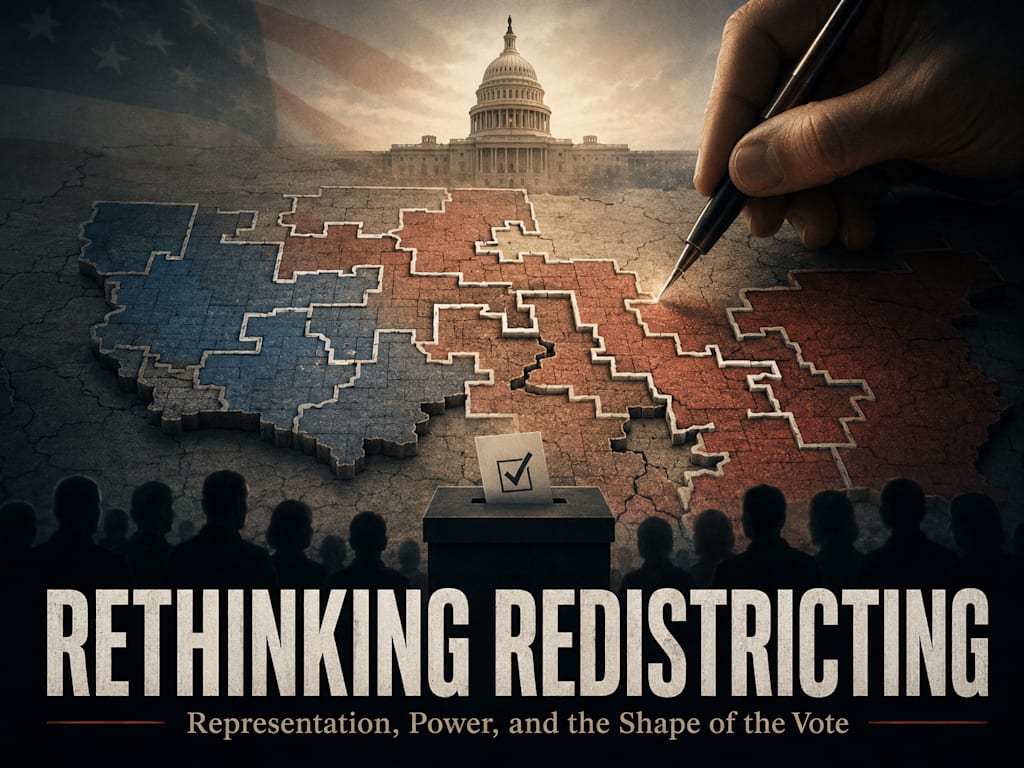
The Word Sounds Dangerous Because the Tradeoff Is Real
Ideological districts can fairly be described as a kind of political segregation. That does not mean racial segregation. It does not mean legal inferiority. It does not mean forced exclusion from public life. It means voters would be grouped into representative constituencies according to political values, governing priorities, worldview, party affinity, or ideological alignment rather than geography alone. Voters would be separated politically so that each district could elect someone who actually speaks for the values of that district.
That word should not be avoided just because it creates discomfort. If a system groups people by ideology, then it is separating people by ideology. The honest question is not whether separation exists. The honest question is what kind of separation it is, what purpose it serves, whether it is voluntary or imposed, whether it produces better representation, and whether the tradeoff is worth the cost. A system can be dangerous if it separates people to exclude, punish, isolate, or dehumanize. But a system can also separate people administratively to make representation more accurate.
The moral issue is therefore not solved by reacting to the word. It has to be analyzed. Geographic districts already separate people by land. Party primaries already separate voters by affiliation in many systems. Legislative chambers already separate representation by state, district, municipality, or population. The question is not whether political systems divide people. They do. The question is whether the division serves representation or manipulates it.
Forced Mixture Can Also Be Unrepresentative
The usual defense of geographic districts is that they mix people who live near each other. A district may contain left, right, center, rich, poor, religious, secular, urban, suburban, rural, working-class, professional, homeowners, renters, business owners, and laborers. That mixture can be good when the office governs a shared place. A city council member should hear from different neighborhoods. A county commissioner should answer to different towns. A local representative should understand the practical tensions inside a real community.
But forced mixture is not automatically representation. If a district is divided 50.01 percent to 49.99 percent, the winner legally represents everyone, but nearly half the district may have no meaningful voice. The losing side is present but not represented in the deeper sense. Their votes were counted, but their values may be ignored. Their concerns may be acknowledged, but the representative’s survival depends on the other side. That is not always avoidable, but it should not be confused with ideal representation.
A mixed district may look healthy from a distance while functioning as a permanent power contest. Every election becomes a fight over which side controls the same artificial container. The winner claims the whole district. The loser is told to try again next time. That is normal under current rules, but it is not the only possible model. If representation means someone speaks for a coherent constituency, then forced mixture can fail even when the election is technically fair.
Representation Requires a Voice, Not Merely a Seat
The purpose of representation is not only to assign a seat. It is to give a people a voice in government. A district is supposed to create a body of voters who can choose someone to speak for their interests, values, needs, and priorities. If the district is internally divided in ways that prevent one large portion from ever having a representative who reflects them, then representation has become formal more than substantive.
This is the strongest argument for ideological districts. They do not merely ask whether voters live near each other. They ask whether voters can actually send a representative who shares their governing priorities. A constitutionalist district would elect someone accountable to constitutional limits. A libertarian district would elect someone accountable to liberty, privacy, speech, and limits on coercion. A progressive district would elect someone accountable to progressive priorities. A labor district would elect someone accountable to working-class and production concerns. A nonaligned district would elect someone accountable to voters who reject fixed party or ideological labels.
That kind of representation may be less diverse inside each district, but it is more coherent. The representative is not merely the winner of a divided container. The representative is the spokesman for a defined constituency. That matters because a representative system should do more than count people. It should create channels through which real communities of interest can speak.
Internal Diversity Is Not the Only Democratic Good
Modern political language often treats diversity inside every institution as an automatic good. But representation has more than one good. Internal diversity matters in some contexts. Coherence matters in others. A jury, a citizens’ assembly, a public forum, and a legislature may each require different forms of mixture and representation. A district whose purpose is to elect someone for a constituency may reasonably prioritize shared interests over maximum internal disagreement.
A district made entirely of people who oppose one another may be diverse, but it may not be representative of any coherent body. A district made of people who share major governing priorities may be less internally diverse, but it may produce a representative who can speak clearly. The first model emphasizes mixture. The second emphasizes voice. Neither good should be treated as absolute in every context.
This distinction is especially important for federal representation. A congressional representative votes on war, debt, federal agencies, constitutional limits, speech, privacy, immigration, taxation, national regulation, and foreign policy. These questions are often value-based. A voter may need a representative who shares governing philosophy more than a representative who happens to live nearby. In that context, internal ideological diversity may be less important than alignment between representative and constituency.
The Danger Is Political Isolation
The strongest objection to ideological districts is that they may isolate people politically. If voters are sorted into like-minded districts, they may hear fewer opposing arguments. Representatives may become more extreme because they no longer need to persuade a mixed electorate. Parties and movements may become more internally pure. Compromise may become harder. Shared civic life may weaken if each district becomes a separate ideological camp.
That danger is real. A political system cannot survive if every group becomes sealed off from every other group. Government still requires a shared constitutional order, shared rules, shared rights, shared limits, shared procedures, and some ability to resolve disputes without treating opponents as enemies. If ideological districts destroy that shared frame, they may improve representation inside districts while weakening the larger republic.
This is why ideological districts should not be treated as a universal solution. They are strongest when used for offices that govern broad values, and weakest when used for offices that require local practical knowledge. They may also work best in a layered system, where one part of government represents place and another part represents values. That would prevent ideological separation from becoming the entire structure.
The Danger Is Also Label Capture
Another danger is that ideological districts can be captured by labels. If a district is named Constitutionalist, Progressive, Libertarian, Labor, Populist, Religious Conservative, Anti-War, or Nonaligned, someone must define what that label means. Whoever controls the label can influence who enters, who feels welcome, who is stigmatized, and who the district is presumed to represent. The mapmaker’s power may be replaced by the category-maker’s power.
That is ideological gerrymandering by language. A district can be manipulated by renaming, splitting, merging, redefining, or describing categories in biased ways. One side can be fragmented into several districts while another is consolidated. A label can be made attractive or repulsive through wording. A district can be quietly changed after voters have already joined it. These are not imaginary risks. They are exactly the kinds of risks any political system must expect.
The safeguard is that labels must be stable, public, descriptive, and difficult to alter. Voters should choose districts through ranked preference. District definitions should be clear. Caps should preserve equal population. Wait-lists should prevent flooding. No party should control category design. A voluntary political compass may guide voters, but the state should not force ideological classification. The system is defensible only if the voter remains a citizen choosing representation, not a subject being sorted by authorities.
Voluntary Separation Is Different From Imposed Exclusion
The moral character of ideological districts depends heavily on whether the separation is voluntary. If voters choose or rank the districts that best represent them, the system has a consent-based foundation. A voter says, “This is the constituency that best speaks for my governing priorities.” That is different from the state assigning citizens to ideological boxes against their will.
Voluntary political association is already part of civic life. People join parties, caucuses, unions, churches, advocacy groups, neighborhood associations, political clubs, and movements because they share interests or values. A voter-selected district system would formalize one version of that association for representative purposes, while population caps preserve equality. The separation would not be designed to exclude citizens from government. It would be designed to give them a clearer path to representation.
Forced ideological assignment is much more dangerous. If the state determines what a voter believes through a mandatory test or administrative classification, the system becomes coercive. That is not the strongest version of the model. The defensible version allows voters to rank or select districts, uses caps to preserve equality, and uses voluntary tools only to help voters understand their options.
The 100-0 Ideal Is About Alignment, Not Perfection
The argument for ideological districts often points toward an ideal of full alignment. A district where every voter shares the representative’s values would produce the clearest representation. In practice, a true 100-0 district is unlikely and probably not necessary. The point is not mathematical purity. The point is that representation becomes more meaningful as the representative’s governing priorities align more closely with the constituency.
A 50.01 percent district produces legal victory but weak unity. A 60-40 district may be more stable but still leave a large minority misrepresented. An 80-20 district may be less competitive but more coherent. A 90-10 district may be highly aligned but risk internal complacency. The ideal is not that disagreement disappears. The ideal is that districts exist for a clear representational purpose, and voters have a meaningful path toward the district that best reflects them.
This challenges the common belief that competitive districts are always better. Competition is useful when it holds representatives accountable. But competition is not the same as representation. A district full of voters who share major values may still have vigorous internal competition among candidates who disagree over strategy, priority, temperament, competence, or policy details. Safe districts are dangerous only when they eliminate accountability. They are not automatically illegitimate if they reflect a real constituency.
Internal Competition Still Matters
Ideological districts should not become coronation districts. A Constitutionalist District should still have multiple constitutionalist candidates. A Progressive District should still have debate among progressives. A Libertarian District should still contain disagreements about borders, policing, drugs, economics, foreign policy, and local government. A Labor District should still debate trade, unions, automation, immigration, wages, and corporate power. A Religious Conservative District should still debate strategy, law, education, family policy, and economic priorities.
This is important because ideological alignment does not eliminate political judgment. Voters still need to evaluate character, competence, honesty, courage, prudence, knowledge, and consistency. A district can share broad values while disagreeing sharply about how those values should govern. That internal competition is healthier than a mixed district where one side simply tries to defeat the other side every cycle.
The safeguard against complacency is not forced ideological mixture. It is real candidate competition inside the constituency. It is recall power, primary competition, transparent records, public debates, term limits if adopted, and voter ability to change districts during defined windows. A coherent district can still hold a representative accountable if the system permits real challenges.
The Local Level Should Not Be Ideologically Segregated
Ideological districts become weaker as government becomes more local. A city council district should not be organized primarily by ideology if the office governs streets, zoning, utilities, neighborhood safety, local businesses, development, public works, and schools. A county commissioner needs to understand the county. A school board member needs to understand the families and schools. A local representative should know the place, not merely the ideology.
This is where geographic representation remains essential. Local government manages place. It deals with bridges, potholes, factories, business owners, farms, police response, school zones, churches, water systems, land use, and municipal culture. Those realities require place-based districts. Ideological alignment matters, but it cannot replace local knowledge.
The better argument is not that ideological districts should replace all districts. The better argument is that they may belong where the office itself is more ideological, moral, constitutional, or national in function. Federal representation is the strongest case. Local government is the weakest. State government sits between them and may require a hybrid approach.
A Layered System Reduces the Moral Risk
The most persuasive answer to the segregation objection is a layered system. One part of government represents place. Another part represents values. Local offices remain geographic. State offices preserve geography and communities of interest. Federal or higher-level representation may include value-based, voter-selected, party-affinity, ranked-preference, or ideological constituencies. This prevents political separation from becoming total.
A layered model respects the fact that citizens are both residents and believers. They live in places, but they also hold governing values. A person needs someone who understands the local bridge and someone who shares their view of federal power. A person needs representation for the town and representation for the national direction. One district cannot always do both jobs well.
This model also preserves civic contact. Citizens still share municipalities, states, courts, laws, roads, schools, public spaces, and local institutions. Ideological districts would not erase common life. They would simply create one channel of representation where value alignment matters more. That is a safer arrangement than using ideological separation everywhere.
The Question Is Which Failure Is Worse
Every system has a failure mode. Geographic districts can create artificial mixtures where one group is permanently diluted. Ideological districts can create separation and reduce cross-pressure. Lottery districts can create procedural equality without community. Party-affinity districts can flatten voters into party labels. Political compass districts can become classification machines. Compact districts can preserve place while failing to represent values. No model escapes tradeoffs.
The moral question is which failure is worse for a given office. For local government, losing place-based accountability is worse. The representative must know the roads, schools, utilities, businesses, and local culture. For federal government, losing value representation may be worse. The representative votes on war, debt, speech, privacy, agencies, immigration, constitutional limits, and national power. The office itself is different, so the risk balance is different.
That is why the question cannot be answered with one rule. Political segregation may be dangerous in one context and beneficial in another. Forced geographic mixture may be healthy in one office and representationally dishonest in another. The method must match the function.
The Charge Should Be Reframed Honestly
Calling ideological districts “segregation” can either clarify or confuse. It clarifies if it names the fact that voters are being separated by political identity. It confuses if it implies that all separation has the same moral meaning. There is a difference between exclusion and association. There is a difference between forced inferiority and voluntary constituency formation. There is a difference between separating people to deny them power and separating people so they can finally elect someone who speaks for them.
The honest term may be political separation for representational accuracy. That phrase admits the cost and the purpose. It does not pretend the model has no risk. It also does not let the word segregation end the analysis before the argument begins. The real question is whether the separation produces a more faithful representative relationship than the forced mixture it replaces.
A system that groups voters by shared values may be less internally diverse, but more directly representative. A system that groups voters by geography may be more mixed, but less aligned. Both can be defended. Both can be abused. The serious work is deciding where each belongs.
Representation Is Not the Same as Proximity
The deepest premise behind ideological districts is that proximity is not representation. Living near someone does not always mean sharing governing priorities. Sharing roads does not mean sharing views on war, debt, speech, immigration, federal agencies, privacy, family, constitutional limits, or state power. Geography matters when government manages place. It matters less when government governs principle.
That does not erase geography. It puts geography in its proper role. Local government should remain place-based because local government serves place. But national representation may need to recognize that voters are not only neighbors. They are moral and political agents with convictions about what government is allowed to do. A federal representative who shares a voter’s state but opposes that voter’s core governing principles may be geographically near and politically distant.
Ideological districts attempt to close that distance. They say the representative should not merely be from a district. The representative should speak for a constituency. If that constituency is formed voluntarily, capped equally, protected from takeover, and defined honestly, then political separation may become a tool of representation rather than exclusion.
The Moral Tradeoff Cannot Be Avoided
The central tradeoff is clear. Ideological districts sacrifice some internal mixture to gain representational alignment. Geographic districts preserve local mixture but can dilute values. Random districts maximize equal assignment but weaken community. Party districts simplify sorting but flatten voters. Political tests increase precision but create control risks. Every model pays a price.
The question is not whether ideological districts are free of danger. They are not. The question is whether the current system already imposes a different danger: voters counted inside districts where they do not have a meaningful voice. If a representative elected by a bare majority can claim to represent everyone while nearly half the district is consistently unheard, then the moral problem is already present. Ideological districts simply answer it differently.
The strongest version would be voluntary, capped, ranked, stable, transparent, and limited to the levels of government where value alignment matters most. It would not replace local geographic representation. It would not allow mandatory belief testing. It would not let politicians rewrite labels. It would not pretend separation has no cost. It would say plainly: representation sometimes requires grouping people by what they are asking government to do. Where that is true, political separation may be less unjust than forced mixture without voice.
About the Creator
Peter Thwing - Host of the FST Podcast
Peter unites intellect, wisdom, curiosity, and empathy —
Writing at the crossroads of faith, philosophy, and freedom —
Confronting confusion with clarity —
Guiding readers toward courage, conviction, and renewal —
With love, grace, and truth.
Enjoyed the story? Support the Creator.
Subscribe for free to receive all their stories in your feed.
Comments
There are no comments for this story
Be the first to respond and start the conversation.