
Political Compass Assignment
The Promise and Danger of Sorting Voters by Values Tests

A Test Can Reveal What Party Labels Hide
A political compass-style assignment system begins with an attractive idea. Instead of assuming that voters fit neatly into party labels, geographic districts, or a single left-right line, the system asks voters a series of questions about power, economics, culture, war, liberty, authority, local control, institutional trust, and national direction. The answers reveal a pattern. That pattern can then help place the voter into a district with others who hold similar governing values.
The appeal is obvious. Many voters do not fit cleanly into the categories the current system offers. A voter may be anti-war, pro-family, skeptical of federal power, economically populist, protective of speech, and distrustful of both major parties. Another may be progressive on economics, libertarian on civil liberties, interventionist on foreign policy, and trusting of public institutions. Another may be culturally conservative but strongly pro-labor. A party label may flatten these voters. A geographic district may bury them. A values assessment could make them more visible.
That is the promise of political compass assignment. It offers a more detailed picture of political identity than residence, party registration, or one-dimensional ideology. If the purpose of representation is to send someone into government who actually speaks for the voter’s priorities, then a deeper assessment may seem more honest than a crude map. The system would not merely ask where a voter lives. It would ask what kind of government the voter believes should exist.
The Test Becomes the New Map
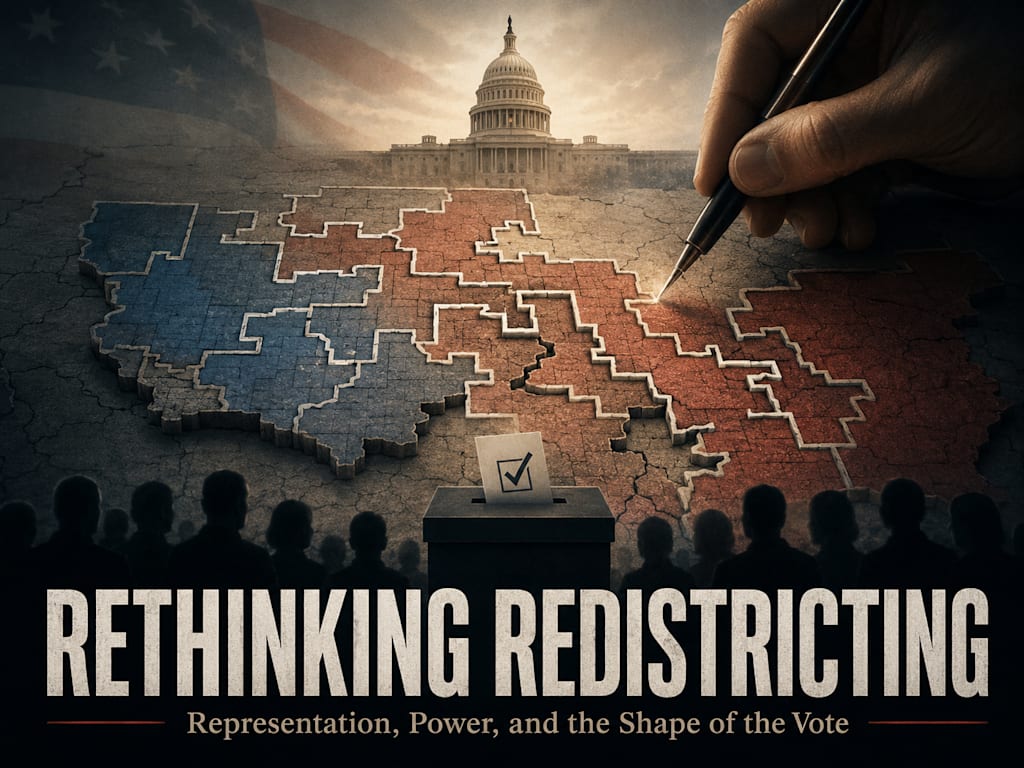
The danger is just as serious. A political compass test can become the new map. In ordinary gerrymandering, manipulation happens through lines. In a test-based system, manipulation can happen through questions, answer choices, scoring formulas, category weights, district definitions, and assignment rules. The map may disappear, but the power to arrange voters remains. It simply moves from geography to classification.
This is why the test cannot be treated as neutral just because it uses questions and numbers. Every question frames reality. Every answer choice limits what the voter can say. Every scoring formula decides which beliefs matter most. Every category system decides which political communities are real enough to receive representation. If one axis is included and another is excluded, the system changes. If war is ignored but culture is emphasized, one kind of voter is misread. If institutional trust is treated as moderation and institutional skepticism is treated as extremism, another kind of voter is misread.
A test may look objective while carrying hidden assumptions. That can make it more dangerous than a visible map. A strange district line can be seen and challenged. A biased scoring method may be harder for ordinary voters to detect. If the formula is hidden, the voter may never know why they were placed in a district that does not represent them.
Question Design Can Manipulate Outcomes
The most obvious point of abuse is question design. A fair question allows voters to express a real position without being pushed toward a preferred answer. A manipulative question frames one answer as moral, intelligent, compassionate, patriotic, scientific, or responsible while framing the other as cruel, extreme, ignorant, selfish, or dangerous. That kind of design does not measure belief honestly. It pressures voters to accept the test writer’s assumptions.
For example, a question about speech can be written as, “Should hateful misinformation be restricted to protect vulnerable communities?” That framing pushes one direction. The same issue could be framed as, “Should government or state-backed institutions be allowed to restrict lawful speech based on contested definitions of harm?” That framing pushes another direction. Both may point toward a real debate, but each emphasizes different moral risks. A fair assessment would need to present the actual conflict clearly: protection from harm versus protection from censorship and abuse of authority.
The same problem appears in questions about war, immigration, taxation, religious liberty, policing, public health authority, parental rights, environmental regulation, corporate power, labor, education, and federal agencies. If the question hides the tradeoff, the answer becomes less meaningful. A political compass system must not be allowed to measure voters through loaded language. Otherwise the test becomes persuasion disguised as administration.
Scoring Is Even More Powerful Than the Questions
Even if the questions are fair, the scoring can still manipulate the result. The test designer decides how much each answer counts. One question may move a voter strongly toward one category. Another may barely matter. Some issues may be weighted heavily. Others may be treated as secondary. The voter sees the questions, but the real assignment happens inside the scoring system.
This creates a serious problem. A voter may answer honestly and still be placed inaccurately because the system weights issues differently than the voter does. One voter may consider war the most important issue. Another may consider speech the most important. Another may prioritize parental authority, local control, debt, labor, religious liberty, or immigration. If the test weights all issues equally, it may misread the voter’s actual priorities. If the test weights issues secretly, it can quietly shape district outcomes.
A fairer version would allow voters to rank issue importance. The system could ask not only what the voter believes, but which issues matter most when choosing representation. Even then, the scoring must remain public. If the formula is hidden, the system becomes an ideological sorting machine controlled by whoever administers it. A test-based district system cannot be legitimate unless voters can inspect how answers become assignments.
Mandatory Testing Creates a Freedom Problem
A mandatory political-values test raises a deeper objection. The state should be extremely limited in its ability to force citizens to disclose ideological beliefs as a condition of representation. Voting is a civic act. It should not become a confession booth controlled by government. A citizen should not have to prove political identity, reveal moral priorities, or submit to ideological classification before receiving representation.
This concern is not merely about privacy. It is about conscience and power. If the government can require citizens to answer political questions before assigning them to districts, then the government gains a structured record of political belief. Even if the current administrators promise neutrality, the system can be abused later. Records can be leaked, shared, weaponized, subpoenaed, hacked, or used indirectly. A society that values liberty should be careful before creating official belief profiles.
This is why a political compass should be voluntary at most. It can guide voters. It can help citizens compare districts. It can show likely alignment. But it should not overrule the voter’s own choice. The citizen should retain final authority to rank or select districts. The test may advise. It should not command.
A Voluntary Guide Is Stronger Than Forced Assignment
The strongest version of a political compass system is not mandatory assignment. It is voluntary guidance. Voters could answer a values assessment privately and receive suggested districts. The system might say that the voter appears closest to the Localist District, Constitutionalist District, Libertarian District, Anti-War District, or Nonaligned District. The voter could then rank those districts or choose differently.
This preserves the benefit without surrendering control. The test helps voters understand the district options, especially in a system with many categories. It may help people who do not know whether they fit better in a constitutionalist, libertarian, conservative, populist, localist, labor, progressive, anti-war, or nonaligned constituency. It may also help cross-pressured voters see that their views form a recognizable pattern.
But the final decision should belong to the voter. A person may answer like a libertarian on many questions but still want to join a constitutionalist district because constitutional limits are the highest priority. Another may score as progressive but choose an anti-war district because foreign policy matters most. Another may score as conservative but choose a localist district because decentralization is the central concern. A voluntary test can inform those choices without replacing them.
The Assessment Must Measure Tradeoffs, Not Slogans
A serious political compass must avoid slogan testing. It should not ask whether voters support “freedom,” “justice,” “safety,” “fairness,” “democracy,” “equality,” “family,” “security,” or “rights” in vague terms. Nearly everyone supports those words in some form. The real political question is what happens when goods conflict. Does safety justify surveillance? Does equality justify coercion? Does local control justify policy variation? Does national uniformity justify overriding local communities? Does compassion justify debt? Does order justify censorship? Does liberty justify risk?
A useful assessment would measure tradeoffs. It would ask voters which principle should govern when two real goods collide. That is where political identity becomes clearer. A voter’s answer to an isolated moral word reveals little. A voter’s answer to a conflict reveals more. For example, “Should government be allowed to restrict lawful speech to prevent social harm, or should lawful speech remain protected even when it causes offense or disorder?” That kind of question names the tradeoff.
This does not mean every question must be long or complicated. It means the test should respect the voter enough to present the conflict honestly. Political philosophy is not a collection of slogans. It is an ordering of goods under pressure. A values assessment that ignores pressure will produce shallow results.
Categories Must Reflect Real Constituencies
A test-based system also depends on the categories available. If the only categories are left, right, and center, the test will misrepresent many voters. If there is no anti-war category, anti-war voters may be scattered. If there is no localist category, decentralists may be misread. If there is no labor-populist category, working-class voters may be forced into party labels that do not match them. If there is no civil-liberties category, voters concerned with speech and privacy may be buried.
Categories should emerge from real political patterns, not from party convenience. A state may have a constitutionalist cluster, progressive cluster, libertarian cluster, labor-populist cluster, religious conservative cluster, anti-war cluster, localist cluster, market-oriented cluster, institutionalist cluster, and nonaligned cluster. Another state may have different clusters. The test should not pretend every population has the same political shape.
This is another reason mandatory assignment is risky. If the category list is wrong, the voter is misclassified before the election begins. A voluntary model is safer because voters can reject the test’s suggestion and choose the district that better fits their own understanding. The system should help voters find representation, not trap them inside bureaucratic categories.
Transparency Is the Core Safeguard
A test-based system can only be trusted if the questions, scoring, categories, weights, and assignment rules are public. There should be no hidden formula. There should be no secret weighting. There should be no private vendor controlling the model without public inspection. There should be no partisan committee adjusting the test after seeing likely outcomes. If the assessment affects representation, it must be open to scrutiny.
Transparency also allows criticism. Citizens should be able to challenge loaded questions, missing axes, unfair weights, vague categories, and manipulative descriptions. Public review does not guarantee perfection, but it makes abuse harder. A hidden test would invite suspicion and corruption. An open test can be debated, corrected, audited, and improved.
The public should also be able to see aggregate results without exposing individual voters. The state can report how many voters were suggested for each district, how many chose each district, how many used the guide, and how assignment worked under caps. But individual answers should remain private unless the voter voluntarily discloses them. The system must be transparent in structure and private in personal belief.
Appeals and Manual Choice Are Necessary
Any assessment system will make mistakes. A voter may be placed near the wrong district. A question may fail to capture nuance. A scoring formula may overemphasize one issue. A voter may misunderstand an answer. A person’s priorities may not be captured by the available categories. Therefore, any system that uses assessment must allow manual correction.
The simplest correction is voter override. The test can suggest, but the voter ranks districts. That removes the need for a formal appeal in many cases because the voter already has final say. If the system ever uses automatic assignment, then appeals become essential. A voter should be able to say, “This assignment does not represent me,” and request reassignment according to published rules.
But even appeal systems can become burdensome. A citizen should not have to argue with the state about what they believe. That is another reason voluntary guidance is better than mandatory classification. The more power the assessment has, the more intrusive the appeal process becomes. The fairest system is one where the voter’s own ranked choice remains primary.
Privacy Cannot Be an Afterthought
Political belief is sensitive because political power can punish dissent. A values assessment may reveal a voter’s views on war, religion, sexuality, family, policing, immigration, taxation, speech, race, guns, public health, institutional trust, and federal power. That information should not be casually stored, shared, or exposed. A districting system that creates detailed ideological profiles must be treated as dangerous unless privacy protections are built in from the beginning.
The best approach would minimize retained data. If a voter uses a voluntary guide, the system should not need to store every answer permanently. It may calculate suggestions and then allow the voter to rank districts. The final district assignment may need to be retained for election administration, but the underlying answers should not become a permanent file. Data minimization should be a core rule.
Privacy also means protection from social pressure. If every voter’s ideological district is publicly searchable, the system could create retaliation risks. Some level of registration information may already exist in different systems, but a values-based assignment model would raise the stakes. Public aggregate data is useful. Individual belief exposure is dangerous. The system should never confuse transparency of rules with exposure of citizens.
The Best Use Is Educational, Not Coercive
A political compass assessment may be most valuable as an educational tool. It can help voters understand the difference between districts. It can reveal that left and right are not enough. It can show voters that they may be localist, libertarian, anti-war, labor-populist, institutionalist, constitutionalist, progressive, nonaligned, or some combination. It can help citizens think more clearly about what they actually want represented.
Used this way, the assessment strengthens the system without controlling it. It gives voters information. It does not force identity. It helps a voter rank districts. It does not replace judgment. It makes political complexity visible. It does not turn people into administrative objects.
This educational function fits the broader goal of representation reform. The point is not only to rearrange voters. It is to make the act of representation more honest. Voters should know what they are choosing, why their district exists, and what kind of representative they are trying to send. A voluntary political compass can serve that purpose if it remains subordinate to voter choice.
The Promise and the Warning
Political compass assignment has real promise. It can reveal voters who are hidden by party labels. It can make cross-pressured citizens visible. It can help build districts around real governing values instead of land alone. It can show that political identity has multiple axes: power, liberty, authority, war, economics, culture, institutional trust, localism, and class. It can help voters find constituencies that better represent their priorities.
But the danger is equally real. If the test is mandatory, opaque, biased, weighted secretly, or controlled by political actors, it becomes the new gerrymander. The manipulation no longer happens through crooked lines. It happens through crooked questions. A district can be rigged by classification as easily as by geography if the classifier controls the categories.
The safe principle is clear. A political compass may guide, but it should not govern. The voter must retain final authority to choose or rank districts. The questions must be public. The scoring must be auditable. The categories must be stable. The data must be private. The process must be transparent. Used carefully, a values assessment can help representation become more accurate. Used coercively, it becomes one of the most dangerous versions of the very problem it was meant to solve.
About the Creator
Peter Thwing - Host of the FST Podcast
Peter unites intellect, wisdom, curiosity, and empathy —
Writing at the crossroads of faith, philosophy, and freedom —
Confronting confusion with clarity —
Guiding readers toward courage, conviction, and renewal —
With love, grace, and truth.
Enjoyed the story? Support the Creator.
Subscribe for free to receive all their stories in your feed.
Comments
There are no comments for this story
Be the first to respond and start the conversation.