
Who Is Murdering Hope?
Who Stole the Future from the Kids?
The other day, an article by a well-known left-wing intellectual popped up on my feed. The headline was practically screaming: “Is a Generational Revolt Coming? We Need an Uprising of the Youth More Than Ever.”
He sounded deadly serious, like the world was scheduled to end by next Tuesday. The piece wasn’t original; it read like dozens of gloomy manifestos we’ve had to endure lately. Only the villains rotate.
One year, it’s climate change. The next, late-stage capitalism. Then social media feeds. Then border drama. And now, the robot apocalypse.
Yet beneath all the hand-wringing, the same sad song hums in the background:
The future is a trap, so don’t bother planning anything fun.
We’re told twenty-somethings are facing an existential nightmare. A total mental breakdown is guaranteed. They’ll never buy a flat. AI will steal their lunch. The planet is frying. The system is out to get them. And if a young person somehow manages to still enjoy being alive, an expert will gladly show up to explain why they shouldn’t.
Reading it, I didn’t know whether to laugh, swear, or feel deeply sorry.
Not for the kids, but for the adults who are failing them.
II. A History of Doomsdays
Humans have always had a weird, romantic crush on the apocalypse.
The end of the world is a remarkably cozy intellectual sanctuary. It absolves you of all personal responsibility. It paints the grand finale in vivid, eschatological colors. It gets you off the hook for everything.
Why break a sweat laying bricks for a house? Why learn a tough craft? Why work through the mess of a real relationship? Why have kids? Why risk your neck starting a business — when we’re all going to freeze, drown, burn, or get automated away in ten years anyway?
My generation has lived through several ends of the world already:
We narrowly slipped past nuclear annihilation.
Our parents patched the ozone hole.
Then came Y2K.
Bird flu.
Swine flu.
The 2008 financial crash.
Several definitive ends of democracy.
The climate crisis.
A global pandemic.
And now, almighty Artificial Intelligence.
I’m starting to suspect the apocalypse has a chronic problem with keeping its deadlines.
Every era invents its favorite bedtime horror story. The Middle Ages awaited the Last Judgment. The Cold War braced for the mushroom cloud. Today, we play doomsday bingo and call it polycrisis. In advanced civilizations, we never suffer from a shortage of crises. We just dont have enough time to properly mourn them all.
Past generations were scared too, but they still had babies, plotted big adventures, and tamed the wild world. Today, whining has become a civic duty, and giving up, refusing to build, reproduce and enjoy life is marketed as a moral virtue.
Turning pure nihilism into a badge of honor is a dangerous brand of stupid.
If you don’t want to live, if you see no future, keep it to yourself. Stop poisoning the minds of others and simply excting in peace.
III. The Crime Against Human Agency
I couldn’t help but think of my grandfather. At twenty, he was forced into labor in the Third Reich. There was a very decent chance a German patrol would shoot him in the street or throw him into a camp. (Though with many local husbands away on the front lines, my grandfather ended up having quite a lively time, but that’s a story for another day.)
When my father was twenty, Soviet tanks rolled into Prague, and the prospect of spending the next four decades of soul-crushing totalitarian grey would have broken a lab rat.
Yet neither war nor occupation snuffed out their spirit. They planned for tomorrow, celebrated life, one conscripted in Germany, the other occupied in Prague. They started families. They built. They worked. They saved. They raised children. Nobody promised them a cake walk. But they kept marching toward the horizon anyway.
And that’s the real gap between generations. Tough times have always been here, and past generations had it ten times worse. But they didn’t quit.
The difference is the horizon adults offer to the young.
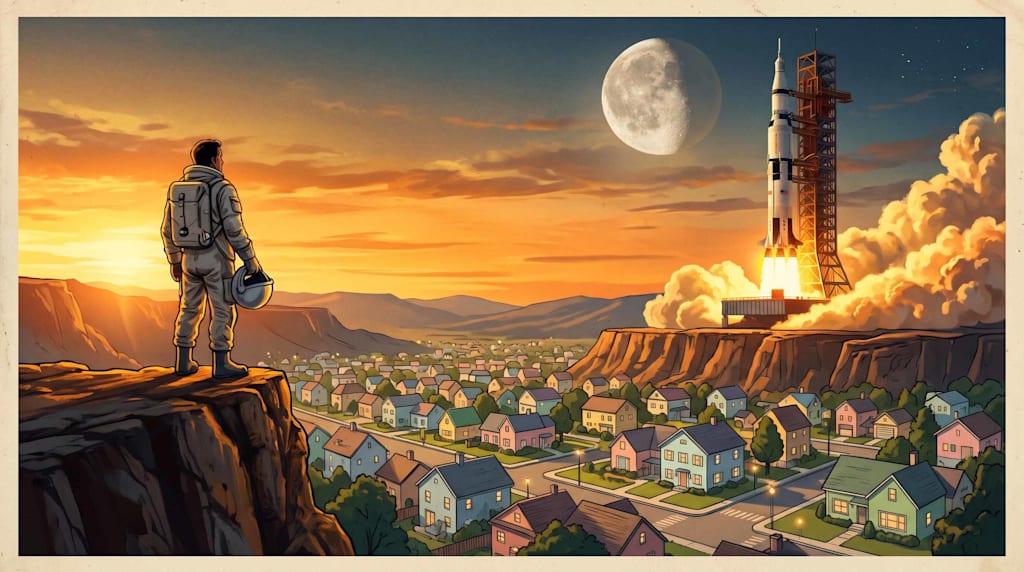
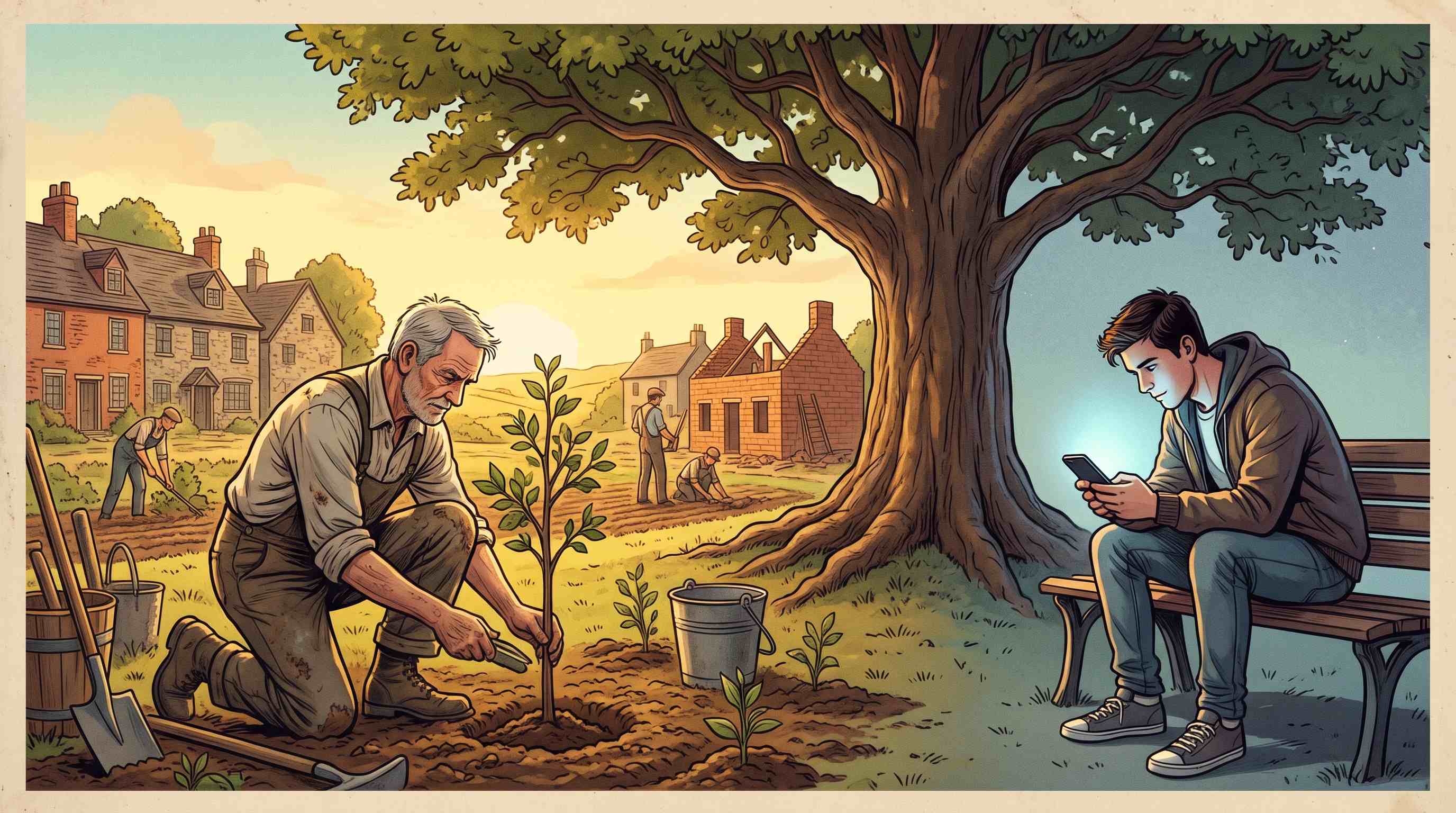
Our ancestors knew life could be raw and brutal. Yet they planted apple trees whose full shade they would never enjoy. They laid stone foundations for homes meant for grandkids they hadn’t met yet. With their bare hands, they shaped the landscape. Our grandfathers rebuilt after the ruins of communism. The Apollo crew aimed for the Moon. The nineties tasted the electric air of freedom and open roads.
What do we offer our youth today?
Anxiety. Catastrophe. Trauma. Apocalypse. Guilt. Instead of agency and strength, we prescribe fragility.
And then we act shocked when they sink into depression. Instead of giving them a direction, tools and a map, we hand them a mirror instructing them to gaze into it endlessly, obsess over their insecurities, catalogue their wounds, and await the inevitable collapse.
Instead of walking forward, they’re told to walk backward, tally the sins of dead ancestors, and apologize for breathing.
A self-appointed tour guide in a museum of European guilt — that’s how regressive ivory-tower thinkers see the world.
That is not care for mental health. That is a crime against the frontier spirit, against the never-ending dawn of a new world. That’s blowing out the candle while someone is trying to find the way in the dark.
IV. Ivory Towers and Stolen Horizons
A twenty-year-old wrestling with fear doesn’t bother me. At twenty, you’re scared of almost everything: failing, ending up alone, jobs, girls, bills, and your own awkward insignificance. That’s just what being twenty feels like; we all survived it.
What bothers me is a fifty-year-old intellectual sitting in a warm faculty lounge or newsroom, smugly assuring that twenty-year old kid that his panic is noble. Telling him that trying hard at work is just “getting exploited,” that the world is doomed, and that his highest calling is to throw a generational tantrum against the people who built the roof over his head.
If you tell a kid every morning that tomorrow is a trap, you aren’t raising a sensitive thinker. You’re raising someone who is terrified to live. That’s not empathy. That’s laziness dressed up as compassion.
Here’s the tragedy: the young didn’t decide to give up on their own. They just believed the tired and twisted adults who threw in the towel years ago.
When you strip a young person of their agency, the gut feeling that their effort actually matters, you don’t save them from burnout. You sentence them to an empty void. The human mind can’t survive believing that nothing matters. Without a horizon, even a tiny pothole feels like the Grand Canyon.
V. Builders and Prophets of Doom
Every civilization has two kinds of people: prophets and builders.
Prophets write dramatic eschatological essays explaining how everything is going to hell. It’s an easy gig. All you need is a handful of fancy words and a bad attitude. A prophet never takes a risk. If disaster doesn’t happen, he says it was a close call. If it does, he grins: “Told you so!”
Prophets have their place. They point out potholes and hit the brakes when we get reckless. But when ivory towers leave society with only prophets, everything grinds to a halt. Prophets hate builders because building stuff threatens their gloomy predictions. So we stop taking chances, we surrender our agency, and we waste all our energy coming up with clever reasons why nothing can be done.
And then there are the builders. Weird, stubborn, slightly crazy people. The builder lays the first brick even though he knows houses can catch fire. He launches a business knowing most startups crash. He starts a family knowing love gets messy and kids are an expensive mountain of stress in dirty diapers.
Builders stumble. They make mistakes. They go broke. They have egos and can be a pain in the neck. Sometimes we secretly resent them for pulling off what we couldn’t, and we look for an excuse to kick them when they trip.
Yet without builders, we’d still be shivering in damp caves, weeping in terror every time thunder clattered overhead. History was never moved forward by the cynics with the best arguments for doing nothing. It was pushed forward by the crazy bastards willing to build anyway.
Builders stumble. They make mistakes. They occasionally go bankrupt. They can be unbearable, driven by sharp egos.
VI. Why Millions Follow the Archetype of Elon Musk
You can think whatever you like of Elon Musk. You can hate his tweets, cringe at his jokes, or roll your eyes at his ego. Critics spend all day dissecting his flaws, missing the forest for the trees.
This isn’t about Musk the man. It is about an archetype of the builder and the frontier spirit that our culture has starved people of.
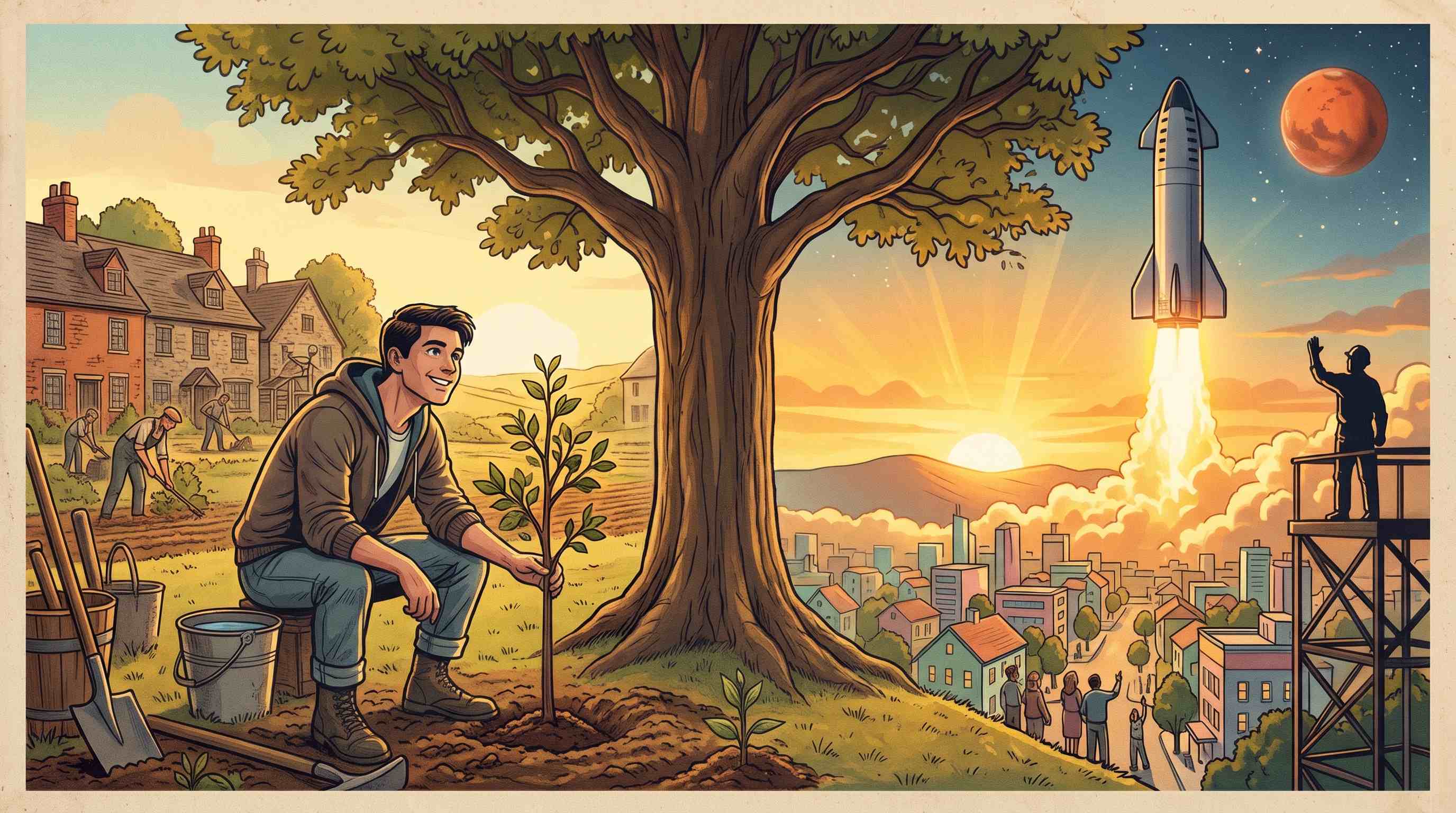
Kids aren’t drawn to Musk because he’s a saint. They’re drawn to him for the exact same reason their grandfathers watched the Apollo launches or the transcontinental railroad. What is he actually offering them?
He gives them an uncharted horizon and hands them back their agency.
He does not whisper: “The world is ending.” He says: “We will engineer the most colossal, cost-effective rocket in human history.”
He does not preach: “The future is ruined.” He says: “Let us make humanity a multi-planetary species.”
In doing so, he says nothing less than:
Let us refuse extinction; we deserve to be here.
He doesn’t baby your feelings or hand you a blankie. He speaks to that untamed part of the human spirit that wants to push past the fence, shatter boundaries. Whether every project works out doesn’t matter. What matters is that a huge chunk of this generation is starving for what institutions stopped serving: an audacious goal, an adventure, and a reason to get out of bed in the morning. The Meaning.
People need a big story they can be part of. They need to believe tomorrow can be better than yesterday. And if school, media, and culture refuse to offer it, they will find it somewhere else.
VII. The Future Won’t Happen on Its Own
Civilizations don’t fall apart when they run out of money, chips, or electricity. They fall apart the minute people lose the appetite to invest sweat into tomorrow. They collapse when people believe there are only two choices left: angry riots or curling into a ball waiting for the storm to pass.
It won’t pass. The universe doesn’t hit pause to wait for us to finish feeling sorry for ourselves.
Two paths lie before us.
The first path whines: The world is unfair. Effort is pointless. Technology will enslave us. The system is rigged. We are victims.
The second path proclaims: Yes, it’s damn hard. Technology is turning everything upside down. The old playbooks are trash. And that is exactly why it’s time to build. New companies. New communities. New tools. New ways for humans and intelligent agents to team up.
Every single generation was handed its share of agony. It was by dealing with it that we evolved as a species.
Only to the most recent generations did someone whisper the toxic lie that building the future is pointless and that giving up is a moral stance.
That is the true crime. Not the climate. Not the “system.” But the theft of our faith that tomorrow can be brighter than today a crime committed by bored cynics against their own kids.
The future is not an event on a calendar that arrives automatically. The future is whatever we have the guts, sweat, and agency to drag into existence.
That’s the world I want to live in. A world of builders who wake up and get to work anyway.
About the Creator
Enjoyed the story? Support the Creator.
Subscribe for free to receive all their stories in your feed.
Comments
There are no comments for this story
Be the first to respond and start the conversation.