
We Weren't Really Fighting About the Kitchen
How a retreat in Santa Barbara taught me to look beneath every argument

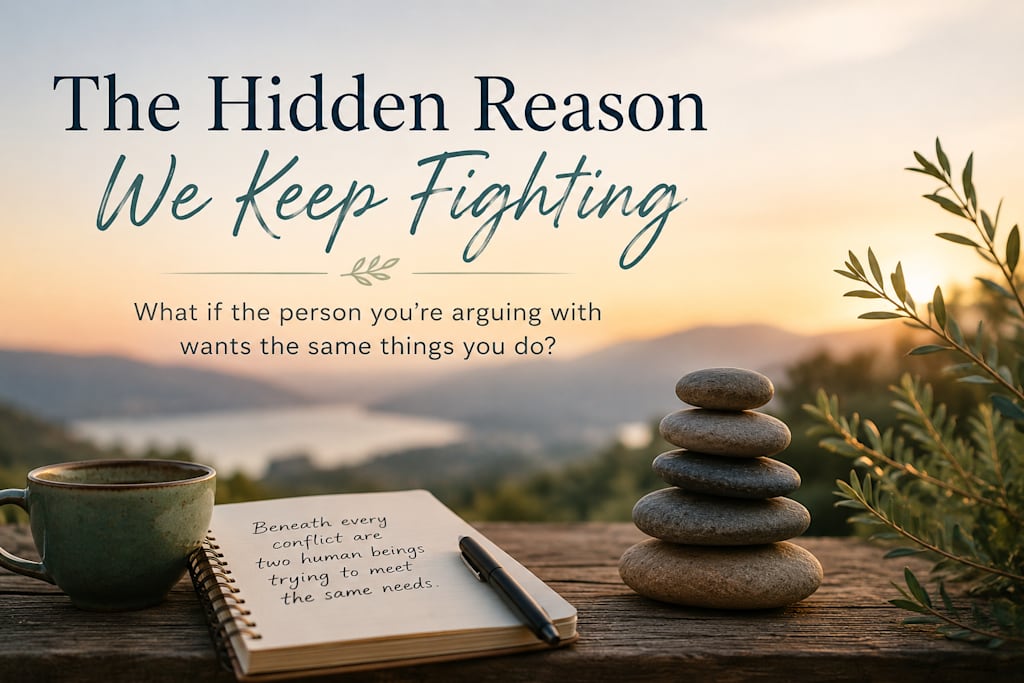
My ex-husband cooked sometimes.
Not often. But when he did, something in me would simultaneously feel loved and quietly dread what was coming.
Because what came after the cooking was the kitchen.
Tomato handprints on the white door knobs.
Oil from the pan somehow finding its way to the walls, the counter tops, the oven top — places I still cannot explain physically.
A cutting board at an angle. A stovetop that looked like a small war had been declared and lost.
Every time I walked in after him, something in me tightened.
It wasn't just the mess.
It was what the mess did to me.
I love peace. Genuinely. Not as a concept — as a physical need. A clean, organized space is not a preference for me. It is the condition under which I can breathe. When I see disorder, something in my body registers it as a task, an obligation, something undone. The feeling of peace I work so hard to cultivate — in meditation, in my mornings, in my daily rituals — evaporates the moment I walk into a chaotic kitchen.
So we argued.
More than once.
More than twice.
On the surface we were arguing about cleaning. About who left what where. About tomato handprints and oil splatter and a stovetop that required twenty minutes of work to restore.
But we weren't really arguing about the kitchen.
It took me years — and a retreat in Santa Barbara, California — to finally understand what we were actually fighting about.
Ninety people in a room
Many years ago I attended a retreat with Dr. Marshall Rosenberg, the creator of Nonviolent Communication — a framework for understanding not just what people say but what they need underneath what they say.
Ninety people had come from all over the world. Different countries. Different religions. Different stories. Different wounds.
It was the first time I had been surrounded by so many people from completely different backgrounds who genuinely wanted to understand one another rather than win against one another.
I thought I was there to learn better communication skills.
I left with something I hadn't expected.
A completely different way of seeing conflict.
The need beneath the argument
One morning Dr. Rosenberg said something I have never forgotten.
He explained that beneath every conflict, people are almost always trying to meet the same universal human needs. Even two people who have stood on opposite sides of an argument for years — even decades — are often, at the deepest level, longing for the same things.
I remember thinking: that cannot be true.
How could two people fighting about a kitchen — or a curfew, or money, or a friendship that ended over a misunderstanding — possibly want the same thing?
As we worked through examples throughout the retreat, I slowly began to understand.
Imagine a mother and teenage daughter arguing about curfew.
The mother says: I don't want you home after midnight.
The daughter says: You're trying to control my life.
On the surface — a fight about a time.
But underneath?
The mother is trying to protect safety.
The daughter is trying to protect freedom.
Neither need is wrong.
Neither person is the enemy.
The fight was never really about midnight.
What we were really protecting
When I thought back to my kitchen arguments through this lens, something shifted.
I wasn't fighting about tomato handprints.
I was protecting peace. Harmony. The feeling of a home that felt like a sanctuary rather than a task list. For me, a clean organized space is not about control or perfectionism. It is the physical environment in which inner peace becomes possible. Mess and peace cannot coexist in my body. That is simply true for me.
And him?
He wasn't being careless or inconsiderate.
He was expressing something — creativity, spontaneity, the freedom to move through a space without self-consciousness. Perhaps love, in the way he knew how to show it.
Two people.
Two completely different needs.
Neither of them wrong.
Neither of them the enemy.
We were just never able to find the conversation that lived beneath the argument about the kitchen.
The question that changes everything
Dr. Rosenberg taught us to ask a different question during conflict.
Not: who is right?
But: what human need is this person trying to protect?
It sounds simple. It is not always easy. I still react sometimes. I still say things I wish I had said differently. But when I remember to pause and ask that question — even silently, even just to myself — something shifts.
It becomes harder to stay angry at someone once you remember they are protecting something precious.
Not wrong. Not your enemy.
Just human. Trying to feel safe, or free, or heard, or seen, or loved.
The same things you are trying to feel.
The larger picture
I think about this question beyond personal relationships too.
Behind every opinion, every border, every flag — there are human beings longing for many of the same things.
Safety. Freedom. To be heard. To matter. To belong. To be understood. To have a future for the people they love.
I wonder sometimes how many conflicts — large and small — might unfold differently if we became a little more curious about one another's humanity before reacting.
Perhaps peace doesn't always begin with agreement.
Perhaps it begins with remembering our shared humanity.
I still love a clean kitchen.
That hasn't changed.
But now, when I feel that familiar tightening — in a kitchen, in a conversation, in any moment where two needs are trying to find space to coexist — I try to remember to look a little deeper.
Beneath the tomato handprints.
Beneath the argument.
Beneath the words.
Two human beings.
Both longing for the very same things.
🌿
This essay is written from my own experiences and memories. I use AI assistance for editing and refinement.
About the Creator
Inbar Shahar
Life coach & author. Writing about inner peace, spiritual practice & finding your way back to yourself. Founder of Wise Woman Bloom. wisewoman.love
Enjoyed the story? Support the Creator.
Subscribe for free to receive all their stories in your feed.
Comments
There are no comments for this story
Be the first to respond and start the conversation.