
The Women We Call Monsters
How myths, history, and self-doubt transform complex women into villains—and why reclaiming our own stories matters.

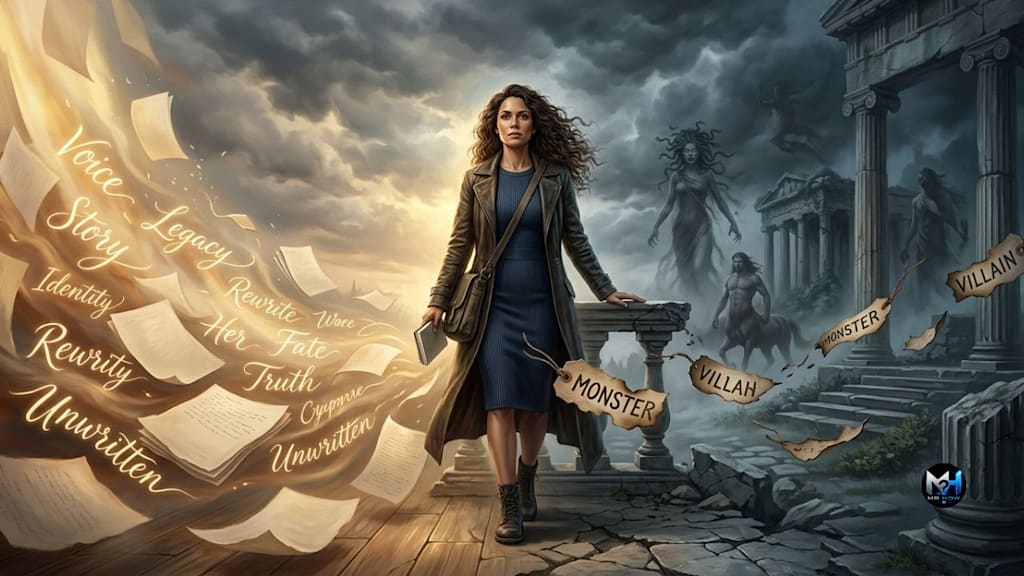
Every culture has its monsters.
Some breathe fire. Some haunt forests. Some emerge from the depths of oceans to drag sailors into the darkness. Yet among all the creatures that fill our myths and legends, there is one category that has always fascinated me more than any other: the women history decided to fear.
These women appear again and again across stories separated by centuries and continents. They are queens, witches, mothers, lovers, and rebels. Their names survive long after their lives have been forgotten. We remember them not for who they were but for what they supposedly did. They become warnings disguised as characters, lessons wrapped in myth.
The moment a woman steps beyond the boundaries society has drawn for her, the transformation often begins. Her confidence becomes arrogance. Her anger becomes madness. Her ambition becomes greed. Her independence becomes danger.
Eventually, she becomes a monster.
I've spent years thinking about why these stories endure.
Perhaps it is because monsters simplify complicated truths. It is easier to place someone into a category than it is to understand them. Once a person becomes a villain, we no longer feel obligated to examine their motives, struggles, or circumstances. We can dismiss them with a single word and move on.
But life is rarely that simple.
As I grew older, I found myself questioning many of the stories I had accepted without hesitation. The older I became, the more I realized that history and mythology are often shaped by the perspectives of those who tell them. Every story has a narrator, and every narrator carries biases, fears, and assumptions.
What happens when the narrator misunderstands the subject?
What happens when the subject never gets the chance to speak for herself?
These questions eventually led me back to my own life.
For a long time, I wanted desperately to be a writer. Not just someone who wrote occasionally, but a real writer—the kind whose words mattered. The kind who published stories people remembered. The kind who inspired others.
At first, writing felt magical.
Ideas arrived unexpectedly. Characters appeared in my imagination fully formed. Entire scenes unfolded in my mind before I ever touched a keyboard. I could spend hours lost inside a story without noticing the passage of time.
Then something changed.
The more seriously I took writing, the more afraid I became.
I started comparing myself to successful authors. I examined every sentence I wrote and found flaws. I measured my progress against impossible standards. Instead of focusing on the joy of creation, I became obsessed with outcomes.
Would people like it?
Would they share it?
Would they think I was talented?
Every piece of writing became a test.
The pressure slowly drained the excitement from the process. What had once been an act of exploration transformed into an endless search for validation. I wasn't writing because I loved writing anymore. I was writing because I wanted proof that I was good enough.
When that proof didn't arrive as quickly as I hoped, doubt rushed in to fill the empty space.
Doubt is a strange companion.
It doesn't usually arrive with dramatic declarations. Instead, it whispers. It asks questions that seem harmless at first.
What if you're not talented?
What if nobody cares?
What if you're wasting your time?
What if you've misunderstood yourself completely?
Over time, those questions became difficult to ignore.
I wrote less frequently. Projects remained unfinished. Ideas that once excited me suddenly felt inadequate. Eventually, I stopped sharing my work altogether.
From the outside, it probably looked like I had simply lost interest.
The truth was more complicated.
I was terrified.
Terrified that I would discover my dreams were larger than my abilities. Terrified that I would spend years chasing something I could never achieve. Terrified that the identity I had built around being creative might not be real.
For months, I barely wrote anything.
Yet even during that silence, stories refused to leave me alone.
A sentence would appear while I was washing dishes. A character would emerge during a walk. An idea would interrupt an ordinary afternoon and demand attention.
No matter how far I tried to distance myself from writing, writing continued to find me.
That persistence taught me something important.
Creativity is not always about achievement.
Sometimes it is about survival.
We often talk about art as though its value depends on recognition. We celebrate bestsellers, awards, and viral success stories. Those accomplishments are wonderful, but they are not the only reason people create.
Many people write, paint, sing, or build simply because doing so helps them make sense of themselves.
Creation gives shape to emotions that otherwise remain invisible.
It transforms confusion into understanding.
It allows us to leave evidence that we were here.
Perhaps that is why I continue to think about the women history calls monsters.
In many ways, they represent the same struggle.
Their stories were often reduced to simple narratives that ignored complexity. They became symbols rather than people. Their voices disappeared beneath generations of retellings.
The more I reflect on these figures, the less interested I become in determining whether they were heroes or villains. Real people are rarely either. Most of us exist somewhere in between.
We are imperfect. We make mistakes. We carry contradictions.
And perhaps the greatest act of courage is refusing to let those contradictions be flattened into a single label.
So I continue writing.
Not because I expect every story to succeed.
Not because I believe every word will be remembered.
But because telling stories matters.
Because every voice deserves the chance to be heard.
And because sometimes the people we call monsters are simply people whose stories were never fully told.
About the Creator
Enjoyed the story? Support the Creator.
Subscribe for free to receive all their stories in your feed.
Comments
There are no comments for this story
Be the first to respond and start the conversation.