
The Hidden Cost of Low Awareness
How missed micro‑signals quietly shape your decisions, your relationships, and your safety — long before you notice the impact.
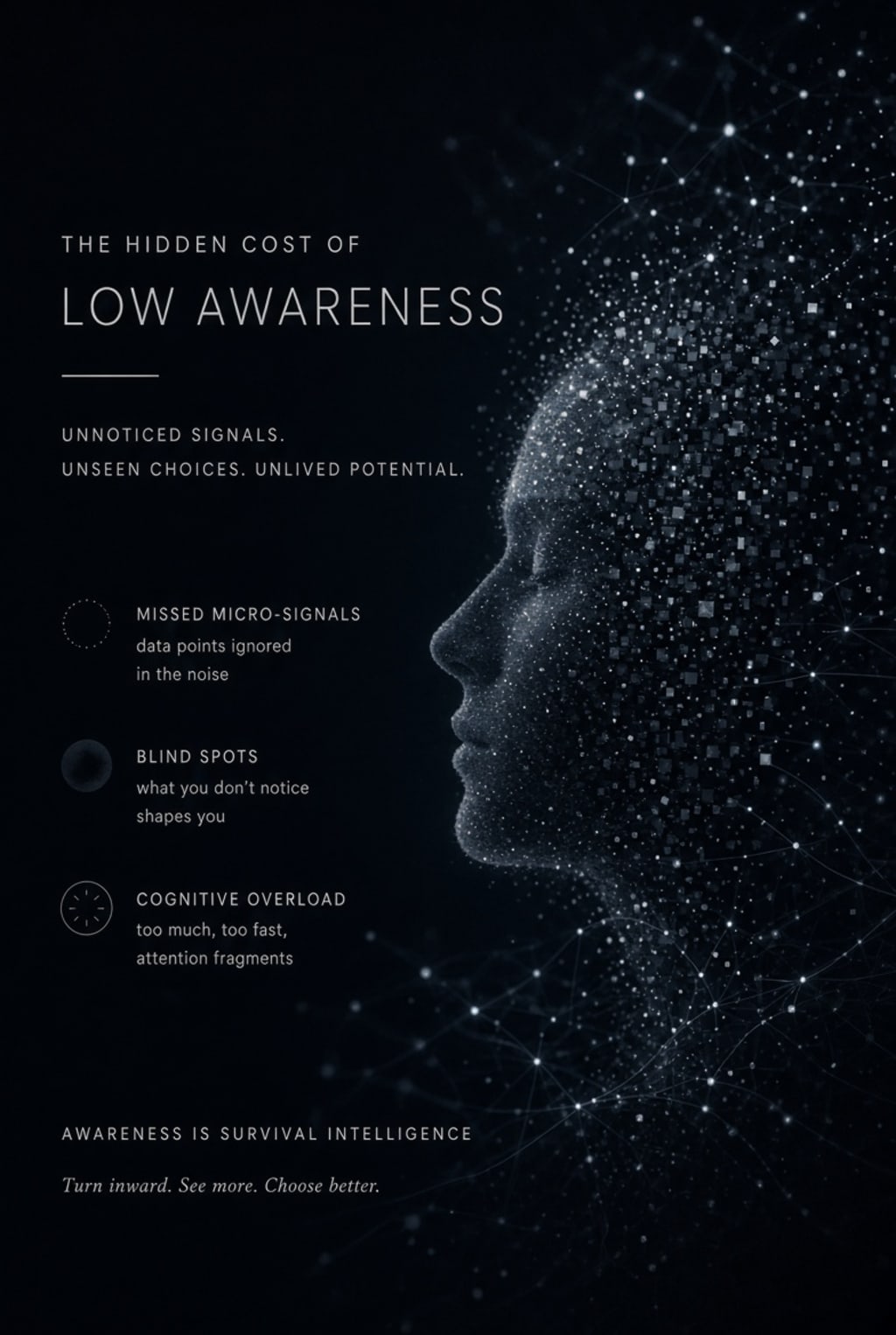
Most people think awareness is about noticing danger.
But the truth is far more subtle — and far more costly.
The biggest problems in life don’t arrive loudly.
They arrive quietly.
They begin as micro‑signals: a shift in tone, a change in rhythm, a small discomfort, a subtle tension.
And when you miss these signals, you pay for them later.
Low awareness doesn’t just make you less safe.
It makes you less connected, less stable, less emotionally clear, and less capable of navigating the complexity of modern life.
This story explores the hidden cost of low awareness — and how missed micro‑signals shape your relationships, your decisions, your safety, and your internal world more than you think.
1. The Silent Consequences of Not Noticing
Low awareness doesn’t feel dangerous at first.
It feels comfortable.
It feels automatic.
It feels like “everything is fine.”
But underneath that comfort, consequences are forming.
Emotional Drift
Relationships rarely break suddenly.
They break slowly — through micro‑signals people fail to notice:
shorter replies
quieter silences
subtle withdrawal
reduced enthusiasm
emotional distance
When you miss these signals, you react too late.
By the time you notice the problem, the emotional gap is already wide.
Social Misreading
Conflicts don’t start with shouting.
They start with tiny shifts:
a change in tone
a pause that lasts too long
a slight tension in posture
a micro‑expression of frustration
Low awareness turns these signals invisible — and invisible signals become misunderstandings.
Environmental Blindness
Danger doesn’t appear suddenly.
It grows quietly:
a person standing where they usually don’t
a shift in the rhythm of a room
a sudden silence
an unusual movement
People with low awareness don’t see these changes.
They walk into situations unprepared.
2. The Micro‑Signals People Ignore Every Day
Micro‑signals are everywhere.
They are the early warnings of emotional, social, and environmental change.
But most people ignore them because they seem “too small” to matter.
Tone Shifts
A slight change in tone can reveal stress, frustration, or emotional overload.
Subtle Withdrawal
Someone pulling back emotionally is rarely obvious — but always meaningful.
Rhythm Changes
Every environment has a rhythm. When the rhythm changes, something is happening.
Environmental Shifts
A room’s energy can change before anyone speaks.
Emotional Spikes
Your own emotions send early warnings — tension, irritability, fatigue — long before you understand why.
Ignoring these signals is the root of most avoidable problems.
3. How Low Awareness Creates Avoidable Problems
Low awareness doesn’t just make life harder — it makes life more expensive.
Unnecessary Conflict
Most arguments could be prevented if people noticed tension early.
Emotional Overload
Stress builds quietly. People who don’t notice early signs burn out.
Poor Decisions
When you don’t see the full picture, you choose blindly.
Unsafe Situations
Missed environmental signals lead to avoidable danger.
Missed Opportunities
Opportunities appear as subtle signals — curiosity, interest, timing, energy. Low awareness makes them invisible.
4. The Psychology Behind “Not Seeing”
Low awareness is not a personality flaw.
It’s a psychological mechanism — one that activates quietly and invisibly.
Most people don’t miss signals because they don’t care.
They miss signals because their mind is overloaded, distracted, or fatigued.
Understanding why people fail to notice micro‑signals is the first step toward improving awareness.
Cognitive Overload
Modern life demands constant attention:
notifications, deadlines, conversations, responsibilities, digital noise.
When the brain is overloaded, it stops noticing subtle cues.
It focuses only on what is loud, urgent, or directly in front of you.
Micro‑signals disappear.
Habituation
The brain adapts to repeated environments.
When something feels familiar, the mind stops scanning for change.
This is why people miss signals in places they visit every day:
their home, workplace, commute, routine environments.
Familiarity creates blindness.
Inattentional Blindness
This is one of the most powerful psychological effects.
When the mind focuses on one thing, it becomes blind to everything else — even obvious signals.
People don’t miss danger because it’s invisible.
They miss danger because they’re focused on something else.
Emotional Fatigue
When someone is tired, stressed, or emotionally drained, awareness collapses.
The mind becomes narrow.
Signals become blurry.
Interpretation becomes slow.
Low awareness is often a symptom of emotional exhaustion.
5. The Awareness Gap: Why Some People Always React Too Late
Some people consistently react late — in relationships, in conversations, in danger, in opportunities.
This is not random.
It’s the result of an awareness gap: the distance between when a signal appears and when a person finally notices it.
The larger the gap, the more expensive the consequences.
The Slow Mind
Some people process signals slowly.
They notice tension only when it becomes conflict.
They notice withdrawal only when it becomes distance.
They notice danger only when it becomes threat.
A slow mind is not a weak mind — it’s an untrained mind.
The Distracted Mind
Distraction is the enemy of awareness.
A distracted person cannot read a room, a conversation, or an environment.
They miss:
tone shifts
emotional cues
environmental changes
social dynamics
internal signals
Distraction creates blind spots.
The Overwhelmed Mind
When someone is overwhelmed, awareness collapses completely.
They stop noticing:
their own emotions
other people’s signals
environmental patterns
subtle changes in energy
Overwhelm creates a tunnel — and everything outside the tunnel disappears.
6. How Low Awareness Shapes Your Internal World
Low awareness doesn’t just affect your environment. It affects your inner life — your emotions, your decisions, your stability.
You Misinterpret Your Own Feelings
People with low internal awareness often confuse:
stress with anger,
fatigue with sadness,
fear with irritation,
overwhelm with apathy.
When you misinterpret your emotions, you respond incorrectly — and create unnecessary problems.
You Lose Control of Your Reactions
Reactions come from signals.
If you don’t notice the signal early, your reaction becomes sudden and intense.
This is why people “explode” emotionally.
The signal was there — they just didn’t see it.
You Make Decisions Without Context
Good decisions require awareness.
When awareness is low, decisions become impulsive, emotional, or incomplete.
You choose based on what is loud, not what is true.
You Become Vulnerable to External Influence
Low awareness makes you reactive to:
other people’s moods,
other people’s energy,
other people’s pressure,
other people’s expectations.
You lose your internal stability — because you’re not noticing your own signals.
7. How Low Awareness Shapes Your Relationships
Relationships don’t collapse because of one big event.
They collapse because of a thousand small signals that go unnoticed.
Low awareness creates emotional distance long before people realize it.
You Miss Early Signs of Disconnection
Disconnection begins quietly:
shorter answers
reduced enthusiasm
less eye contact
slower responses
subtle withdrawal
These signals are not dramatic — they are soft, almost invisible.
But they matter.
People with low awareness notice disconnection only when it becomes painful.
By then, the emotional gap is already wide.
You Misread Intentions
When awareness is low, you interpret others through your own emotional state — not through their signals.
You think someone is angry when they’re tired.
You think someone is distant when they’re overwhelmed.
You think someone is cold when they’re stressed.
Misreading intentions creates unnecessary conflict.
You React Instead of Adjust
Awareness allows adjustment.
Low awareness forces reaction.
When you don’t notice early signals, you respond too late — and your reaction becomes bigger than necessary.
This is how small tensions become big arguments.
8. How Low Awareness Shapes Your Safety
Safety is not about paranoia.
It’s about noticing small environmental changes before they become problems.
Low awareness makes danger look sudden — even though it rarely is.
You Miss Environmental Shifts
Every environment has a baseline.
When the baseline changes, something is happening.
People with low awareness don’t notice:
unusual movement
strange positioning
sudden silence
changes in rhythm
people scanning the room
tension in the air
These signals appear before danger — not after.
You Walk Into Situations Blindly
Low awareness makes people enter environments without reading them first.
They don’t scan.
They don’t observe.
They don’t interpret.
They move automatically — and automatic movement is vulnerable movement.
You React Late
Danger is expensive when you react late.
Awareness is what gives you time — time to adjust, time to move, time to think.
Low awareness removes that time.
9. How to Reduce the Cost: Awareness Training
Awareness is not a talent.
It’s a trainable skill — one that improves with practice.
Here are the core methods that reduce the cost of low awareness.
Micro‑Observation
Train your eyes to notice small signals:
posture, tone, rhythm, movement, silence.
Small signals reveal big truths.
Emotional Labeling
Name your emotions early. When you label your feelings, you understand them — and when you understand them, you control them.
Environmental Scanning
Before entering any environment, pause for one second.
Scan the room.
Read the atmosphere.
Notice the rhythm.
This one‑second habit prevents most surprises.
Pattern Recognition
Awareness is about patterns.
When a pattern changes, something is happening.
Train yourself to notice changes in:
behavior
tone
energy
rhythm
environment
Patterns are the language of awareness.
Conclusion: Awareness Is a Life Multiplier
Low awareness is expensive.
It costs you clarity, stability, relationships, opportunities, and safety.
But awareness is a multiplier.
It gives you:
emotional intelligence
social precision
environmental understanding
internal stability
early detection
better decisions
Awareness is not about fear.
It’s about seeing early — so you can act wisely.
The people who master awareness don’t live in reaction mode.
They live in prevention mode.
They navigate life with calm, clarity, and confidence.
Awareness is the quiet human skill that changes everything.
The 10 Everyday Places Where Awareness Matters Most
https://vocal.media/psyche/the-10-everyday-places-where-awareness-matters-most
About the Creator
abidi
I write about practical preparedness and everyday safety with a human, down‑to‑earth voice. More of my work here: https://linktr.ee/hnajet32
Enjoyed the story? Support the Creator.
Subscribe for free to receive all their stories in your feed.
Comments
There are no comments for this story
Be the first to respond and start the conversation.