advice
Advice and tips on managing mental health, maintaining a positive outlook and becoming your happiest self.
Why Your Truth Fears Your Fear???
By Muhammad Ilyan Ahmad Introduction: The Silent Struggle of Truth: “Speak your truth” is empowering, but what if your truth feels too heavy? It’s not false—it’s raw, vulnerable, and tangled with fear. Your truth senses the risks: rejection, conflict, or unraveling your life. So it retreats, mirroring your hesitation. This article explores why fear silences truth and how to create space for it, using neuroscience, psychology, and real-world experiences. 1. The Brain’s Fear Firewall: Your brain protects you from harm. Voicing truth—admitting desires, challenging norms, or facing reality—activates the amygdala, the fear center. Neuroscientist Dr. Joseph LeDoux says social threats like judgment trigger fight-or-flight responses. A 2021 *Frontiers in Psychology* study found fear of rejection increases prefrontal cortex activity, suppressing authentic expression for conformity. Your truth stays trapped, not because it’s weak, but because your brain sees exposure as a risk. > “Our brains prioritize survival over truth.” > — Dr. Lisa Feldman Barrett, *How Emotions Are Made* 2. Truth as a Disruptor: Truth can destabilize. Acknowledging dissatisfaction with a career, relationship, or identity threatens life’s foundations. Dr. Susan David, in *Emotional Agility*, notes confronting truth requires dismantling “emotional contracts” with ourselves and others, feeling like betrayal. For example, admitting career misalignment risks disappointing family or destabilizing finances. Truth stays silent for self-preservation, waiting for you to face the wreckage. 3. Authenticity vs. Belonging: Humans crave authenticity and belonging, but they clash. Carl Rogers argued authenticity requires congruence between inner and outer self, yet belonging demands conformity. A 2019 *Personality and Social Psychology Bulletin* study found fear of exclusion leads to suppressed opinions. Hiding progressive views in a conservative community avoids alienation but erodes self-esteem as the “false self” overshadows the real. 4. Self-Silencing: A Survival Strategy: Self-silencing suppresses truth to maintain relationships. Dr. Dana Crowley Jack’s *Silencing the Self* shows marginalized groups—women, minorities—silence truth due to fear of invalidation. A 2023 *Journal of Social Issues* study linked self-silencing to anxiety and depression. It’s not weakness; it’s survival. Your truth stays quiet, sensing the cost of rejection, but silence fractures your sense of self. 5. The Jonah Complex: Abraham Maslow’s “Jonah Complex” describes fearing one’s greatness. Truth promising freedom—like pursuing a passion or leaving toxicity—faces fear of change. A 2022 *Psychological Review* study noted “status quo bias” favors predictable discomfort over uncertain growth. Truth fears your fear because change feels like stepping into the unknown. 6. Childhood Roots of Self-Betrayal: Truth is shaped early. Children corrected for unfiltered thoughts learn truth is conditional. A 2020 *Developmental Psychology* study found kids as young as five self-censor for approval. By adulthood, fear of being “too much” makes truth hesitate, preserving learned acceptance. > “We hide our truth before we trust it.” > — Dr. Lindsay C. Gibson, *Adult Children of Emotionally Immature Parents* 7. Society’s Conformity Trap: Culture prioritizes performance over authenticity. Social media rewards curated personas, workplaces value compliance. A 2024 Pew Research survey found 62% of adults feel conformity pressure. Speaking truth risks opportunities or backlash—whistleblowers like Edward Snowden faced exile. Your truth fears real-world consequences. 8. The Body’s Silent Protest: Suppressed truth lingers. Dr. Bessel van der Kolk’s *The Body Keeps the Score* explains unexpressed emotions cause anxiety, fatigue, or creative blocks. A 2023 *Psychosomatic Medicine* study linked suppressed expression to higher cortisol. Restlessness signals buried truth, inviting you to listen. 9. Creating Safety for Truth: Overcome fear by creating space for truth: - Journal privately. - Confide in a trusted ally. - Practice self-compassion. - Affirm truth internally. Dr. Kristin Neff’s research shows self-kindness reduces suppression. Truth needs your permission, not an audience. 10. Truth as a Living Process: Truth evolves. What’s true at 20 shifts by 40. Dr. Martha Beck’s *The Way of Integrity* calls truth a relationship requiring curiosity. Each step toward authenticity weakens fear’s grip. Conclusion: Let Your Truth Tremble: Your truth fears your fear, but fear signals what matters. Recognize self-censorship to dismantle barriers. Be curious: *What am I avoiding? What if I let truth exist quietly?* Truth doesn’t punish—it guides you to a life that’s yours. References: - Barrett, L. F. (2017). *How Emotions Are Made*. - David, S. (2016). *Emotional Agility*. - Gibson, L. C. (2015). *Adult Children of Emotionally Immature Parents*. - Jack, D. C. (1991). *Silencing the Self*. - LeDoux, J. (2000). *Emotion Circuits in the Brain*. *Annual Review of Neuroscience*. - Maslow, A. (1971). *The Farther Reaches of Human Nature*. - Neff, K. (2011). *Self-Compassion*. - van der Kolk, B. (2014). *The Body Keeps the Score*. - *Frontiers in Psychology* (2021). “Social Rejection and Self-Expression.” - *Journal of Social Issues* (2023). “Self-Silencing and Mental Health.” - *Pew Research Center* (2024). “Societal Conformity Pressures.”
By cheaper collectionabout a year ago in Psyche
The Last One Waiting
Left Behind, Watching When the world moves forward and you're still standing on the platform I disappoint them. A shut mouth: what is the point? Trembling lips, and all morning I have disappeared like a turned down flower. I would like them to see the last of me, wherever this goes, however it ends, but I send them away quickly. And if they try coming back, I will send them away again. They do not belong here, nor I with them. Like the slow train cutting diagonal across the road. Where is it going? Into a field to disappear, where it will become grass, then hay. In the distance the cows are specks, and up close they are blobs, and all my figuring cannot stop life from being so. If I were good for them they would stay, and if I were meant for them, I would be capable.
By Burhan Afridiabout a year ago in Psyche
Beyond the Infusion: Integration Tools That Solidify Ketamine’s Benefits
Ketamine infusions are not a cure. They are a powerful beginning. For many, ketamine offers rapid relief, especially from depression, PTSD, anxiety, or chronic pain, when traditional treatments fall short.
By Richard Baileyabout a year ago in Psyche
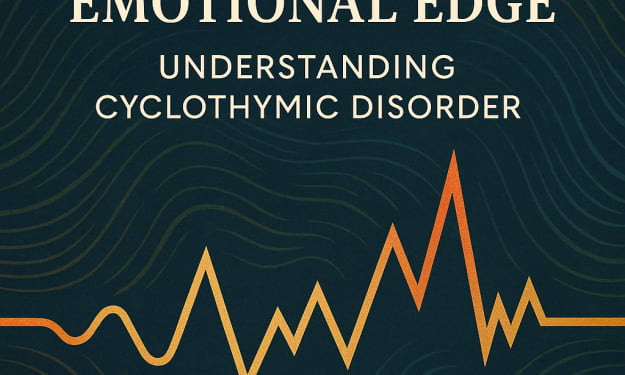
Living on the Emotional Edge: Understanding Cyclothymic Disorder
Introduction Everyone experiences emotional ups and downs. A burst of excitement one day, a dip in motivation the next — it's part of being human. But for some, these fluctuations are more than just ordinary mood shifts; they form a persistent, confusing rhythm that quietly shapes their entire life. When your inner world feels like a never-ending ride between minor emotional highs and unexpected lows — without ever tipping fully into mania or deep depression — it might not just be personality. It might be Cyclothymic Disorder.
By Siria De Simoneabout a year ago in Psyche
The Complexities of Co-Dependency
Have you ever met a person who couldn't do the simplest of tasks on their own? That person might even be you. There is always a deeper understanding of things like introverts, extroverts, the ego, etc., within society. The idea that someone doesn't like to be surrounded by noise isn't too uncommon. Just like the idea that an individual is their best drowning in a sea of people. Sometimes, you can struggle with an entirely different aspect of self. One that might even make you lose your own. Co-dependency.
By The Darkest Sunriseabout a year ago in Psyche
"The Interpretation of Dreams" by Sigmund Freud: A Journey into the Unconscious Mind
"The Interpretation of Dreams" by Sigmund Freud: A Journey into the Unconscious Mind "The Interpretation of Dreams" is not just a book; it is the foundation of modern psychology and a journey into the mysterious world of the unconscious. First published in 1899, this book revolutionized our understanding of dreams. Dreams are no longer seen as random or meaningless images; instead, they are glimpses into our hidden desires, fears, and experiences. Freud's writing is a blend of science, philosophy, and personal discovery. This book explains how dreams are formed, their connection to the unconscious mind, and how they reveal hidden truths through symbols. Although it can be challenging, for those interested in understanding the human mind, it is a feast for the intellect.
By Ikram Ullahabout a year ago in Psyche
Why we trust some people and not others
A story of instincts, quiet observation, and the subtle signals of character. --- In the heart of the valley, where the hills rolled like sleeping giants and the river carved stories through the land, stood a village called Eldenbrook. It was a quiet place—steady, honest, unhurried. Life moved to the rhythm of the seasons, and the people valued truth like gold. Eli, the village watchmaker, was a quiet man. His workshop, tucked between the cobbler’s and the baker’s, smelled of oil, brass, and old wood. Eli was known not just for his craftsmanship, but for something harder to name. People said he had “a feel” for others. If Eli said someone could be trusted, the village listened. One autumn, a stranger named Marek arrived. He wore a polished coat, boots with foreign buckles, and spoke with the ease of someone used to being listened to. Marek carried a satchel full of trinkets and a mouth full of promises. He said he had traveled far, done business with important people, and now wanted to invest in small towns “on the rise.” He was charming. Too charming, Eli thought. The villagers, hungry for growth and dazzled by Marek’s confidence, welcomed him with open arms. He offered to help the blacksmith buy new tools, promised to bring books to the school, and even offered to “modernize” Eli’s watch shop by turning it into a franchise. He spoke in big words—“scaling,” “capital,” “partnership.” Most villagers didn’t understand the terms, but they nodded along, hopeful. Marek gave out shiny pocket watches as gifts. He handed one to the mayor, another to the schoolteacher, and even left one on Eli’s counter. Eli opened the watch and observed its movement. The hands ticked, but unevenly. The gears were shiny but loose. The mechanism looked right but didn’t feel right. The next day, as Marek spoke to a crowd in the town square about “transforming Eldenbrook,” Eli stood in the back, silent. He wasn’t drawn in by Marek’s words. He was watching something else: how Marek reacted when interrupted (with irritation), how he dismissed questions he didn’t like, how he smiled without his eyes. That evening, Eli invited the mayor and a few others for tea. “Do you trust him?” Eli asked simply. “He’s offering help,” said the mayor. “Isn’t that what we need?” “He’s confident,” said the schoolteacher. “But when I asked about the books, he changed the subject.” Eli placed two watches on the table. One was Marek’s. The other was his own. “Same design,” he said. “But only one keeps time.” He opened both. His own ticked with calm precision. Marek’s raced, then stalled, then spun again. The difference was clear. “People can be like this,” Eli said. “Some tick smoothly, quietly, day after day. Others shine on the surface, but inside, their parts don’t fit.” “But how can you know who to trust?” the mayor asked. “Time,” Eli said. “Watch how someone acts when they’re not trying to impress you. Notice if they keep their word in small things. Trust isn’t built with promises. It’s built with patterns.” In the following days, people began paying attention. Marek was still charming, still generous with words, but inconsistencies began to surface. He promised donations but never followed through. He offered help but never asked what people actually needed. He didn’t remember names, repeated stories, and when someone questioned him, he laughed it off or changed the subject. Then, as quickly as he had come, Marek disappeared. No goodbye, no explanation. Just gone. In his wake, a few villagers felt foolish. But Eli reassured them. “Being open isn’t weakness,” he said. “Wanting to trust is human. But now we’ve learned to look deeper.” Years passed. Eldenbrook didn’t become a booming town, but it grew steadily. New ideas came—some worked, some didn’t—but the people were wiser now. They didn’t judge by charm or promises alone. They watched actions. They trusted slowly. Eli continued fixing watches until his hands grew too shaky. On his last day in the shop, a young girl named Mira brought in a broken clock. She had heard the story of Marek and the two watches. “Is it true?” she asked. “That you can tell if someone’s good like you can tell if a clock will work?” Eli smiled, handing her the repaired clock. “Not always,” he said. “But most of the time, the truth is in the rhythm. Just listen.” --- Moral: Trust is not a product of words, appearances, or charisma. It’s earned through consistency, honesty, and time. In a world full of ticking sounds, the true ones keep time quietly, day after day.
By Waleedkhanabout a year ago in Psyche
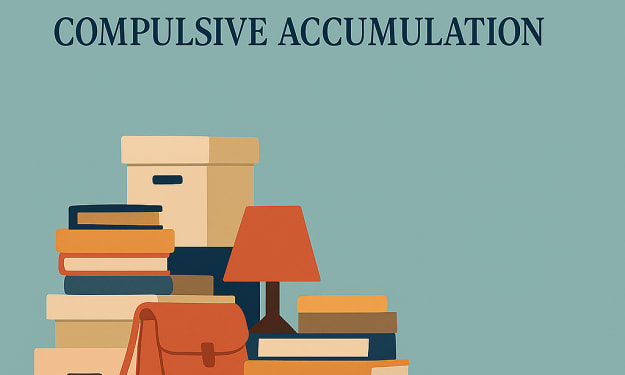
The Psychology of Hoarding: Inside the Mind of Compulsive Accumulation
Introduction In today’s society, where minimalism and decluttering are often glorified, the reality of Hoarding Disorder stands in stark contrast — a condition that disrupts lives, endangers health, and challenges the boundaries of our understanding of mental illness. Far from being a lifestyle choice or mere disorganization, Hoarding Disorder is a serious psychological condition now formally recognized in the Diagnostic and Statistical Manual of Mental Disorders, Fifth Edition (DSM-5). Despite its prevalence, the disorder remains largely misunderstood, stigmatized, and underdiagnosed.
By Siria De Simoneabout a year ago in Psyche