advice
Advice and tips on managing mental health, maintaining a positive outlook and becoming your happiest self.
The Loneliness Vending Machine: How We Started Paying for Connection. AI-Generated.
I. A Machine for Love Last month, I rented a friend. Not metaphorically. I paid $29.99 for a one-hour video call with someone who promised to listen to me, validate me, and laugh at my jokes. The app was clean, the interface sleek, and the calendar surprisingly full. My session started with a smiling young woman named Emma—probably not her real name—who said, “So, how was your day?” with the kind of warmth you’d expect from someone you’ve known since high school. Except we hadn’t.
By Ahmet Kıvanç Demirkıranabout a year ago in Psyche
2025 Is the Year to Take Risks
We’ve all heard it a million times: “Play it safe. Don’t take risks.” But what if this year, 2025, you decide to challenge that advice? The reality is that sticking to what feels comfortable might be the biggest obstacle standing between you and the life you want. Taking risks—smart, purposeful risks—can open doors you didn’t even know existed.
By Kamran Zebabout a year ago in Psyche
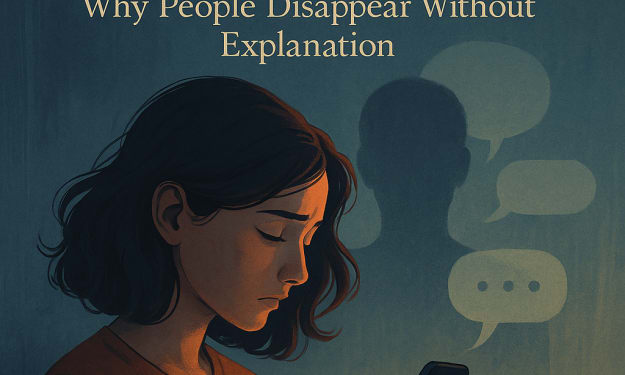
The Psychology of Ghosting: Why People Disappear Without Explanation. AI-Generated.
You’re texting someone, everything seems to be going well, and then—suddenly—nothing. No reply. No explanation. Just silence. You double-check your messages, wonder if you said something wrong, and slowly spiral into a loop of confusion and self-doubt. This experience has a name: ghosting. It’s when someone abruptly cuts off all communication without warning, and it’s become increasingly common in the digital age. But why do people ghost? What’s happening inside their minds when they decide to vanish? And why does it hurt so much? Ghosting is a modern psychological phenomenon, but its roots go deep into human behavior. On the surface, it may seem like a simple case of avoidance or disinterest, but underneath lies a complex mix of emotional discomfort, fear, and self-protection. People ghost because facing discomfort—whether it’s confrontation, guilt, or vulnerability—is often harder than disappearing. And with digital tools that make vanishing as easy as swiping away a conversation, escape becomes effortless. From a psychological perspective, ghosting is closely tied to avoidant attachment styles. People with this attachment style often struggle with emotional intimacy. When things start to get too close, too vulnerable, or too “real,” they panic—not always consciously—and choose to back away rather than engage. Ghosting, for them, feels safer than dealing with emotional confrontation. It allows them to maintain distance and avoid the anxiety that comes with honesty or potential rejection. But ghosting isn’t limited to dating. It happens in friendships, professional relationships, even family connections. The core motive is often the same: emotional discomfort. In a world where communication is instant but empathy is optional, it’s easy to choose silence over explanation. What ghosters often fail to realize, however, is the psychological damage it causes to the person being ghosted. Being ghosted can feel like emotional whiplash. One moment, things feel stable or promising; the next, you’re left alone with no closure. This sudden disconnection triggers deep emotional responses—especially in those with anxious attachment styles. Your brain, wired for connection, begins to panic. The amygdala, the brain's fear center, lights up, interpreting the silence as a threat. "What did I do wrong?" "Was I not good enough?" "Did they ever care at all?" The mind spins into overdrive trying to make sense of something it was never given the tools to understand. This kind of emotional ambiguity can be more painful than an honest rejection. When someone clearly tells you they’re not interested or that they need space, your brain can process that information. But ghosting offers no data—only silence. This forces the brain to fill in the blanks, often with the harshest assumptions possible. It’s not just a social rejection; it becomes a psychological mystery, and the human mind hates unfinished stories. Interestingly, ghosting also affects the ghoster. While it may feel like an easy escape, it often comes with lingering guilt and emotional avoidance. Many ghosters justify their silence by convincing themselves that cutting contact is “kinder” than rejection. Others avoid the discomfort altogether, telling themselves the other person will “get the hint.” In truth, ghosting is rarely about the other person—it’s more about the ghoster’s inability to manage emotional discomfort or conflict. So how do we heal from ghosting? The first step is recognizing that ghosting says more about the ghoster than about you. It’s not a reflection of your worth, your character, or your attractiveness. It’s a reflection of someone else's emotional maturity—or lack thereof. Healthy communication requires courage, and not everyone is willing or able to show up in that way. It also helps to shift your mindset from seeking closure from others to creating closure for yourself. Write a letter you’ll never send. Journal your thoughts and feelings. Acknowledge the pain, but also remind yourself that silence is an answer too. Someone who disappears without explanation is showing you their emotional capacity—and that’s useful information. Setting boundaries with yourself is equally important. Stop checking their online status. Don’t reread old messages. Don’t wait for the “what if” moment. Ghosting is a passive act, but your response can be powerful. Use it as a chance to reconnect with your own worth and realign your expectations. You deserve communication, honesty, and emotional presence. Anything less is not a loss—it’s a redirection. As a society, we need to talk more openly about the emotional impact of ghosting. It may be normalized, but it’s not harmless. In a world full of screens and instant messages, emotional maturity still matters. Kindness still matters. And communication—even when it’s uncomfortable—is a skill we must continue to value. In the end, ghosting is a symptom of emotional avoidance. It’s an act of disconnection in a time when connection is more needed than ever. But your healing doesn’t depend on the person who vanished—it depends on your ability to rise above their silence and choose to speak compassionately to yourself. Because the one voice that should never disappear is your own.
By Muhammad Hussainabout a year ago in Psyche
What If We're All Just Characters in Someone's Draft Folder?
What If We're All Just Characters in Someone's Draft Folder? Somewhere, beyond the veil of our observable reality, maybe beyond space and time as we understand them, imagine this: a cluttered desktop screen, a blinking cursor, a folder titled "Drafts". In it, thousands—maybe millions—of half-written stories, fragmented characters, speculative worlds. And what if we—you, me, your dog, the man who delivers your mail, the quiet girl who always sits in the corner at lunch—are all part of one of these drafts? Not final products. Not finished novels. Just characters in someone’s work-in-progress. A cosmic draft.
By Huzaifa Dzineabout a year ago in Psyche
Jim Morrison was right, people are strange!
Jim Morrison was right, people are strange! What is it about humans that we seem to “want” to attract drama into our lives?! Feelings of animosity are never enjoyable so why on earth do we so often not only entertain them but willingly attract them into our sphere of being?!
By Feral La Femmeabout a year ago in Psyche
When Love Isn't Enough: A Story of Trust, Betrayal, and Letting Go
Four years. That's how long I thought I knew what love looked like. Four years with Jessie, a woman who took my breath away the first time I saw her. She had this way of lighting up a room, and when she smiled at me, I felt like I could conquer the world.
By Prince Esienabout a year ago in Psyche
The Illusion of Control: Why Letting Go Brings Peace. AI-Generated.
The Illusion of Control: Why Letting Go Brings Peace Most of us like to believe we’re in control. We plan our days, set goals, check boxes, manage routines, and try to keep everything in order. We tell ourselves, “If I just try hard enough, I can make everything go my way.” It’s comforting to think that life is a puzzle we can solve with enough effort. But life has a way of showing us otherwise. A traffic jam ruins your perfectly timed schedule. A sudden illness shifts your future plans. A person you trusted lets you down. These moments feel frustrating, overwhelming, and often unfair. But they all point to one truth we often resist: we are not in control of everything — and that’s okay. Psychologists call this need to control “the illusion of control.” It’s a powerful cognitive bias that convinces us we have more influence over outcomes than we really do. This illusion gives us a sense of safety. After all, who wouldn’t want to feel like they’re steering the ship in stormy waters? But the problem begins when we cling too tightly to control—over people, events, or even our own emotions. When life doesn’t follow our script, anxiety creeps in. We feel like we’re failing, even when we’re doing our best. Neuroscience backs this up. Our brains are wired to seek predictability. The prefrontal cortex—our brain’s decision-making center—loves order and logic. When things go according to plan, we feel calm and capable. But when uncertainty hits, the amygdala (our emotional response system) triggers stress and fear. That’s why uncertainty feels so emotionally draining—it creates a chemical storm in the brain. But here’s the twist: trying to control everything actually creates more anxiety, not less. Why? Because life isn’t a machine—it’s a dance. It moves with rhythm, but not always in straight lines. Trying to force outcomes that are beyond your control leads to constant tension. You might find yourself overthinking every detail, replaying conversations, obsessing over what “should” happen. Instead of living, you’re constantly managing, fixing, micromanaging. And that’s exhausting. What if the solution isn’t to grip tighter—but to let go? Letting go doesn’t mean giving up. It means surrendering the need to control things that are fundamentally uncontrollable—like other people’s opinions, the future, or unexpected outcomes. It’s the radical acceptance that life is uncertain, and peace comes not from mastering the chaos but from trusting yourself to navigate it. It’s choosing to respond instead of react. Take relationships, for example. You can’t control how someone feels about you. You can’t control whether they stay or leave, whether they forgive or hold a grudge. But you can control how you show up—with honesty, love, and boundaries. When you let go of trying to control their actions, you reclaim your energy. You stop trying to manage their emotions and start tending to your own. The same is true for goals. You can’t control whether a project goes viral, whether a job interview lands, or whether your dream pans out exactly as imagined. But you can control your effort, your consistency, and your mindset. Ironically, letting go of the outcome often improves your results. Why? Because when you stop fearing failure, you act more freely and authentically. You give your best without the heavy weight of perfection. One of the most powerful practices in learning to let go is mindfulness. It trains your brain to stay in the present moment instead of spiraling into what-ifs. You learn to observe your thoughts without judgment, to breathe through uncertainty, to trust that even if you don’t have all the answers, you have the strength to face whatever comes. Mindfulness isn’t passive—it’s the bold act of being fully alive in the now. Another tool is journaling. Writing down your thoughts helps you identify what you’re trying to control. Ask yourself: “What am I afraid of losing?” “What outcome am I trying to force?” “What can I let go of today?” The more you name your fears, the less power they hold over you. Slowly, you begin to shift from control to clarity, from pressure to presence. Letting go is not a one-time event. It’s a daily decision. It means waking up each day and choosing peace over perfection, flow over force, trust over tension. It’s not always easy. In fact, it can feel terrifying at first. But over time, it brings a deeper kind of confidence—the kind that doesn’t depend on everything going right, but on your ability to stay grounded when things go wrong. In a world that glorifies hustle, control, and certainty, surrender feels like weakness. But in truth, it’s a kind of strength the world desperately needs. Because the most peaceful people are not those who have life perfectly planned—but those who have learned to dance with its uncertainty.
By Muhammad Hussainabout a year ago in Psyche
Social Media and Anxiety: The Neuroscience Behind Constant Comparison. AI-Generated.
Social Media and Anxiety: The Neuroscience Behind Constant Comparison We open our phones with a swipe and step into a world where everyone seems to be living their best lives. Smiling faces, perfect bodies, exotic vacations, career milestones—all served up in a never-ending scroll. At first glance, it feels harmless, maybe even motivating. But underneath that glittering surface, a silent war brews in the mind. As likes pour in for others and silence greets our own posts, a subtle unease sets in. That unease, over time, often turns into something deeper: anxiety. And the science shows—it’s not all in your head. Social media platforms are designed to keep us engaged, and they do that by constantly feeding us content tailored to our interests and social circles. But the human brain didn’t evolve to process highlight reels from hundreds of people every single day. In fact, comparing ourselves to others is a very old psychological instinct. Thousands of years ago, it helped us understand where we stood in a tribe or community. But now, thanks to social media, we are comparing ourselves not to ten people—but to thousands. And worse, we’re comparing ourselves to carefully edited, filtered, and curated versions of them. At the core of this phenomenon lies a part of the brain called the amygdala—the region responsible for processing emotions like fear, stress, and threat. When you see someone who appears to be more successful, attractive, or happier than you, your brain interprets it as a kind of social threat. This triggers a stress response, releasing cortisol—the body’s primary stress hormone. Over time, repeated exposure to this cycle can lead to chronic stress, feelings of inferiority, and a persistent sense of anxiety. But it’s not just the amygdala doing the heavy lifting. The dopamine system, which governs the brain’s reward circuit, plays a massive role in social media addiction. Every like, comment, or follower triggers a small release of dopamine—the same chemical involved in addiction to gambling or drugs. So, we begin to crave validation. We post for approval. And when we don’t get it? The dopamine crashes, and the anxiety rushes in. The most dangerous part is how subtle it all is. You might not even realize you're comparing yourself until it’s already affecting your mood. You open Instagram “just to relax,” but 15 minutes later, you're feeling worse about your body, your job, your life. You see a friend announce a promotion, and suddenly your own progress feels meaningless. You watch a couple post vacation selfies, and your own relationship begins to feel dull in comparison. It’s a slow erosion of self-worth, pixel by pixel. What makes it more complicated is the illusion of connection. Social media promises closeness, but often delivers isolation. You may be surrounded by content, but not real conversation. You know what someone ate for breakfast but haven’t heard their voice in months. This fake sense of closeness can deepen the loneliness, especially when your feed is filled with people you don’t even speak to anymore. And as loneliness rises, so does anxiety. However, this doesn’t mean social media is evil. Like any tool, its impact depends on how we use it. The first step toward reclaiming your mental peace is becoming aware of when and how social media is triggering anxiety. Do you feel worse after scrolling? Are you checking it first thing in the morning and last thing before bed? Are you measuring your worth in likes and followers? Awareness is everything. Once you’ve identified the patterns, you can begin to shift your habits. Curate your feed with intention. Follow people who inspire you—not those who make you feel inferior. Take breaks, even if it’s just for a few hours a day. Use features like “mute” or “limit screen time.” And most importantly, remind yourself that what you’re seeing isn’t real life—it’s someone’s edited version of it. Another powerful practice is to replace screen time with grounding activities: journaling, walking in nature, talking to someone in real life, or reading. These actions reconnect you with your true self, outside the noise of the algorithm. They also give your brain the break it needs from the comparison loop and reintroduce real dopamine sources—like achievement, connection, and creativity. If you're a content creator or someone who has to be online a lot, create with a mindset of authenticity rather than validation. Post because you have something valuable to say, not because you’re hoping for external approval. The more genuine your interaction with social media, the less anxious it will make you. In the end, social media isn't the villain—comparison is. But now we know the science behind it. We understand how our brains respond. And with that knowledge comes power: the power to pause, reflect, and protect our mental peace. Because you are more than what fits inside a square box. Your life is worth more than a caption. And no amount of scrolling will ever replace the value of real self-worth.
By Muhammad Hussainabout a year ago in Psyche