advice
Advice and tips on managing mental health, maintaining a positive outlook and becoming your happiest self.
The Day I Stopped Pretending I Was Fine. AI-Generated.
I was the kind of person who smiled a lot. At work, in family gatherings, even on the street when I bumped into neighbors — I always had a polite grin and the words “Alhamdulillah, everything’s good.” But that was far from the truth. Inside, something was breaking slowly. I couldn’t name it at first — was it sadness? Fear? Exhaustion? Whatever it was, it made my chest heavy, especially at night when the world grew quiet. I’d lie in bed scrolling my phone, trying to distract myself from my thoughts. But they always came back, louder, meaner. “You’re not doing enough.” “You’re a disappointment.” “You’re pretending to be someone you’re not.” I kept pushing through. I thought this was what strength looked like — keeping it together, not burdening anyone. I was scared of looking weak. I thought maybe this was a phase, maybe I just needed better sleep, or maybe I was just being ungrateful. So I forced smiles and answered “Alhamdulillah” every time someone asked how I was. But I wasn’t okay. One evening, after a particularly stressful day at work, I walked home in silence. I skipped dinner. I didn’t respond to messages. I simply sat in my room, staring at the floor. A strange numbness wrapped around me. It felt like I was drowning in a room full of air. When the call for Maghrib echoed from the nearby masjid, I didn’t feel like getting up. But something inside me, some remaining thread of discipline or hope, pulled me to the prayer mat. I stood there, raising my hands to say “Allahu Akbar.” The words trembled. My heart raced. I bowed. I went into sujood — and I stayed there longer than I ever had before. My forehead pressed into the ground. My lips moved, but the words barely came out. Finally, in a whisper only Allah could hear, I said: “Ya Allah, I can’t do this alone anymore.” That was the moment everything changed. I didn’t suddenly become healed or happy. But I felt something shift. Maybe because, for the first time, I was honest — not with people, but with my Creator. That night, I opened the Quran randomly and my eyes landed on: > “Did He not find you lost and guide you?” — Surah Duha (93:7) I read the full Surah slowly: > “By the morning brightness…” > “And by the night when it covers with darkness…” > “Your Lord has not forsaken you…” Those words wrapped around me like a warm blanket. It felt as if Allah Himself was speaking to me. The next morning, I did something I’d never done before. I wrote down how I felt. Just a few lines in a notebook: “I don’t hate life. I just don’t know how to carry it anymore.” I started journaling every day. It wasn’t poetic or organized. Just raw, messy thoughts. Somehow, writing them made me feel less overwhelmed. Later that week, I spoke to a close friend — someone I trusted, someone who wouldn’t judge. I told him how I’d been feeling. He didn’t try to fix me. He just listened. And that alone made a difference. I began reading Surah Duha every morning. I treated it like a personal message from Allah. I stopped pretending everything was fine. I started being kinder to myself. I also learned that our Prophet Muhammad ﷺ faced days of deep sorrow. He lost loved ones. He cried. He felt alone. Yet he turned to Allah every single time. Islam does not shame emotion — it gives us ways to guide it. Duas, patience, prayer, community, dhikr, rest. And yes, even seeking professional help when needed. The Prophet ﷺ said: “Seek treatment, for Allah has not made a disease without appointing a remedy for it.” (Abu Dawood) I’m not writing this to say I’ve conquered anxiety or sadness. I still have hard days. But I’ve stopped pretending. I’ve stopped hiding behind fake smiles. And I’ve realized that asking for help — from Allah and from people — is not weakness. It’s wisdom. It’s trust. It’s tawakkul. --- 🌱 Moral Reflection: There are battles that happen within the heart — silent, invisible, and exhausting. Many of us walk around wearing masks, saying “I’m fine,” when inside, we’re crumbling. But strength isn’t about staying silent. Strength is in seeking help. It’s in turning to Allah when your chest feels tight. It’s in making sujood and letting the tears fall. It’s in sharing your struggle with someone who can listen without judgment. Islam encourages healing — emotional, physical, and spiritual. If you're struggling, remember: your pain is not ignored by your Lord. Every tear you shed, every silent prayer, every sleepless night — Allah knows. And He is closer to you than your own thoughts. The day I stopped pretending was the day I started healing. You can too.
By Kaleem Ullahabout a year ago in Psyche
The Cognitive Mechanics of Getting Stuck
Have you ever stared at a simple task, maybe sending an email, filing a form, or reading a short article, and found yourself paralyzed? The task is not hard. It is not beyond your capability. You even understand why it matters. But for some reason, it feels ungraspable. No traction. No flow. Just cognitive friction.
By Nikesh Lagunabout a year ago in Psyche
To Whom It May Concern
To Whom It May Concern, (especially if you’re struggling too). Hi, My Name Is Annie, and I’m a Recovering Psycho. Because, you know… I take antipsychotics. So technically, that makes me a recovering psycho. (Yeah, I know, not everyone finds that funny. My mom didn’t laugh. But I did.)
By Annie Edwards about a year ago in Psyche
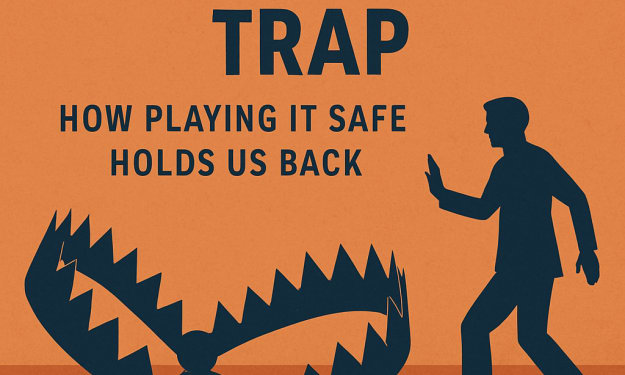
The Comfort Trap: How Playing It Safe Holds Us Back. AI-Generated.
There’s a silent belief many of us carry—so silent that we rarely notice it. It whispers when we hesitate. It lingers when we want to try something bold. It’s the idea that playing it safe is better than risking failure.
By Sajjad Aliabout a year ago in Psyche
The Masterful Lie We Tell Ourselves That Prevents Us From Reaching Our Potential. Top Story - August 2025.
As Humans, We are Incredibly Good at Lying to Ourselves. When you look at the Psychophysiology of it, you'll discover that it is a Fascinating Magic Trick that We Play on Our Brain.
By H.E. Dr. Cody Dakota Wooten, COIE, DFM, DHMabout a year ago in Psyche
My Thoughts Were Holding Me Captive—Until a Prayer Set Me Free. AI-Generated.
I didn’t even notice when the noise inside my head got louder than the world outside. It began subtly. I would lie awake in bed, rehearsing conversations that never happened. I’d think about things I said ten years ago, wondering if people still remembered them. I’d feel ashamed of my mistakes, terrified of my future, and unsure about who I was becoming. Every day, I smiled for the world—but inside, I was battling a storm of thoughts I couldn’t control. --- The Invisible Battle I was 22, healthy, and surrounded by people. Yet, I felt utterly alone. Nobody saw the war raging inside me. I could be in a crowd and still feel lost. Simple tasks became exhausting. Decisions made me anxious. My mind became my enemy, whispering doubts, guilt, and fears—on repeat. "You're not enough." "You’ll fail again." "What's the point of trying?" These whispers weren’t voices, but they felt just as real. I tried distracting myself—music, social media, TV—but the silence always returned. And with it, the thoughts came back louder, sharper. I didn’t realize it then, but I was slipping into a mental prison—brick by brick, thought by thought. --- The Breaking Point One night, something inside me cracked. I sat in the dark corner of my room, knees pressed against my chest. My breathing was heavy, heart racing, mind spiraling. I wanted peace. Not the kind of peace people post quotes about. I wanted the kind of peace that silences screaming thoughts and fills you with warmth again. I remember whispering, "God, if You're there… please help me. I’m tired." And then, out of nowhere, I felt this strange pull—toward the dusty bookshelf in the corner of my room. It had been months since I touched the Qur’an. Not because I didn't care, but because I was afraid. Afraid that I was too broken to be spiritual. But that night, something changed. --- A Light in the Darkness I opened the Qur’an randomly. My eyes fell on a verse—one I had heard as a child, but never truly understood: "رَبِّ اشْرَحْ لِي صَدْرِي" “O my Lord, expand my chest.” (Surah Taha, 20:25) Just a few words. But they echoed through me like thunder. I whispered them. Once. Twice. Then again. "O my Lord, expand my chest..." What did it mean? I looked it up. It was the prayer of Prophet Musa (Moses) when he felt afraid and overwhelmed. He asked Allah to expand his heart—to give him clarity, strength, and calmness to face what lay ahead. That’s exactly what I needed. I began repeating it daily. --- The Healing Begins Nothing magical happened overnight. But slowly—almost invisibly—things began to shift. That verse became my anchor. Whenever my thoughts spiraled, I paused and whispered: "Rabbishrah li sadri..." And slowly, I noticed changes. I began journaling my thoughts, separating reality from fear. I started talking to Allah honestly, not formally. No fancy words—just raw, broken truth. I also reached out to a therapist, something I once thought was “too much.” But faith and therapy went hand in hand. My healing wasn’t either/or—it was both. Some days were still hard. But I no longer felt alone. I no longer believed the lie that I was beyond repair. --- Reflection: The Power of Faith in Mental Health Mental health struggles are real. They’re not a sign of weak faith. In fact, some of the strongest believers—like Prophet Musa—felt fear and overwhelm. And yet, they turned to Allah with honest, simple prayers. "Rabbishrah li sadri" isn’t just a verse—it’s a lifeline. Sometimes, all it takes is one sincere prayer to open a locked heart. Sometimes, all you need is a reminder that your thoughts don’t define you—and you’re not stuck. We all carry invisible wounds. But we’re also all given tools to heal. Prayer, reflection, therapy, connection—they work together. If you're reading this and you’re struggling: You’re not alone. You’re not weak. And you’re definitely not hopeless. Maybe, like me, you just need a verse to hold on to. So say it with me, one more time: "O my Lord, expand my chest..."
By Kaleem Ullahabout a year ago in Psyche
How to Ground Yourself During an Anxiety Attack (With Examples)
Anxiety attacks can come on fast. One moment, everything seems okay. The next, your heart races, your breath shortens, and your thoughts spiral out of control. You might feel detached from reality or even believe you're dying.
By Richard Baileyabout a year ago in Psyche