advice
Advice and tips on managing mental health, maintaining a positive outlook and becoming your happiest self.
Coping with Life Transitions: Tips from a Licensed Therapist. AI-Generated.
Life is full of changes—some we plan for, others catch us completely off guard. Whether it’s a career shift, moving to a new city, ending a relationship, or becoming a parent, transitions can feel overwhelming. Learning how to handle major life changes can help you navigate these moments with confidence and calm.
By Pushpa Srivastavaabout a year ago in Psyche
Practical Takeaways: Helping Teens Build Resilience During War
Why Practical Tools Matter Theories and statistics provide understanding, but the true value of research lies in how it can be applied in everyday life. When we talk about resilience, it is not an abstract concept but a set of concrete strategies that help adolescents cope with academic pressure, family conflict, war, or even simple misunderstandings with peers.
By Daria Barabashabout a year ago in Psyche
Why Vulnerability is My Greatest Strength — Healing Through Honest Connection
I used to think that strength meant keeping everything inside. That if I never let anyone see me cry, break, or struggle, I would somehow appear stronger. For years, I wore a mask—smiling when I wanted to scream, nodding when I wanted to collapse, and pretending everything was “fine” when, deep down, I was drowning.
By Nadeem Shah about a year ago in Psyche
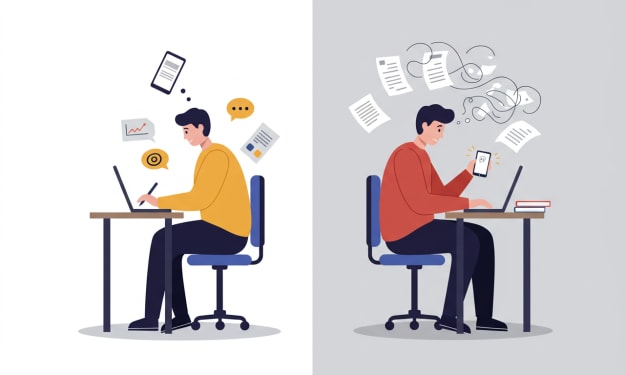
Why Your Focus Feels Unstable
One of the most discouraging things about personal effort isn't failure. It's an inconsistency. You're focused and steady one day, then suddenly foggy and restless the next. From the outside, it looks like you lost discipline. From the inside, it feels like you've fallen off track.
By Nikesh Lagunabout a year ago in Psyche
The Invisible Weight of Anxiety — Living With a Mind That Never Stops Racing
Anxiety doesn’t always look like panic attacks or someone gasping for air. Sometimes it’s invisible—quiet, hidden beneath a smile or small talk. For me, anxiety has always felt like carrying a backpack full of bricks that no one else can see. On the outside, I might look composed, even cheerful. But inside, my thoughts are racing, my chest feels tight, and I’m constantly preparing for a disaster that never seems to come.
By Nadeem Shah about a year ago in Psyche
Breaking Free from the People-Pleaser Trap — How I Learned to Value My Own Voice
The Trap I Didn’t See Coming For years, I thought being agreeable, kind, and always available for others was a good thing. I believed that if I kept everyone around me happy, they would like me more, respect me more, and maybe even love me more. But what I didn’t realize was that in trying to meet everyone else’s expectations, I was losing myself. Every “yes” that went against my true feelings was another step away from who I really was.
By Nadeem Shah about a year ago in Psyche
How Journaling Helps Reduce Stress and Anxiety
Stress and anxiety can quietly take over, often before you realize how much they’ve been weighing you down. The racing thoughts. The constant what-ifs. The pressure to keep it all together while feeling like you’re falling apart inside. In moments like these, journaling can be more than just writing on paper—it can become a powerful tool for emotional release, clarity, and control.
By Richard Baileyabout a year ago in Psyche
Attachment Styles and Coping: Insights from Ukrainian Adolescent Research (2024)
Why This Research Matters Attachment theory and resilience are well-known concepts in psychology. Yet when it comes to Ukrainian adolescents - especially in the context of war and displacement - empirical data is still scarce. My 2024 research project revealed a crucial nuance: attachment styles do not directly determine resilience levels, but they strongly shape the coping strategies adolescents use under stress.
By Daria Barabashabout a year ago in Psyche
The Paradox of Choice: Why Having More Options Makes Us Unhappier. AI-Generated.
Introduction: Imagine standing in a supermarket aisle with hundreds of cereal boxes lined up in front of you. Different flavors, sizes, health claims, and price tags scream for your attention. At first glance, it feels empowering you have the freedom to choose. But as you reach for a box, a strange feeling creeps in: What if I’m making the wrong choice? What if the one I didn’t pick was better? This everyday scenario captures the essence of the Paradox of Choice a psychological phenomenon that suggests more options do not necessarily bring more happiness. In fact, too much choice often leads to stress, decision fatigue, and regret. The Illusion of Freedom: In modern society, freedom of choice is celebrated as the ultimate sign of independence and progress. From online shopping to dating apps, we are surrounded by endless options. On the surface, this seems like a gift. The more options we have, the greater the chance of finding something perfect right? Psychologist Barry Schwartz, in his book The Paradox of Choice, argues the opposite. Too many choices can overwhelm the brain, making it harder to decide, and leaving us less satisfied with whatever decision we finally make. Instead of enjoying freedom, we end up trapped in uncertainty. Decision Fatigue: When the Brain Gets Tired Every decision we make, no matter how small, consumes mental energy. Psychologists call this decision fatigue a state where the brain becomes exhausted after facing too many options. Think about scrolling through Netflix. With thousands of movies and shows, it often takes longer to choose what to watch than to actually watch it. By the time you settle on something, you’re already mentally drained, and ironically, the movie might not even feel enjoyable. Maximizers vs. Satisficers: Not everyone reacts to choices in the same way. Psychologists divide people into two groups: Maximizers: People who want the “best of the best.” They analyze every option, compare endlessly, and often delay making decisions. Even after choosing, they worry they might have missed out on something better. Satisficers: People who look for something “good enough.” They don’t obsess over finding the absolute best they just want something that meets their needs. Research shows that maximizers are more likely to feel anxious, regretful, and dissatisfied, even if they end up with a better option than a satisficer. The chase for perfection often steals their happiness. The Fear of Missing Out (FOMO) The paradox of choice is tightly linked with FOMO the fear of missing out. When we are bombarded with too many options, we become anxious about losing what we didn’t pick. For example, a person choosing a career may constantly wonder: What if another job would have made me happier? A person in a relationship might think: What if I could have found someone better? This constant second-guessing fuels dissatisfaction and prevents us from fully enjoying what we have. Regret: The Silent Enemy: Too many choices often increase the risk of regret. If you pick one of only two options, the chances of regret are small. But when you choose one from fifty, the thought of “what if” lingers much stronger. Even worse, regret is amplified when we believe that the “perfect choice” was out there and we just didn’t find it. This creates a painful cycle of dissatisfaction, even when the decision was objectively good. Less is More: The Beauty of Simplicity: Research consistently shows that people feel happier and more satisfied when choices are limited. One famous study offered customers samples of jam at a store. When there were 24 flavors, fewer people bought them. But when only 6 flavors were offered, purchases increased dramatically. Why? Because fewer choices made the decision easier and more enjoyable. Minimalism, capsule wardrobes, and even simplified diets are modern examples of people fighting back against the overwhelming burden of too many options. By reducing choices, people experience less stress and more clarity. How to Escape the Trap of Too Many Choices: Here are some practical ways to avoid the stress of the paradox of choice: 1. Set clear priorities Decide what really matters before making a choice. This reduces confusion. 2. Limit your options Instead of browsing through 50, narrow it down to 3–5 choices. 3. Practice satisficing Aim for “good enough” rather than the “perfect” option. 4. Embrace constraints Boundaries actually free the mind and reduce decision fatigue. 5. Be mindful Focus on the choice you made instead of the ones you left behind.
By Muhammad Hussainabout a year ago in Psyche