addiction
The realities of addition; the truth about living under, above and beyond the influence of drugs and alcohol.
Internal Turmoil
I've always heard that our thoughts shape our reality. Yet, I often found myself grappling with feelings of fear, anger, and anxiety, despite knowing they were just products of my mind. I realized that to truly transform my life, I needed to understand the nature of my thoughts and how to master them. Here's a glimpse into my journey of overcoming inner turmoil and finding peace.
By Horace Wasmore2 years ago in Psyche
Do Video Games Make You Violent?
While it is true that the top five video games at the moment are all shooter games, politicians frequently accuse video games of contributing to some of the violence in our society. However, do the firearms in these games actually cause hostility in real life? Do violent video games cause violence? The claim that video games instill violence in children is one of the principal criticisms leveled against them.
By Mariam Fathalrahman2 years ago in Psyche
Brain Hacks for Quick Learning:
In my dual roles as a neuroscientist and lecturer, I've observed the struggles students face with learning, especially as they age. Often, we are expected to learn without any real guidance on how to optimize this process. The reality is that learning becomes more challenging as we grow older. However, the good news is that by applying certain strategies supported by neuroscience, you can enhance your learning efficiency and effectiveness. In this post, I’ll walk you through six essential strategies for accelerated learning: attention, alertness, sleep, repetition, breaks, and mistakes.
By Horace Wasmore2 years ago in Psyche
Group Therapy Explained
Group therapy is a powerful tool in the field of psychology, offering unique benefits that individual therapy might not provide. By understanding the different types of groups and their dynamics, you can appreciate how peer support contributes to psychological growth.
By Horace Wasmore2 years ago in Psyche
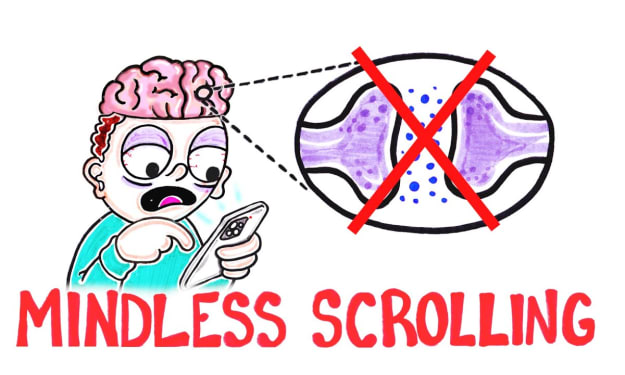
Mindlessly Scrolling
What would happen to your brain and body if you tried to stop using your phone? Since the average American touches their phone 2,600 times a day and this constant scrolling has altered your brain's neurology, after one hour you have probably tried to pick up your phone three or four times. After 12 hours of not using your phone, you may start to feel anxious because not using it releases the stress hormone cortisol.
By Mariam Fathalrahman2 years ago in Psyche
How Your Brian is being CHANGED by The Internet
Imagine how different life would be if there were no internet. The idea of not having smartphones, maps, and search engines at our fingertips seems completely foreign to us now that everything is connected. However, how is our growing reliance on the online world affecting us? Our relationships and information sources are changing quickly, and there are even noticeable effects happening inside our brains as more and more devices are connected to the internet.
By Mariam Fathalrahman2 years ago in Psyche
Training for Counselors, Therapists, Coaches, Students, and Educators
On Wednesday and Thursday of this week, I trained at (MAIIADS) Minnesota American Indian Institute of Alcohol and Drug Studies. It is something I have been doing since approximately 2004 yearly. And several years prior.
By Denise E Lindquist2 years ago in Psyche
Suicide Rainbows-Part 3
Ride the tide, don’t fight with the current that guided you Melt the ice round the furnace burning inside of you I gotta do better, I gotta do better, I gotta do better There’s nothing they can do that I can’t do better Better yet, there’s nothing I can do that I can’t do better Yeah, I’m better I said I’m better… -Ab Soul-’Do Better’
By lazarusInfinity2 years ago in Psyche
Psychologist Attitudes on Psychedelic-Assisted Therapy: New Research. AI-Generated.
Imagine treating depression or PTSD with a therapeutic experience rather than conventional medication. This innovative concept, known as psychedelic therapy, is gaining traction. However, its acceptance among therapists varies. A recent study by a therapy group in Portland explored the reasons behind these diverse attitudes, providing valuable insights
By Lauren Rutherford2 years ago in Psyche