
I Watched a Guy’s Entire Worldview Crumble Over a Cup of Coffee
A chance café eavesdrop, a forgotten seminar, and the single question that separates a house of thought from a wall of newspaper.
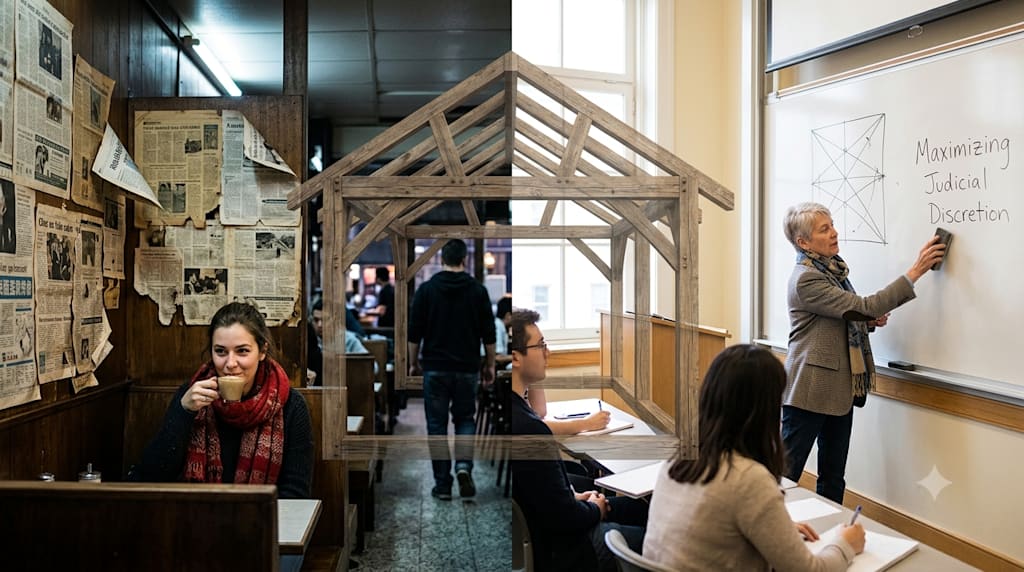
Claire tore her croissant into small pieces and didn’t eat. In the booth next to hers, a guy in a hoodie had been talking for almost ten minutes, his voice pitched just loud enough to carry over the wooden partition.
“…What I can’t stand are people who bitch about the system while milking it for everything they can. Free competition. How great is that? If you’ve got the ability, you rise. If you don’t, you accept it. All these handouts just breed laziness.”
The young woman across from him, a ginger‑red scarf draped over the back of her chair, sipped her iced Americano. Her voice was flat. “The Pell Grant you applied for last semester: isn’t that federal aid?”
The hoodie guy paused. “That’s different.”
“How?”
“That’s an educational resource, not just cash. A university should remove financial barriers for talented people…” He leaned back, turning the paper cup in his hands. “And I’ll pay taxes after I graduate. The math works out.”
“So when you take it, it’s fine. When other people take it, it’s breeding laziness?”
“I didn’t say other people can’t take it. I’m talking about abuse.”
“Then who decides what counts as abuse? Where’s the line? If the only standard is ‘I feel like my case is different,’ can that criticism you just made really hold up under scrutiny?”
The hoodie guy didn’t answer. After a few seconds he said, “You’re overthinking this,” and got up to add more sugar.
Claire watched his back, and suddenly she remembered exactly what Professor Harrison had said in the seminar room on Tuesday afternoon.
“See if he can hold his own under questioning. Sounds easy, but it’s actually the hardest requirement of all.”
That day’s topic was ethics in public policy, but Harrison had pushed the handout aside, drawn a square on the whiteboard, and added a few intersecting lines inside it.
“Most people deliver opinions the way you paste newspaper over a drafty wall. Wherever the wind leaks through, you slap on another sheet, and yesterday’s paste doesn’t have to match today’s. Push with two layers of follow‑up questions, and the seams will split.” He set the marker down. “But a person with some depth of thought: their views aren’t a wall. They’re a house. You open different doors, and you can see how the beams connect.”
A student asked, “How do you know if you’re pasting newspaper or building a house?”
Harrison picked the marker back up and wrote three lines beside the square.
First: Understand that everything has a cost.
“Last week you discussed raising the minimum wage. Half of you argued for the dignity of labor, the other half said small businesses would cut jobs. Did anyone say, ‘I want to protect workers’ dignity, and I’m willing to accept that the bookstore on the corner might close because of it’? Very few. Most people want it all—rights without obligations, stability without constraints. But every value has a boundary. Choose freedom, and you face uncertainty. You can’t lay a foundation until you can see the opposing side of your own position.”
Second: Learn to separate what’s fact from what’s emotion.
“When I was young, I did community research in the South Side of Chicago and wrote a report arguing that the crime rate was driven by under‑policing. My advisor—an old Jewish guy in his sixties, cigar in hand—flipped through my report and asked, ‘David, were you angry when you wrote this?’ I said of course I was, people there were afraid to go out at night. He said, ‘Your anger is justified, but you’ve mistaken it for evidence. Go back and re‑examine every cause‑and‑effect claim. Check whether you’ve confused correlation with causation.’ I did. At least three key inferences fell apart.”
Claire remembered with particular clarity the way he had stubbed out his cigar in the ashtray.
“Nothing contaminates judgment more easily than emotion. When you’re angry, the whole world looks like an enemy. When you’re anxious, the future is nothing but traps. Thinking begins the moment you can separate the feeling from the facts.”
Third: Don’t be afraid to revise yourself.
“The people who can really hold their own under questioning are often the ones most willing to change their minds. Because what they’re protecting isn’t their ego; it’s the logic. Spotting a hole when someone presses them isn’t humiliation; it’s a free structural inspection.” Harrison smiled and tapped the whiteboard with his knuckles. “A shallow thinker, when questioned, gets defensive. A deep thinker, when questioned, pauses, because the question hands them a chance to reinforce a beam.”
Claire had raised her hand that day. “Have you ever found yourself in a situation where the whole structure was wrong?”
Harrison nodded. “When I was thirty‑three, I published a book arguing for the maximization of judicial discretion. During a book tour, a retired judge stood up in the audience and asked me a single question: ‘Dr. Harrison, if your neighbor’s dog bit your daughter, and the local judge had so much discretion he could rule the dog innocent, would you sleep at night?’”
Someone in the seminar room drew a soft breath.
“I stood at that podium in silence for about ten seconds,” Harrison said. “Then I said, ‘No.’”
He turned and erased the entire line “Maximizing Judicial Discretion” from the whiteboard. “I don’t cite that book anymore. No shame in it. Halfway through building, you realize the foundation’s crooked. You tear it down and start again. Better than forcing yourself to live inside.”
After the seminar, Claire had caught him in the hallway. “That person who questioned you, did you stay in touch?”
Harrison was wrapping his scarf, fastening each button with care. “His name was Frank O’Connor. He became my editor. On every draft chapter he’d write in red pen in the margin: Is this a fact, or is this just what you feel?”
Claire memorized the name.
Now she sat in the café. The hoodie guy was already gone. The young woman with the ginger scarf was closing her iPad, an essay still open on the screen, the word “self‑consistency” visible in the title.
Claire finished her croissant, paid, and pushed the door open. The March wind in New York still had an edge. She walked toward campus, thinking about her midterm essay due tomorrow. Harrison had set the question. It was a single line:
“State your core position in one sentence. Then use three follow‑up questions to try to dismantle it. If you can’t, you haven’t thought it through yet.”
She slid her hands into the pockets of her coat and, unexpectedly, smiled.
Yes.
Seeing if a person can hold their own isn’t about whether they can say something clever. It’s about whether their views have beams—whether they can bear the weight of a real question, whether they dare to admit to a cost, whether they can tell which parts are solid timber and which are just emotional wallpaper, and, when a load‑bearing wall cracks, whether they are willing to take a hammer to it with their own hands.
Some people have nothing but a wall plastered in newspaper. When the wind blows, it rustles.
Some people have a house built slowly over time, not large, but the beams are all connected.
When the wind comes, it makes no sound.
About the Creator
Jin
Writer of reamstories
https://reamstories.com/jin
Enjoyed the story? Support the Creator.
Subscribe for free to receive all their stories in your feed. You could also become a paid subscriber, letting them know you appreciate their work.
Comments
There are no comments for this story
Be the first to respond and start the conversation.