
🌿 HIGH TIMES, HARD LAWS & BADGER STATE POLITICS
Miss Lil Takes a Puff and Dishes the Dirt on Wisconsin's Cannabis Legalization Battle

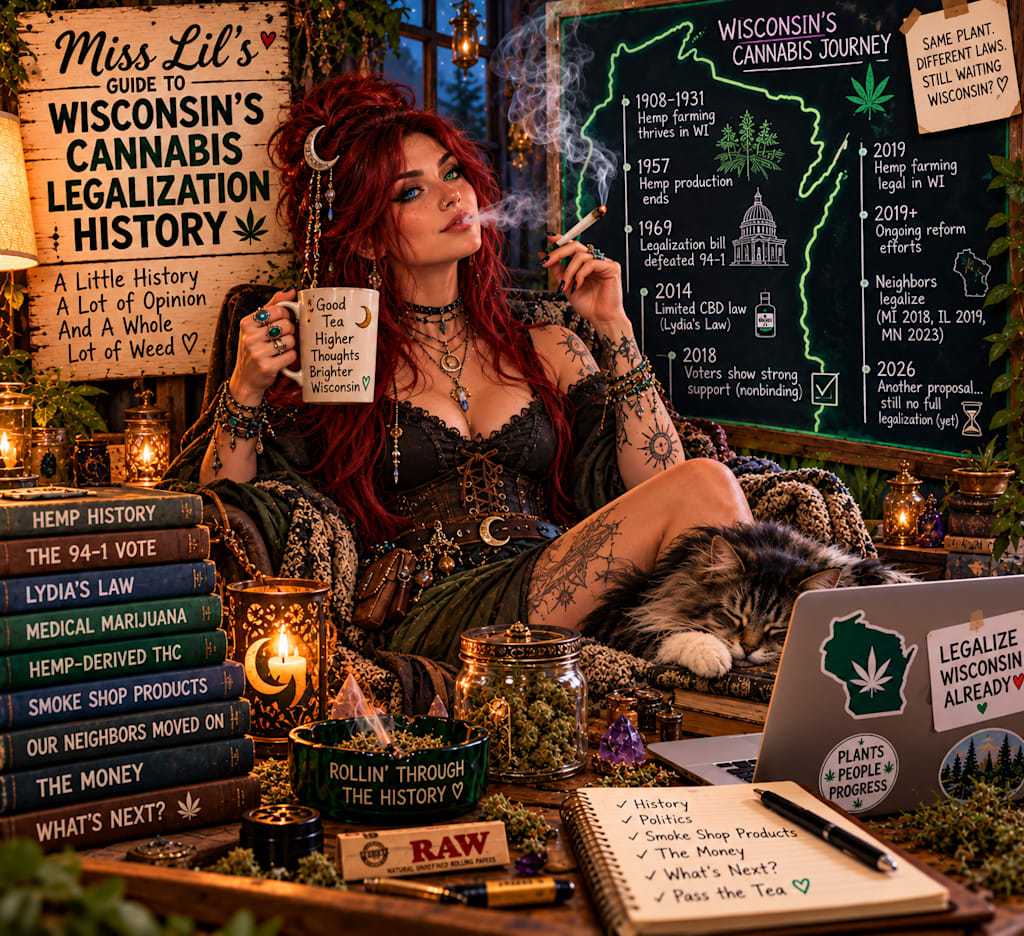
🌿 HIGH TIMES, HARD LAWS & BADGER STATE POLITICS
Miss Lil Takes a Puff and Dishes the Dirt on Wisconsin's Cannabis Legalization Battle
An unapologetically pro-legalization look at Wisconsin's long, winding road to cannabis reform, told by Miss Lil herself, with a cup of tea, a little smoke, and plenty to say.
By Miss Lil
Miss Lil settles herself into her favorite chair, tucks one leg beneath her, and reaches for the steaming cup of southern pecan tea sitting on the little table beside her. The rich, nutty aroma drifts through the room, mingling with the faint herbal scent curling lazily from the joint resting between her fingers.
She takes a slow sip, closes her eyes for a moment, and lets out a contented sigh. Then she picks up her joint, gives it a little turn between her fingers, and studies it thoughtfully before taking a leisurely puff.
"Now, sugar," she begins, leaning back against the cushions, "I hope you've got yourself something good to drink, because Miss Lil has been doing a little digging, and let me tell you something. Wisconsin's relationship with cannabis is one heck of a story."
She gestures with her joint, sending a delicate ribbon of smoke spiraling toward the ceiling.
"Can you believe we've spent decades arguing over this plant while our neighbors have gone ahead and legalized the stuff? Meanwhile, we've got hemp-derived gummies, THC drinks, vape cartridges, and flower sitting on smoke shop shelves all over the state, and folks are still trying to figure out what the devil is legal and what might get them into trouble."
She shakes her head, takes another sip of tea, and gives the reader a knowing little smile.
"Well, honey, pull up a chair. We're going to talk about history, politics, money, medical marijuana, those so-called legal products in smoke shops, and why this woman thinks Wisconsin needs to get its act together."
Miss Lil taps a little ash into the ashtray, settles deeper into her chair, and raises her cup.
"Let's clear the air, shall we? Literally and politically." 🌿
🌱 CHAPTER ONE: BEFORE CANNABIS BECAME A POLITICAL HEADACHE
Miss Lil reaches for a small notebook lying beside her teacup. She flips through a few pages, squints at her notes, and adjusts herself in the chair.
"Now, here's something that might surprise you, sugar. Wisconsin's relationship with cannabis didn't begin with somebody sneaking a joint behind the tavern or a teenager buying a bag of gummies at a smoke shop. No, no. This story goes back to farming."
She lifts one finger for emphasis.
"Hemp, which comes from the cannabis plant, has been cultivated for practical purposes for a very long time. Depending on the variety and how it's processed, hemp can provide fibers for rope and textiles, seeds for food, and materials for other industrial uses."
Wisconsin began growing hemp commercially around 1908. Between 1919 and 1931, the state became a major center of American hemp production, reportedly cultivating more hemp acreage than any other state during that period.
Miss Lil pauses, her eyebrows rising.
"Would you look at that? Wisconsin farmers were growing cannabis long before the plant became the center of so many political arguments."
She takes another sip of tea and slowly shakes her head.
"Imagine walking into a modern smoke shop with one of those old farmers. He'd probably have a hundred questions about the packaging alone."
Hemp production eventually declined. Following World War II, the federal government ended its hemp purchasing and price-support programs, and commercial hemp production in Wisconsin came to an end in 1957.
The cultural and political conversation surrounding cannabis also changed dramatically throughout the twentieth century. Increasingly, marijuana became associated with drug prohibition rather than its agricultural history.
Miss Lil crosses her ankles and leans forward, resting her elbows on her knees.
"And that's where things started getting complicated. We went from growing a useful crop to treating the broader cannabis conversation like something nobody ought to discuss in polite company."
She gives a small, amused snort.
"Funny how a plant can go from the farm to the courtroom without ever changing its name."
🚬 CHAPTER TWO: WHEN WISCONSIN SAID NO
Miss Lil picks up her joint, takes a measured puff, and watches the smoke drift upward while she gathers her thoughts.
"Now, let's turn the clock back to 1969. This is where Wisconsin's political history gets downright stubborn."
In 1969, Milwaukee legislator Lloyd Barbee attempted to introduce marijuana legalization in Wisconsin. His proposal was defeated by a vote of 94 to 1.
Miss Lil nearly chokes on her tea.
"Ninety-four to one? Mercy! That wasn't a disagreement, honey. That was the political equivalent of showing up to a pie-eating contest with a salad."
She sets her cup down, laughing under her breath, then waves her hand as if dismissing the memory.
"But the joke only goes so far. That vote reflected an era when marijuana prohibition had tremendous political support."
The following year, the federal Controlled Substances Act of 1970 established a nationwide drug-control framework and classified marijuana as a Schedule I substance.
That classification historically placed marijuana among substances considered to have a high potential for abuse and no accepted medical use under the federal system.
Miss Lil's expression becomes more serious. She turns the joint between her fingers, then rests it on the ashtray while she speaks.
"Now, I'm not going to pretend cannabis is harmless. Nothing that affects your brain deserves to be treated carelessly. But I do believe we ought to question laws that can follow somebody around for years because of a substance that other states now allow adults to buy from licensed stores."
Marijuana prohibition brought criminal penalties that varied according to the offense and the person's record. Those consequences could extend well beyond the courtroom, affecting employment, housing, finances, and family life.
She folds her arms and tilts her head.
"And here's the question I keep coming back to. If prohibition was supposed to make marijuana disappear, how's that been working out for us?"
Miss Lil reaches for her tea, takes a slow sip, and gives the reader a pointed look over the rim of her cup.
"Because from where I'm sitting, the plant never got the memo."
🗳️ CHAPTER THREE: WISCONSIN STARTS ASKING QUESTIONS
Miss Lil reaches over to turn a page in her notebook. Her bracelet jingles against the side of her cup.
"By the 2000s and 2010s, the conversation was changing all across America. More states began allowing medical marijuana. Eventually, some decided adults ought to be able to purchase it recreationally, too."
Wisconsin began facing renewed pressure to reconsider its approach.
2014: A small step toward medical access
In 2014, Wisconsin enacted a limited CBD law commonly associated with Lydia's Law. It permitted certain cannabidiol preparations for people with seizure disorders under specified conditions.
This was not comprehensive medical marijuana legalization. It did not establish a general system of licensed cannabis dispensaries or authorize recreational marijuana.
Miss Lil raises her teacup in a small, thoughtful toast.
"Still, it was a step. A small one, certainly, but a step toward acknowledging that cannabis-derived compounds could have legitimate medical applications."
In 2017, legislators introduced the Compassionate Cannabis Care Act, which sought to establish broader medical marijuana access. The proposal did not become law.
Miss Lil's shoulders sink as she lets out a theatrical sigh.
"And there we were again, sugar. Another proposal, another debate, and another opportunity for lawmakers to decide how far they were willing to go."
2018: Voters make themselves heard
During the 2018 election, voters in numerous Wisconsin communities considered nonbinding referenda concerning marijuana policy.
These votes demonstrated substantial public interest in reform, including support for medical marijuana and, in many communities, adult-use legalization.
Miss Lil points her joint toward the reader, careful to keep it well away from her tea.
"Now, remember this part, because it's important. A nonbinding referendum lets voters express their opinions. It doesn't automatically change the law."
The results could send a message to lawmakers, but actual legalization still required legislative action.
She leans back and spreads her hands.
"So the people could speak, the politicians could hear them, and then the politicians could decide what to do with that information."
Miss Lil pauses and raises an eyebrow.
"You see where I'm going with this, don't you?"
2019: The debate continues
Governor Tony Evers proposed marijuana reforms, including medical marijuana legalization and changes to possession penalties. Legislators continued debating broader proposals.
However, disagreements between the governor and the Republican-controlled Legislature made comprehensive reform difficult.
Miss Lil takes another puff, exhales slowly, and watches the smoke drift past the edge of her notebook.
"Year after year, the conversation kept coming back. Medical access. Recreational access. Penalties. Tax revenue. Public safety."
She taps her finger against the table.
"And while Wisconsin was debating the matter, other states were busy writing the rules for legal markets."
🧭 CHAPTER FOUR: OUR NEIGHBORS MOVED ON
Miss Lil scoots forward in her chair and reaches for a second sheet of notes.
"Now, this is the part that really gets my attention. Because Wisconsin doesn't have to imagine what legalization might look like. We can look right across the border."
Michigan legalized adult-use marijuana through a voter-approved initiative in 2018, with licensed recreational sales beginning in 2019.
Illinois legalized recreational marijuana through legislation signed in 2019, and licensed sales began in 2020.
Minnesota legalized adult-use marijuana in 2023.
Miss Lil counts the states off on her fingers.
"Michigan. Illinois. Minnesota. Three neighbors with legal adult-use systems. And here we are, still trying to decide how to handle a gummy."
She gives a small laugh, then takes a sip of tea.
"Now, to be fair, sugar, legalization doesn't magically solve every problem. Each state has had to work through licensing, taxation, public health, impaired driving, illegal sales, and all the other practical details that come with regulating an intoxicating substance."
Those states have created their own systems for possession, sales, cultivation, and taxation. Their approaches differ, but each has established a legal framework that Wisconsin still lacks.
Miss Lil sets her cup down and gestures toward the imaginary map spread across the table.
"Think about the questions this raises. Wisconsin residents can travel across a border and legally purchase marijuana under another state's law, but bringing that marijuana home may violate Wisconsin law."
She pauses, her expression turning thoughtful.
"Businesses can open their doors in neighboring states. Those states can collect cannabis-related taxes. Meanwhile, Wisconsin has to decide what it wants its own policy to be."
She takes a slow breath and settles against the cushions.
"I'm not saying we ought to copy our neighbors word for word. I'm saying we should learn from their experience instead of pretending the rest of the country is waiting for Wisconsin to finish its coffee."
Miss Lil raises her cup with a little grin.
"Although, to be fair, this is very good coffee."
🌿 CHAPTER FIVE: THE HEMP BILL THAT CHANGED THE SMOKE SHOP GAME
Miss Lil reaches for her joint, takes a puff, and leans toward the table with the unmistakable look of somebody getting to the juicy part of a story.
"All right, sugar. This is where things get really interesting. Because if marijuana is illegal in Wisconsin, why can you walk into a smoke shop and find products labeled Delta-8 THC, Delta-9 THC, THCA, CBD, and HHC?"
She raises both eyebrows.
"How can one cannabis-related product be sold on a shelf while another might get somebody into legal trouble?"
The answer involves the difference between marijuana law and hemp law, along with the chemistry of the cannabis plant.
The 2018 federal Farm Bill
The federal Agriculture Improvement Act of 2018 removed hemp, as federally defined, from the federal Controlled Substances Act's marijuana definition. The definition focused on a delta-9 THC concentration of no more than 0.3% by dry weight.
Wisconsin subsequently adopted a hemp framework of its own. In 2019, Governor Evers signed legislation permitting Wisconsin farmers to cultivate hemp under the state's regulatory system.
This created opportunities for hemp farming, CBD production, and other hemp-derived businesses.
Miss Lil nods, looking pleased that we're finally getting somewhere.
"Now, here's the catch. Legalizing hemp didn't mean Wisconsin had legalized every kind of marijuana."
Businesses began exploring hemp-derived cannabinoids, including Delta-8 THC, and some products were designed to produce an intoxicating effect.
The resulting marketplace grew faster than the rules could clearly address every product and manufacturing method.
Miss Lil holds up a finger.
"And that's how we got this peculiar situation. Wisconsin hadn't legalized recreational marijuana, but consumers could walk into certain stores and find hemp-derived products capable of getting them high."
The rise of Delta-8 THC
Delta-8 THC is a psychoactive cannabinoid related to delta-9 THC, the primary intoxicating compound commonly associated with marijuana.
Commercial Delta-8 products often use manufacturing processes to convert other hemp-derived cannabinoids, commonly CBD, into Delta-8 THC.
These products have appeared in gummies, vape cartridges, tinctures, beverages, and smokable products.
Miss Lil makes a face and waves her hand lightly.
"Now, I'm all for knowing what you're putting into your body. But when a product is manufactured through chemical conversion, you want to know whether the process has been properly controlled and whether the finished product has been tested."
The purity and composition of these products can vary. Consumers may not always know the actual potency or whether unwanted by-products are present.
She sets her joint aside for a moment and folds her hands on the table.
"That's why I keep coming back to regulation. If a product is intended to intoxicate people, consumers should be able to find reliable information about what's in it."
🛍️ CHAPTER SIX: WHAT ARE THOSE "LEGAL" PRODUCTS IN WISCONSIN SMOKE SHOPS?
Miss Lil reaches for her notebook again, flips to a fresh page, and takes a moment to straighten the paper.
"Let's go shopping without spending a dime, sugar. We're going to walk through the kinds of products people may see in Wisconsin smoke shops and explain what makes each one different."
She settles back, takes another sip of tea, and smiles.
"And remember, just because something is sitting on a shelf doesn't automatically mean it's legal. Product composition, manufacturing, applicable state and federal law, and changing regulations all matter."
1. CBD: The non-intoxicating cousin
CBD stands for cannabidiol. It is a cannabinoid found in cannabis and hemp that generally does not produce the characteristic marijuana high.
CBD products may include oils, tinctures, capsules, gummies, creams, balms, and some vape products.
Miss Lil gently taps the page with her fingertip.
"CBD isn't the same thing as THC. And please don't let somebody sell you a miracle in a bottle just because the label has a picture of a green leaf on it."
Evidence varies depending on the condition and formulation. CBD can also interact with medications, and retail product labels may not always accurately reflect the contents.
2. Delta-8 THC: The hemp-derived high
Miss Lil lifts her cup, takes a sip, and raises her eyebrows.
"Now we're getting into the intoxicating stuff."
Delta-8 THC can produce a high, although its effects may differ from those of delta-9 THC. It can impair coordination, attention, reaction time, and judgment.
Products may appear as gummies, vape cartridges, tinctures, infused drinks, or cannabinoid-treated flower.
She shakes her head slowly.
"Don't let somebody tell you it's automatically harmless because it's supposedly milder. The effects can be unpredictable, particularly when the product's actual ingredients and potency aren't clear."
3. Hemp-derived Delta-9 THC
Miss Lil leans closer to the reader, lowering her voice as if sharing a particularly interesting bit of gossip.
"Here's a detail that confuses an awful lot of people. Delta-9 THC is the same intoxicating molecule whether it comes from hemp or marijuana."
Some hemp-derived edible products have been formulated to stay within particular THC concentration thresholds by using a small percentage of THC relative to the product's total dry weight.
That does not automatically establish that every such product is lawful. Other legal requirements may apply.
She gives a little shrug.
"So don't assume the word hemp makes every gummy legal. And don't assume the label tells you everything you need to know about how strong it is."
4. THCA flower: The product that looks like marijuana
Miss Lil pauses, sets down her cup, and points toward the next heading.
"Now, this one deserves a closer look."
THCA stands for tetrahydrocannabinolic acid. It is a naturally occurring precursor to delta-9 THC found in raw cannabis.
When heated, THCA can undergo decarboxylation and convert into delta-9 THC. That's why THCA flower can look, smell, and smoke very much like conventional marijuana.
Some products have been marketed as hemp because their delta-9 THC concentration meets a particular threshold before heating. However, the flower may contain substantial potential THC.
Miss Lil leans back, folds her arms, and gives the reader a knowing look.
"Here's my problem with the confusion. If a product can deliver a marijuana-like high, the law ought to address its actual intoxicating potential instead of leaving consumers to guess based on a label."
The legal status of THCA flower is complex and can depend on the applicable definitions and rules. Consumers should not assume it is legally interchangeable with conventional marijuana.
5. HHC and other cannabinoids
Miss Lil flips another page, then makes a little face at the alphabet soup of chemical names.
"HHC stands for hexahydrocannabinol. You'll also find products marketed as THC-P, THC-O acetate, Delta-10 THC, and various cannabinoid blends."
These products may appear in gummies, vape oils, and other formulations. Their effects, manufacturing methods, and safety profiles vary, and the evidence about many of them remains limited.
Some are made through chemical conversion, which can raise questions about purity and unwanted by-products.
Miss Lil sets down her pen and shakes her head.
"A scientific-sounding name doesn't make a product safe, and a smoke shop's decision to stock something doesn't settle the legal question."
THC-O acetate deserves particular caution because of concerns about inhalation and its chemical properties.
6. Traditional marijuana flower and concentrates
Miss Lil draws a firm line beneath the heading in her notebook.
"This is where we need to be absolutely clear."
Conventional marijuana flower, marijuana-derived concentrates, and marijuana edibles do not become legal in Wisconsin simply because a smoke shop sells other cannabis-related products.
Wisconsin has not established a comprehensive licensed recreational marijuana market.
And buying marijuana legally in Michigan, Illinois, or Minnesota does not make it lawful to bring it back into Wisconsin.
She gives the reader a sympathetic little smile.
"I know. It's confusing. That's precisely why we need clear rules."
7. Smoking accessories
Pipes, rolling papers, grinders, glassware, vaporizers, and storage containers are also common in smoke shops.
Miss Lil reaches for her joint, turns it thoughtfully between her fingers, and grins.
"A pipe is a pipe, sugar. But the fact that you can legally buy an accessory doesn't mean every substance you put in it is legal."
⚖️ CHAPTER SEVEN: WHY THE WORD "LEGAL" NEEDS AN ASTERISK
Miss Lil places her joint in the ashtray and leans forward, her expression becoming more serious.
"Here's the heart of the problem. People hear that hemp is legal and assume everything derived from hemp must be legal, too. Other folks see THC gummies in a store and figure Wisconsin must have legalized marijuana after all."
She shakes her head.
"Neither assumption is safe."
The legal status of a product can depend on its ingredients, how it was manufactured, how it is classified under applicable laws, and whether it complies with relevant restrictions.
A product's presence in a store is not a legal guarantee.
Miss Lil takes a moment to stir her tea, watching the spoon circle the cup.
"And as the market changes, the rules change, too."
Milwaukee adopted a local ordinance in 2025 prohibiting sales of hemp-derived THC products to people under 21. That measure illustrated growing concern about intoxicating products being sold in ways that could confuse consumers, including children who might mistake THC edibles for ordinary candy.
Miss Lil puts the spoon down and folds her hands.
"Now, I want adults to have freedom over their own choices. But children deserve protection, and consumers deserve honest labeling. Those two things can absolutely coexist."
A comprehensive regulatory framework could include accurate labels, independent laboratory testing, child-resistant packaging, age restrictions, and clear rules against sales to minors.
She raises her teacup again.
"Personal freedom doesn't mean we have to abandon common sense."
🏛️ CHAPTER EIGHT: THE LEGALIZATION BILLS THAT KEEP COMING BACK
Miss Lil lets out a slow breath, reaches for her notebook, and flips through several pages of legislative history.
"Now, if you've been paying attention, you'll notice that Wisconsin's legalization debate has a habit of coming back around. Again. And again. And again."
Democratic lawmakers have introduced legalization proposals repeatedly over more than a decade. These efforts have included medical marijuana access, adult-use legalization, reduced criminal penalties, and proposals for regulated commercial markets.
Republican lawmakers have generally opposed broad recreational legalization, although some have supported narrower medical cannabis proposals or different approaches to hemp-derived products.
Miss Lil raises her eyebrows.
"And that's part of the problem. Even when lawmakers agree that something needs attention, they don't necessarily agree on what the solution should look like."
Would home cultivation be allowed? How would retail licenses be distributed? What would the minimum age be? How would the state tax marijuana? What rules would apply to hemp-derived intoxicants? What should happen to people previously convicted of marijuana offenses?
These are legitimate questions, and any serious proposal should answer them.
The 2024 medical marijuana proposal
Republican lawmakers introduced a restrictive medical marijuana proposal in 2024, but it did not become law.
The proposal reflected disagreement over how far medical access should extend and how tightly it should be controlled.
Miss Lil takes a small puff, then sets the joint aside while she speaks.
"Medical marijuana and recreational marijuana aren't identical policies, sugar. A medical program generally establishes qualifying conditions, patient eligibility, and rules for access. A recreational program generally allows adults to purchase and possess specified products for personal use."
She reaches for her cup.
"And I believe we can have both conversations without treating them as enemies."
2025 and 2026: The hemp question grows louder
As hemp-derived THC products spread, lawmakers faced increasing pressure to decide whether those products should be banned, restricted, or regulated.
In 2025, proposals emerged to tighten restrictions on hemp-derived intoxicants. Other efforts sought a more structured system for testing, labeling, licensing, and age restrictions.
The debate continued into 2026.
On February 2, 2026, Wisconsin Democrats introduced another proposal to legalize marijuana for medical and recreational use. Wisconsin Public Radio reported on February 12 that the measure faced significant political obstacles in the Republican-controlled Legislature.
Miss Lil leans back and rubs her forehead with two fingers.
"Years of debate, honey. Years."
As of October 22, 2026, Wisconsin has not established a comprehensive statewide adult-use marijuana market.
She picks up her tea and looks directly at the reader.
"And let's keep one important distinction in mind. Introducing a bill isn't the same as passing it. Debating a proposal isn't the same as changing the law."
💸 CHAPTER NINE: FOLLOW THE MONEY, HONEY
Miss Lil perks up, sets her cup on the table, and reaches for a fresh page in her notebook.
"Now we're getting to the part that makes politicians sit up a little straighter. Money."
A regulated cannabis industry could create opportunities for Wisconsin farmers, processors, laboratories, retailers, and other businesses. It could also generate tax revenue, although the amount would depend on consumer demand, tax rates, market structure, and the costs of regulation.
She taps her pen against the notebook.
"Let's not pretend every dollar of projected tax revenue would magically appear in the state treasury. There would be costs, inspections, administration, public education, and enforcement to pay for."
Still, the economic question deserves serious attention.
Wisconsin farmers could benefit
A regulated marijuana market could potentially create new opportunities for licensed growers, agricultural suppliers, processors, and manufacturers.
Miss Lil smiles and gestures toward the window.
"I'd like to see Wisconsin farmers get a fair chance at participating in that industry. We have an agricultural tradition, and small businesses shouldn't automatically be pushed aside by giant corporations."
Wisconsin could keep more spending at home
When residents travel to neighboring states to purchase marijuana legally, Wisconsin doesn't collect the cannabis-specific taxes associated with those transactions.
A legal Wisconsin market could keep some of that spending within the state.
Miss Lil takes a sip of tea and gives a small shrug.
"Of course, it wouldn't mean every customer would suddenly shop here. But it's certainly worth examining how much economic activity Wisconsin might be leaving on the table."
Criminal justice has costs, too
Enforcing marijuana prohibition can involve police time, court proceedings, legal representation, probation, and incarceration, depending on the offense.
Legalization would not eliminate every cannabis-related crime. Unlicensed distribution, sales to minors, impaired driving, and violations of possession limits could remain offenses.
However, reducing penalties for conduct that becomes legal could allow resources to be redirected.
Miss Lil's expression softens as she closes the notebook halfway.
"And then there's the human cost. A criminal record can follow somebody long after the original offense, affecting employment and other opportunities."
She pauses before continuing.
"If the state decides to change its approach, it ought to consider what happens to people who were punished under the old one. Fairness should be part of the conversation."
🩺 CHAPTER TEN: MEDICAL MARIJUANA AND THE PEOPLE WHO NEED OPTIONS
Miss Lil reaches for her cup, wraps both hands around it, and takes a thoughtful sip.
"This isn't just about recreational use, sugar. We need to talk about patients, too."
Cannabis contains numerous cannabinoids, including THC and CBD, that interact with the body's endocannabinoid system. Researchers have studied cannabis-based treatments for various symptoms and medical conditions.
Some cannabinoid-based medicines have established medical uses. Evidence for other applications varies, and patients should be given honest information about potential benefits, side effects, interactions, and uncertainties.
Miss Lil sets her cup down carefully.
"I don't believe cannabis should be presented as a miracle cure. But I also don't believe every conversation about its medical potential should be shut down because the plant has a complicated legal history."
Wisconsin's limited CBD legislation was an early acknowledgment of this issue. It did not, however, establish a comprehensive medical marijuana program.
A carefully designed medical system could establish qualifying conditions, professional guidance, product standards, and patient protections.
She reaches for her notebook and underlines a sentence.
"Patients shouldn't have to become amateur chemists just to figure out what they're buying. And they should be able to discuss treatment options with qualified healthcare professionals without feeling as though they're confessing to a crime."
🚨 CHAPTER ELEVEN: LEGALIZATION DOES NOT MEAN "ANYTHING GOES"
Miss Lil sets her joint aside, straightens in her chair, and gives the reader a firm look.
"Now, before somebody accuses me of wanting Wisconsin to turn into one giant smoke circle, let's get something straight."
Marijuana can impair reaction time, coordination, attention, and judgment. It can cause anxiety or other unpleasant psychological effects, especially with high-potency products or in susceptible individuals. Frequent use can also lead to cannabis use disorder.
Young people deserve particular protection because the brain continues developing into early adulthood. Edibles that resemble ordinary candy can create accidental ingestion risks, especially when they are poorly labeled or improperly stored.
Miss Lil nods slowly.
"Supporting legalization doesn't mean ignoring those risks. It means addressing them honestly."
A responsible system should consider minimum purchase ages, accurate labels, independent laboratory testing, child-resistant packaging, restrictions on deceptive advertising, secure storage, impaired-driving enforcement, and public education.
It should also establish clear licensing and inspection requirements for growers, manufacturers, laboratories, and retailers.
She reaches for her cup, takes a small sip, and settles back into her chair.
"Regulation isn't the enemy of personal freedom, sugar. Done properly, it can help protect it."
🔥 CHAPTER TWELVE: WHY IS WISCONSIN STILL WAITING?
Miss Lil stares into her cup for a moment, then sets it down with a soft clink.
"Well, we've made it through the history, the politics, the hemp loophole, and the money. So let's ask the question that keeps bringing us back to this table."
She leans forward and rests her elbows on her knees.
"Why are we still here?"
There isn't one single answer. Wisconsin's political divisions are a major factor. Lawmakers disagree over the scope of legalization, how a legal market should operate, what restrictions should apply, and how to address intoxicating hemp-derived products.
Some opponents worry about addiction, impaired driving, public health, and the effects of commercialization. Those concerns deserve serious consideration.
Supporters argue that prohibition has not eliminated demand, that adults should have greater freedom over personal choices, that patients need access, and that regulated markets can provide stronger consumer protections than unregulated sales.
Miss Lil reaches for her joint, takes a leisurely puff, and exhales toward the ceiling.
"People can disagree about cannabis. That's perfectly fair. But disagreement shouldn't mean we leave consumers guessing, businesses navigating unclear rules, and patients wondering what options they can legally access."
Wisconsin continues to prohibit conventional recreational marijuana while allowing certain hemp-derived products under a different and increasingly contested legal framework.
Miss Lil gives a small, weary shake of her head.
"That's the contradiction we need to address. Not by pretending every product is harmless, and not by pretending prohibition has solved everything. By actually doing the work."
🌿 CHAPTER THIRTEEN: WHAT MISS LIL WANTS TO SEE
Miss Lil takes one last sip of tea, sets the cup down, and opens her notebook to a clean page.
"All right, lawmakers. If you're listening, Miss Lil has a few suggestions."
She begins counting on her fingers.
"First, establish a comprehensive, regulated system for adult-use marijuana, with sensible possession limits, age restrictions, testing requirements, licensing, and responsible taxation."
"Second, create meaningful medical access for qualifying patients, with appropriate professional guidance and safeguards."
"Third, deal honestly with intoxicating hemp-derived products. Distinguish non-intoxicating CBD from products designed to produce a high, and establish clear standards for testing, labeling, manufacturing, and sales."
"Fourth, invest in public education, impaired-driving prevention, youth protections, and evidence-based research."
"Fifth, examine past marijuana convictions and provide fair relief where appropriate."
Miss Lil lowers her hand and studies the list.
"Now, is that going to solve every problem? Of course not. No law does. But it would give Wisconsin a clearer, more consistent framework than leaving everyone to figure out the rules from headlines and tiny print on a gummy package."
She closes the notebook with a decisive little snap.
"And I'd like to see small businesses and Wisconsin farmers have a fair opportunity to participate, too. If we create an industry, let's make sure the rules aren't written only for the biggest players in the room."
Miss Lil reaches for her joint again, then pauses and smiles.
"See? You can support legalization and still believe in rules. Imagine that."
🍃 THE FINAL PUFF: WISCONSIN, IT'S TIME TO CLEAR THE AIR
Miss Lil settles back into her favorite chair, tucks her feet beneath her, and reaches for her cup. The southern pecan tea has cooled a little, but she takes another sip anyway. She turns her joint between her fingers, takes a final leisurely puff, and watches the smoke curl upward in delicate ribbons.
"Well, sugar, look at how far we've traveled."
Wisconsin once grew hemp as an important agricultural crop. Then came decades of prohibition, followed by limited medical exceptions, renewed public debate, and repeated efforts to change marijuana law.
The 2018 federal Farm Bill helped open the door to a booming hemp-derived cannabinoid market. Wisconsin adopted its own hemp framework, and businesses began selling products that could produce intoxicating effects even as conventional recreational marijuana remained illegal.
Michigan, Illinois, and Minnesota established adult-use markets. Wisconsin continued debating what its own approach should be.
Miss Lil slowly shakes her head, then reaches for the teapot and pours herself another cup.
"That's the strange part of this whole story. We've got a plant with a long agricultural history, a changing medical conversation, a growing market for hemp-derived products, and neighbors who have already moved forward with legalization."
She places the teapot back on its little warmer and folds her hands around her fresh cup.
"And here we are, still trying to figure out whether we're going to regulate the situation or keep arguing about it."
Miss Lil supports legalization because she believes adults should have the freedom to make informed decisions about cannabis, patients deserve meaningful access to appropriate treatment options, and responsible regulation makes more sense than pretending demand will simply disappear.
But she also believes in protecting children, informing consumers, addressing impaired driving, and acknowledging the real risks associated with intoxicating products.
She raises her cup toward the reader.
"Freedom and responsibility can sit at the same table, honey. We don't have to choose one and throw the other out the window."
Miss Lil takes a final sip, settles comfortably against the cushions, and gives the reader a warm, knowing smile.
"So here's what I want to know. If our neighbors can create regulated markets, if Wisconsin consumers are already buying hemp-derived intoxicants, and if lawmakers keep bringing legalization proposals back to the table, what exactly are we waiting for?"
She gestures toward her notebook, then toward the empty chair across from her.
"Because I'd much rather see Wisconsin establish clear laws, protect consumers, support legitimate businesses, and treat people fairly than keep everybody guessing."
Miss Lil lifts her cup one last time.
"Here's to honest information, sensible laws, and a little less political smoke in the air."
She takes a comfortable breath, sets her tea down, and smiles.
"And Wisconsin?"
She pauses for dramatic effect.
"It's time to clear the air." 🌿☕
Miss Lil has spoken. Now, who's ready to join the conversation?
🌿☕ PULL UP A CHAIR, DARLINGS! MISS LIL HAS SOMETHING TO SAY! ☕🌿
Love dark history, creepy mysteries, true crime, controversial conversations, and stories that make you stop scrolling and say, “Well, I'll be damned!”? Then sugar, you've found your people! 😉🖤
Whether we're sipping southern pecan coffee, exploring the paranormal, uncovering forgotten history, discussing the latest news, or stirring the pot with a little social commentary, there's always something brewing at Miss Lil's table.
Sometimes we get spooky. Sometimes we get serious. And sometimes we tackle the subjects folks would rather avoid. No topic is too strange, too dark, or too controversial for an honest conversation!
🖋️ COME FOLLOW MY WRITING!
📘 Facebook: Lily Writes
Join the conversation, catch new article teasers, share your opinions, and see what's brewing next!
👉 https://www.facebook.com/groups/2155720388491578
📝 Vocal Media: Lilithea Adasia
Find my full-length articles, deep dives, creepy tales, historical rabbit holes, true crime, and thought-provoking commentary.
👉 https://vocal.media/authors/lilithea-adasia
So grab your coffee, bring your curiosity, and settle in. If you enjoy stories with substance, a little darkness, and plenty to talk about, I'd love to have you along for the ride. 🌿🕯️
Every follow and share helps independent writing reach new readers, and I appreciate everyone who takes the time to read and join the discussion.
Life's too short for boring conversations and stories without a little bite, darling! 💋
📚 A FEW PLACES TO FOLLOW THE SMOKE
For readers who want to dig deeper into Wisconsin's cannabis history and the changing legal landscape, these are useful starting points:
Wisconsin Public Radio: Other states have legalized weed. Why hasn't Wisconsin?
Wisconsin Public Radio: Wisconsin lawmakers consider changes to hemp policy that's 'clear as mud'
Wisconsin Public Radio: A legal loophole allows the sale of 'Delta 8' cannabis in Wisconsin
Wisconsin Statutes: Section 94.55, Hemp
Editorial note: This article reflects the legal and political landscape as of October 22, 2026. Proposed legislation, federal hemp rules, and state or local restrictions can change. Hemp-derived products should not be assumed lawful solely because a retailer sells them or a package labels them as hemp. This is an informational article, not legal or medical advice.
About the Creator
Lilithea Adasia
I dig where others look away. 🖤 True crime, paranormal mysteries, uncomfortable truths, and the beautifully broken human experience. I chase the stories others bury and ask the questions others avoid. Come curious. Leave questioning.
Enjoyed the story? Support the Creator.
Subscribe for free to receive all their stories in your feed.
Comments