social media
Social Media targeted at influencers and trending topics in the Potent universe.
Cancel Culture: Protection or Problem?
In the digital era, public opinion travels faster than ever. A single tweet, video, or statement can reach millions within minutes—and sometimes, it can just as quickly destroy reputations. This phenomenon is often referred to as “cancel culture,” a term used to describe the act of collectively calling out, boycotting, or withdrawing support from individuals or organizations for behavior deemed offensive or unacceptable.
By Robert Redford6 months ago in Potent
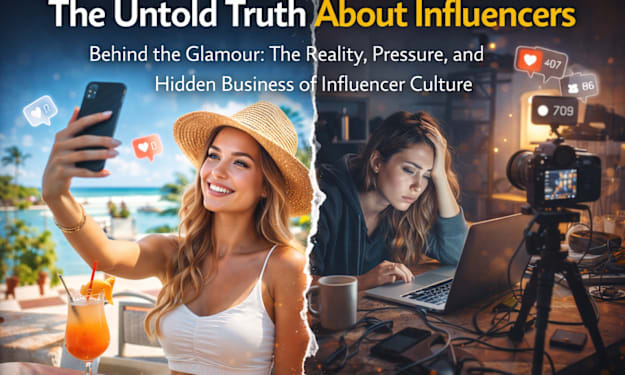
The Untold Truth About Social Media Influencers
Social media influencers are often seen as symbols of success, freedom, and luxury. From exotic travel destinations to perfectly curated lifestyles, their content creates the impression of a dream life that many aspire to achieve. But behind the polished photos, viral videos, and brand collaborations lies a reality that is rarely discussed openly.The world of influencers is not just about creativity and fame—it’s also about pressure, strategy, competition, and, at times, emotional strain.
By Robert Redford6 months ago in Potent
Robert Jenrick
Introduction Robert Jenrick is a well-known British politician. He belongs to the Conservative Party in the United Kingdom. Over the years, he has worked in many important government roles. He is especially known for his views on housing, immigration, and law. Some people support his ideas, while others criticize them, but there is no doubt that he is an important figure in modern British politics.
By Farhan Sayed9 months ago in Potent
From Rejection to Revolution. AI-Generated.
--- When Jack Ma was born in 1964 in Hangzhou, China, no one could have imagined that this small, skinny boy would one day become one of the most influential entrepreneurs in the world. His early life was not filled with privilege or connections. In fact, Jack Ma grew up in a time when China was still opening up to the outside world, and opportunities were scarce. His parents were traditional musicians and storytellers, earning very modest incomes. But what Jack lacked in resources, he made up for in curiosity and determination. As a boy, Jack was fascinated by the English language. He would ride his bicycle to a nearby hotel every morning, just to speak to foreigners and practice his English for free. In exchange, he would guide tourists around his city. These conversations opened his eyes to the world beyond China’s borders. While many of his peers stayed in their comfort zones, Jack was already learning how to adapt, connect, and communicate with people from different cultures — a skill that would later become one of his greatest assets. However, school life was not easy for him. Jack was far from a straight-A student. In fact, he failed his primary school exams twice, middle school exams three times, and even failed his college entrance exams twice before finally passing. His math skills were weak, and he often struggled in subjects that others found easy. But Jack never saw these failures as a reason to quit. Instead, he treated them as lessons and stepping stones. After college, Jack faced a new challenge: finding a job. He applied for dozens of positions — including at KFC when it first entered China — but was rejected from all of them. At KFC, out of 24 applicants, 23 were hired. Jack Ma was the only one rejected. He even applied to become a police officer but was told he was “not good enough.” Harvard University? He applied ten times, and every time he received a rejection letter. Most people would have been crushed by so much rejection, but Jack had a unique perspective. He often said: “If you don’t give up, you still have a chance. Giving up is the greatest failure.” This belief kept him moving forward. Jack eventually found work as an English teacher, earning just $12 a month. It was not a glamorous job, but he loved teaching. His passion for communication and helping others made him a favorite among his students. Yet deep inside, Jack knew he wanted to do something bigger — something that could change lives on a larger scale. In 1995, Jack visited the United States for the first time. While in Seattle, a friend introduced him to the internet. It was a life-changing moment. Jack searched for “China” online and was surprised to find almost no information. That’s when an idea struck him: Why not create a website to introduce China to the world? With almost no technical skills, Jack started his first internet company, “China Pages.” He convinced friends to invest in his vision, and soon the website was online. While the project gained some attention, it failed to become profitable. Jack learned an important lesson: passion must be paired with a solid business model. But Jack was not done. In 1999, in his small apartment in Hangzhou, he gathered 17 friends and shared his vision of building a platform where small Chinese businesses could connect with buyers around the world. That was the birth of Alibaba. At first, investors laughed at him. The idea of Chinese businesses selling products internationally through the internet seemed unrealistic. But Jack had one powerful advantage: belief. He believed in the potential of the internet and the hardworking spirit of small businesses in China. He also believed in his team, calling them “fighters” who could take on the giants of the business world. Alibaba began to grow slowly but steadily. In 2000, the company faced a cash crisis. Many suggested charging membership fees to raise money, but Jack refused. He wanted to first build trust with customers, proving Alibaba’s value before asking for payment. This decision, though risky, helped Alibaba gain credibility and loyalty. Over time, Alibaba expanded its services, creating Taobao — a marketplace that would rival eBay in China. When eBay entered the Chinese market with its strong financial backing, many thought Alibaba would lose. But Jack understood one thing: in business, understanding the local culture matters as much as money. While eBay charged listing fees, Taobao was free. It also offered friendlier customer support and features designed specifically for Chinese buyers. Within a few years, Taobao had driven eBay out of China. Jack’s leadership style was unconventional. He encouraged creativity, resilience, and humor in the workplace. He once told his employees, “We’re not afraid of competitors who are bigger than us. We’re afraid of competitors who are more desperate than us.” His energy and vision inspired his team to keep innovating. By 2014, Alibaba had become the largest e-commerce company in China, and its initial public offering (IPO) on the New York Stock Exchange raised $25 billion — the largest IPO in history at that time. From a man who could not get a job at KFC to the founder of a multi-billion-dollar company, Jack Ma’s journey was nothing short of extraordinary. However, Jack’s success was never just about money. He often said, “We don’t want to be the richest people in the world. We want to be the most respected.” He invested heavily in philanthropy, education, and environmental causes, aiming to create lasting change. In 2019, at the age of 55, Jack stepped down as Alibaba’s chairman to focus on these efforts, leaving behind a powerful legacy. Jack Ma’s life is a story of resilience, vision, and the ability to turn rejection into opportunity. He proved that you don’t need to be born rich, be the smartest in the room, or have all the resources to succeed. What you need is persistence, creativity, and the courage to keep going when others tell you it’s impossible. In his own words: “Today is hard, tomorrow will be worse, but the day after tomorrow will be sunshine.” And for Jack Ma, that sunshine not only lit his own path but also illuminated the way for millions of entrepreneurs around the world. ---
By Danyal Hashmiabout a year ago in Potent
Social Media Bubble Explained. AI-Generated.
In the present world most of us spend a big part of our day on social media. From scrolling through Instagram to catching up on the latest trends on TikTok we are always connected. But behind the fun there is something many people do not notice about the social media bubble.
By AN Solutionabout a year ago in Potent
What Today's Ultra-Potent Weed Really Means for Your Mind: Beyond the Buzz.. AI-Generated.
Cannabis has undergone a transformation unlike any other recreational drug in the past two decades. The mellow weed of the 1970s had THC (tetrahydrocannabinol) levels of about 2% to 3%, whereas today's strains frequently have potencies that exceed 25%. Dabs and oils, for example, can contain as much as 90% THC. However, despite the fact that headlines scream about "super weed" and its mind-melting potency, focusing solely on potency misses the real problem: our understanding of cannabis has not kept up with its evolution. Yes, today's marijuana is much stronger. However, this does not automatically make it riskier. The fact that we don't know much about how these high-potency strains affect the developing brain, mental health conditions, and long-term cognition makes it dangerous. We have adopted a permissive attitude that frequently overlooks the science—or lack thereof—as cannabis culture enters the mainstream and legalization spreads. Psychological effects of cannabis have been undervalued due to its laudation as a "natural" or "safe" alternative to drugs, alcohol, and opioids. Even though cannabis is physically and addictively less harmful than many legal substances, that does not mean it is harmless. The dangers are real, especially for young users. High-potency cannabis use is linked to higher rates of anxiety, depression, and even psychosis, according to recent research. In 2019, research was published in The Lancet Psychiatry indicating that daily use of high-strength cannabis was linked to a fivefold increase in the risk of developing psychotic disorders, particularly in urban areas where high-strength weed is widely available. Nevertheless, despite this data, many casual users continue to be unaware of the potential effects on mental health. The lack of public understanding is even more troubling. We have barely scratched the surface of understanding how these changes affect the brain, particularly in adolescents, with cannabis now being a lab-enhanced, genetically modified powerhouse. Cannabis interacts with the endocannabinoid system, which is important for brain development, mood regulation, and stress response. During crucial developmental years, regular interference with that system may have ripple effects, which we are just beginning to investigate. The issue of regulation and consistency comes next. In contrast to pharmaceuticals, the potency, chemical composition, and quality of cannabis products can vary greatly, particularly in markets where there is no strict oversight. Users can't always tell what they're consuming, and researchers can't always see clear cause-and-effect relationships because of this inconsistency. So, what concerns should we have? Not only is the weed potent, but we are also flying blind. Our cultural, legal, and medical frameworks haven't changed fast enough to help people with mental health issues related to cannabis, create safety standards, or educate people on responsible use. The nuance has been lost as the conversation about cannabis has shifted from prohibition to normalization. This is not a defense of legalization. In point of fact, legal regulation is one of the few means of ensuring that products are safer, education is improved, and research is more robust. But it is a reason to slow down our enthusiasm for culture and ask better questions. Not "How high can I go with this?" but rather "How will this impact me in the long run?" In the end, the issue is more than just the potency of today's marijuana. The assumption that we already comprehend it is the problem. We are not. And until we do, not only our lungs but also our minds may be at risk.
By Ashfaque Mahmud 🇧🇩about a year ago in Potent