love poems
Love poems for hopeless romantics; I'm the poet and you're my muse.
The Circle of Ink
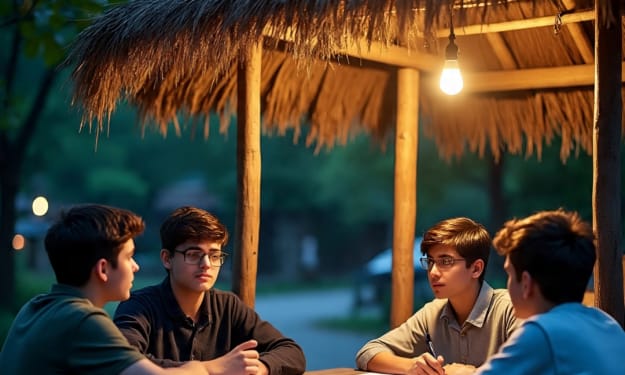
In a quiet corner of the old city, where bicycle bells and street vendors blended into a familiar melody, four boys met every evening at a small tea stall called Chai Baithak. They were not famous poets, not even published writers—just friends with notebooks full of thoughts they believed were too heavy for ordinary conversations. The group called themselves The Circle of Ink. Malik, the oldest among them, had a slow voice and deep eyes that seemed to carry untold stories. He wrote poems about streets, old houses, and forgotten people. To him, poetry was like dust on shelves—it settled, but only after years of silence. Usman was the opposite—loud, funny, never serious until he touched a pen. His poems were full of emotions hidden behind jokes. He wrote about dreams, failure, and hope, but he pretended it didn’t matter. Harris, who rarely talked, wrote more than anyone. His poems were short but sharp, like needles that stitched broken hearts. His notebook was filled with one-line poems sometimes more powerful than full pages. And then there was Zain, the youngest, who had joined the group only a month ago. He believed poems must rhyme, must sound beautiful, must please the reader. The others were teaching him that poetry was more than rhyme—it was honesty. One evening, Zain came looking worried, rubbing his notebook nervously. “Will people laugh at my poetry?” he asked. Malik sipped his tea and looked at him. “People don’t laugh at poetry,” he said calmly. “They only laugh when they don’t understand themselves.” Usman grinned. “Or when the poet himself is confused!” Everybody laughed, except Zain. His eyes remained doubtful. He pulled out a page, his voice trembling as he read his poem about a bird stuck behind a window, trying to fly toward the open sky. When he finished, silence surrounded them—not uncomfortable, but thoughtful. Harris nodded slowly, as if carving the poem into his memory. Malik looked at Zain. “Why do you think the bird tried again and again?” he asked. “To fly,” Zain said. “No,” Malik replied softly. “To hope.” Zain’s face brightened, and for the first time, he looked like a poet who understood his own words. Weeks passed, and the Circle of Ink kept growing—not in number, but in depth. They shared not only poems but pieces of their lives. Malik wrote about a neighbor who lost his job but still watered his plants every morning. Usman wrote about a broken kite that still danced in the air. Harris wrote one line every evening, each one leaving everyone silent. One day, Harris arrived late with his notebook open. He looked at his friends and said, “My father passed away last night.” None of them spoke. For the first time, poetry could not find a sentence. Harris placed his notebook on the table and pointed to a line he had written: “The smell of my father’s jacket is stronger than sadness.” Tears gathered in Malik’s eyes. Usman placed a hand on his shoulder. Zain closed his notebook, feeling suddenly small before the power of truth. That evening, no one wrote a poem. No one recited. They simply sat together, understanding that poetry wasn’t only words—it was how hearts held pain gently, like a fragile cup of tea on a windy day. From that day forward, their circle was stronger, not because they wrote better, but because they understood life better. Poetry, they realized, was not a performance; it was a friendship with feelings. The Circle of Ink remained at Chai Baithak, evening after evening, finding beauty in ordinary moments and courage in simple words. And slowly, each of them became a poet—not for the world, but for himself.
By Muhammad Saad 10 months ago in Poets
“Whispers of the Pen: Journeys of Poetic Minds and Creative Spirits”
In the quiet corners of every city, small groups of men gather—not just to write, but to breathe life into words. These poets are not bound by fame or recognition; they are driven by the irresistible pull of creativity and the joy of expression. Each line they craft carries intention, every verse a reflection of thought, emotion, and the shared human experience. For them, poetry is more than a craft—it is a bridge connecting the inner world to the wider community. They dedicate hours to refining each word, each rhythm, ensuring that the quality of content resonates deeply with anyone who reads it. They understand that high-quality writing is the foundation of engagement and the key to capturing the attention and hearts of readers. Structure matters. Every poem is thoughtfully organized with headings, stanzas, and occasional lists or bullet points to guide readers smoothly through the piece. This careful formatting ensures their work is searchable, discoverable, and SEO-friendly, making it easier for both newcomers and loyal followers to find and appreciate their creations. Publishing regularly has become their secret weapon. A poem released today might spark discussion; another shared tomorrow can capture new readers. Each story, shared on social media platforms like Twitter, LinkedIn, or personal blogs, amplifies their reach, drawing attention to their words and their passion. Over time, this consistency builds a following—readers who return, comment, tip, and share. Engagement within the Vocal community itself is equally vital. These poets make it a point to read, like, and comment on each other’s work, fostering connections that strengthen their network. Feedback flows freely, encouragement is abundant, and shared insights inspire improvement. By participating in Vocal challenges and competitions, they not only gain recognition but also increase visibility, ensuring their voices are heard by a wider audience. Affiliate links are used sparingly and thoughtfully, embedded only where they enhance the reader’s experience—such as recommending books on poetic techniques, tools for writers, or collections that inspire. This subtle integration ensures trust remains intact and the community continues to value their guidance. The path to building a following is gradual but rewarding. A loyal audience emerges naturally when writers focus on quality, relevance, and engagement. Readers tip generously, share passionately, and become active participants in the poets’ journey. Each story contributes to a growing ecosystem where creativity, dedication, and positivity thrive. Ultimately, these men are not just poets—they are builders of culture and custodians of expression. Their commitment to craft, community, and continual growth transforms ordinary moments into extraordinary reflections. In every verse, they capture hope, curiosity, and inspiration, reminding themselves and others that poetry is not just written; it is lived, shared, and celebrated. Through discipline, engagement, and purpose, these poets demonstrate that the art of words is timeless, capable of connecting minds, inspiring hearts, and shaping communities. And in their dedicated hands, every penstroke becomes a whisper that echoes far beyond the page, carrying with it the power of passion, creativity, and human connection.
By EchoVerse Poet10 months ago in Poets
The Ink-Bound Brotherhood
In the heart of the old city of Hilstone, there was a forgotten garden behind a dusty public library. Most people passed by it without paying attention—except a group of boys who believed that words had the power to change the world. They called themselves The Ink-Bound Brotherhood. The members were not famous, rich, or well-dressed. They were ordinary young men from different backgrounds. Still, every evening, after school, work, or part-time jobs, they gathered to turn their feelings into verses. To them, poetry was not a hobby—it was a lifeline. The group was led by Rohan, a calm boy with spectacles and a voice that always sounded thoughtful. Rohan never considered himself talented, but everyone knew his words carried depth as if each poem came from a hidden ocean inside him. Then there was Sameer, the loud one, whose poems were like fire—angry, passionate, filled with emotion too big to stay silent. Bilal, the shy sketch artist, only spoke through his drawings, adding illustrations to everyone’s poetry. Zain, the storyteller, could turn a simple walk to school into an epic adventure. And Arif, the youngest, always questioned everything through short poetic lines that surprised the older members. Every Friday evening, they held small poetry readings in the garden. They took turns reciting, while the others clicked fingers as applause. They didn’t care about likes, applause, or fame. They wrote for healing, for peace, for hope—and sometimes, just to feel understood. One day, the garden was suddenly sealed off by construction workers. The library was being renovated, and the garden was to be demolished to build a storage room. The news shattered the group. The place where they had grown as friends, as poets, as people, was about to disappear. Sameer wanted to protest loudly. Rohan suggested diplomacy. Zain wanted to write a story. But it was Arif who said something simple: > “If we believe poetry can change hearts, then let us try to change theirs.” Inspired, they came up with an idea. They wrote a long poem together—each verse by a different member. It spoke about brotherhood, their city, dreams hidden in silence, and a small garden that gave life to their voices. Bilal created drawings around the poem: lanterns, benches, falling leaves, notebooks. They printed copies and gave them to the library staff and construction manager. At first, the workers smiled but didn’t take them seriously. Yet, something unexpected happened: the library’s head librarian read their combined poem that night. He was moved by the sincerity and unity of their voice. The next day, the librarian visited the group. “I didn’t know this garden had a story,” he said. Rohan replied softly, “Every place that carries feelings becomes a story.” The librarian convinced the city committee to keep part of the garden intact—not as a storage site, but as a Public Poetry Corner. Instead of destruction, the space was given life, benches, and even a small notice board where anyone could post poems. The Ink-Bound Brotherhood celebrated that evening, reciting their shared poem in the garden they saved. Their words were no longer just ink on paper; they had changed something real. And from that day on, the garden was no longer forgotten. It became a home where strangers became poets, and poets became friends.
By Muhammad Saad 10 months ago in Poets