love poems
Love poems for hopeless romantics; I'm the poet and you're my muse.
The Echoes of Gentle Pens
In a peaceful town woven with cobblestone paths and whispering trees, there existed a quiet circle known as the Community of Gentle Pens. They were poets—men of calm thoughts, steady hands, and hearts that beat in the rhythm of unsaid verses. But they were not famous poets. They were ordinary people who carried extraordinary worlds inside them. They met every Sunday evening in a small room above an old bookstore. The room had creaking wooden floors, lanterns that glowed softly, and shelves lined with forgotten books that smelled of dust and memory. Among them was Ayaan, a young man with a thoughtful face and a notebook always tucked under his arm. He was new to the town, new to the community, and unsure of himself. He had hundreds of poems in his mind, but fear kept them locked away. On his first evening with the poets, he sat quietly in the corner. The others introduced themselves—Rehan, the soft-spoken teacher who wrote haikus about the sky; Sarmad, who loved metaphors more than anything; and Umar, a gentle soul who rarely spoke but whose poems carried oceans inside them. When the lanterns were lit and the tea was poured, Rehan stood and said, “Let us begin with the poem of the week. Ayaan, if you wish, you may start.” Ayaan froze. His heart trembled. “I… I didn’t bring anything special.” Rehan smiled. “Everything the heart writes is special.” But Ayaan shook his head, lowering his gaze. “Maybe next time.” The poets didn’t pressure him. They simply continued, each sharing verses woven from their week’s experiences—hope, sorrow, dreams, and memories. Ayaan listened, feeling something warm inside him. These men were not competing; they were sharing their souls like lanterns lighting one another. That night, Ayaan returned home inspired but still unsure. He sat by his small window, looking at the moon. His notebook lay open, waiting. Slowly, his hand began to move, and a poem formed—soft, fragile, yet sincere. It was about belonging, and about a heart finding a place to rest. The next Sunday, he carried that poem with him, though fear still held onto his steps. When the meeting began, Rehan looked at him gently. “Ayaan, would you like to share today?” Ayaan took a breath. “Maybe… I can try.” And he read. His voice shook at first, but as the words filled the quiet room, something changed. The silence embraced him, not in judgment, but in understanding. When he finished, the room stayed still for a moment before Rehan said, “That was beautiful.” Umar nodded. “You write with honesty. That is rare.” Sarmad smiled softly. “Your poem felt like morning after rain.” For the first time in months, Ayaan felt his chest lighten. Week after week, he returned. He shared more poems—some bright like dawn, some heavy like evening—but each one was accepted with kindness. The poets often helped him improve his verses, suggesting stronger metaphors, deeper lines, or a clearer rhythm. Ayaan learned, grew, and blossomed. One evening, Rehan made an announcement. “We have been invited to present a collection of poems at the town’s annual gathering. I want Ayaan to write the opening poem.” Ayaan’s eyes widened. “Me? But… I am still learning.” Rehan placed a hand on his shoulder. “We all are. Poetry is a journey, not a prize.” With the support of his friends, Ayaan wrote a poem that captured the heart of their community—how poetry connects strangers, heals wounds, and gives voice to quiet dreams. At the gathering, Ayaan stood before the crowd and read his poem. His hands trembled, but his voice carried the courage he had gained from his companions. As he finished, the hall erupted into soft, warm applause. In that moment, Ayaan knew: He had found more than a poetry circle. He had found a family of words, ink, and gentle hearts— a place where quiet souls write loud dreams.
By Muhammad Saad 10 months ago in Poets
A Letter To My First Love
The Prompt - Write a poem on endings, using flame or fire as your central image. This is the final challenge in our Vocal+ Fall Poetry Series, and it’s all about endings. Flames fade, fires burn out, and what remains is ash, memory, or the promise of something new. Your poem might take fire as destruction, as warmth, as memory, or as transformation. However you approach it, let the flame guide you to what it means to reach an ending, whether it arrives with silence or with a burst of light. Write like you are watching the last fire fade.
By Denise E Lindquist10 months ago in Poets
The Opera House
10/24/25 4:37am I’m the most sober I’ve been since sober meant anything and Chicago must not believe in autumn anymore because I’ve already got my earmuffs attached to my bag any time I leave the house but it’s not so bad unless my fingers get itchy then it means it’s too cold too fast I just hope my medication isn’t expired because God knows I don’t have the means to pay for it or most things at this point and I’ll blame it on everything except my own will because it doesn’t weigh my arms down as much and they’ve been hurting at night so maybe it’s the breakthrough the doctors have been looking for maybe it’s the key to whatever hypothesis involves the need for a snot rag and numb lips maybe it’s ancient scripture or hieroglyphics and maybe when it’s all done it’ll reveal a map to the Opera House and I won’t have any choice but to spend the last ball on two tickets to The Winter’s Tale and I’ll remember how serotonin doesn’t have to taste like a respiratory infection it can just exist inside me and leave without any weak link or toe-holed sock or empty dispensers of longing
By Olivia Dodge10 months ago in Poets
The Path Lit by Quiet Dreams
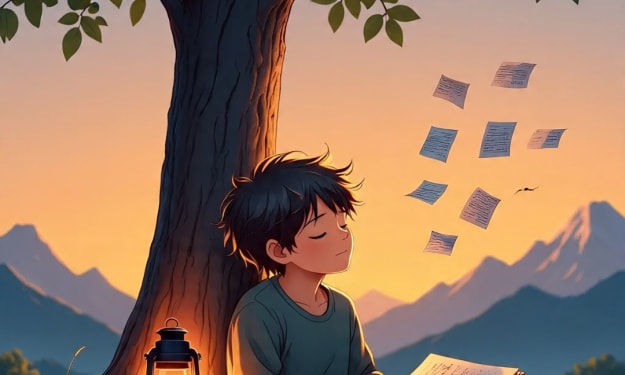
The sun dipped low behind the mountains, painting the sky with shades of orange and gold. In the quiet of the evening, a young boy named Ayaan sat beneath an old banyan tree that grew at the edge of his village. This tree was his favorite place in the world — a place where worries softened and thoughts became clearer. He carried with him an old notebook, its pages filled with half-written poems, scattered thoughts, and dreams too shy to speak aloud. Ayaan loved writing, even though almost no one knew. His village was simple, and most people spent their days working, farming, or repairing things that needed fixing. Poetry was not something people talked about. But for Ayaan, words were like small stars — tiny, shining, and full of magic. He believed they had the power to change lives, even if only in small ways. Every evening, he came to the banyan tree to write. Today, however, his notebook remained blank. He stared at the empty page, unsure of what to say. Nothing in his heart felt large enough to become a poem. Nothing seemed important enough to write about. “Maybe I’m not a real poet,” he whispered to himself. At that very moment, a gentle breeze passed, rustling the leaves above him. A small lantern that he left beside him flickered, its warm light dancing on the paper. Ayaan sighed and closed his eyes, hoping the quiet would stir something inside him. Then he heard footsteps. It was his grandfather, a man known in the village for his calm wisdom. He walked slowly toward Ayaan, his hands behind his back, eyes soft with kindness. “You look troubled,” his grandfather said, sitting beside him. Ayaan hesitated but finally replied, “I can’t think of anything to write. My words feel small. Maybe I’m not meant to be a poet.” His grandfather smiled, not mocking, but full of understanding. “Do you know what makes someone a poet?” he asked. Ayaan shook his head. “A poet is not someone who writes big words,” his grandfather said. “A poet is someone who feels deeply and tries to give those feelings a place to live. Your words do not have to be perfect. They only need to be true.” Ayaan looked at his notebook again. “But what if no one reads them?” “Then write for the sky,” his grandfather said gently. “Write for the tree. Write for the breeze. Write for yourself. The world does not always have to hear your voice for your voice to matter.” Ayaan felt something warm bloom in his chest, like a soft fire lighting up the darkness. His grandfather stood, placed a hand on Ayaan’s shoulder, and said, “Even quiet dreams are important, my son. Give yours a chance.” As the old man walked back toward the village, Ayaan opened his notebook once more. The lantern beside him glowed brighter, as if cheering him on. He let his pen touch the page, and slowly, the words began to flow. He wrote about the mountains — strong and patient. He wrote about the sky — wide and full of promise. He wrote about hope — small but unbreakable. Before he realized it, the page was full. Ayaan smiled for the first time that evening. He understood now that writing was not about proving anything. It was about expressing the quiet truths living inside him. Years later, people would know him as the village poet — the boy who grew into a man whose words softened hearts and brought light to difficult days. But for Ayaan, the true beginning was that one quiet evening under the banyan tree, when a tiny lantern, a gentle breeze, and a few honest words changed everything. And so, the path of his life was lit — not by thunder or applause, but by quiet dreams that refused to fade.
By Muhammad Saad 10 months ago in Poets