celebrities
No matter their age, some celebrities have old souls; poems written by celebrity poets and your favorite celebrities' favorite poems.
The Last Poem of Elara Vane
M Mehran In the coastal town of Windmere, where gulls wheeled over cliffs and sea spray painted the windows, people still spoke in hushed tones about Elara Vane—the poet who vanished without a trace. Elara had lived in a cottage perched on the edge of the sea. She was not famous in her lifetime, but her slim book of verses, Salt and Silence, was beloved in Windmere. Her words carried the rhythm of tides, the loneliness of harbors, and the fragile hope of ships returning home. The mystery was this: one stormy evening, she walked out toward the lighthouse with a lantern in hand and never came back. Some said the sea claimed her. Others whispered that she had followed her own poems into another world. Fifty years later, her cottage still stood, weathered and ivy-covered. Few dared to enter. But when seventeen-year-old Noah Ellis, an aspiring poet himself, moved to Windmere with his family, curiosity tugged at him. Noah had always scribbled verses in the margins of his schoolbooks, but his words felt clumsy, hollow. He longed for something real, something that could stir hearts the way Elara’s poems had. One twilight, unable to resist, he wandered up the cliff path and pushed open the door to her abandoned cottage. The air smelled of seaweed and dust. Books lay scattered, their spines curled with age. And on the wooden desk by the window, he found it: a notebook. Its cover was worn, its pages thin, but the ink was still sharp, as though it had been written yesterday. The title page read: The Last Poem. Noah’s pulse quickened. Inside were verses unlike anything he had ever read. They shifted like waves, each line unfinished, flowing into the next as if the poem itself was still being written. But the strangest part was this: after a few stanzas, the ink stopped mid-sentence—“I will return when the tide…”—and the rest of the page was blank. That night, Noah couldn’t sleep. The unfinished poem pulled at him like a current. He began to write where Elara had left off, filling the silence with his own words. The moment his pen touched the paper, the candle beside him flickered, and he swore he heard a woman’s voice whisper, “Go on.” For weeks, Noah returned to the cottage, adding lines, then tearing them out, rewriting again. The notebook seemed to breathe beneath his hand, guiding him but never fully revealing its intent. Each time he wrote, the sea outside grew louder, as if listening. One stormy evening—so like the night Elara vanished—he finished the poem. He wrote the last line without thinking, his hand moving as though not entirely his own: “…and the sea shall return what it has taken.” The wind rattled the windows. The candle flared. And then, in the corner of the room, a figure appeared—a woman in a salt-stained cloak, her face pale, her eyes luminous like the moon on water. “Elara?” Noah whispered. The figure nodded faintly. Her lips moved, but no sound came—only the crash of the tide below. She reached toward the notebook, touched the final line, and then looked at Noah with gratitude. As quickly as she appeared, she was gone. The storm outside calmed. The sea grew still. When Noah looked back at the notebook, the pages were full—every blank space filled with Elara’s handwriting, as though she had finished her life’s work through him. At the very end, beneath her signature, one final line glowed faintly in the candlelight: “Every poet needs another to carry the pen.” The next morning, the townspeople awoke to find the lighthouse shining brighter than it had in years, though no one had lit its lamp. Word spread quickly: Elara Vane’s lost manuscript had been found. When Noah shared the poems, they carried both voices—hers and his. Readers felt the old magic of Elara’s tides but also the raw, searching hope of a new generation. Critics called it The Bridge of Poets, a dialogue across time. But in Windmere, no one cared about critics. They only said, with quiet certainty, that Elara had finally come home. As for Noah, he no longer doubted whether his words mattered. He knew now that poets did not vanish; they lingered in unfinished lines, waiting for someone brave enough to listen. And every evening, when the sea turned gold beneath the setting sun, Noah sat by the lighthouse with his notebook open, writing—not to replace Elara, but to walk beside her in verse, across the endless tide.
By Muhammad Mehranabout a year ago in Poets
The Poet’s Bench
M Mehran In the heart of Willowbrook Park, near the old fountain where children still tossed pennies for wishes, stood a weathered wooden bench. Its paint had long since faded to a pale gray, and the carved initials of decades of young lovers ran across it like secret graffiti. Yet, in the evenings, the bench came alive with words. For years, people swore that if you sat there long enough, lines of poetry would rise in your mind—verses you had never thought of before, words strung together like pearls on a silver thread. Some dismissed it as imagination. Others said it was the spirit of Arthur Gray, the town’s most beloved poet, who had spent every afternoon of his final years sitting on that very bench, scribbling in a battered notebook until the sun sank behind the hills. Maya, a high-school English teacher, had grown up hearing the stories but had never believed them. She admired Arthur Gray—his slim collection Rivers of Quiet Fire was still studied in her classes—but she chalked the bench legends up to small-town folklore. That changed one September evening. She had just finished a long day of teaching and wandered through Willowbrook Park, grading papers as she walked. The bench was empty, glowing faintly in the last stretch of sunlight. She sat down absentmindedly, balancing a stack of essays on her lap. It happened so suddenly she nearly dropped her papers. Words. Whole stanzas. They weren’t in her voice—they felt older, wiser, and yet intimately hers: “The river keeps a memory of every stone it has touched. And we— we are only stones carried once, hoping the water remembers.” She gasped. She wasn’t writing. She wasn’t even thinking of poems. But there it was, like a voice placed directly into her heart. Startled, she scribbled the lines onto the margin of a student’s essay. The words flowed, tumbling faster than she could catch them. By the time the park lamps flickered on, she had covered three pages with verses that seemed to rise from the wood beneath her. The next morning, she showed them to her colleague, Mr. Patel, who had taught in Willowbrook for thirty years. He read them quietly, then looked at her with wide eyes. “These,” he said slowly, “sound like Arthur Gray.” Maya laughed nervously, but when she returned to the bench the following evening, the same thing happened. New lines, different rhythms, yet always carrying that deep pulse of Gray’s unmistakable style. Soon, word spread. Students whispered that their teacher had been “chosen.” Retired librarians dug out old recordings of Arthur Gray’s readings, comparing them to Maya’s sudden stream of poems. Local reporters began hovering around the park, hoping to witness the phenomenon. But it was not performance. The bench did not work for everyone. When others sat there, the wood remained silent. Yet for Maya, the words came night after night, as if the spirit of the poet had chosen her as a vessel. One evening, she brought her notebook instead of her students’ essays and asked aloud, “Arthur… why me?” The fountain trickled nearby, leaves rustled in the autumn wind, and then—clear as any line she had ever heard—came the reply: “Because poets are never gone. We only need new hands to carry the pen.” Maya’s throat tightened. She wasn’t a poet—at least, she had never dared to call herself one. She was a teacher, a reader, someone who admired the beauty of language but never believed she could shape it herself. Yet the bench seemed to disagree. Over the following weeks, she began compiling the poems into a small manuscript. She titled it Echoes on the Bench. When she nervously read a few verses aloud at the town’s autumn festival, the crowd fell silent. Some wept quietly. Others swore they heard Arthur’s voice carried on the wind. The local newspaper ran the headline: “Willowbrook Poet Lives On Through Teacher.” Bookstores in nearby towns began requesting copies of the manuscript. Even publishers reached out, curious about the strange story of inspiration flowing from an old bench. But Maya wrestled with doubt. Was she truly writing? Or was she just a mouthpiece for someone else, long gone? Did it matter? One late November night, with the first flakes of snow falling across the park, she sat once more on the bench. Her hands were cold, ink smudged across her fingers, but the words came anyway. They came softer now, slower, like a grandfather saying goodbye. “All poems are borrowed. All voices shared. When you write, child, it is not only me. It is you, too.” The bench seemed to exhale. The wood beneath her no longer hummed with that strange electric energy. The silence was complete. Maya realized the gift had ended. But it left her with something more precious: belief. Not just in Arthur Gray’s lingering spirit, but in herself. She could write—not as a vessel, not as a ghost’s echo, but as Maya, the teacher who had always loved words. The following spring, her first original poem was published in the Willowbrook Chronicle. It was simple, about the sound of chalk against a blackboard and the way students’ eyes lit up when they discovered a new story. Yet it was wholly hers. The bench remained in the park, weathered and quiet. Tourists sat on it, hoping for magic, but it no longer whispered verses. Some said Arthur had finally passed on, his work complete. Others believed he had simply given his bench a new guardian. As for Maya, she never told anyone the exact night the words had stopped. She kept that secret folded inside her like a final poem. For every time she passed the fountain, she felt a quiet gratitude. In the end, the bench had not made her a poet. It had only shown her that she already was one.
By Muhammad Mehranabout a year ago in Poets
How Long Does Grief Echo?
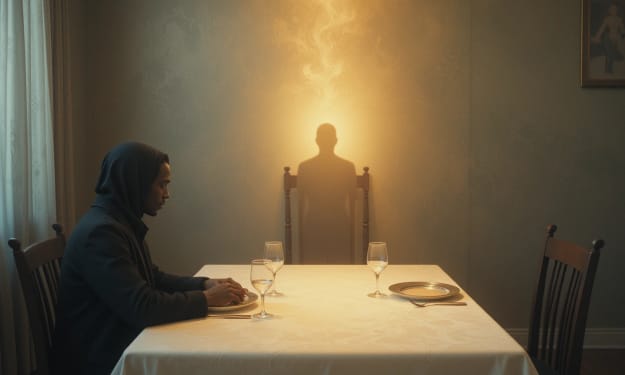
How Long Does Grief Echo? Sometimes love lingers not in sight, but in sound. The house is quiet now, but not silent Silence is heavy, absolute, the kind that presses against your ribs until you choke on it. This is not silence. This is something else — a thin, shifting hush that still carries traces of what once was.
By waseem khanabout a year ago in Poets
A Primordial Howl
In A Primordial Howl, Novel Allen offers more than just free verse — the poem reads like a myth, a prophecy, and a warning all wrapped into one. From the opening cry that echoes across the void to the final haunting image of humanity stranded between heaven and hell, the piece reminds us of poetry’s ancient function: to awaken, to warn, and to connect us with the elemental forces that shape existence. The Mythic Opening The poem begins with a startling line: “A primordial howl escaped my lips as it all began to form.” Immediately, the reader is pulled into a space beyond ordinary time. This is not the comfortable terrain of modern life; this is the cosmic edge, where creation itself is about to begin. By placing the speaker at “the precipice, the edge of Nothing,” the poem establishes a mythic voice — one that is both witness and participant in the unfolding of the world. This opening works as a hook because it triggers curiosity and awe. We wonder: who is this speaker? Are they human, divine, or something in between? What does it mean to stand before life itself has begun? That open loop compels us to keep reading, not for answers in a conventional sense, but for images that will make the unknowable feel vivid. From Creation to Corruption As the poem progresses, it moves through cycles of creation: winter frost, summer rain, autumn leaves, spring flowers. Life is evoked in its simplest, most beautiful rhythms. But soon, a shift occurs. The speaker watches humanity emerge — head, torso, arms, lungs filling with breath — and feels hope at this birth. Yet that hope quickly curdles into despair. The wolves, figures of natural wisdom and primal instinct, warn humanity to be careful. But the warnings are ignored. Instead of listening, humanity chases greed, silences nature, and loses its connection to what truly matters. Lines like “lakes gone… gold no longer glitters” are stark in their simplicity, offering a bleak vision of ecological and moral decline. Here, Allen uses contrast as a key poetic device. The beauty of early creation collides with the corruption of later human choices. That tension gives the poem its emotional arc: awe, hope, disappointment, and urgent warning. The Prophetic Voice In the middle of the poem, the speaker takes on the role of prophet, almost preacher. Commands ring out: “Stop the fake smiles. Howl at the moon. Live beautifully.” The tone shifts from observation to exhortation. The voice no longer describes what is happening but demands what must be done. This shift is crucial for the poem’s effectiveness. Without it, the work might remain only a lament. With it, the poem becomes a call to action. The howl is not just a symbol of primal energy; it is a reminder that authenticity, resistance, and attention to the natural world are essential for survival. Myth, Burden, and the Final Warning Allen deepens the prophetic tone by invoking myth. The image of Sisyphus — eternally straining under the rock — becomes a symbol of the “penitent few” who still carry the burden of trying to save the world. Myth here functions not as decoration but as reinforcement: the struggle to redeem humanity is eternal, exhausting, and heroic. The climax of the poem is its stark warning: “This is the final warning. Repent or become lost forever, somewhere between Heaven and Hell, in Limbo!” The diction is unmistakably biblical, echoing sermons and apocalyptic scripture. By fusing mythic, natural, and spiritual registers, the poem elevates itself beyond personal reflection. It becomes a collective warning, directed at all of us. Why the Poem Resonates What makes A Primordial Howl powerful is not just its imagery but its structure. It begins in mystery, rises to awe, descends into despair, and ends in haunting uncertainty. Along the way, it uses open loops — questions left hanging — to keep the reader engaged. Who is the speaker? Will humanity listen? Will there be a second chance? The poem refuses to close these loops neatly, leaving us unsettled, which is precisely the point. In terms of voice, the speaker is visionary and authoritative, yet vulnerable. They howl alone, yet also stand as witness for all of humanity. This mixture of loneliness and authority gives the poem its urgency. It is both deeply personal and universally prophetic. Conclusion: Howling for Survival Ultimately, A Primordial Howl is a meditation on beginnings and endings, on creation and destruction. It asks us to reconsider our place in the great cycles of life, to remember that ignoring the natural world carries a terrible cost. Its refrain — the howl — is at once grief, resistance, and prayer. By the end, the reader is left with an image of humanity stranded, still howling, waiting for the world to tilt again and begin anew. It is not a comforting vision, but it is a necessary one. Poetry, at its best, does not soothe us into complacency; it unsettles us into action. And in that sense, Allen’s howl is not just primordial. It is timely, urgent, and enduring.
By Qaseem Ahmadzaiabout a year ago in Poets