
Why Western Games Keep Choosing the Katana
Greatswords still own fantasy. Cyberpunk, asset libraries, and Japan’s cultural head start made the katana the default blade.
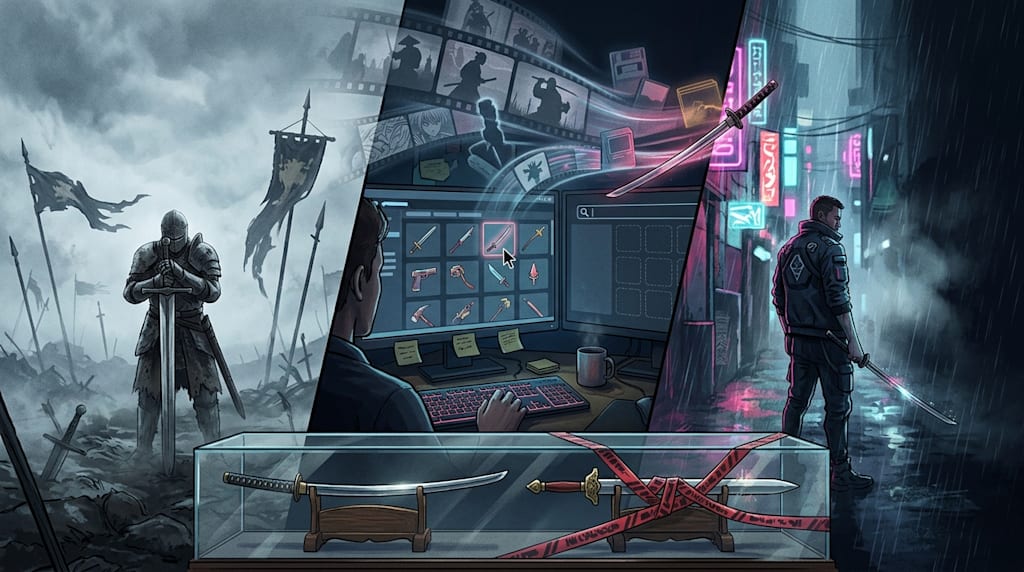
Why are there always katanas in Western games?
Night City, Japantown. The player picks up a blade from an Arasaka agent’s corpse. The inventory says Katana. He switches to melee, draws, dashes, parries, executes. Neon slides along the blade. The cybernetic arm makes a hydraulic sound. In The Witcher, the same action belongs to the steel sword on Geralt’s back. In Dark Souls, it belongs to Artorias’s greatsword. In Elden Ring, to a greatsword jump attack.
But this is cyberpunk. So the blade is a katana.
From this, many people conclude that Western works love katanas most. That conclusion skips the first half. Western fantasy has never lacked greatswords, longswords, hand-and-a-half swords, battle axes, and warhammers. The Dragonborn in Skyrim carries a two-handed sword. Geralt has two swords. The knight in Dark Souls uses a straight sword and shield. The Tarnished in Elden Ring rolls with a greatsword. Kratos uses the Leviathan Axe. For Honor has Kensei, Conqueror, Warden. The katana appears in scenes where the greatsword does not fit.
When the scene changes, the weapon changes.
I. Cyberpunk needs Japan
Cyberpunk did not grow only out of the West. Its visual genes include Japan.
In the 1980s, Japan’s economy was rising. The West imagined Tokyo as the prototype of the future city: neon, high-rises, subways, robots, megacorporations, crowds, kanji signs, gangs, cyberware, information networks. Blade Runner pushed this aesthetic into the world. Neuromancer wrote it into science fiction. Ghost in the Shell and Akira exported Japan’s own future anxiety to the globe.
Cyberpunk then acquired a fixed set of images: megacorporations, cybernetic modification, neon cities, Eastern text, black markets, samurai-like solitude, Japanese swords.
Cyberpunk 2077 has Arasaka, Japantown, samurai, street gangs, cyberware. The katana is not out of place. It is a worldbuilding prop. It represents this: in a high-tech, low-life world, a person still chooses a premodern cold weapon to fight huge capital and machines.
A gun belongs to order, mass production, and distance. A sword belongs to rebellion, craft, and the body.
The katana carries that romance.
II. Gameplay: the katana is one of the best-made Eastern weapons
Action design alone makes the katana almost made for games.
It has a ready-made action library: draw, iaijutsu, combo, parry, sheathe, blood flick, sheathe. It has a strong rhythm: stillness, motion, stillness. It has high visual recognition: one arc of light, one sheathing pose, and the player knows this is a Japanese sword.
In Sekiro, the deflecting sound is metal against metal, crisp, short. The player hears it, and the finger presses again on its own. In Ghost of Tsushima, Jin Sakai adjusts his breath before drawing. The moment the blade leaves the sheath, the camera pushes in, blood flick, sheathe. In Cyberpunk 2077, the player installs Sandevistan, activates time slow, draws, combos. The enemy has not turned around, and the sword is already back in the sheath.
A greatsword cannot do these actions. A greatsword is heavy, slow, wide-swinging. It fits medieval battlefields, fantasy monsters, heavy-armored knights. Cyberpunk combat is often high-speed, close-range, cyber-enhanced, neon-lit. Here the katana coordinates better than the greatsword.
In numerical terms, the pop-culture katana roughly equals a hand-and-a-half sword or a saber. It can be one-handed or two-handed, fast or heavy, realistic or surreal. If the designer wants an agile weapon, add attack speed. If heavy, add charge. If it blocks bullets, add cyberware. If it glows, add an energy blade.
The greatsword stayed in fantasy.
III. Katana is already an English word
The clearest sign of successful cultural export is not that others understand your culture. It is that they use your word.
Western players know samurai, ninja, katana, shogun, anime, manga. They may not distinguish tachi from uchigatana, but they know what a katana looks like. They may not know Japanese history, but they know samurai swords are cool.
What about the Chinese sword in English? Usually “Chinese sword,” or “jian.” To ordinary Western players, “jian” is far less recognizable than katana. You say “Chinese sword,” and the other person’s mind may conjure wuxia, xianxia, Daoists, flowing white robes, but not a clear weapon image.
The Japanese sword completed symbolization. The Chinese sword is still inside its culture. Japan used decades of anime, film, and games to nail katana into a global pop symbol. Ghost of Tsushima, Sekiro, Ninja Gaiden, Way of the Samurai, Yakuza. Every work repeats and reinforces the symbol. Repeat long enough, and it becomes the default option.
Open a Western game engine asset library. Search “sword.” Out come longsword, greatsword, scimitar, katana. Search “jian.” Few results. Search “Chinese sword.” Fewer.
The asset library shows the same thing.
IV. Fault tolerance: Japanese swords can be modded; Chinese swords are easily nitpicked
At the Japanese public level, people generally separate artifact swords from entertainment swords.
Japanese swords in museums are strict in hierarchy, clear in form, refined in craft. Japanese swords in anime, games, and film can glow, block bullets, cut steel, and take cyberware. When foreigners get it wrong, the Japanese audience mostly will not hunt them down. They may even think, “You are willing to use it. That is good.” There are nitpickers, but industry and public are generally more accepting of modification.
Chinese swords and hanfu are different.
Once they appear in Western works, some circles enter archaeology mode: What dynasty is this? Is the form correct? How is the handle wrapped? Is the guard correct? Is the wearing method correct? Is the pattern correct? One mistake, and long criticism may follow.
Creators avoid these elements for a different reason: using Chinese elements has higher risk and cost. So they choose safer symbols: qipao, kung fu, panda, lantern, red lantern, dragon, Chinese characters, chopsticks. These symbols are simple, recognizable, and not easily attacked.
The result: games are full of qipao but almost no hanfu; Western works are full of katana but Chinese swords are rare.
The Chinese sword is not ugly. The threshold for using it is too high. Not technical. Public opinion.
V. What did Japan do right?
Japan did several things well.
First, separate artifact from entertainment. Artifacts require rigor. Entertainment requires freedom. If you cannot separate the two, you lose entertainment.
Second, allow fan creation. When foreigners make Japanese samurai, they are not required to fully understand Japanese history. As long as they are willing to use samurai, ninja, Japanese swords, Japanese industry and public usually welcome first, and gossip privately later. Let people in first, then talk about correctness.
Third, create types. Samurai, ninja, cyber samurai, ronin, swordsman. These identities have fixed visuals: sword, scabbard, hakama, topknot, drawing pose. Western creators do not need to understand Japan. They only need to collage the symbols to produce a Japanese feel.
Fourth, global words. Katana, samurai, ninja, anime. These words have entered English and need no translation. The Chinese sword lacks an equal word.
Fifth, sustained IP. Anime, games, film, music, fashion, decades of continuous output. Countless repetitions make a symbol. One advertisement does not.
VI. Why is the Chinese sword absent?
The Chinese sword has history, beauty, and stories. What it lacks is modern entertainment re-symbolization.
First, the definition is too complex. Chinese swords have forms from different dynasties, a jian/dao distinction, one-handed and two-handed, literary and martial, ceremonial and combat. A Western creator wants to use one but does not know which.
Second, it is bound too deeply. The Chinese sword is mainly bound to wuxia, xianxia, and period drama. Once it leaves period drama, what should a modern Chinese sword look like? What should a cyber Chinese sword look like? No one has given a globally recognized answer.
Third, the English name is weak. “Jian” is not widespread enough. “Chinese sword” is too generic. There is no one-word equivalent of katana.
Fourth, internal nitpicker drain. Hanfu circles, sword circles, history circles, internal standards fight each other. An external creator looks at it, finds it too troublesome, and does not touch it.
Fifth, it lacks a strong IP. Sekiro and Ghost of Tsushima made global players remember the Japanese sword. The Chinese sword needs an equal work to modernize it, internationalize it, and make it cool. It needs a game, film, or anime, not a documentary or archaeology video.
VII. Symbol war
So, the number of katanas in Western works has less to do with strength or quality than with these conditions:
Cyberpunk needs the Japanese sword;
Game action needs the katana;
The English-speaking world knows the word katana;
Japanese culture allows modification;
The Chinese sword’s cost of use is too high;
The Chinese sword lacks a modern symbol and a strong IP.
The katana won as a symbol.
The greatsword remains the fantasy default.
The Chinese sword still lacks a modern translation.
A Western indie game developer opens an asset library. Search “sword.” Up come katana, longsword, scimitar. He inputs “jian.” Few results. He picks katana. The actions are ready, players recognize it, and no one will post a long thread.
He saves the project.
About the Creator
Jin
Writer of reamstories
https://reamstories.com/jin
Enjoyed the story? Support the Creator.
Subscribe for free to receive all their stories in your feed. You could also become a paid subscriber, letting them know you appreciate their work.
Comments
There are no comments for this story
Be the first to respond and start the conversation.