
"The Quiet Rebellion: How Gen Z Students Are Rewriting the Rules Without Making a Sound"
They aren't marching in the streets—they're building empires in dorm rooms, curating identities in 15-second clips, and quietly dismantling every system their parents trusted. This is the revolution that doesn't need a megaphone.

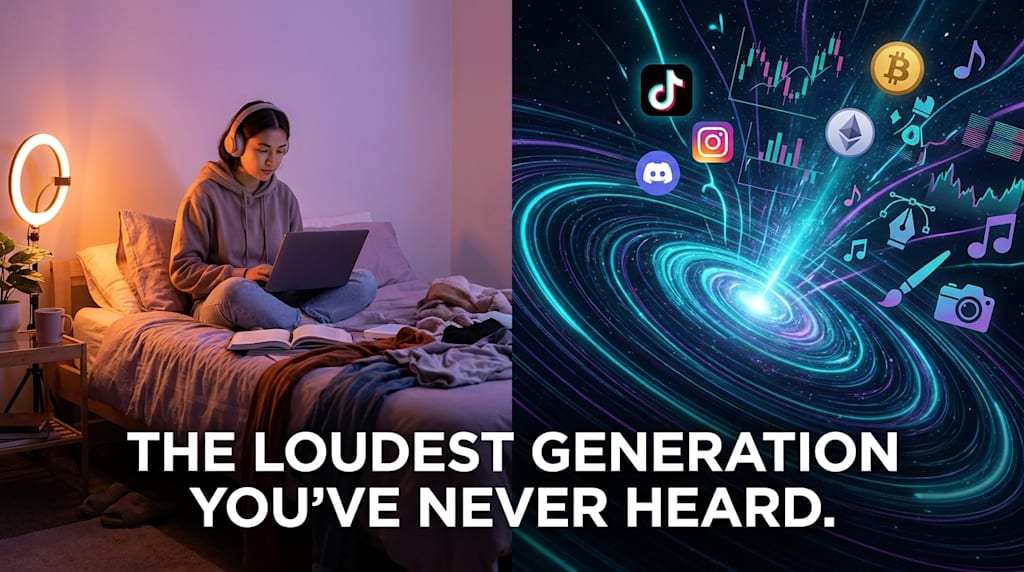
"Gen Z isn't lazy. We're just building the future in ways your 9-to-5 brain can't understand." That's what Maya Chen wrote in the caption of her latest TikTok. She was sitting cross-legged on her twin bed, ring light glowing, laptop open, three browser tabs running—one for her e-commerce store, one for her data analytics course, one for the Discord server where she moderates a community of 40,000 young entrepreneurs. It was 11 PM on a Tuesday. She'd already made $847 that day. She hadn't left her dorm room. Her parents still ask when she's going to "get a real job." But Maya knows something her parents' generation never fully grasped. As James Clear writes in Atomic Habits : "You do not rise to the level of your goals. You fall to the level of your systems." Maya didn't set out to be an entrepreneur. She built systems—tiny, daily, almost invisible systems—that compounded into something her parents can't see because it doesn't look like work to them. It looks like scrolling. It looks like texting. It looks like the thing they warned her would ruin her life. "Habits are the compound interest of self-improvement," Clear reminds us. Maya's habit of waking at 5 AM to analyze market trends before class. Her habit of sending one cold email every day. Her habit of documenting her journey in 60-second clips that now reach millions. Each atomically small. Each outrageously powerful. Here's what the headlines get wrong about Gen Z: they think we're apathetic because we're not protesting the way they did. They think we're disconnected because we communicate in memes and DMs. They think we're lost because we didn't follow the map they drew—college, corporate ladder, mortgage, retirement at 65. But look closer. We're not apathetic. We're strategic . Daniel Kahneman, in his masterpiece Thinking, Fast and Slow , observed: "Our comforting conviction that the world makes sense rests on a secure foundation: our almost unlimited ability to ignore our ignorance." The older generation's conviction that their path is the only path? That's the ignorance Gen Z refuses to inherit. We've seen the data. We watched the 2008 crash evaporate our parents' security. We graduated into a pandemic that proved most "essential" jobs could be done from anywhere. We watched billionaires go to space while our friends crowdfunded insulin. We stopped believing the world made sense the way they said it did. And Kahneman warned us: "We are prone to overestimate how much we understand about the world and to underestimate the role of chance in events." Gen Z took that warning seriously. We don't overestimate our understanding. We diversify. We hedge. We build multiple income streams because we know—deep in our bones—that chance can destroy a single path overnight. Take Marcus, 21, junior at a state university. His grandfather was a union organizer. His father worked the same factory job for thirty years. Marcus? He runs a six-figure content agency from his dorm. His "employees" are freelancers in Lagos, Manila, and São Paulo. His office is a $79 desk from Target. His commute is the three steps from his bed to his chair. "I respect what my grandpa did," Marcus told me over Zoom, his camera slightly angled to hide the laundry pile behind him. "But the playbook he used doesn't exist anymore. The companies aren't loyal. The pensions are gone. The housing market is a joke. So I wrote my own playbook." David Epstein, in Range: Why Generalists Triumph in a Specialized World , captures exactly what Marcus represents: "In a wicked world, relying upon experience from a single domain is not only limiting, it can be disastrous." Marcus didn't specialize in one thing. He learned copywriting, then video editing, then community management, then basic coding. He sampled. He wandered. He built what Epstein calls "T-shaped expertise"—deep enough to deliver value, broad enough to see connections no specialist can see. "Our greatest strength is the exact opposite of narrow specialization," Epstein writes. "It is the ability to integrate broadly." Marcus integrates across time zones, currencies, and platforms. His grandfather organized workers in one factory. Marcus organizes talent across continents before his 9 AM class. That's the quiet rebellion. It's not about rejecting work—it's about redefining it. Not about abandoning ambition—about redirecting it. Or consider Aisha, 19, who dropped out of pre-med after her freshman year—not because she couldn't handle the workload, but because she realized she could learn more from YouTube and online courses than from $400 textbooks and professors who hadn't practiced medicine in decades. Now she runs a health literacy platform with 2 million followers. She partners with actual doctors. She makes content that saves lives. She's 19. Her mother cried when she left school. Her mother shares her videos now. Aisha embodies another truth from Atomic Habits : "True behavior change is identity change. You might start a habit because of motivation, but the only reason you'll stick with one is that it becomes part of your identity." Aisha didn't just change her major. She changed who she believed she could be. She stopped being "a pre-med student" and became "someone who democratizes health knowledge." The habit stuck because the identity stuck. And when the identity shifts, everything shifts. This generation grew up watching institutions crumble in real-time. Banks failed. Governments fumbled. Universities charged $200,000 for degrees that no longer guaranteed employment. We learned early that the institutions our parents trusted were designed for a world that no longer exists. So we stopped asking permission. The dorm room entrepreneur isn't an anomaly anymore. It's an archetype. The student with three side hustles isn't "unfocused." She's diversified. The kid who'd rather build a personal brand than pad a résumé isn't naive. He's read the data: 70% of employers now screen candidates through social media. Your "personal brand" is your résumé. As Clear teaches: "When you can't win by being better, you can win by being different." Gen Z looked at the overcrowded ladder and chose to build a different game entirely. But here's what makes this rebellion truly radical: it's not angry. It's not bitter. It's creative . Gen Z isn't burning the system down. We're coding around it. We're not rejecting relationships—we're reimagining community in Discord servers and Twitch streams. We're not anti-capitalist; we're just building micro-economies where we control the terms. We trade crypto, sell digital art, launch podcasts, and coach each other through burnout in Instagram group chats at 2 AM. Kahneman understood something about human nature that explains this perfectly: "The easiest way to increase happiness is to control your use of time. Can you find more time to do the things you enjoy doing?" Gen Z took this as a design principle, not a suggestion. We architect our days around joy and purpose, not around someone else's schedule. We don't wait for weekends. We don't wait for retirement. We don't wait for permission to be happy. Clear said it even more directly: "When you fall in love with the process rather than the product, you don't have to wait to give yourself permission to be happy. You can be satisfied anytime your system is running." That's why Maya can feel fulfilled at 11 PM on a Tuesday in her dorm room. Her system is running. Her process is alive. The product—the money, the followers, the recognition—is just a lagging indicator of habits she's already fallen in love with. We've learned that power doesn't always roar. Sometimes it whispers through a well-timed tweet. Sometimes it builds quietly, one Shopify sale at a time, until the old world has no choice but to notice. Epstein's research on creativity reveals why this works: "Breadth of training predicts breadth of transfer. That is, the more contexts in which something is learned, the more the learner creates abstract models, and the less they rely on any particular example." Gen Z learned in more contexts than any generation before us—YouTube tutorials, Reddit threads, Twitter debates, TikTok explainers, real-world failures, online experiments. We don't rely on any single example of success. We've built abstract models that let us adapt to situations no one has seen before. That's creativity. That's survival. That's the quiet rebellion. Maya Chen's TikTok went viral. 3.2 million views. The comments were a battlefield—boomers calling her entitled, millennials defending her, Gen Z flooding the thread with their own stories of dorm room empires and quiet victories. She didn't respond to the hate. She had a shipment to fulfill. That's the thing about this generation. We don't need you to understand us. We're too busy building the future you didn't see coming. And when you finally look up from your 9-to-5? The empire will already be built. Because as James Clear reminds anyone who will listen: "Success is the product of daily habits—not once-in-a-lifetime transformations." Maya's empire wasn't built in a day. It was built in a thousand invisible moments. A thousand atomic habits. A thousand quiet rebellions that no one noticed until they couldn't be ignored anymore.
About the Creator
Enjoyed the story? Support the Creator.
Subscribe for free to receive all their stories in your feed.
Comments
There are no comments for this story
Be the first to respond and start the conversation.