
The Boy Who Said “I Don’t Want Money” Changed How I See Helping Forever
There’s a memory I keep coming back to.

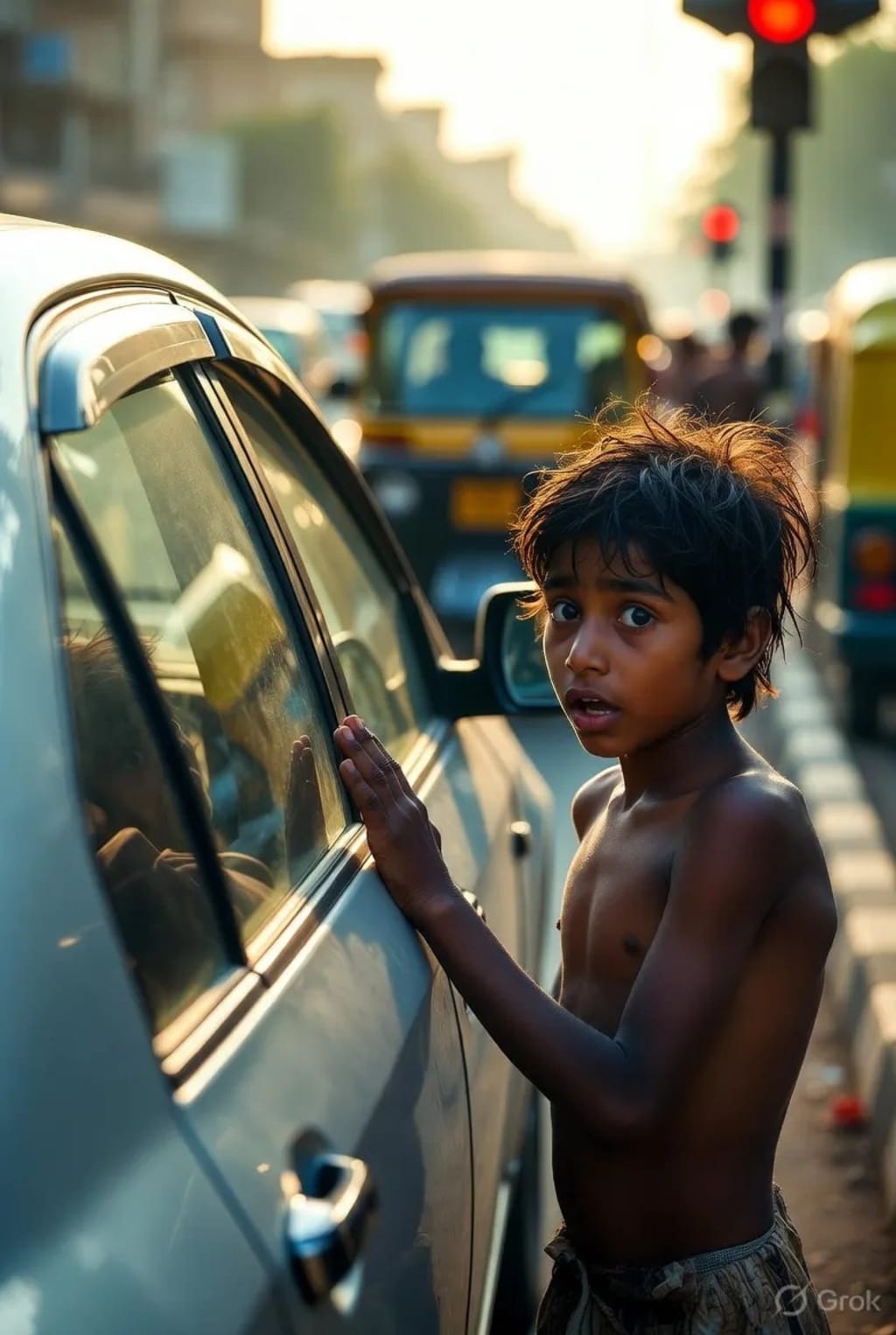
I'm sitting in the backseat of a car. The light turns red. And before the world even settles, a small hand appears at the window - knocking softly, persistently.
"Bhaiya… just one rupee."
I remember looking at my parents. Sometimes they gave something. Sometimes they didn't. But I always had the same question sitting heavy in my chest, one I didn't know how to say out loud yet:
"Why are we giving money… and not what they actually need?"
I didn't understand poverty back then… but I understood that a coin wasn't the answer.
The Inequality That Kept Me Awake
As a child, I didn't have language for what I was feeling. But I had eyes.
On one side, I was going to school. Carrying books. Dreaming about what I'd become. On the other side, a child my exact age stood barefoot on a road, asking strangers for coins.
Same city. Same world. Completely different lives.
That gap didn't just bother me - it haunted me. And one question kept returning, no matter how many times I tried to push it away:
If I were in their place, would I want a coin? Or would I want a chance?
The Quiet Choice I Made
By the time I reached college, I had quietly made up my mind about something.
I didn't give money.
Not because I didn't care - but because something inside me always resisted it. Giving money felt like doing the easiest thing and calling it help. It felt like I was solving my discomfort, not their problem.
So I chose differently. Whenever I could, I gave books.
Not something that disappears in minutes. Something that stays. Something that could speak long after I was gone, that could turn confusion into direction, and helplessness into possibility.
I held onto a simple belief:
"If I'm going to give… it should be something that has the power to stay in their life, not just pass through their hands."
It wasn't a grand gesture. But it felt honest.
I didn't have much to give… but I knew I could give something that lasts.
The Ordinary Afternoon That Became Extraordinary
Then came a day I didn't expect to remember.
We were at a bus stand, dropping off a relative. Nothing special. Just another routine errand on an unremarkable afternoon.
A young man - maybe twenty years old - caught my eye. He wasn't begging. He was just standing there, watching us, and then slowly, deliberately, walking in our direction.
I felt that familiar instinct kick in. The slight stiffening. The quiet alertness.
What does he want?
He stopped in front of my father. And like most of us would, my father reached into his pocket - already assuming, already preparing to give coins.
But before he could, the boy spoke.
"I don't want money. I just need some work."
The Silence After That Sentence
For a second, no one said anything.
Because no one expected that.
We had already written his story in our heads - the story we always write about someone who looks like him, standing where he was standing. And he had just crumpled it up and handed it back to us.
My father, to his credit, didn't brush past it. He paused. He actually listened. He asked questions. He tried to understand.
And then he gave the boy work.
What Happened Next Is What I'll Never Forget
That decision didn't solve one bad day. It changed a life.
That young man still works with my father today.
And not just that - with the money he earned, he went back to school. He continued his education on his own terms, through his own effort, with his own dignity intact.
Every time I see him, I feel the same quiet weight of that afternoon at the bus stand. The moment we almost missed. The moment my father almost reached for coins instead of actually listening.
What I Learned About "Helping"
We are so quick to give that we forget to understand.
We assume what people need. We reach for the easiest answer - the coin, the bill, the gesture that lets us feel like we did something - and then we move on, satisfied.
But that boy didn't need our assumption. He needed someone to stop and actually hear what he was saying.
Real help, I've come to believe, doesn't make someone dependent on you. It makes them able to live without you.
"Real help doesn't make someone dependent. It makes them independent."
"A coin can fill a stomach for a moment… but the right opportunity can feed a lifetime."
I'm Not Saying Money Is Wrong
I want to be clear: giving money isn't bad. There are moments when it's exactly the right thing to do. There are emergencies, genuine immediate needs, situations where cash is the only answer.
But it's not always the answer. And we've gotten so comfortable with it that we've stopped asking whether there's something better we could offer.
The next time someone comes to you - pause before you reach for your wallet.
Not because giving money is wrong. But because the pause itself might reveal something more. A skill you could share. A connection you could make. A door you could open that no coin ever could.
I Still Don't Have All the Answers
I started this journey as a kid with too many questions and no way to ask them.
I still don't have everything figured out. Helping is complicated. People are complicated. And sometimes, despite our best intentions, we still get it wrong.
But I know this much:
"Helping is not about what you give. It's about what changes because you chose to care."
And sometimes, all it takes to offer that kind of help is to stop talking, stop assuming, and actually listen - long enough to hear someone say the thing you never expected:
"I don't want money. I just need a chance."
About the Creator
Shivani Gaonkar
I write about the silences between people ,the weight of unsaid words, and the love that lingers quietly
Enjoyed the story? Support the Creator.
Subscribe for free to receive all their stories in your feed.
Comments
There are no comments for this story
Be the first to respond and start the conversation.