
SWOT
SWOT Analysis: Understanding Strengths, Weaknesses, Opportunities and Threats to Support Strategic Planning and Business Growth.

Ever had one of those mornings where your to-do list looks less like a plan and more like a mountain range? You sit down with your morning coffee, stare at the screen, and realise your brain has effectively turned to porridge. Meanwhile, the rest of the professional world seems to glide effortlessly through their day, fully in control, while you quietly hold things together with duct tape and hope.
We have all been there. When the pressure turns up, it is remarkably easy to feel as though you have completely lost hold of the steering wheel. In those moments, the natural temptation is to retreat, panic, or try to tackle every single problem at once in a chaotic flurry of frantic activity.
Here is the plot twist: you actually have far more control than you think.
You do not need a silver bullet, an enterprise-level overhaul, or a shelf full of trendy management manuals to regain your footing. What you really need is a bit of breathing space and genuine clarity. That's where a SWOT analysis comes in. By taking an honest, objective look at your landscape and breaking intimidating goals down into bite-sized, manageable steps, that thick fog of overwhelm clears out—leaving you with a practical action plan that actually feels doable.
Strengths, Weaknesses, Opportunities and Threats (SWOT)
At its core, a SWOT analysis—covering Strengths, Weaknesses, Opportunities, and Threats—is simply a practical, down-to-earth tool for understanding yourself and your situation far better. Think of it as taking an accurate, unvarnished inventory of your personal toolkit alongside the environment you are operating in.
It strips away the guesswork and forces you to look at reality with open eyes. To keep things crystal clear:
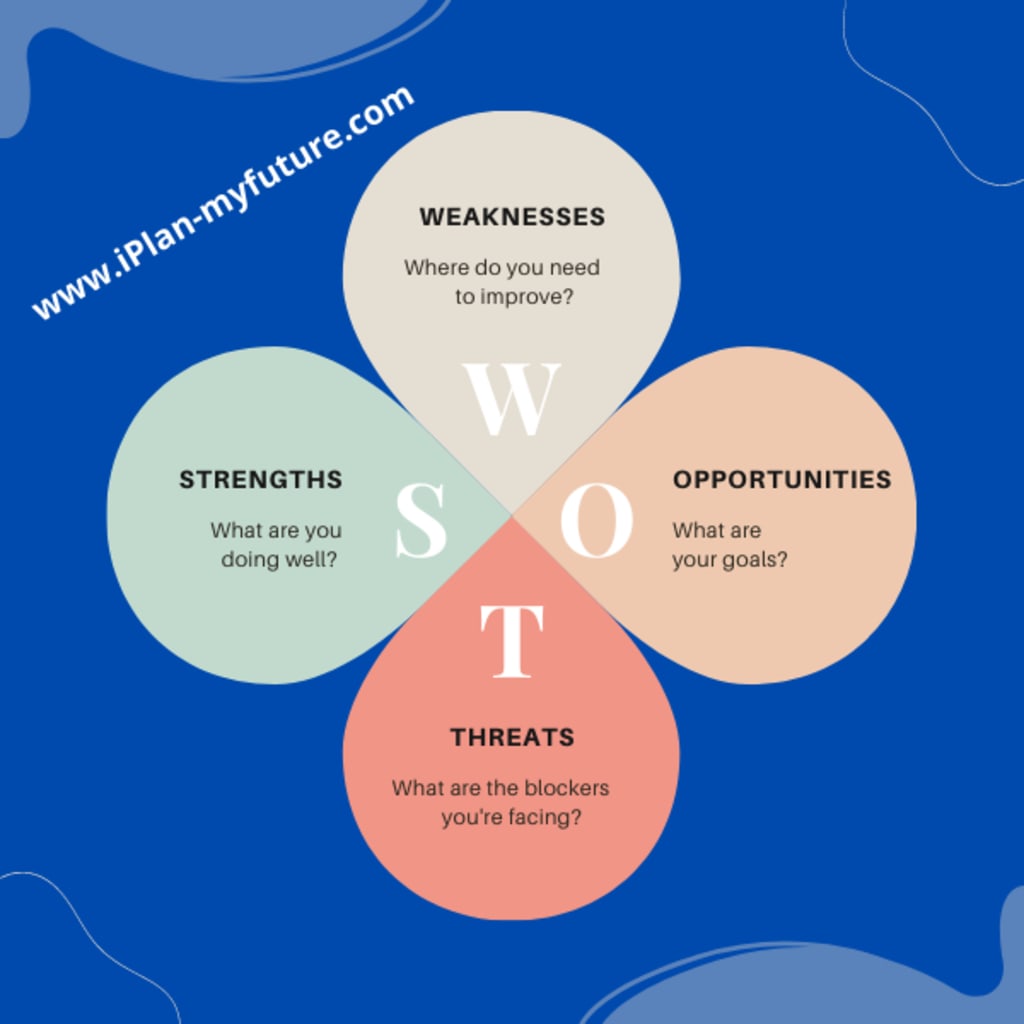
Strengths are your internal power-ups. They represent the inherent skills, unique talents, solid habits, and valuable resources that help you achieve your goals and smash through obstacles.
Weaknesses are internal friction points. They are missing skills, bad habits, or resource gaps that actively hinder steady progress or keep you from hitting your full stride.
Opportunities are external green lights. These are the golden chances, emerging market trends, new networks, or favourable circumstances sitting right outside your door, ready for you to grab.
Threats are external speed bumps. They are potential curveballs—economic shifts, sudden industry disruptions, or fierce competition—that could throw a spanner in the works if you don't plan for them.
What am I really good at? Think of weaknesses as areas for development rather than negatives

When listing your strengths, it feels natural to give yourself a quick pat on the back. But the moment most people move over to the 'Weaknesses' column, the inner critic takes the microphone. We start listing our shortcomings as if they are fundamental character flaws.
Here is a healthier, more constructive way to look at it: treat your weaknesses as areas for development, not negative black marks against your name.
Nobody arrives on day one fully equipped with every skill under the sun. If you are not ready to run a marathon tomorrow morning, or if complex mental arithmetic makes your brain freeze, that is not a life sentence—it is simply your current starting point. The trick is to actively shift your internal dialogue. Stop saying, "I am completely useless at this", and start asking, "What practical steps can I take to upgrade this skill so it stops holding me back?"
Consider a very common real-world example: you might be fantastic at writing, expressing ideas, and communicating with clarity and flair in English, but your formal grammar needs work. Instead of beating yourself up over a misplaced comma or an awkward clause, flip the question: What can I do to strengthen my weak spots so my writing truly shines?
How can you use your strengths to help you achieve your goals?
Setting ambitious goals is inspiring, but aligning those goals directly with your natural strengths is where real, tangible momentum happens. When you build a plan around what you already do well, progress feels less like pushing a boulder uphill and more like sailing with the wind at your back.
There are two particularly sharp ways to approach this:
The Strength-First Approach: Identify what you naturally excel at and consider how those specific talents make a tangible difference in your daily work. Then, look closely at the gap between what you are naturally brilliant at and where your current targets lie. Are you actually spending your time on the things that play to your core strengths, or are you fighting against your natural grain?
The Counterbalance Approach: Pinpoint your main development areas and figure out how to neutralise or overcome them by deploying one or more of your primary strengths. If financial forecasting isn't your strong suit, but you're an exceptional communicator and networker, use that people-focused strength to build a strong advisory relationship or collaborate with a colleague who loves spreadsheets.
SWOT analysis is a tool for understanding yourself and your situation better

The true beauty of a SWOT exercise is that it forces you to step back, take a breath, and look at things from an entirely fresh perspective. When you are deep in the weeds of daily execution, it's easy to miss the bigger picture. SWOT acts like a fresh pair of glasses, bringing hidden blind spots into sharp focus and revealing strategic opportunities or quiet threats you might have completely overlooked.
If you run your own business or manage a key department, doing this at least once a year is not just a nice exercise to tick off—it is essential maintenance. It gives you a clear, balanced health check on how things are really going by measuring your internal capabilities (your strengths and weaknesses) against the fast-changing world outside your front door (the wider market environment).
Is a SWOT analysis a flawless, magical silver bullet? Of course not. It comes with its own limitations. It can be tricky to draw a hard, neat line between a strength and a weakness, and turning four boxes on a sheet of paper into real-world action on a busy Monday morning takes deliberate focus.
Yet, even if you are not filling out a formal matrix every week, adopting the SWOT mindset is invaluable. It shifts you out of a reactive survival mode and puts you back in the driver's seat of your own life and business.
So, grab a proper cup of tea, pull out a notepad, and take an honest look at your board. You might just realise you hold a much stronger hand than you thought—now go out there and play it.
About the Creator
iPlan MyFuture
iPlan-Myfuture is a revolutionary career planning service that puts you in the driver's seat. With custom-tailored advice and guidance, you can jump into the driving seat and take control of your career and future.
Enjoyed the story? Support the Creator.
Subscribe for free to receive all their stories in your feed.
Comments
There are no comments for this story
Be the first to respond and start the conversation.